 Add to Chrome
 Add to Firefox
 Add to Edge
Generic-to-Specific Distillation of Masked Autoencoders
Feb 28, 2023
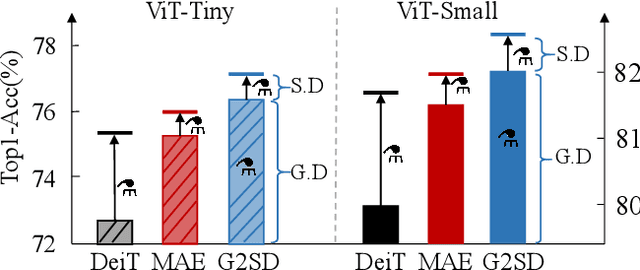
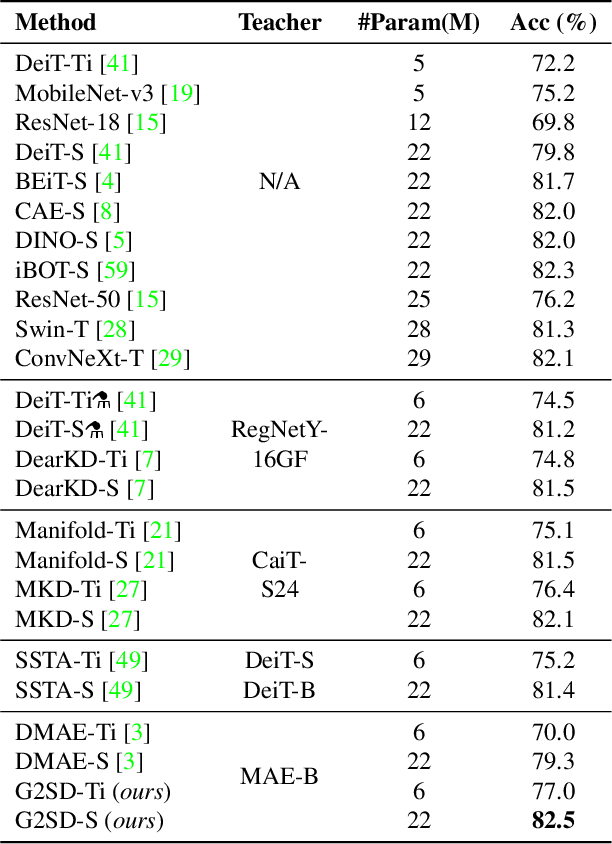
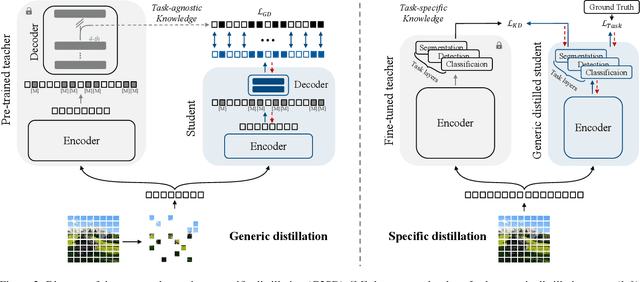
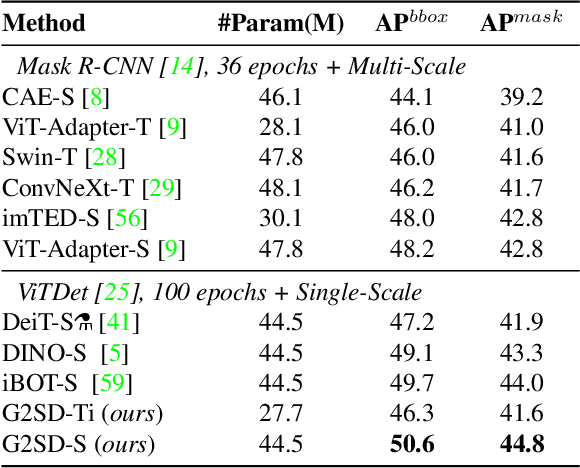
Large vision Transformers (ViTs) driven by self-supervised pre-training mechanisms achieved unprecedented progress. Lightweight ViT models limited by the model capacity, however, benefit little from those pre-training mechanisms. Knowledge distillation defines a paradigm to transfer representations from large (teacher) models to small (student) ones. However, the conventional single-stage distillation easily gets stuck on task-specific transfer, failing to retain the task-agnostic knowledge crucial for model generalization. In this study, we propose generic-to-specific distillation (G2SD), to tap the potential of small ViT models under the supervision of large models pre-trained by masked autoencoders. In generic distillation, decoder of the small model is encouraged to align feature predictions with hidden representations of the large model, so that task-agnostic knowledge can be transferred. In specific distillation, predictions of the small model are constrained to be consistent with those of the large model, to transfer task-specific features which guarantee task performance. With G2SD, the vanilla ViT-Small model respectively achieves 98.7%, 98.1% and 99.3% the performance of its teacher (ViT-Base) for image classification, object detection, and semantic segmentation, setting a solid baseline for two-stage vision distillation. Code will be available at https://github.com/pengzhiliang/G2SD.

HanoiT: Enhancing Context-aware Translation via Selective Context
Jan 17, 2023Context-aware neural machine translation aims to use the document-level context to improve translation quality. However, not all words in the context are helpful. The irrelevant or trivial words may bring some noise and distract the model from learning the relationship between the current sentence and the auxiliary context. To mitigate this problem, we propose a novel end-to-end encoder-decoder model with a layer-wise selection mechanism to sift and refine the long document context. To verify the effectiveness of our method, extensive experiments and extra quantitative analysis are conducted on four document-level machine translation benchmarks. The experimental results demonstrate that our model significantly outperforms previous models on all datasets via the soft selection mechanism.
Neural Codec Language Models are Zero-Shot Text to Speech Synthesizers
Jan 05, 2023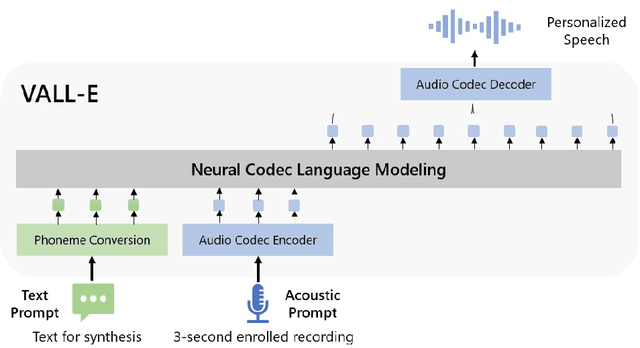
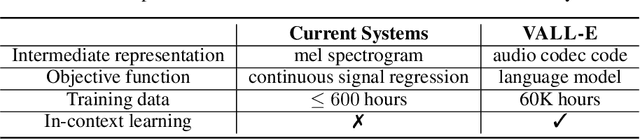
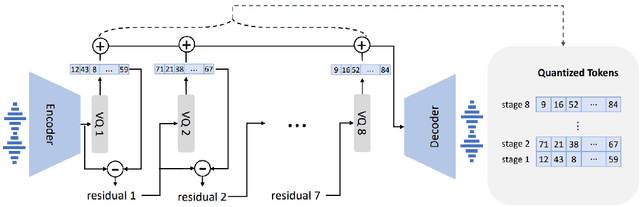

We introduce a language modeling approach for text to speech synthesis (TTS). Specifically, we train a neural codec language model (called Vall-E) using discrete codes derived from an off-the-shelf neural audio codec model, and regard TTS as a conditional language modeling task rather than continuous signal regression as in previous work. During the pre-training stage, we scale up the TTS training data to 60K hours of English speech which is hundreds of times larger than existing systems. Vall-E emerges in-context learning capabilities and can be used to synthesize high-quality personalized speech with only a 3-second enrolled recording of an unseen speaker as an acoustic prompt. Experiment results show that Vall-E significantly outperforms the state-of-the-art zero-shot TTS system in terms of speech naturalness and speaker similarity. In addition, we find Vall-E could preserve the speaker's emotion and acoustic environment of the acoustic prompt in synthesis. See https://aka.ms/valle for demos of our work.
Language Models as Inductive Reasoners
Dec 21, 2022Inductive reasoning is a core component of human intelligence. In the past research of inductive reasoning within computer science, logic language is used as representations of knowledge (facts and rules, more specifically). However, logic language can cause systematic problems for inductive reasoning such as disability of handling raw input such as natural language, sensitiveness to mislabeled data, and incapacity to handle ambiguous input. To this end, we propose a new task, which is to induce natural language rules from natural language facts, and create a dataset termed DEER containing 1.2k rule-fact pairs for the task, where rules and facts are written in natural language. New automatic metrics are also proposed and analysed for the evaluation of this task. With DEER, we investigate a modern approach for inductive reasoning where we use natural language as representation for knowledge instead of logic language and use pretrained language models as ''reasoners''. Moreover, we provide the first and comprehensive analysis of how well pretrained language models can induce natural language rules from natural language facts. We also propose a new framework drawing insights from philosophy literature for this task, which we show in the experiment section that surpasses baselines in both automatic and human evaluations.
Why Can GPT Learn In-Context? Language Models Secretly Perform Gradient Descent as Meta-Optimizers
Dec 21, 2022
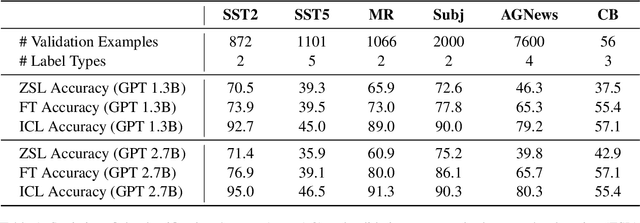

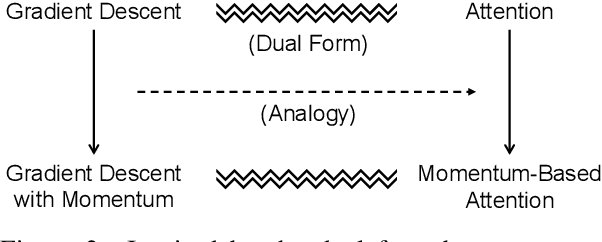
Large pretrained language models have shown surprising In-Context Learning (ICL) ability. With a few demonstration input-label pairs, they can predict the label for an unseen input without additional parameter updates. Despite the great success in performance, the working mechanism of ICL still remains an open problem. In order to better understand how ICL works, this paper explains language models as meta-optimizers and understands ICL as a kind of implicit finetuning. Theoretically, we figure out that the Transformer attention has a dual form of gradient descent based optimization. On top of it, we understand ICL as follows: GPT first produces meta-gradients according to the demonstration examples, and then these meta-gradients are applied to the original GPT to build an ICL model. Experimentally, we comprehensively compare the behavior of ICL and explicit finetuning based on real tasks to provide empirical evidence that supports our understanding. The results prove that ICL behaves similarly to explicit finetuning at the prediction level, the representation level, and the attention behavior level. Further, inspired by our understanding of meta-optimization, we design a momentum-based attention by analogy with the momentum-based gradient descent algorithm. Its consistently better performance over vanilla attention supports our understanding again from another aspect, and more importantly, it shows the potential to utilize our understanding for future model designing.
A Length-Extrapolatable Transformer
Dec 20, 2022Position modeling plays a critical role in Transformers. In this paper, we focus on length extrapolation, i.e., training on short texts while evaluating longer sequences. We define attention resolution as an indicator of extrapolation. Then we propose two designs to improve the above metric of Transformers. Specifically, we introduce a relative position embedding to explicitly maximize attention resolution. Moreover, we use blockwise causal attention during inference for better resolution. We evaluate different Transformer variants with language modeling. Experimental results show that our model achieves strong performance in both interpolation and extrapolation settings. The code will be available at https://aka.ms/LeX-Transformer.
Pay Attention to Your Tone: Introducing a New Dataset for Polite Language Rewrite
Dec 20, 2022We introduce \textsc{PoliteRewrite} -- a dataset for polite language rewrite which is a novel sentence rewrite task. Compared with previous text style transfer tasks that can be mostly addressed by slight token- or phrase-level edits, polite language rewrite requires deep understanding and extensive sentence-level edits over an offensive and impolite sentence to deliver the same message euphemistically and politely, which is more challenging -- not only for NLP models but also for human annotators to rewrite with effort. To alleviate the human effort for efficient annotation, we first propose a novel annotation paradigm by a collaboration of human annotators and GPT-3.5 to annotate \textsc{PoliteRewrite}. The released dataset has 10K polite sentence rewrites annotated collaboratively by GPT-3.5 and human, which can be used as gold standard for training, validation and test; and 100K high-quality polite sentence rewrites by GPT-3.5 without human review. We wish this work (The dataset (10K+100K) will be released soon) could contribute to the research on more challenging sentence rewrite, and provoke more thought in future on resource annotation paradigm with the help of the large-scaled pretrained models.
GanLM: Encoder-Decoder Pre-training with an Auxiliary Discriminator
Dec 20, 2022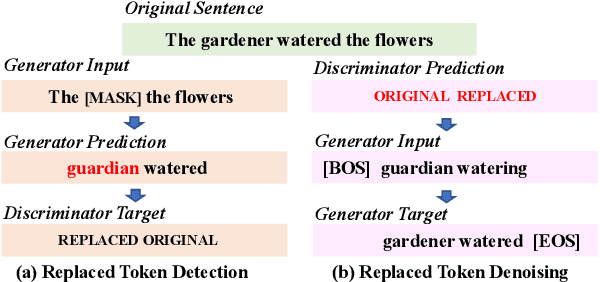
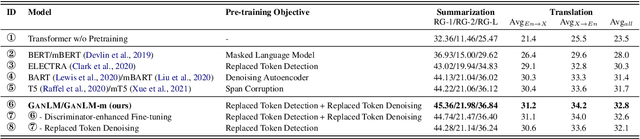
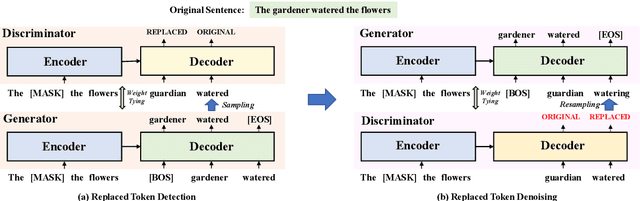
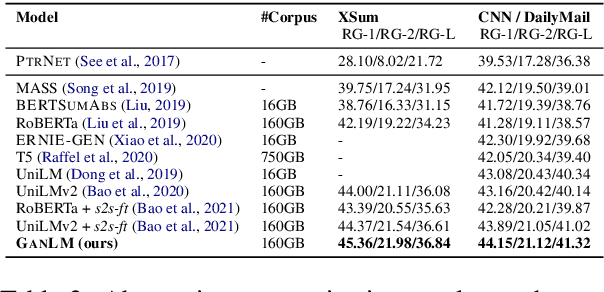
Pre-trained models have achieved remarkable success in natural language processing (NLP). However, existing pre-training methods underutilize the benefits of language understanding for generation. Inspired by the idea of Generative Adversarial Networks (GANs), we propose a GAN-style model for encoder-decoder pre-training by introducing an auxiliary discriminator, unifying the ability of language understanding and generation in a single model. Our model, named as GanLM, is trained with two pre-training objectives: replaced token detection and replaced token denoising. Specifically, given masked source sentences, the generator outputs the target distribution and the discriminator predicts whether the target sampled tokens from distribution are incorrect. The target sentence is replaced with misclassified tokens to construct noisy previous context, which is used to generate the gold sentence. In general, both tasks improve the ability of language understanding and generation by selectively using the denoising data. Extensive experiments in language generation benchmarks show that GanLM with the powerful language understanding capability outperforms various strong pre-trained language models (PLMs) and achieves state-of-the-art performance.
Optimizing Prompts for Text-to-Image Generation
Dec 19, 2022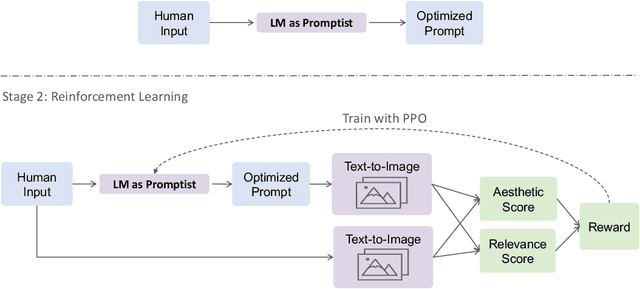
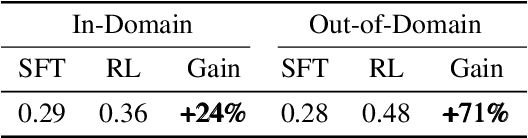
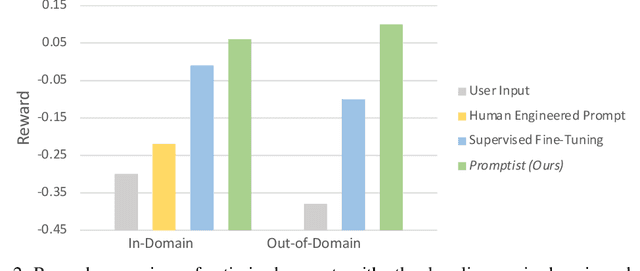

Well-designed prompts can guide text-to-image models to generate amazing images. However, the performant prompts are often model-specific and misaligned with user input. Instead of laborious human engineering, we propose prompt adaptation, a general framework that automatically adapts original user input to model-preferred prompts. Specifically, we first perform supervised fine-tuning with a pretrained language model on a small collection of manually engineered prompts. Then we use reinforcement learning to explore better prompts. We define a reward function that encourages the policy to generate more aesthetically pleasing images while preserving the original user intentions. Experimental results on Stable Diffusion show that our method outperforms manual prompt engineering in terms of both automatic metrics and human preference ratings. Moreover, reinforcement learning further boosts performance, especially on out-of-domain prompts. The pretrained checkpoints are available at https://aka.ms/promptist. The demo can be found at https://aka.ms/promptist-demo.
BEATs: Audio Pre-Training with Acoustic Tokenizers
Dec 18, 2022The massive growth of self-supervised learning (SSL) has been witnessed in language, vision, speech, and audio domains over the past few years. While discrete label prediction is widely adopted for other modalities, the state-of-the-art audio SSL models still employ reconstruction loss for pre-training. Compared with reconstruction loss, semantic-rich discrete label prediction encourages the SSL model to abstract the high-level audio semantics and discard the redundant details as in human perception. However, a semantic-rich acoustic tokenizer for general audio pre-training is usually not straightforward to obtain, due to the continuous property of audio and unavailable phoneme sequences like speech. To tackle this challenge, we propose BEATs, an iterative audio pre-training framework to learn Bidirectional Encoder representation from Audio Transformers, where an acoustic tokenizer and an audio SSL model are optimized by iterations. In the first iteration, we use random projection as the acoustic tokenizer to train an audio SSL model in a mask and label prediction manner. Then, we train an acoustic tokenizer for the next iteration by distilling the semantic knowledge from the pre-trained or fine-tuned audio SSL model. The iteration is repeated with the hope of mutual promotion of the acoustic tokenizer and audio SSL model. The experimental results demonstrate our acoustic tokenizers can generate discrete labels with rich audio semantics and our audio SSL models achieve state-of-the-art results across various audio classification benchmarks, even outperforming previous models that use more training data and model parameters significantly. Specifically, we set a new state-of-the-art mAP 50.6% on AudioSet-2M for audio-only models without using any external data, and 98.1% accuracy on ESC-50. The code and pre-trained models are available at https://aka.ms/beats.