 Add to Chrome
 Add to Firefox
 Add to Edge
Video-to-Audio Generation with Hidden Alignment
Jul 10, 2024
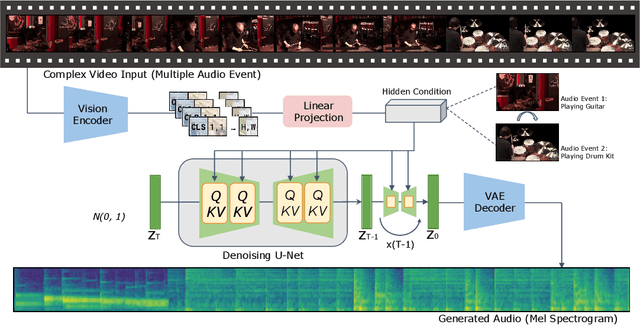


Generating semantically and temporally aligned audio content in accordance with video input has become a focal point for researchers, particularly following the remarkable breakthrough in text-to-video generation. In this work, we aim to offer insights into the video-to-audio generation paradigm, focusing on three crucial aspects: vision encoders, auxiliary embeddings, and data augmentation techniques. Beginning with a foundational model VTA-LDM built on a simple yet surprisingly effective intuition, we explore various vision encoders and auxiliary embeddings through ablation studies. Employing a comprehensive evaluation pipeline that emphasizes generation quality and video-audio synchronization alignment, we demonstrate that our model exhibits state-of-the-art video-to-audio generation capabilities. Furthermore, we provide critical insights into the impact of different data augmentation methods on enhancing the generation framework's overall capacity. We showcase possibilities to advance the challenge of generating synchronized audio from semantic and temporal perspectives. We hope these insights will serve as a stepping stone toward developing more realistic and accurate audio-visual generation models.

Iterative Nash Policy Optimization: Aligning LLMs with General Preferences via No-Regret Learning
Jun 30, 2024


Reinforcement Learning with Human Feedback (RLHF) has achieved great success in aligning large language models (LLMs) with human preferences. Prevalent RLHF approaches are reward-based, following the Bradley-Terry (BT) model assumption, which may not fully capture the complexity of human preferences. In this paper, we explore RLHF under a general preference framework and approach it from a game-theoretic perspective. Specifically, we formulate the problem as a two-player game and propose a novel algorithm, iterative Nash policy optimization (INPO). The key idea is to let the policy play against itself via no-regret learning, thereby approximating the Nash policy. Unlike previous methods, INPO bypasses the need for estimating the expected win rate for individual responses, which typically incurs high computational or annotation costs. Instead, we introduce a new loss objective that is directly minimized over a preference dataset. We provide theoretical analysis for our approach and demonstrate its effectiveness through experiments on various representative benchmarks. With an LLaMA-3-8B-based SFT model, INPO achieves a 41.5% length-controlled win rate on AlpacaEval 2.0 and a 38.3% win rate on Arena-Hard, showing substantial improvement over the state-of-the-art iterative algorithm [Dong et al., 2024] under the BT model assumption. Additionally, our ablation study highlights the benefits of incorporating KL regularization for response length control.
LiteSearch: Efficacious Tree Search for LLM
Jun 29, 2024Recent research suggests that tree search algorithms (e.g. Monte Carlo Tree Search) can dramatically boost LLM performance on complex mathematical reasoning tasks. However, they often require more than 10 times the computational resources of greedy decoding due to wasteful search strategies, making them difficult to be deployed in practical applications. This study introduces a novel guided tree search algorithm with dynamic node selection and node-level exploration budget (maximum number of children) calculation to tackle this issue. By considering the search progress towards the final answer (history) and the guidance from a value network (future) trained without any step-wise annotations, our algorithm iteratively selects the most promising tree node before expanding it within the boundaries of the allocated computational budget. Experiments conducted on the GSM8K and TabMWP datasets demonstrate that our approach not only offers competitive performance but also enjoys significantly lower computational costs compared to baseline methods.
Scaling Synthetic Data Creation with 1,000,000,000 Personas
Jun 28, 2024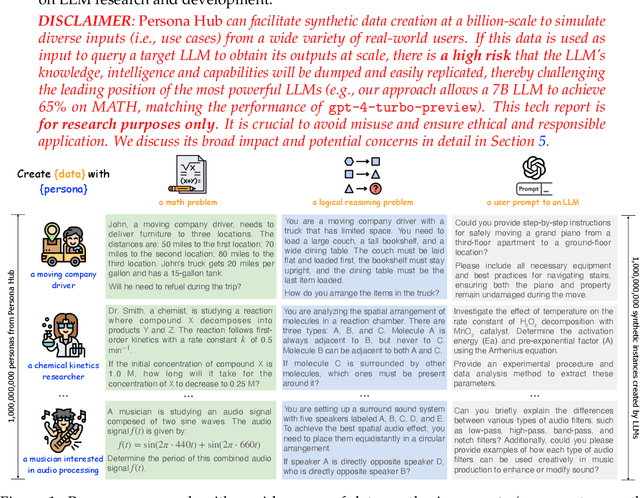
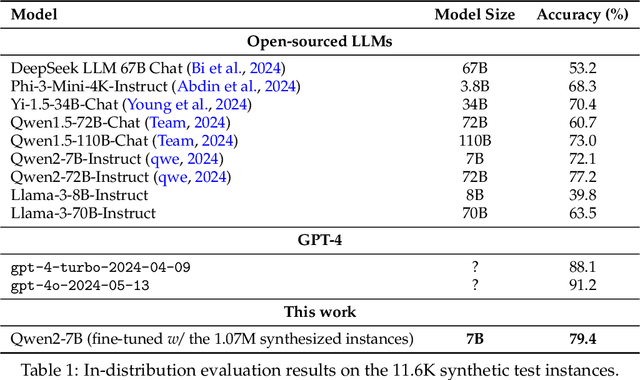
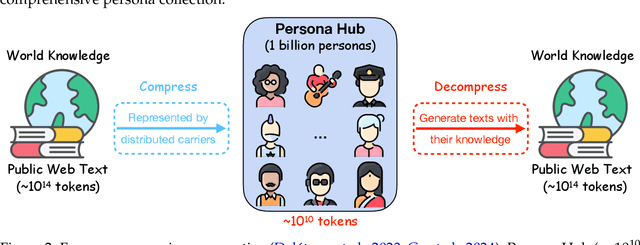
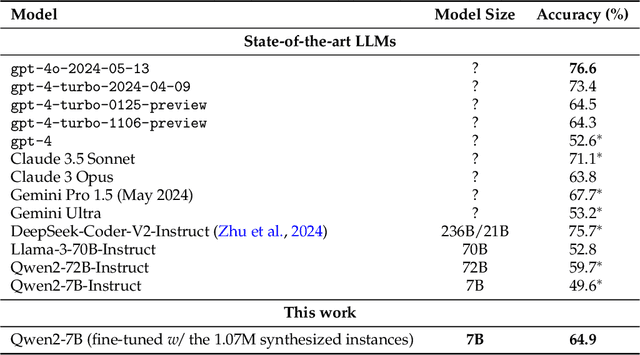
We propose a novel persona-driven data synthesis methodology that leverages various perspectives within a large language model (LLM) to create diverse synthetic data. To fully exploit this methodology at scale, we introduce Persona Hub -- a collection of 1 billion diverse personas automatically curated from web data. These 1 billion personas (~13% of the world's total population), acting as distributed carriers of world knowledge, can tap into almost every perspective encapsulated within the LLM, thereby facilitating the creation of diverse synthetic data at scale for various scenarios. By showcasing Persona Hub's use cases in synthesizing high-quality mathematical and logical reasoning problems, instructions (i.e., user prompts), knowledge-rich texts, game NPCs and tools (functions) at scale, we demonstrate persona-driven data synthesis is versatile, scalable, flexible, and easy to use, potentially driving a paradigm shift in synthetic data creation and applications in practice, which may have a profound impact on LLM research and development.
Abstraction-of-Thought Makes Language Models Better Reasoners
Jun 18, 2024
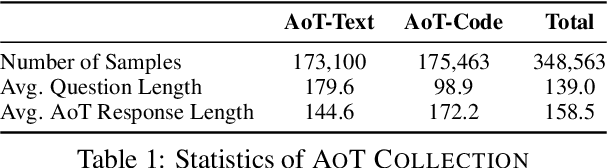
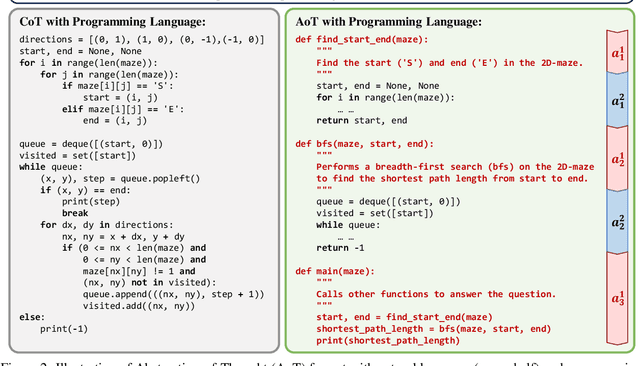

Abstract reasoning, the ability to reason from the abstract essence of a problem, serves as a key to generalization in human reasoning. However, eliciting language models to perform reasoning with abstraction remains unexplored. This paper seeks to bridge this gap by introducing a novel structured reasoning format called Abstraction-of-Thought (AoT). The uniqueness of AoT lies in its explicit requirement for varying levels of abstraction within the reasoning process. This approach could elicit language models to first contemplate on the abstract level before incorporating concrete details, which is overlooked by the prevailing step-by-step Chain-of-Thought (CoT) method. To align models with the AoT format, we present AoT Collection, a generic finetuning dataset consisting of 348k high-quality samples with AoT reasoning processes, collected via an automated and scalable pipeline. We finetune a wide range of language models with AoT Collection and conduct extensive evaluations on 23 unseen tasks from the challenging benchmark Big-Bench Hard. Experimental results indicate that models aligned to AoT reasoning format substantially outperform those aligned to CoT in many reasoning tasks.
SMRU: Split-and-Merge Recurrent-based UNet for Acoustic Echo Cancellation and Noise Suppression
Jun 17, 2024The proliferation of deep neural networks has spawned the rapid development of acoustic echo cancellation and noise suppression, and plenty of prior arts have been proposed, which yield promising performance. Nevertheless, they rarely consider the deployment generality in different processing scenarios, such as edge devices, and cloud processing. To this end, this paper proposes a general model, termed SMRU, to cover different application scenarios. The novelty lies in two-fold. First, a multi-scale band split layer and band merge layer are proposed to effectively fuse local frequency bands for lower complexity modeling. Besides, by simulating the multi-resolution feature modeling characteristic of the classical UNet structure, a novel recurrent-dominated UNet is devised. It consists of multiple variable frame rate blocks, each of which involves the causal time down-/up-sampling layer with varying compression ratios and the dual-path structure for inter- and intra-band modeling. The model is configured from 50 M/s to 6.8 G/s in terms of MACs, and the experimental results show that the proposed approach yields competitive or even better performance over existing baselines, and has the full potential to adapt to more general scenarios with varying complexity requirements.
Learn Beyond The Answer: Training Language Models with Reflection for Mathematical Reasoning
Jun 17, 2024


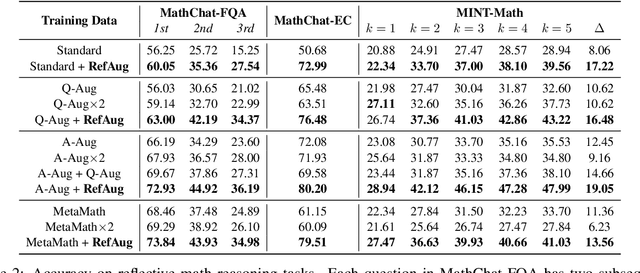
Supervised fine-tuning enhances the problem-solving abilities of language models across various mathematical reasoning tasks. To maximize such benefits, existing research focuses on broadening the training set with various data augmentation techniques, which is effective for standard single-round question-answering settings. Our work introduces a novel technique aimed at cultivating a deeper understanding of the training problems at hand, enhancing performance not only in standard settings but also in more complex scenarios that require reflective thinking. Specifically, we propose reflective augmentation, a method that embeds problem reflection into each training instance. It trains the model to consider alternative perspectives and engage with abstractions and analogies, thereby fostering a thorough comprehension through reflective reasoning. Extensive experiments validate the achievement of our aim, underscoring the unique advantages of our method and its complementary nature relative to existing augmentation techniques.
Multi-Channel Multi-Speaker ASR Using Target Speaker's Solo Segment
Jun 17, 2024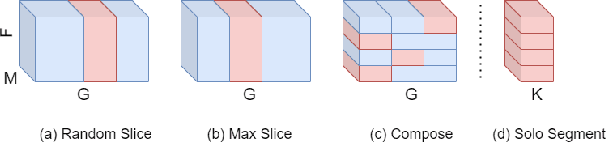
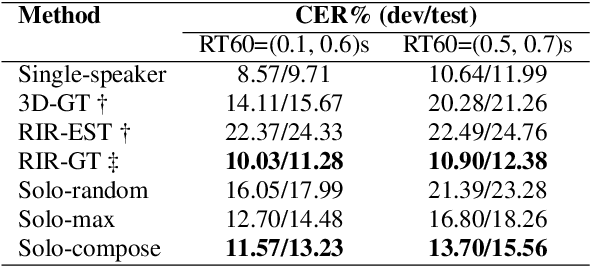
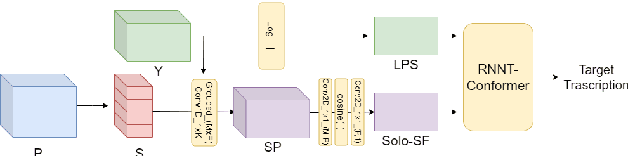
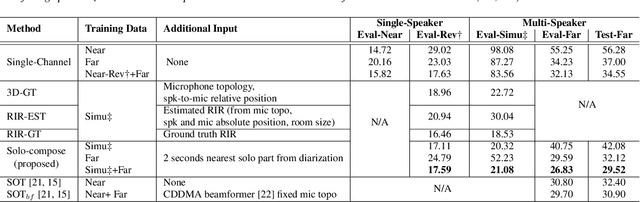
In the field of multi-channel, multi-speaker Automatic Speech Recognition (ASR), the task of discerning and accurately transcribing a target speaker's speech within background noise remains a formidable challenge. Traditional approaches often rely on microphone array configurations and the information of the target speaker's location or voiceprint. This study introduces the Solo Spatial Feature (Solo-SF), an innovative method that utilizes a target speaker's isolated speech segment to enhance ASR performance, thereby circumventing the need for conventional inputs like microphone array layouts. We explore effective strategies for selecting optimal solo segments, a crucial aspect for Solo-SF's success. Through evaluations conducted on the AliMeeting dataset and AISHELL-1 simulations, Solo-SF demonstrates superior performance over existing techniques, significantly lowering Character Error Rates (CER) in various test conditions. Our findings highlight Solo-SF's potential as an effective solution for addressing the complexities of multi-channel, multi-speaker ASR tasks.
When Reasoning Meets Information Aggregation: A Case Study with Sports Narratives
Jun 17, 2024


Reasoning is most powerful when an LLM accurately aggregates relevant information. We examine the critical role of information aggregation in reasoning by requiring the LLM to analyze sports narratives. To succeed at this task, an LLM must infer points from actions, identify related entities, attribute points accurately to players and teams, and compile key statistics to draw conclusions. We conduct comprehensive experiments with real NBA basketball data and present SportsGen, a new method to synthesize game narratives. By synthesizing data, we can rigorously evaluate LLMs' reasoning capabilities under complex scenarios with varying narrative lengths and density of information. Our findings show that most models, including GPT-4o, often fail to accurately aggregate basketball scores due to frequent scoring patterns. Open-source models like Llama-3 further suffer from significant score hallucinations. Finally, the effectiveness of reasoning is influenced by narrative complexity, information density, and domain-specific terms, highlighting the challenges in analytical reasoning tasks.
Generative Pre-trained Speech Language Model with Efficient Hierarchical Transformer
Jun 03, 2024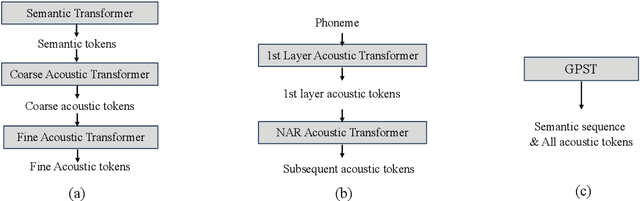
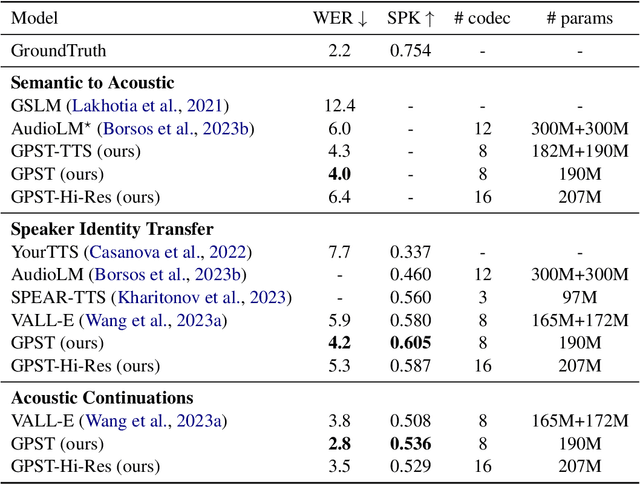
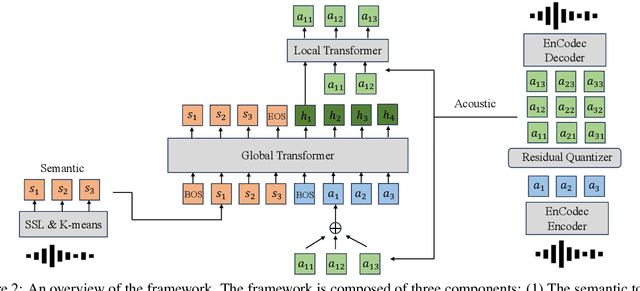
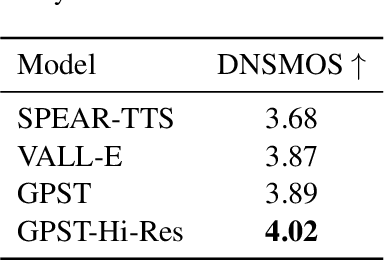
While recent advancements in speech language models have achieved significant progress, they face remarkable challenges in modeling the long acoustic sequences of neural audio codecs. In this paper, we introduce \textbf{G}enerative \textbf{P}re-trained \textbf{S}peech \textbf{T}ransformer (GPST), a hierarchical transformer designed for efficient speech language modeling. GPST quantizes audio waveforms into two distinct types of discrete speech representations and integrates them within a hierarchical transformer architecture, allowing for a unified one-stage generation process and enhancing Hi-Res audio generation capabilities. By training on large corpora of speeches in an end-to-end unsupervised manner, GPST can generate syntactically consistent speech with diverse speaker identities. Given a brief 3-second prompt, GPST can produce natural and coherent personalized speech, demonstrating in-context learning abilities. Moreover, our approach can be easily extended to spoken cross-lingual speech generation by incorporating multi-lingual semantic tokens and universal acoustic tokens. Experimental results indicate that GPST significantly outperforms the existing speech language models in terms of word error rate, speech quality, and speaker similarity. See \url{https://youngsheen.github.io/GPST/demo} for demo samples.