 Add to Chrome
 Add to Firefox
 Add to Edge
ViStoryBench: Comprehensive Benchmark Suite for Story Visualization
May 30, 2025
Story visualization, which aims to generate a sequence of visually coherent images aligning with a given narrative and reference images, has seen significant progress with recent advancements in generative models. To further enhance the performance of story visualization frameworks in real-world scenarios, we introduce a comprehensive evaluation benchmark, ViStoryBench. We collect a diverse dataset encompassing various story types and artistic styles, ensuring models are evaluated across multiple dimensions such as different plots (e.g., comedy, horror) and visual aesthetics (e.g., anime, 3D renderings). ViStoryBench is carefully curated to balance narrative structures and visual elements, featuring stories with single and multiple protagonists to test models' ability to maintain character consistency. Additionally, it includes complex plots and intricate world-building to challenge models in generating accurate visuals. To ensure comprehensive comparisons, our benchmark incorporates a wide range of evaluation metrics assessing critical aspects. This structured and multifaceted framework enables researchers to thoroughly identify both the strengths and weaknesses of different models, fostering targeted improvements.

SynLogic: Synthesizing Verifiable Reasoning Data at Scale for Learning Logical Reasoning and Beyond
May 26, 2025Recent advances such as OpenAI-o1 and DeepSeek R1 have demonstrated the potential of Reinforcement Learning (RL) to enhance reasoning abilities in Large Language Models (LLMs). While open-source replication efforts have primarily focused on mathematical and coding domains, methods and resources for developing general reasoning capabilities remain underexplored. This gap is partly due to the challenge of collecting diverse and verifiable reasoning data suitable for RL. We hypothesize that logical reasoning is critical for developing general reasoning capabilities, as logic forms a fundamental building block of reasoning. In this work, we present SynLogic, a data synthesis framework and dataset that generates diverse logical reasoning data at scale, encompassing 35 diverse logical reasoning tasks. The SynLogic approach enables controlled synthesis of data with adjustable difficulty and quantity. Importantly, all examples can be verified by simple rules, making them ideally suited for RL with verifiable rewards. In our experiments, we validate the effectiveness of RL training on the SynLogic dataset based on 7B and 32B models. SynLogic leads to state-of-the-art logical reasoning performance among open-source datasets, surpassing DeepSeek-R1-Distill-Qwen-32B by 6 points on BBEH. Furthermore, mixing SynLogic data with mathematical and coding tasks improves the training efficiency of these domains and significantly enhances reasoning generalization. Notably, our mixed training model outperforms DeepSeek-R1-Zero-Qwen-32B across multiple benchmarks. These findings position SynLogic as a valuable resource for advancing the broader reasoning capabilities of LLMs. We open-source both the data synthesis pipeline and the SynLogic dataset at https://github.com/MiniMax-AI/SynLogic.
Pessimism Principle Can Be Effective: Towards a Framework for Zero-Shot Transfer Reinforcement Learning
May 24, 2025Transfer reinforcement learning aims to derive a near-optimal policy for a target environment with limited data by leveraging abundant data from related source domains. However, it faces two key challenges: the lack of performance guarantees for the transferred policy, which can lead to undesired actions, and the risk of negative transfer when multiple source domains are involved. We propose a novel framework based on the pessimism principle, which constructs and optimizes a conservative estimation of the target domain's performance. Our framework effectively addresses the two challenges by providing an optimized lower bound on target performance, ensuring safe and reliable decisions, and by exhibiting monotonic improvement with respect to the quality of the source domains, thereby avoiding negative transfer. We construct two types of conservative estimations, rigorously characterize their effectiveness, and develop efficient distributed algorithms with convergence guarantees. Our framework provides a theoretically sound and practically robust solution for transfer learning in reinforcement learning.
Erased or Dormant? Rethinking Concept Erasure Through Reversibility
May 22, 2025To what extent does concept erasure eliminate generative capacity in diffusion models? While prior evaluations have primarily focused on measuring concept suppression under specific textual prompts, we explore a complementary and fundamental question: do current concept erasure techniques genuinely remove the ability to generate targeted concepts, or do they merely achieve superficial, prompt-specific suppression? We systematically evaluate the robustness and reversibility of two representative concept erasure methods, Unified Concept Editing and Erased Stable Diffusion, by probing their ability to eliminate targeted generative behaviors in text-to-image models. These methods attempt to suppress undesired semantic concepts by modifying internal model parameters, either through targeted attention edits or model-level fine-tuning strategies. To rigorously assess whether these techniques truly erase generative capacity, we propose an instance-level evaluation strategy that employs lightweight fine-tuning to explicitly test the reactivation potential of erased concepts. Through quantitative metrics and qualitative analyses, we show that erased concepts often reemerge with substantial visual fidelity after minimal adaptation, indicating that current methods suppress latent generative representations without fully eliminating them. Our findings reveal critical limitations in existing concept erasure approaches and highlight the need for deeper, representation-level interventions and more rigorous evaluation standards to ensure genuine, irreversible removal of concepts from generative models.
Rethink the Role of Deep Learning towards Large-scale Quantum Systems
May 20, 2025Characterizing the ground state properties of quantum systems is fundamental to capturing their behavior but computationally challenging. Recent advances in AI have introduced novel approaches, with diverse machine learning (ML) and deep learning (DL) models proposed for this purpose. However, the necessity and specific role of DL models in these tasks remain unclear, as prior studies often employ varied or impractical quantum resources to construct datasets, resulting in unfair comparisons. To address this, we systematically benchmark DL models against traditional ML approaches across three families of Hamiltonian, scaling up to 127 qubits in three crucial ground-state learning tasks while enforcing equivalent quantum resource usage. Our results reveal that ML models often achieve performance comparable to or even exceeding that of DL approaches across all tasks. Furthermore, a randomization test demonstrates that measurement input features have minimal impact on DL models' prediction performance. These findings challenge the necessity of current DL models in many quantum system learning scenarios and provide valuable insights into their effective utilization.
A Finite-Sample Analysis of Distributionally Robust Average-Reward Reinforcement Learning
May 18, 2025Robust reinforcement learning (RL) under the average-reward criterion is crucial for long-term decision making under potential environment mismatches, yet its finite-sample complexity study remains largely unexplored. Existing works offer algorithms with asymptotic guarantees, but the absence of finite-sample analysis hinders its principled understanding and practical deployment, especially in data-limited settings. We close this gap by proposing Robust Halpern Iteration (RHI), the first algorithm with provable finite-sample complexity guarantee. Under standard uncertainty sets -- including contamination sets and $\ell_p$-norm balls -- RHI attains an $\epsilon$-optimal policy with near-optimal sample complexity of $\tilde{\mathcal O}\left(\frac{SA\mathcal H^{2}}{\epsilon^{2}}\right)$, where $S$ and $A$ denote the numbers of states and actions, and $\mathcal H$ is the robust optimal bias span. This result gives the first polynomial sample complexity guarantee for robust average-reward RL. Moreover, our RHI's independence from prior knowledge distinguishes it from many previous average-reward RL studies. Our work thus constitutes a significant advancement in enhancing the practical applicability of robust average-reward methods to complex, real-world problems.
Not All Documents Are What You Need for Extracting Instruction Tuning Data
May 18, 2025Instruction tuning improves the performance of large language models (LLMs), but it heavily relies on high-quality training data. Recently, LLMs have been used to synthesize instruction data using seed question-answer (QA) pairs. However, these synthesized instructions often lack diversity and tend to be similar to the input seeds, limiting their applicability in real-world scenarios. To address this, we propose extracting instruction tuning data from web corpora that contain rich and diverse knowledge. A naive solution is to retrieve domain-specific documents and extract all QA pairs from them, but this faces two key challenges: (1) extracting all QA pairs using LLMs is prohibitively expensive, and (2) many extracted QA pairs may be irrelevant to the downstream tasks, potentially degrading model performance. To tackle these issues, we introduce EQUAL, an effective and scalable data extraction framework that iteratively alternates between document selection and high-quality QA pair extraction to enhance instruction tuning. EQUAL first clusters the document corpus based on embeddings derived from contrastive learning, then uses a multi-armed bandit strategy to efficiently identify clusters that are likely to contain valuable QA pairs. This iterative approach significantly reduces computational cost while boosting model performance. Experiments on AutoMathText and StackOverflow across four downstream tasks show that EQUAL reduces computational costs by 5-10x and improves accuracy by 2.5 percent on LLaMA-3.1-8B and Mistral-7B
Divide, Optimize, Merge: Fine-Grained LLM Agent Optimization at Scale
May 06, 2025LLM-based optimization has shown remarkable potential in enhancing agentic systems. However, the conventional approach of prompting LLM optimizer with the whole training trajectories on training dataset in a single pass becomes untenable as datasets grow, leading to context window overflow and degraded pattern recognition. To address these challenges, we propose Fine-Grained Optimization (FGO), a scalable framework that divides large optimization tasks into manageable subsets, performs targeted optimizations, and systematically combines optimized components through progressive merging. Evaluation across ALFWorld, LogisticsQA, and GAIA benchmarks demonstrate that FGO outperforms existing approaches by 1.6-8.6% while reducing average prompt token consumption by 56.3%. Our framework provides a practical solution for scaling up LLM-based optimization of increasingly sophisticated agent systems. Further analysis demonstrates that FGO achieves the most consistent performance gain in all training dataset sizes, showcasing its scalability and efficiency.
Synthesizing Images on Perceptual Boundaries of ANNs for Uncovering and Manipulating Human Perceptual Variability
May 06, 2025
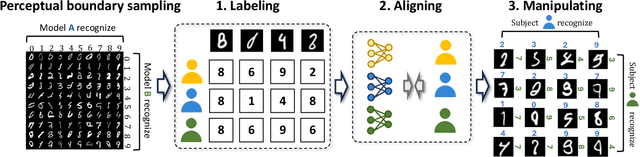
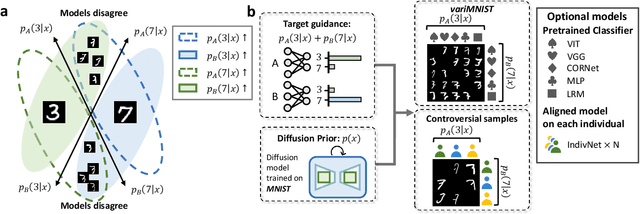
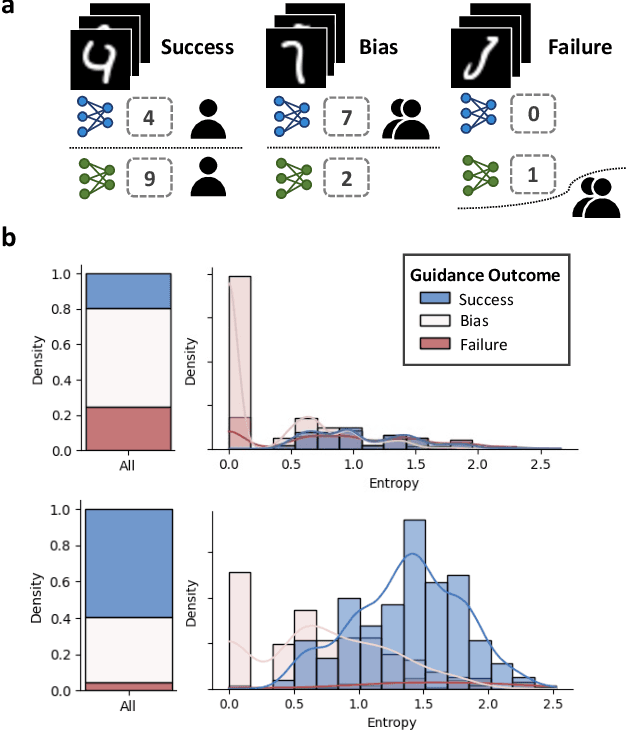
Human decision-making in cognitive tasks and daily life exhibits considerable variability, shaped by factors such as task difficulty, individual preferences, and personal experiences. Understanding this variability across individuals is essential for uncovering the perceptual and decision-making mechanisms that humans rely on when faced with uncertainty and ambiguity. We present a computational framework BAM (Boundary Alignment & Manipulation framework) that combines perceptual boundary sampling in ANNs and human behavioral experiments to systematically investigate this phenomenon. Our perceptual boundary sampling algorithm generates stimuli along ANN decision boundaries that intrinsically induce significant perceptual variability. The efficacy of these stimuli is empirically validated through large-scale behavioral experiments involving 246 participants across 116,715 trials, culminating in the variMNIST dataset containing 19,943 systematically annotated images. Through personalized model alignment and adversarial generation, we establish a reliable method for simultaneously predicting and manipulating the divergent perceptual decisions of pairs of participants. This work bridges the gap between computational models and human individual difference research, providing new tools for personalized perception analysis.
Handling Label Noise via Instance-Level Difficulty Modeling and Dynamic Optimization
May 01, 2025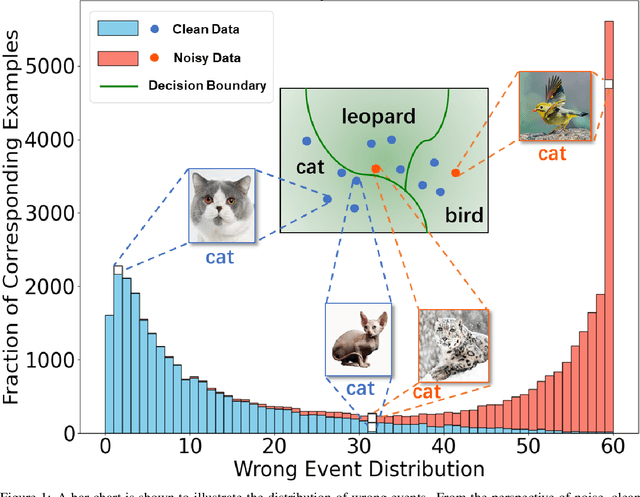
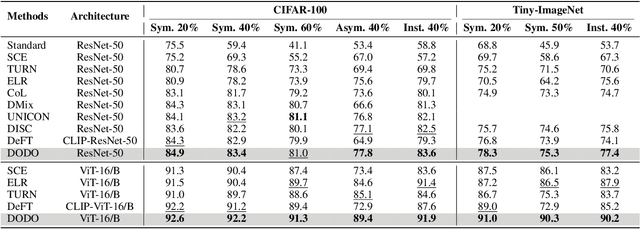
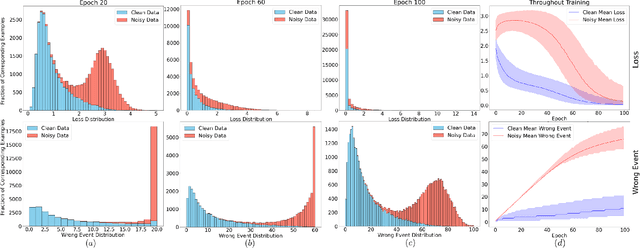
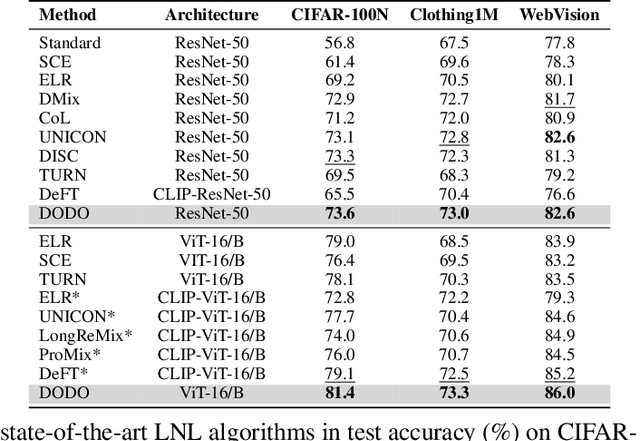
Recent studies indicate that deep neural networks degrade in generalization performance under noisy supervision. Existing methods focus on isolating clean subsets or correcting noisy labels, facing limitations such as high computational costs, heavy hyperparameter tuning process, and coarse-grained optimization. To address these challenges, we propose a novel two-stage noisy learning framework that enables instance-level optimization through a dynamically weighted loss function, avoiding hyperparameter tuning. To obtain stable and accurate information about noise modeling, we introduce a simple yet effective metric, termed wrong event, which dynamically models the cleanliness and difficulty of individual samples while maintaining computational costs. Our framework first collects wrong event information and builds a strong base model. Then we perform noise-robust training on the base model, using a probabilistic model to handle the wrong event information of samples. Experiments on five synthetic and real-world LNL benchmarks demonstrate our method surpasses state-of-the-art methods in performance, achieves a nearly 75% reduction in computational time and improves model scalability.