 Add to Chrome
 Add to Firefox
 Add to Edge
LLaVA-VSD: Large Language-and-Vision Assistant for Visual Spatial Description
Aug 09, 2024
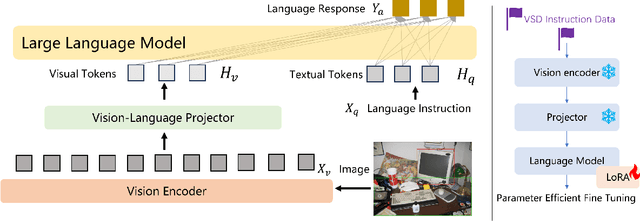
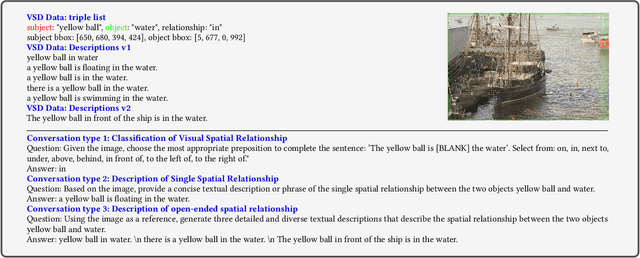

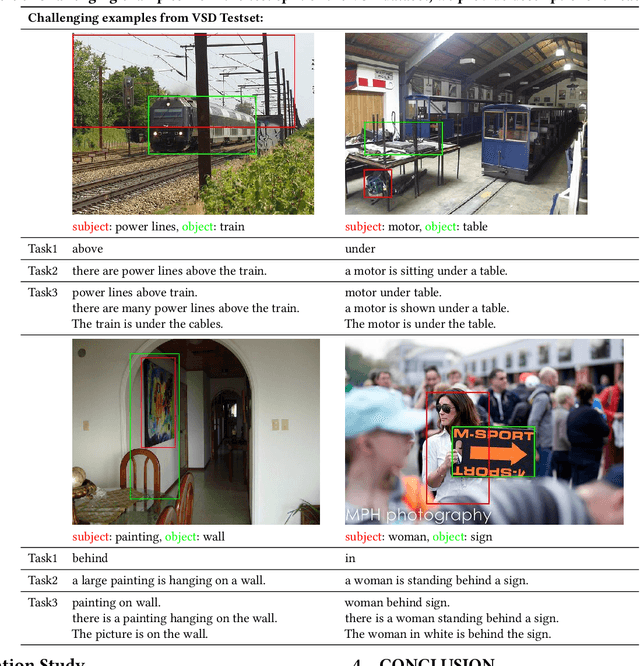
Visual Spatial Description (VSD) aims to generate texts that describe the spatial relationships between objects within images. Traditional visual spatial relationship classification (VSRC) methods typically output the spatial relationship between two objects in an image, often neglecting world knowledge and lacking general language capabilities. In this paper, we propose a Large Language-and-Vision Assistant for Visual Spatial Description, named LLaVA-VSD, which is designed for the classification, description, and open-ended description of visual spatial relationships. Specifically, the model first constructs a VSD instruction-following dataset using given figure-caption pairs for the three tasks. It then employs LoRA to fine-tune a Large Language and Vision Assistant for VSD, which has 13 billion parameters and supports high-resolution images. Finally, a large language model (Qwen-2) is used to refine the generated sentences, enhancing their diversity and accuracy. LLaVA-VSD demonstrates excellent multimodal conversational capabilities and can follow open-ended instructions to assist with inquiries about object relationships in images.

MDT-A2G: Exploring Masked Diffusion Transformers for Co-Speech Gesture Generation
Aug 06, 2024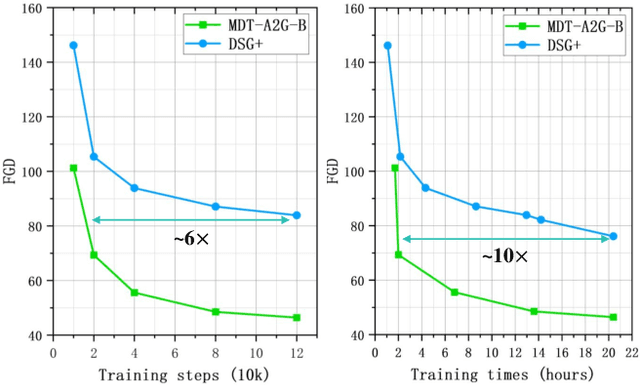

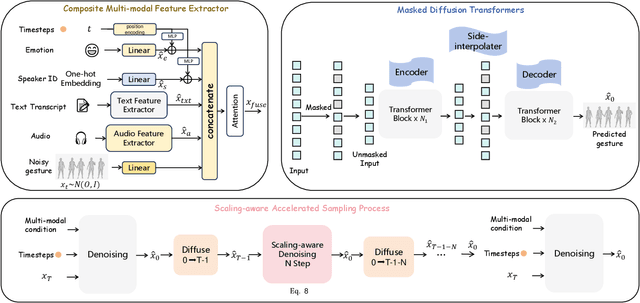

Recent advancements in the field of Diffusion Transformers have substantially improved the generation of high-quality 2D images, 3D videos, and 3D shapes. However, the effectiveness of the Transformer architecture in the domain of co-speech gesture generation remains relatively unexplored, as prior methodologies have predominantly employed the Convolutional Neural Network (CNNs) or simple a few transformer layers. In an attempt to bridge this research gap, we introduce a novel Masked Diffusion Transformer for co-speech gesture generation, referred to as MDT-A2G, which directly implements the denoising process on gesture sequences. To enhance the contextual reasoning capability of temporally aligned speech-driven gestures, we incorporate a novel Masked Diffusion Transformer. This model employs a mask modeling scheme specifically designed to strengthen temporal relation learning among sequence gestures, thereby expediting the learning process and leading to coherent and realistic motions. Apart from audio, Our MDT-A2G model also integrates multi-modal information, encompassing text, emotion, and identity. Furthermore, we propose an efficient inference strategy that diminishes the denoising computation by leveraging previously calculated results, thereby achieving a speedup with negligible performance degradation. Experimental results demonstrate that MDT-A2G excels in gesture generation, boasting a learning speed that is over 6$\times$ faster than traditional diffusion transformers and an inference speed that is 5.7$\times$ than the standard diffusion model.
Learning Multi-view Anomaly Detection
Jul 16, 2024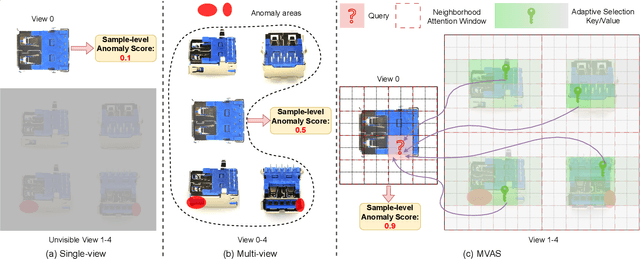
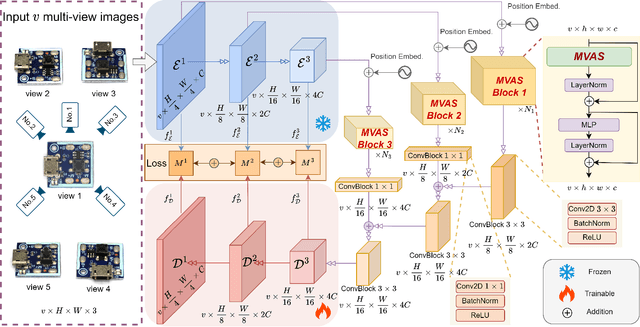
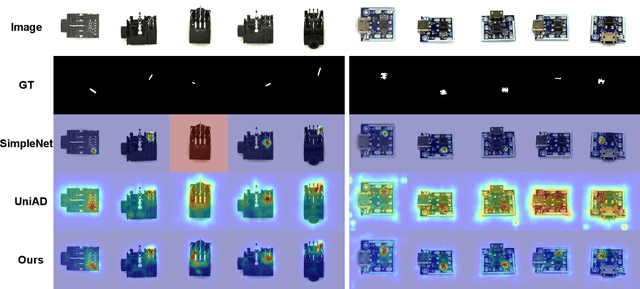
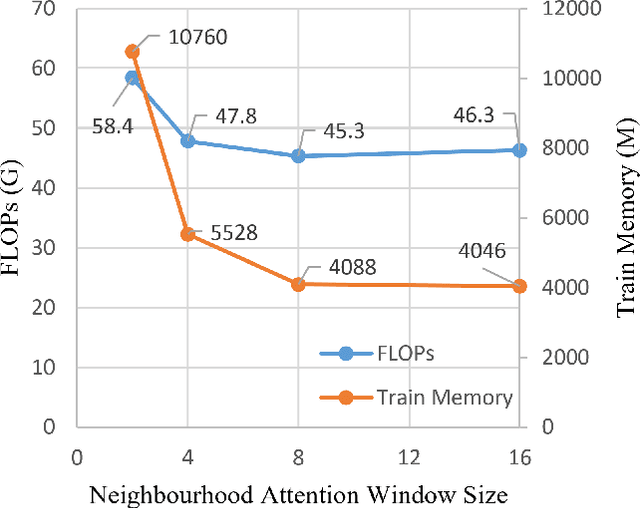
This study explores the recently proposed challenging multi-view Anomaly Detection (AD) task. Single-view tasks would encounter blind spots from other perspectives, resulting in inaccuracies in sample-level prediction. Therefore, we introduce the \textbf{M}ulti-\textbf{V}iew \textbf{A}nomaly \textbf{D}etection (\textbf{MVAD}) framework, which learns and integrates features from multi-views. Specifically, we proposed a \textbf{M}ulti-\textbf{V}iew \textbf{A}daptive \textbf{S}election (\textbf{MVAS}) algorithm for feature learning and fusion across multiple views. The feature maps are divided into neighbourhood attention windows to calculate a semantic correlation matrix between single-view windows and all other views, which is a conducted attention mechanism for each single-view window and the top-K most correlated multi-view windows. Adjusting the window sizes and top-K can minimise the computational complexity to linear. Extensive experiments on the Real-IAD dataset for cross-setting (multi/single-class) validate the effectiveness of our approach, achieving state-of-the-art performance among sample \textbf{4.1\%}$\uparrow$/ image \textbf{5.6\%}$\uparrow$/pixel \textbf{6.7\%}$\uparrow$ levels with a total of ten metrics with only \textbf{18M} parameters and fewer GPU memory and training time.
PSPU: Enhanced Positive and Unlabeled Learning by Leveraging Pseudo Supervision
Jul 09, 2024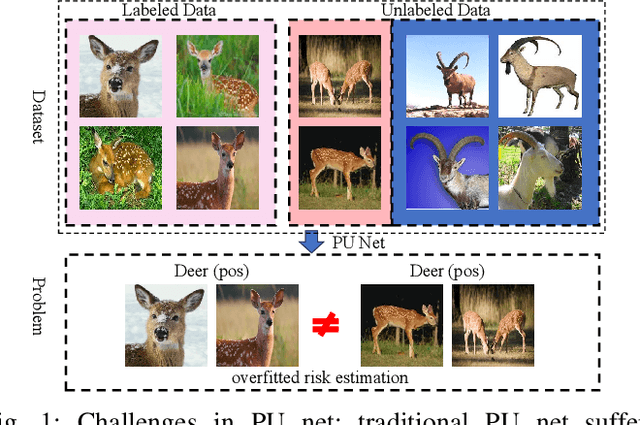
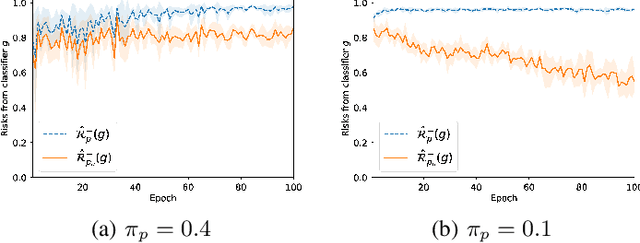
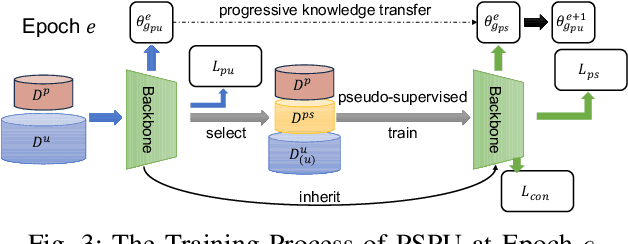

Positive and Unlabeled (PU) learning, a binary classification model trained with only positive and unlabeled data, generally suffers from overfitted risk estimation due to inconsistent data distributions. To address this, we introduce a pseudo-supervised PU learning framework (PSPU), in which we train the PU model first, use it to gather confident samples for the pseudo supervision, and then apply these supervision to correct the PU model's weights by leveraging non-PU objectives. We also incorporate an additional consistency loss to mitigate noisy sample effects. Our PSPU outperforms recent PU learning methods significantly on MNIST, CIFAR-10, CIFAR-100 in both balanced and imbalanced settings, and enjoys competitive performance on MVTecAD for industrial anomaly detection.
Oracle Bone Inscriptions Multi-modal Dataset
Jul 04, 2024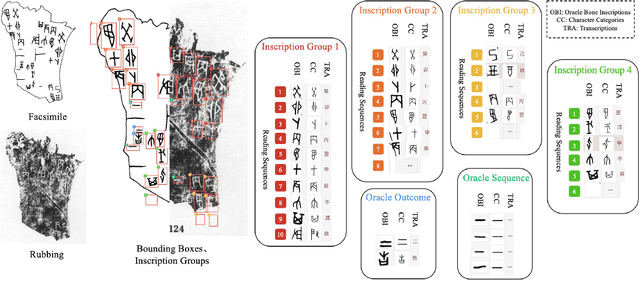
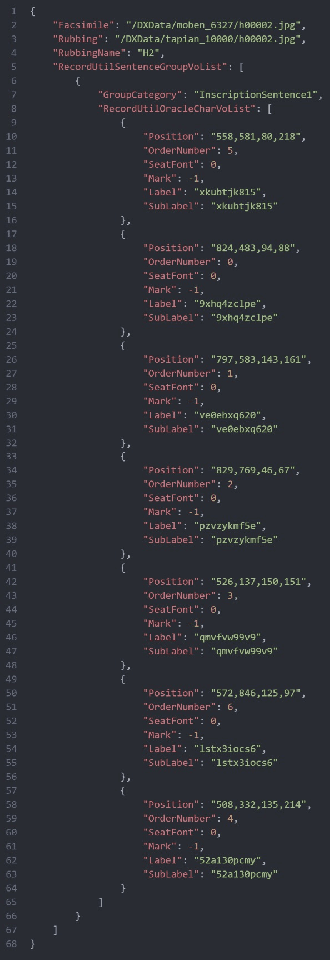
Oracle bone inscriptions(OBI) is the earliest developed writing system in China, bearing invaluable written exemplifications of early Shang history and paleography. However, the task of deciphering OBI, in the current climate of the scholarship, can prove extremely challenging. Out of the 4,500 oracle bone characters excavated, only a third have been successfully identified. Therefore, leveraging the advantages of advanced AI technology to assist in the decipherment of OBI is a highly essential research topic. However, fully utilizing AI's capabilities in these matters is reliant on having a comprehensive and high-quality annotated OBI dataset at hand whereas most existing datasets are only annotated in just a single or a few dimensions, limiting the value of their potential application. For instance, the Oracle-MNIST dataset only offers 30k images classified into 10 categories. Therefore, this paper proposes an Oracle Bone Inscriptions Multi-modal Dataset(OBIMD), which includes annotation information for 10,077 pieces of oracle bones. Each piece has two modalities: pixel-level aligned rubbings and facsimiles. The dataset annotates the detection boxes, character categories, transcriptions, corresponding inscription groups, and reading sequences in the groups of each oracle bone character, providing a comprehensive and high-quality level of annotations. This dataset can be used for a variety of AI-related research tasks relevant to the field of OBI, such as OBI Character Detection and Recognition, Rubbing Denoising, Character Matching, Character Generation, Reading Sequence Prediction, Missing Characters Completion task and so on. We believe that the creation and publication of a dataset like this will help significantly advance the application of AI algorithms in the field of OBI research.
Enhancing Multi-Class Anomaly Detection via Diffusion Refinement with Dual Conditioning
Jul 02, 2024Anomaly detection, the technique of identifying abnormal samples using only normal samples, has attracted widespread interest in industry. Existing one-model-per-category methods often struggle with limited generalization capabilities due to their focus on a single category, and can fail when encountering variations in product. Recent feature reconstruction methods, as representatives in one-model-all-categories schemes, face challenges including reconstructing anomalous samples and blurry reconstructions. In this paper, we creatively combine a diffusion model and a transformer for multi-class anomaly detection. This approach leverages diffusion to obtain high-frequency information for refinement, greatly alleviating the blurry reconstruction problem while maintaining the sampling efficiency of the reverse diffusion process. The task is transformed into image inpainting to disconnect the input-output correlation, thereby mitigating the "identical shortcuts" problem and avoiding the model from reconstructing anomalous samples. Besides, we introduce category-awareness using dual conditioning to ensure the accuracy of prediction and reconstruction in the reverse diffusion process, preventing excessive deviation from the target category, thus effectively enabling multi-class anomaly detection. Futhermore, Spatio-temporal fusion is also employed to fuse heatmaps predicted at different timesteps and scales, enhancing the performance of multi-class anomaly detection. Extensive experiments on benchmark datasets demonstrate the superior performance and exceptional multi-class anomaly detection capabilities of our proposed method compared to others.
RealTalk: Real-time and Realistic Audio-driven Face Generation with 3D Facial Prior-guided Identity Alignment Network
Jun 26, 2024Person-generic audio-driven face generation is a challenging task in computer vision. Previous methods have achieved remarkable progress in audio-visual synchronization, but there is still a significant gap between current results and practical applications. The challenges are two-fold: 1) Preserving unique individual traits for achieving high-precision lip synchronization. 2) Generating high-quality facial renderings in real-time performance. In this paper, we propose a novel generalized audio-driven framework RealTalk, which consists of an audio-to-expression transformer and a high-fidelity expression-to-face renderer. In the first component, we consider both identity and intra-personal variation features related to speaking lip movements. By incorporating cross-modal attention on the enriched facial priors, we can effectively align lip movements with audio, thus attaining greater precision in expression prediction. In the second component, we design a lightweight facial identity alignment (FIA) module which includes a lip-shape control structure and a face texture reference structure. This novel design allows us to generate fine details in real-time, without depending on sophisticated and inefficient feature alignment modules. Our experimental results, both quantitative and qualitative, on public datasets demonstrate the clear advantages of our method in terms of lip-speech synchronization and generation quality. Furthermore, our method is efficient and requires fewer computational resources, making it well-suited to meet the needs of practical applications.
DF40: Toward Next-Generation Deepfake Detection
Jun 19, 2024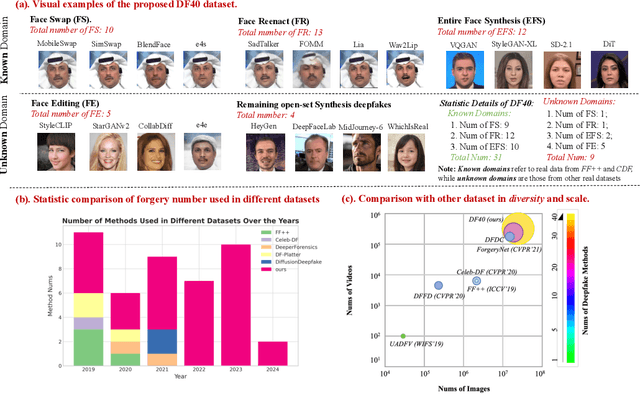
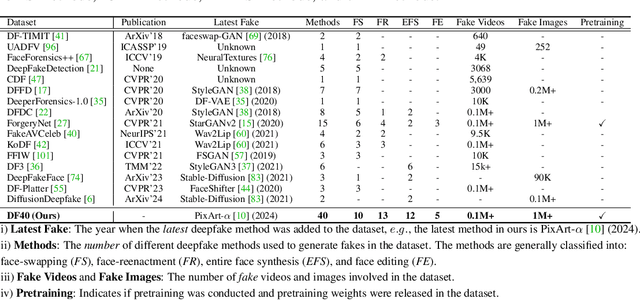
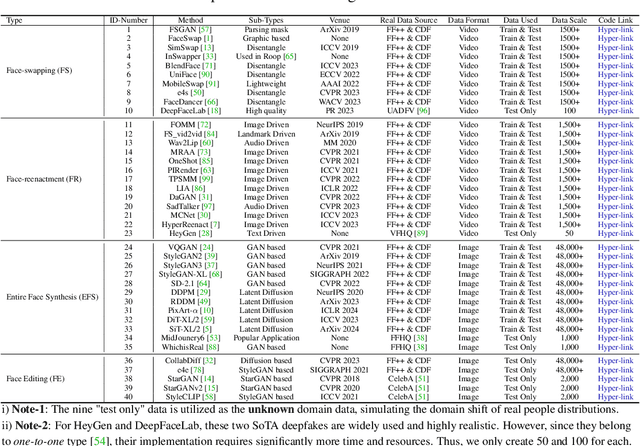
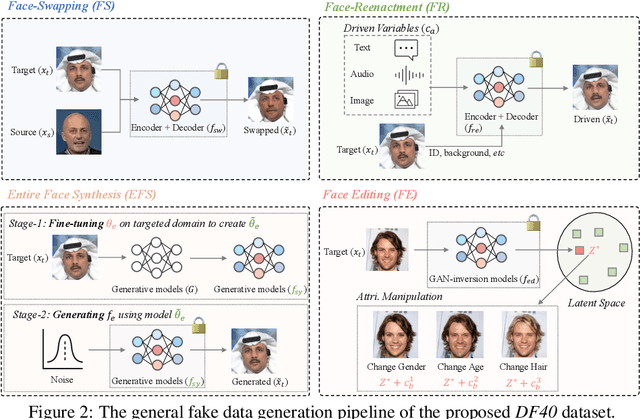
We propose a new comprehensive benchmark to revolutionize the current deepfake detection field to the next generation. Predominantly, existing works identify top-notch detection algorithms and models by adhering to the common practice: training detectors on one specific dataset (e.g., FF++) and testing them on other prevalent deepfake datasets. This protocol is often regarded as a "golden compass" for navigating SoTA detectors. But can these stand-out "winners" be truly applied to tackle the myriad of realistic and diverse deepfakes lurking in the real world? If not, what underlying factors contribute to this gap? In this work, we found the dataset (both train and test) can be the "primary culprit" due to: (1) forgery diversity: Deepfake techniques are commonly referred to as both face forgery (face-swapping and face-reenactment) and entire image synthesis (AIGC). Most existing datasets only contain partial types, with limited forgery methods implemented; (2) forgery realism: The dominant training dataset, FF++, contains old forgery techniques from the past five years. "Honing skills" on these forgeries makes it difficult to guarantee effective detection of nowadays' SoTA deepfakes; (3) evaluation protocol: Most detection works perform evaluations on one type, e.g., train and test on face-swapping only, which hinders the development of universal deepfake detectors. To address this dilemma, we construct a highly diverse and large-scale deepfake dataset called DF40, which comprises 40 distinct deepfake techniques. We then conduct comprehensive evaluations using 4 standard evaluation protocols and 7 representative detectors, resulting in over 2,000 evaluations. Through these evaluations, we analyze from various perspectives, leading to 12 new insightful findings contributing to the field. We also open up 5 valuable yet previously underexplored research questions to inspire future works.
AnyMaker: Zero-shot General Object Customization via Decoupled Dual-Level ID Injection
Jun 17, 2024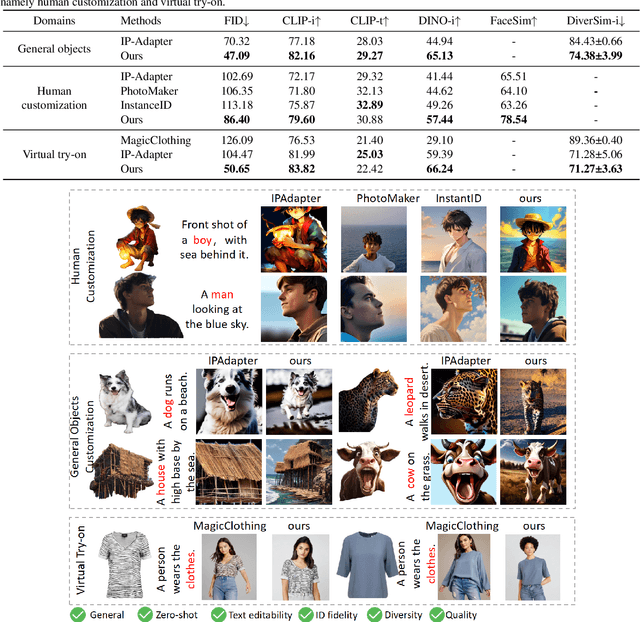
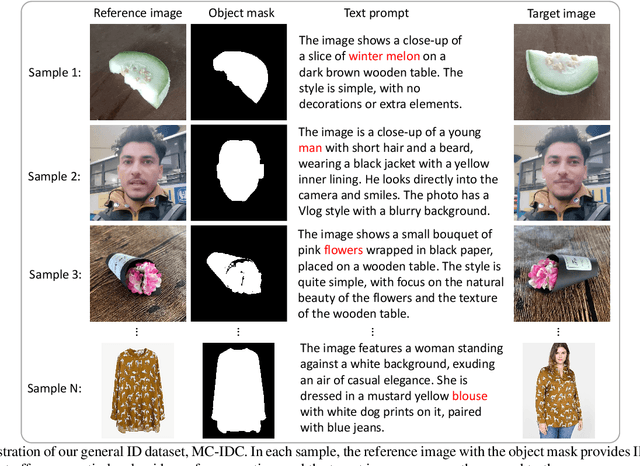
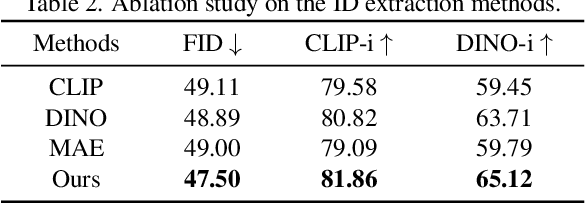
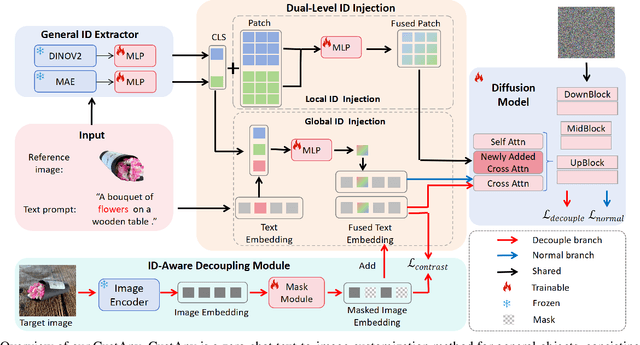
Text-to-image based object customization, aiming to generate images with the same identity (ID) as objects of interest in accordance with text prompts and reference images, has made significant progress. However, recent customizing research is dominated by specialized tasks, such as human customization or virtual try-on, leaving a gap in general object customization. To this end, we introduce AnyMaker, an innovative zero-shot object customization framework capable of generating general objects with high ID fidelity and flexible text editability. The efficacy of AnyMaker stems from its novel general ID extraction, dual-level ID injection, and ID-aware decoupling. Specifically, the general ID extraction module extracts sufficient ID information with an ensemble of self-supervised models to tackle the diverse customization tasks for general objects. Then, to provide the diffusion UNet with the extracted ID as much while not damaging the text editability in the generation process, we design a global-local dual-level ID injection module, in which the global-level semantic ID is injected into text descriptions while the local-level ID details are injected directly into the model through newly added cross-attention modules. In addition, we propose an ID-aware decoupling module to disentangle ID-related information from non-ID elements in the extracted representations for high-fidelity generation of both identity and text descriptions. To validate our approach and boost the research of general object customization, we create the first large-scale general ID dataset, Multi-Category ID-Consistent (MC-IDC) dataset, with 315k text-image samples and 10k categories. Experiments show that AnyMaker presents remarkable performance in general object customization and outperforms specialized methods in corresponding tasks. Code and dataset will be released soon.
ADer: A Comprehensive Benchmark for Multi-class Visual Anomaly Detection
Jun 06, 2024Visual anomaly detection aims to identify anomalous regions in images through unsupervised learning paradigms, with increasing application demand and value in fields such as industrial inspection and medical lesion detection. Despite significant progress in recent years, there is a lack of comprehensive benchmarks to adequately evaluate the performance of various mainstream methods across different datasets under the practical multi-class setting. The absence of standardized experimental setups can lead to potential biases in training epochs, resolution, and metric results, resulting in erroneous conclusions. This paper addresses this issue by proposing a comprehensive visual anomaly detection benchmark, \textbf{\textit{ADer}}, which is a modular framework that is highly extensible for new methods. The benchmark includes multiple datasets from industrial and medical domains, implementing fifteen state-of-the-art methods and nine comprehensive metrics. Additionally, we have open-sourced the GPU-assisted \href{https://pypi.org/project/ADEval}{ADEval} package to address the slow evaluation problem of metrics like time-consuming mAU-PRO on large-scale data, significantly reducing evaluation time by more than \textit{1000-fold}. Through extensive experimental results, we objectively reveal the strengths and weaknesses of different methods and provide insights into the challenges and future directions of multi-class visual anomaly detection. We hope that \textbf{\textit{ADer}} will become a valuable resource for researchers and practitioners in the field, promoting the development of more robust and generalizable anomaly detection systems. Full codes have been attached in Appendix and open-sourced at \url{https://github.com/zhangzjn/ader}.