 Add to Chrome
 Add to Firefox
 Add to Edge
WIDE: Boosting Adaptive LLM Inference via Token-level Dynamic Width Pruning
Jul 30, 2026
Pruning is a promising approach for improving the efficiency of LLMs. Existing static structured pruning methods are hardware-friendly and can deliver practical throughput gains, but their input-agnostic computation allocation often causes substantial accuracy degradation under aggressive sparsity. Recent dynamic sparsity methods improve quality retention by adapting computation to individual inputs, yet they remain largely limited to coarse-grained structural decisions and their practical acceleration under real-world inference scenarios remains challenging. To address these challenges, we present WIDE, the first end-to-end differentiable token-level dynamic width pruning framework designed for both prefill and decode scenarios. WIDE enables fine-grained computation allocation by allowing each token to dynamically select attention-head groups and FFN-channel groups, extending dynamic pruning beyond layer-level decisions to neuron-block-level granularity. Through a two-stage training pipeline, WIDE learns effective token-wise sparse execution patterns and achieves substantially better quality retention than existing approaches. To make such fine-grained dynamic pruning practical, we further propose a pruning--kernel co-design framework that decomposes dynamic sparsity acceleration into mask reordering, hardware-agnostic block-level skipping, and hardware-dependent intra-block skipping, enabling efficient execution across different granularities. At 50% sparsity, WIDE provides 55.1% performance boost when compared to the state-of-the-art dynamic depth pruning under calibration-only settings. Under prefill and decoding inference workloads, WIDE achieves close-to-theoretical kernel-level speedups of up to 1.98x for prefill and 4.95x for decoding, as well as 1.68x and 1.55x end-to-end acceleration. Our code is available at https://github.com/EIT-NLP/LLM-Pruning/tree/main/WIDE.

UniRank: Unified Rank Allocation for Low-Rank LLM Compression
Jun 20, 2026Low-rank decomposition serves as a promising compression paradigm for large language models, however, rank allocation remains challenging: manual rules lack generalizability, and learning-based approaches incur heavy computational overhead. To address these issues, we formulate global low-rank allocation as a sorting-and-truncation pipeline, and score each singular component via dual criteria: \textbf{Local} singular energy ratio that quantifies the intrinsic importance within the decomposed parameter matrix and \textbf{Global} functional importance (measured by input-output cosine similarity) that evaluates the functional significance of decomposed modules. We verify the strong correlation between high input-output cosine similarity and low effective rank through geometric interpretation and experimental validation. Furthermore, we propose rank-preserving fine-tuning, which performs direct LoRA tuning on decomposed weights and avoids extra information loss caused by re-truncation in conventional merging pipelines. Empirical results confirm that our method delivers sustained performance enhancements when combined with models featuring distinct decomposition schemes, model sizes and architectural designs, e.g. in one-shot compression without further fine-tuning, our method reduces perplexity by up to 50\% compared with uniform and heuristic allocation baselines. Code will be available at https://github.com/EIT-NLP/LLM-Pruning.
Metis: A Generalizable and Efficient World-Action Model for Autonomous Driving and Urban Navigation
Jun 14, 2026World action models~(WAMs) have shown great promise for autonomous driving and urban navigation. Built upon Vision-Language-Action models or video generation models, existing approaches suffer key limitations: (1) High inference latency due to future observation prediction at test time, and (2) tightly coupled video and action modeling leading to representational mismatch and degraded generalization. To address both issues, we propose Metis, an end-to-end WAM framework that decouples video generation and action prediction. Specifically, Metis employs a Mixture-of-Transformers architecture with dedicated experts for video generation and action prediction, preserving the intrinsic distributional properties of each task. To enhance efficiency, we introduce an asymmetric attention mask that enables joint training of both experts while allowing the action model to bypass explicit video generation during inference. This design ensures training-inference consistency and significantly reduces computational costs without compromising planning performance. Extensive experiments demonstrate state-of-the-art performance on the NAVSIM navhard and navtest benchmarks and the CityWalker navigation benchmark, validating both the generalizability and efficiency across diverse tasks. Real-robot deployments further confirm the practical feasibility of our approach.
ERNIE-Image Technical Report
May 25, 2026We introduce ERNIE-Image, an open-source text-to-image generation model built upon an 8B single-stream DiT architecture. ERNIE-Image aims to bridge the gap between current open-source models and leading closed-source systems through more effective mining of large-scale pre-training data and improved supervision quality throughout training. During pre-training, we adopt a bottom-up data construction pipeline that combines fine-grained image categorization, rich caption annotation, aesthetic assessment, and hierarchical sampling. This strategy reduces data noise while preserving long-tail concepts and detailed real-world knowledge, providing a stronger foundation for complex generation tasks. In the post-training stage, we use a top-down data construction pipeline for high-demand scenarios, diversify prompt annotations to better match real user inputs, and apply a stabilized DPO strategy to align the model with human aesthetic preferences. We further train ERNIE-Image-Turbo for efficient 8-NFE generation and propose MT-DMD to mitigate capability drift during distillation. To make the model easier to use in practical scenarios, we equip it with a lightweight Prompt Enhancer that expands concise user intents into structured visual descriptions. In addition, we develop ERNIE-Image-Aes, an industrial-grade aesthetic model, together with ERNIE-Image-Aes-1K, a human-annotated benchmark for realistic aesthetic evaluation. Extensive qualitative and quantitative experiments show that ERNIE-Image achieves leading performance among open-source models and approaches top-tier commercial models in instruction following, text rendering, and aesthetic quality. We release the trained models and aesthetic resources to facilitate further academic research and technical progress in the AIGC community.
Good to Go: The LOOP Skill Engine That Hits 99% Success and Slashes Token Usage by 99% via One-Shot Recording and Deterministic Replay
May 14, 2026Deploying AI agents for repetitive periodic tasks exposes a critical tension: Large Language Models (LLMs) offer unmatched flexibility in tool orchestration, yet their inherent stochasticity causes unpredictable failures, and repeated invocations incur prohibitive token costs. We present the LOOP SKILL ENGINE, a system that achieves a combined 99% success rate and 99% token reduction for periodic agent tasks through a one-shot recording, deterministic replay paradigm. On its first run, the agent executes the task with full LLM reasoning while the system transparently intercepts and records the complete tool-call trajectory. A greedy length-descending template extraction algorithm then converts this recording into a parameterized, branch-free Loop Skill -- a deterministic execution plan that captures the task's functional intent while parameterizing time-dependent and result-dependent variables. All subsequent executions bypass the LLM entirely: the engine resolves template variables against real-time values and replays the tool sequence deterministically. We prove two theorems: (1) Replay Determinism -- the step sequence of a validated Loop Skill is invariant across all future executions; (2) Write Safety -- concurrent access to persistent configuration is serialized through reentrant locks and atomic file replacement. Across a benchmark of periodic agent tasks spanning intervals from 5 minutes to 24 hours, the Loop Skill Engine reduces monthly token consumption by 93.3%--99.98% and cuts execution latency by 8.7x while eliminating output non-determinism. A multi-layer degradation strategy guarantees that tasks never stall. We release the engine as part of the buddyMe open-source agent framework.
Artificial Intelligence-Assistant Cardiotocography: Unified Model for Signal Reconstruction, Fetal Heart Rate Analysis, and Variability Assessment
May 14, 2026The monitoring of fetal heart rate (FHR) and the assessment of its variability are crucial for preventing fetal compromise and adverse outcomes. However, traditional methods encounter limitations arising from equipment performance, data transmission, and subjective assessments by doctors. We have developed a tailored AI-based FHrCTG model specifically for FHR monitoring, which effectively mitigates noise interference and precisely reconstructs signals. Our model was pre-trained on a massive dataset consisting of 558,412 unlabeled data points and further refined using 7,266 expert-reviewed entries. To validate FHR, we introduced the Intersection Overlapping Labels (IOL) approach, which transforms rate analysis into categorical judgments. Testing revealed that our model demonstrates high sensitivity and specificity in detecting critical FHR decelerations (89.13% and 87.78%, respectively) and accelerations (62.5% and 92.04%, respectively). Furthermore, based on Fischer's criteria for clinical application, our model achieved impressive AUC scores of 0.7214 and 0.9643 for verifying FHR periodicity and amplitude variation, respectively.
Neural ODE and SDE Models for Adaptation and Planning in Model-Based Reinforcement Learning
Mar 24, 2026We investigate neural ordinary and stochastic differential equations (neural ODEs and SDEs) to model stochastic dynamics in fully and partially observed environments within a model-based reinforcement learning (RL) framework. Through a sequence of simulations, we show that neural SDEs more effectively capture the inherent stochasticity of transition dynamics, enabling high-performing policies with improved sample efficiency in challenging scenarios. We leverage neural ODEs and SDEs for efficient policy adaptation to changes in environment dynamics via inverse models, requiring only limited interactions with the new environment. To address partial observability, we introduce a latent SDE model that combines an ODE with a GAN-trained stochastic component in latent space. Policies derived from this model provide a strong baseline, outperforming or matching general model-based and model-free approaches across stochastic continuous-control benchmarks. This work demonstrates the applicability of action-conditional latent SDEs for RL planning in environments with stochastic transitions. Our code is available at: https://github.com/ChaoHan-UoS/NeuralRL
Optimizing Neural Network Architecture for Medical Image Segmentation Using Monte Carlo Tree Search
Feb 25, 2026This paper proposes a novel medical image segmentation framework, MNAS-Unet, which combines Monte Carlo Tree Search (MCTS) and Neural Architecture Search (NAS). MNAS-Unet dynamically explores promising network architectures through MCTS, significantly enhancing the efficiency and accuracy of architecture search. It also optimizes the DownSC and UpSC unit structures, enabling fast and precise model adjustments. Experimental results demonstrate that MNAS-Unet outperforms NAS-Unet and other state-of-the-art models in segmentation accuracy on several medical image datasets, including PROMISE12, Ultrasound Nerve, and CHAOS. Furthermore, compared with NAS-Unet, MNAS-Unet reduces the architecture search budget by 54% (early stopping at 139 epochs versus 300 epochs under the same search setting), while achieving a lightweight model with only 0.6M parameters and lower GPU memory consumption, which further improves its practical applicability. These results suggest that MNAS-Unet can improve search efficiency while maintaining competitive segmentation accuracy under practical resource constraints.
WorldRFT: Latent World Model Planning with Reinforcement Fine-Tuning for Autonomous Driving
Dec 22, 2025Latent World Models enhance scene representation through temporal self-supervised learning, presenting a perception annotation-free paradigm for end-to-end autonomous driving. However, the reconstruction-oriented representation learning tangles perception with planning tasks, leading to suboptimal optimization for planning. To address this challenge, we propose WorldRFT, a planning-oriented latent world model framework that aligns scene representation learning with planning via a hierarchical planning decomposition and local-aware interactive refinement mechanism, augmented by reinforcement learning fine-tuning (RFT) to enhance safety-critical policy performance. Specifically, WorldRFT integrates a vision-geometry foundation model to improve 3D spatial awareness, employs hierarchical planning task decomposition to guide representation optimization, and utilizes local-aware iterative refinement to derive a planning-oriented driving policy. Furthermore, we introduce Group Relative Policy Optimization (GRPO), which applies trajectory Gaussianization and collision-aware rewards to fine-tune the driving policy, yielding systematic improvements in safety. WorldRFT achieves state-of-the-art (SOTA) performance on both open-loop nuScenes and closed-loop NavSim benchmarks. On nuScenes, it reduces collision rates by 83% (0.30% -> 0.05%). On NavSim, using camera-only sensors input, it attains competitive performance with the LiDAR-based SOTA method DiffusionDrive (87.8 vs. 88.1 PDMS).
Preliminary Investigation into Data Scaling Laws for Imitation Learning-Based End-to-End Autonomous Driving
Dec 03, 2024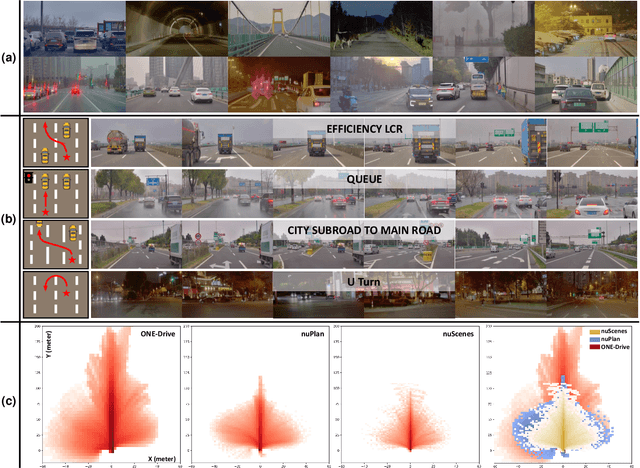
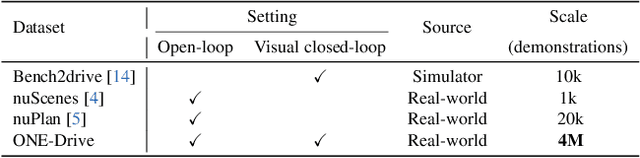

The end-to-end autonomous driving paradigm has recently attracted lots of attention due to its scalability. However, existing methods are constrained by the limited scale of real-world data, which hinders a comprehensive exploration of the scaling laws associated with end-to-end autonomous driving. To address this issue, we collected substantial data from various driving scenarios and behaviors and conducted an extensive study on the scaling laws of existing imitation learning-based end-to-end autonomous driving paradigms. Specifically, approximately 4 million demonstrations from 23 different scenario types were gathered, amounting to over 30,000 hours of driving demonstrations. We performed open-loop evaluations and closed-loop simulation evaluations in 1,400 diverse driving demonstrations (1,300 for open-loop and 100 for closed-loop) under stringent assessment conditions. Through experimental analysis, we discovered that (1) the performance of the driving model exhibits a power-law relationship with the amount of training data; (2) a small increase in the quantity of long-tailed data can significantly improve the performance for the corresponding scenarios; (3) appropriate scaling of data enables the model to achieve combinatorial generalization in novel scenes and actions. Our results highlight the critical role of data scaling in improving the generalizability of models across diverse autonomous driving scenarios, assuring safe deployment in the real world. Project repository: https://github.com/ucaszyp/Driving-Scaling-Law