 Add to Chrome
 Add to Firefox
 Add to Edge
ERNIE-Image Technical Report
May 25, 2026
We introduce ERNIE-Image, an open-source text-to-image generation model built upon an 8B single-stream DiT architecture. ERNIE-Image aims to bridge the gap between current open-source models and leading closed-source systems through more effective mining of large-scale pre-training data and improved supervision quality throughout training. During pre-training, we adopt a bottom-up data construction pipeline that combines fine-grained image categorization, rich caption annotation, aesthetic assessment, and hierarchical sampling. This strategy reduces data noise while preserving long-tail concepts and detailed real-world knowledge, providing a stronger foundation for complex generation tasks. In the post-training stage, we use a top-down data construction pipeline for high-demand scenarios, diversify prompt annotations to better match real user inputs, and apply a stabilized DPO strategy to align the model with human aesthetic preferences. We further train ERNIE-Image-Turbo for efficient 8-NFE generation and propose MT-DMD to mitigate capability drift during distillation. To make the model easier to use in practical scenarios, we equip it with a lightweight Prompt Enhancer that expands concise user intents into structured visual descriptions. In addition, we develop ERNIE-Image-Aes, an industrial-grade aesthetic model, together with ERNIE-Image-Aes-1K, a human-annotated benchmark for realistic aesthetic evaluation. Extensive qualitative and quantitative experiments show that ERNIE-Image achieves leading performance among open-source models and approaches top-tier commercial models in instruction following, text rendering, and aesthetic quality. We release the trained models and aesthetic resources to facilitate further academic research and technical progress in the AIGC community.

Memorize-and-Generate: Towards Long-Term Consistency in Real-Time Video Generation
Dec 23, 2025Frame-level autoregressive (frame-AR) models have achieved significant progress, enabling real-time video generation comparable to bidirectional diffusion models and serving as a foundation for interactive world models and game engines. However, current approaches in long video generation typically rely on window attention, which naively discards historical context outside the window, leading to catastrophic forgetting and scene inconsistency; conversely, retaining full history incurs prohibitive memory costs. To address this trade-off, we propose Memorize-and-Generate (MAG), a framework that decouples memory compression and frame generation into distinct tasks. Specifically, we train a memory model to compress historical information into a compact KV cache, and a separate generator model to synthesize subsequent frames utilizing this compressed representation. Furthermore, we introduce MAG-Bench to strictly evaluate historical memory retention. Extensive experiments demonstrate that MAG achieves superior historical scene consistency while maintaining competitive performance on standard video generation benchmarks.
DDAVS: Disentangled Audio Semantics and Delayed Bidirectional Alignment for Audio-Visual Segmentation
Dec 23, 2025Audio-Visual Segmentation (AVS) aims to localize sound-producing objects at the pixel level by jointly leveraging auditory and visual information. However, existing methods often suffer from multi-source entanglement and audio-visual misalignment, which lead to biases toward louder or larger objects while overlooking weaker, smaller, or co-occurring sources. To address these challenges, we propose DDAVS, a Disentangled Audio Semantics and Delayed Bidirectional Alignment framework. To mitigate multi-source entanglement, DDAVS employs learnable queries to extract audio semantics and anchor them within a structured semantic space derived from an audio prototype memory bank. This is further optimized through contrastive learning to enhance discriminability and robustness. To alleviate audio-visual misalignment, DDAVS introduces dual cross-attention with delayed modality interaction, improving the robustness of multimodal alignment. Extensive experiments on the AVS-Objects and VPO benchmarks demonstrate that DDAVS consistently outperforms existing approaches, exhibiting strong performance across single-source, multi-source, and multi-instance scenarios. These results validate the effectiveness and generalization ability of our framework under challenging real-world audio-visual segmentation conditions. Project page: https://trilarflagz.github.io/DDAVS-page/
Post-Training Quantization for Video Matting
Jun 12, 2025Video matting is crucial for applications such as film production and virtual reality, yet deploying its computationally intensive models on resource-constrained devices presents challenges. Quantization is a key technique for model compression and acceleration. As an efficient approach, Post-Training Quantization (PTQ) is still in its nascent stages for video matting, facing significant hurdles in maintaining accuracy and temporal coherence. To address these challenges, this paper proposes a novel and general PTQ framework specifically designed for video matting models, marking, to the best of our knowledge, the first systematic attempt in this domain. Our contributions include: (1) A two-stage PTQ strategy that combines block-reconstruction-based optimization for fast, stable initial quantization and local dependency capture, followed by a global calibration of quantization parameters to minimize accuracy loss. (2) A Statistically-Driven Global Affine Calibration (GAC) method that enables the network to compensate for cumulative statistical distortions arising from factors such as neglected BN layer effects, even reducing the error of existing PTQ methods on video matting tasks up to 20%. (3) An Optical Flow Assistance (OFA) component that leverages temporal and semantic priors from frames to guide the PTQ process, enhancing the model's ability to distinguish moving foregrounds in complex scenes and ultimately achieving near full-precision performance even under ultra-low-bit quantization. Comprehensive quantitative and visual results show that our PTQ4VM achieves the state-of-the-art accuracy performance across different bit-widths compared to the existing quantization methods. We highlight that the 4-bit PTQ4VM even achieves performance close to the full-precision counterpart while enjoying 8x FLOP savings.
KV-Edit: Training-Free Image Editing for Precise Background Preservation
Feb 25, 2025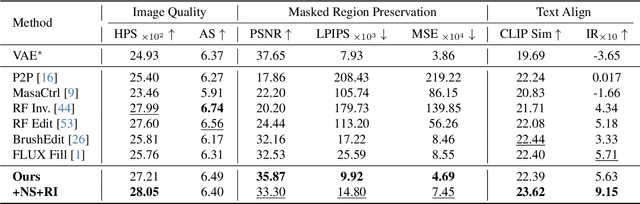
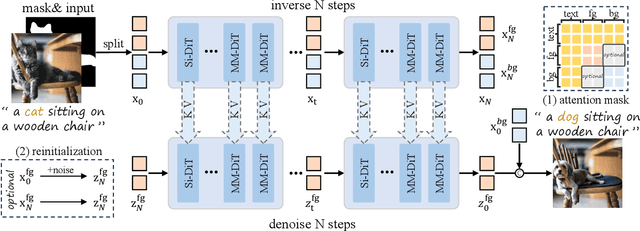
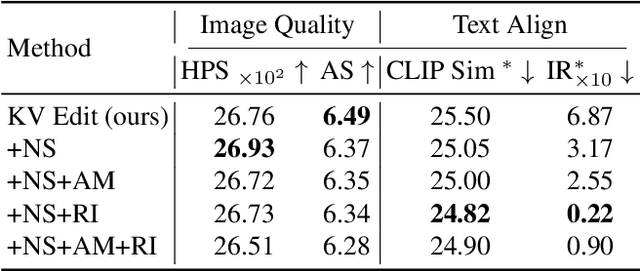
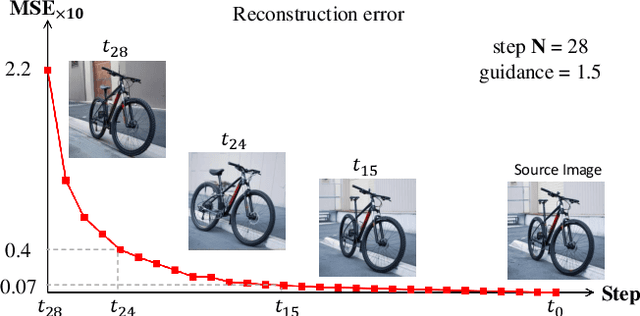
Background consistency remains a significant challenge in image editing tasks. Despite extensive developments, existing works still face a trade-off between maintaining similarity to the original image and generating content that aligns with the target. Here, we propose KV-Edit, a training-free approach that uses KV cache in DiTs to maintain background consistency, where background tokens are preserved rather than regenerated, eliminating the need for complex mechanisms or expensive training, ultimately generating new content that seamlessly integrates with the background within user-provided regions. We further explore the memory consumption of the KV cache during editing and optimize the space complexity to $O(1)$ using an inversion-free method. Our approach is compatible with any DiT-based generative model without additional training. Experiments demonstrate that KV-Edit significantly outperforms existing approaches in terms of both background and image quality, even surpassing training-based methods. Project webpage is available at https://xilluill.github.io/projectpages/KV-Edit
Research on Key Technologies of Infrastructure Digitalization based on Multimodal Spatial Data
Oct 22, 2023Since NASA put forward the concept of the digital twin in 2010, many industries have put forward the dynamic goal of digital development, and the transportation industry is also among them. With more and more companies laying out on this virgin land, the digital twin transportation industry has grown rapidly and gradually formed a complete scientific research system. However, under the largely mature framework, there are still many loophole problems that need to be solved. In the process of constructing a road network with point cloud information, we summarize several major features of the point cloud collected by laser scanners and analyze the potential problems of constructing the network, such as misjudging the feature points as ground points and grid voids. On this basis, we reviewed relevant literature and proposed targeted solutions, such as building a point cloud pyramid modeled after the image pyramid, expanding the virtual grid, etc., applying CSF for ground-point cloud extraction, and constructing a road network model using the PTD (progressive density-based filter) algorithm. For the problem of road sign detection, we optimize the remote sensing data in the ground point cloud by enhancing the information density using edge detection, improving the data quality by removing the low intensity points, and achieving 90% accuracy of road text recognition using PaddleOCR and Densenet. As for the real-time digital twin traffic, we design the P2PRN network using the backbone of MPR-GAN for 2D feature generation and SuperGlue for 2D feature matching, rendering the viewpoints according to the matching optimization points, completing the multimodal matching task after several iterations, and successfully calculating the road camera position with 10{\deg} and 15m accuracy.