 Add to Chrome
 Add to Firefox
 Add to Edge
WALA Learning Executable Latent Actions from Action-Labeled Demonstrations and Action-Free Videos
Jul 13, 2026
Generalizable robot policies typically rely on action-labeled robot demonstrations, which are expensive to collect and difficult to scale. In contrast, large-scale human and robot videos contain rich physical interactions but often lack executable robot action labels. We present WALA, a framework for learning executable latent actions from both action-labeled demonstrations and action-free videos. WALA first pretrains a semantic-geometric latent action model from videos by modeling the evolution between current observations and sparsely sampled future observations. Instead of reconstructing raw pixels, WALA predicts future deltas in the DINOv3 feature space and dense depth space, preserving task-relevant semantic and geometric structure while reducing sensitivity to appearance details. During policy training, the pretrained encoder provides stable latent action targets, and the decoder serves as a trainable latent world model. The latent actions generated by the vision-language backbone are jointly supervised by robot action prediction, latent action target matching, and future dynamics prediction. This enables action-labeled demonstrations to provide executable control supervision, while action-free videos contribute dynamics supervision without requiring robot action annotations. Experiments show that WALA achieves strong performance on RoboTwin, sets a new state-of-the-art result on RoboCasa with 75.2% average success, and improves both policy performance and generalization in real-world manipulation tasks.

Preliminary Investigation into Data Scaling Laws for Imitation Learning-Based End-to-End Autonomous Driving
Dec 03, 2024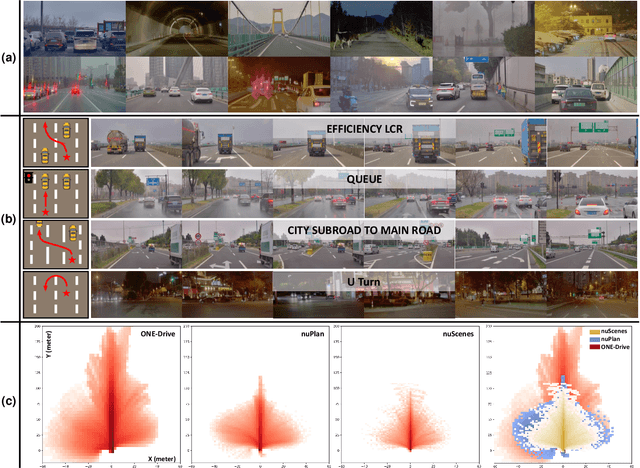
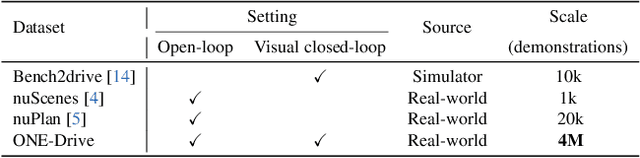

The end-to-end autonomous driving paradigm has recently attracted lots of attention due to its scalability. However, existing methods are constrained by the limited scale of real-world data, which hinders a comprehensive exploration of the scaling laws associated with end-to-end autonomous driving. To address this issue, we collected substantial data from various driving scenarios and behaviors and conducted an extensive study on the scaling laws of existing imitation learning-based end-to-end autonomous driving paradigms. Specifically, approximately 4 million demonstrations from 23 different scenario types were gathered, amounting to over 30,000 hours of driving demonstrations. We performed open-loop evaluations and closed-loop simulation evaluations in 1,400 diverse driving demonstrations (1,300 for open-loop and 100 for closed-loop) under stringent assessment conditions. Through experimental analysis, we discovered that (1) the performance of the driving model exhibits a power-law relationship with the amount of training data; (2) a small increase in the quantity of long-tailed data can significantly improve the performance for the corresponding scenarios; (3) appropriate scaling of data enables the model to achieve combinatorial generalization in novel scenes and actions. Our results highlight the critical role of data scaling in improving the generalizability of models across diverse autonomous driving scenarios, assuring safe deployment in the real world. Project repository: https://github.com/ucaszyp/Driving-Scaling-Law