 Add to Chrome
 Add to Firefox
 Add to Edge
MatrAIx: Simulating the World with 8.3 Billion Persona Agents
Aug 04, 2026
Human evaluation of AI systems and digital products is costly, slow, and difficult to scale. Offline evaluations are more scalable but often abstract away human diversity and interactive behavior. We therefore introduce MatrAIx, a population-scale simulated-user evaluation infrastructure for testing AI systems and digital products with heterogeneous users. MatrAIx has three core components: First, Persona 8B contains 8.3 billion persona records represented by 1,290 categorical dimensions. Records are either sampled from a dependency graph that preserves correlated attributes or derived from human-authored profiles. We release a quality-filtered coreset of approximately 1 million personas, comprising 599,847 human-grounded and 400,000 synthetic records. Second, the MatrAIx Playground provides four environments in which diverse users evaluate and interact with digital products: Survey, AI Chatbot, Web, and App. Third, MatrAIx provides 1,010 application tasks spanning more than 25 domains, including Commerce, Software, Finance, and Healthcare. We conducted 18,189 evaluation trials across eight representative tasks. Persona agents were powered by three LLMs: Claude Opus 4.8, GPT 5.5, and Claude Haiku 4.5. The resulting feedback captures how decisions and preferences vary across persona backgrounds, including hesitation after a price increase, willingness to continue after an AI assistant fails, and latency tolerance. We conducted two main validation studies: First, a 400-trial controlled study evaluated persona adherence across ten behavioral attributes and all four environments. The declared behavior was expressed or correctly suppressed in 366 trials (91.5%). Second, human and LLM judges evaluated the extraction quality of human-grounded personas. Overall, MatrAIx provides an end-to-end infrastructure for evaluating AI systems and digital products with diverse simulated human users.

Automated Benchmark Auditing for AI Agents and Large Language Models
May 26, 2026Modern AI benchmarks operate at a complexity that outpaces traditional verification methods. Tasks authored by domain experts often contain implicit assumptions, incomplete environment specifications, and brittle evaluation logic that human annotation cannot reliably catch. We introduce Auto Benchmark Audit (ABA), an agentic framework that systematically audits individual benchmark tasks, uncovering issues such as hidden environment dependencies, specification gaps, and limited grading logic. We run ABA on a collection of frontier LLM benchmarks and previous NeurIPS publications, totaling 168 benchmarks across nine domains. Across this corpus, ABA identifies critical issues including ambiguous task design, execution environment conflicts, and incorrect ground truths in over 25.7% of the evaluated tasks. The precision of these automated audits is validated by expert review and independent third-party reports such as upstream PRs. Crucially, we demonstrate that these problematic tasks severely distorts capability assessments for agents and LLMs: filtering out these tasks with issues shifts model rankings and increases average performance on SWE-bench Verified and Terminal-Bench 2 by 9.9% and 9.6%, respectively. We release the agentic tool and all task annotations to support the future development of frontier benchmarks.
Peer-Predictive Self-Training for Language Model Reasoning
Apr 14, 2026Mechanisms for continued self-improvement of language models without external supervision remain an open challenge. We propose Peer-Predictive Self-Training (PST), a label-free fine-tuning framework in which multiple language models improve collaboratively by leveraging a cross-model aggregated response as an internal training signal. Given a prompt question, the models generate responses sequentially; the final aggregated answer, often more reliable than individual responses in practice, serves as an internal target for learning. We measure how informative each intermediate response is about the aggregate using pointwise mutual information (PMI), and use this signal to scale self-training updates. Responses already aligned with the aggregate are updated less, while less informative or misaligned responses are updated more. On mathematical reasoning benchmarks (SimulEq, Math500, and MultiArith), PST improves exact-match accuracy by 2.2 to 4.3 percentage points across Gemma-2-2B, LLaMA-3.2-1B, and Qwen-2.5-1.5B, and reduces the average generator-verifier gap (GV-Gap) by 26 to 40 percent, while requiring no external supervision or teacher-student hierarchy and relying solely on cross-model interactions. These results suggest that cross-model generations and peer-predictive feedback can serve as an effective approach for self-supervised training.
Physion-Eval: Evaluating Physical Realism in Generated Video via Human Reasoning
Mar 20, 2026Video generation models are increasingly used as world simulators for storytelling, simulation, and embodied AI. As these models advance, a key question arises: do generated videos obey the physical laws of the real world? Existing evaluations largely rely on automated metrics or coarse human judgments such as preferences or rubric-based checks. While useful for assessing perceptual quality, these methods provide limited insight into when and why generated dynamics violate real-world physical constraints. We introduce Physion-Eval, a large-scale benchmark of expert human reasoning for diagnosing physical realism failures in videos generated by five state-of-the-art models across egocentric and exocentric views, containing 10,990 expert reasoning traces spanning 22 fine-grained physical categories. Each generated video is derived from a corresponding real-world reference video depicting a clear physical process, and annotated with temporally localized glitches, structured failure categories, and natural-language explanations of the violated physical behavior. Using this dataset, we reveal a striking limitation of current video generation models: in physics-critical scenarios, 83.3% of exocentric and 93.5% of egocentric generated videos exhibit at least one human-identifiable physical glitch. We hope Physion-Eval will set a new standard for physical realism evaluation and guide the development of physics-grounded video generation. The benchmark is publicly available at https://huggingface.co/datasets/PhysionLabs/Physion-Eval.
Optimizing Neural Network Architecture for Medical Image Segmentation Using Monte Carlo Tree Search
Feb 25, 2026This paper proposes a novel medical image segmentation framework, MNAS-Unet, which combines Monte Carlo Tree Search (MCTS) and Neural Architecture Search (NAS). MNAS-Unet dynamically explores promising network architectures through MCTS, significantly enhancing the efficiency and accuracy of architecture search. It also optimizes the DownSC and UpSC unit structures, enabling fast and precise model adjustments. Experimental results demonstrate that MNAS-Unet outperforms NAS-Unet and other state-of-the-art models in segmentation accuracy on several medical image datasets, including PROMISE12, Ultrasound Nerve, and CHAOS. Furthermore, compared with NAS-Unet, MNAS-Unet reduces the architecture search budget by 54% (early stopping at 139 epochs versus 300 epochs under the same search setting), while achieving a lightweight model with only 0.6M parameters and lower GPU memory consumption, which further improves its practical applicability. These results suggest that MNAS-Unet can improve search efficiency while maintaining competitive segmentation accuracy under practical resource constraints.
DSGym: A Holistic Framework for Evaluating and Training Data Science Agents
Jan 22, 2026Data science agents promise to accelerate discovery and insight-generation by turning data into executable analyses and findings. Yet existing data science benchmarks fall short due to fragmented evaluation interfaces that make cross-benchmark comparison difficult, narrow task coverage and a lack of rigorous data grounding. In particular, we show that a substantial portion of tasks in current benchmarks can be solved without using the actual data. To address these limitations, we introduce DSGym, a standardized framework for evaluating and training data science agents in self-contained execution environments. Unlike static benchmarks, DSGym provides a modular architecture that makes it easy to add tasks, agent scaffolds, and tools, positioning it as a live, extensible testbed. We curate DSGym-Tasks, a holistic task suite that standardizes and refines existing benchmarks via quality and shortcut solvability filtering. We further expand coverage with (1) DSBio: expert-derived bioinformatics tasks grounded in literature and (2) DSPredict: challenging prediction tasks spanning domains such as computer vision, molecular prediction, and single-cell perturbation. Beyond evaluation, DSGym enables agent training via execution-verified data synthesis pipeline. As a case study, we build a 2,000-example training set and trained a 4B model in DSGym that outperforms GPT-4o on standardized analysis benchmarks. Overall, DSGym enables rigorous end-to-end measurement of whether agents can plan, implement, and validate data analyses in realistic scientific context.
UQ: Assessing Language Models on Unsolved Questions
Aug 25, 2025Benchmarks shape progress in AI research. A useful benchmark should be both difficult and realistic: questions should challenge frontier models while also reflecting real-world usage. Yet, current paradigms face a difficulty-realism tension: exam-style benchmarks are often made artificially difficult with limited real-world value, while benchmarks based on real user interaction often skew toward easy, high-frequency problems. In this work, we explore a radically different paradigm: assessing models on unsolved questions. Rather than a static benchmark scored once, we curate unsolved questions and evaluate models asynchronously over time with validator-assisted screening and community verification. We introduce UQ, a testbed of 500 challenging, diverse questions sourced from Stack Exchange, spanning topics from CS theory and math to sci-fi and history, probing capabilities including reasoning, factuality, and browsing. UQ is difficult and realistic by construction: unsolved questions are often hard and naturally arise when humans seek answers, thus solving them yields direct real-world value. Our contributions are threefold: (1) UQ-Dataset and its collection pipeline combining rule-based filters, LLM judges, and human review to ensure question quality (e.g., well-defined and difficult); (2) UQ-Validators, compound validation strategies that leverage the generator-validator gap to provide evaluation signals and pre-screen candidate solutions for human review; and (3) UQ-Platform, an open platform where experts collectively verify questions and solutions. The top model passes UQ-validation on only 15% of questions, and preliminary human verification has already identified correct answers among those that passed. UQ charts a path for evaluating frontier models on real-world, open-ended challenges, where success pushes the frontier of human knowledge. We release UQ at https://uq.stanford.edu.
Weak-for-Strong: Training Weak Meta-Agent to Harness Strong Executors
Apr 07, 2025Efficiently leveraging of the capabilities of contemporary large language models (LLMs) is increasingly challenging, particularly when direct fine-tuning is expensive and often impractical. Existing training-free methods, including manually or automated designed workflows, typically demand substantial human effort or yield suboptimal results. This paper proposes Weak-for-Strong Harnessing (W4S), a novel framework that customizes smaller, cost-efficient language models to design and optimize workflows for harnessing stronger models. W4S formulates workflow design as a multi-turn markov decision process and introduces reinforcement learning for agentic workflow optimization (RLAO) to train a weak meta-agent. Through iterative interaction with the environment, the meta-agent learns to design increasingly effective workflows without manual intervention. Empirical results demonstrate the superiority of W4S that our 7B meta-agent, trained with just one GPU hour, outperforms the strongest baseline by 2.9% ~ 24.6% across eleven benchmarks, successfully elevating the performance of state-of-the-art models such as GPT-3.5-Turbo and GPT-4o. Notably, W4S exhibits strong generalization capabilities across both seen and unseen tasks, offering an efficient, high-performing alternative to directly fine-tuning strong models.
TAROT: Targeted Data Selection via Optimal Transport
Nov 30, 2024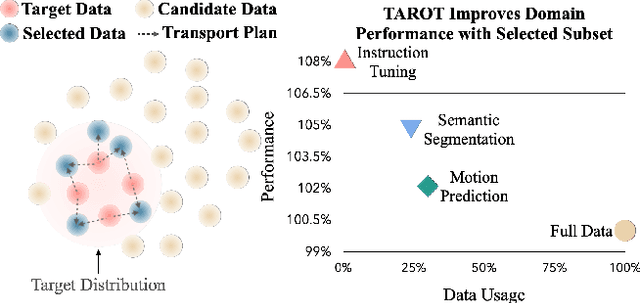
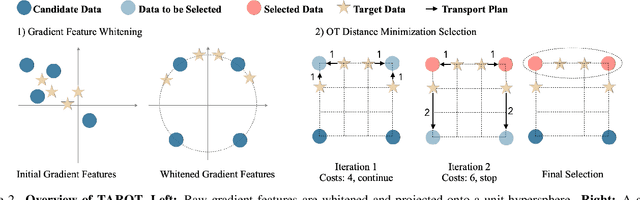

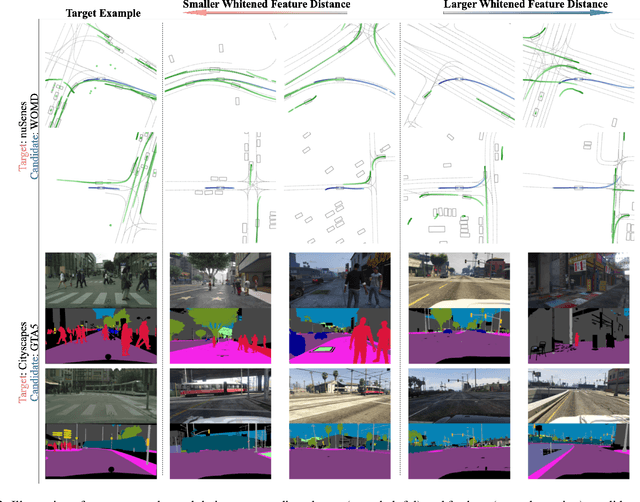
We propose TAROT, a targeted data selection framework grounded in optimal transport theory. Previous targeted data selection methods primarily rely on influence-based greedy heuristics to enhance domain-specific performance. While effective on limited, unimodal data (i.e., data following a single pattern), these methods struggle as target data complexity increases. Specifically, in multimodal distributions, these heuristics fail to account for multiple inherent patterns, leading to suboptimal data selection. This work identifies two primary factors contributing to this limitation: (i) the disproportionate impact of dominant feature components in high-dimensional influence estimation, and (ii) the restrictive linear additive assumptions inherent in greedy selection strategies. To address these challenges, TAROT incorporates whitened feature distance to mitigate dominant feature bias, providing a more reliable measure of data influence. Building on this, TAROT uses whitened feature distance to quantify and minimize the optimal transport distance between the selected data and target domains. Notably, this minimization also facilitates the estimation of optimal selection ratios. We evaluate TAROT across multiple tasks, including semantic segmentation, motion prediction, and instruction tuning. Results consistently show that TAROT outperforms state-of-the-art methods, highlighting its versatility across various deep learning tasks. Code is available at https://github.com/vita-epfl/TAROT.
FactTest: Factuality Testing in Large Language Models with Statistical Guarantees
Nov 04, 2024


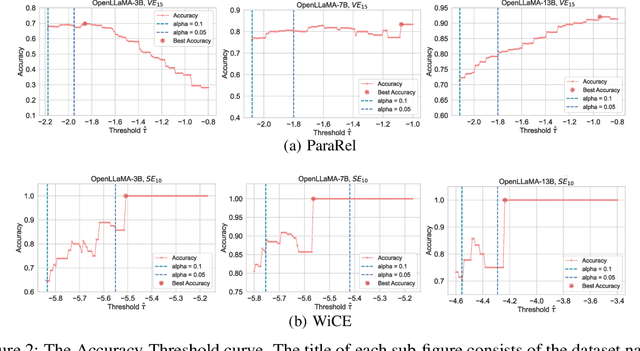
The propensity of Large Language Models (LLMs) to generate hallucinations and non-factual content undermines their reliability in high-stakes domains, where rigorous control over Type I errors (the conditional probability of incorrectly classifying hallucinations as truthful content) is essential. Despite its importance, formal verification of LLM factuality with such guarantees remains largely unexplored. In this paper, we introduce FactTest, a novel framework that statistically assesses whether an LLM can confidently provide correct answers to given questions with high-probability correctness guarantees. We formulate factuality testing as hypothesis testing problem to enforce an upper bound of Type I errors at user-specified significance levels. Notably, we prove that our framework also ensures strong Type II error control under mild conditions and can be extended to maintain its effectiveness when covariate shifts exist. %These analyses are amenable to the principled NP framework. Our approach is distribution-free and works for any number of human-annotated samples. It is model-agnostic and applies to any black-box or white-box LM. Extensive experiments on question-answering (QA) and multiple-choice benchmarks demonstrate that \approach effectively detects hallucinations and improves the model's ability to abstain from answering unknown questions, leading to an over 40% accuracy improvement.