 Add to Chrome
 Add to Firefox
 Add to Edge
Neural ODE and SDE Models for Adaptation and Planning in Model-Based Reinforcement Learning
Mar 24, 2026
We investigate neural ordinary and stochastic differential equations (neural ODEs and SDEs) to model stochastic dynamics in fully and partially observed environments within a model-based reinforcement learning (RL) framework. Through a sequence of simulations, we show that neural SDEs more effectively capture the inherent stochasticity of transition dynamics, enabling high-performing policies with improved sample efficiency in challenging scenarios. We leverage neural ODEs and SDEs for efficient policy adaptation to changes in environment dynamics via inverse models, requiring only limited interactions with the new environment. To address partial observability, we introduce a latent SDE model that combines an ODE with a GAN-trained stochastic component in latent space. Policies derived from this model provide a strong baseline, outperforming or matching general model-based and model-free approaches across stochastic continuous-control benchmarks. This work demonstrates the applicability of action-conditional latent SDEs for RL planning in environments with stochastic transitions. Our code is available at: https://github.com/ChaoHan-UoS/NeuralRL

A Study of Demographic Bias in CNN-based Brain MR Segmentation
Aug 13, 2022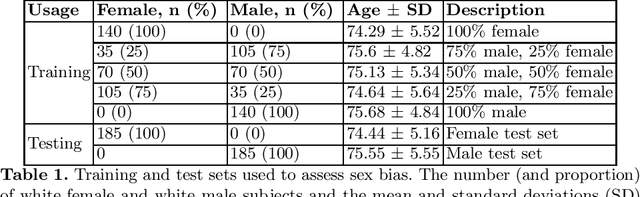
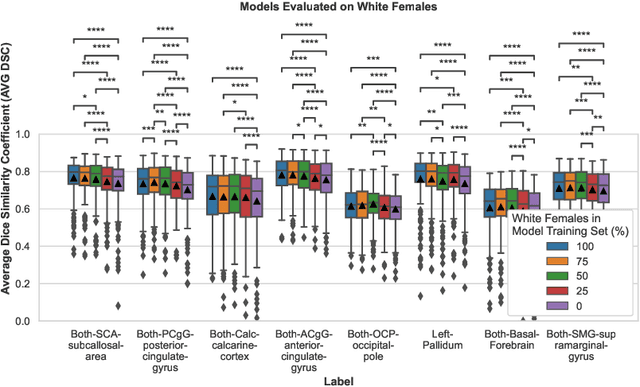
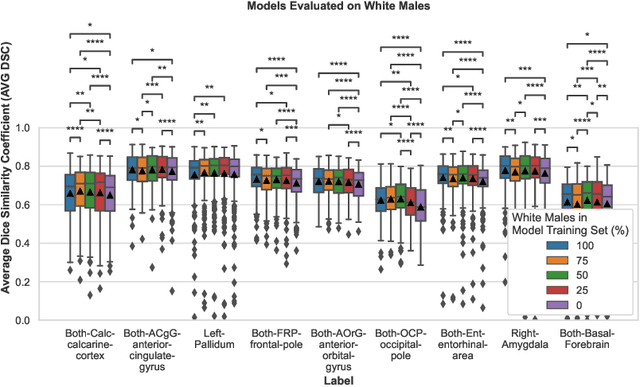
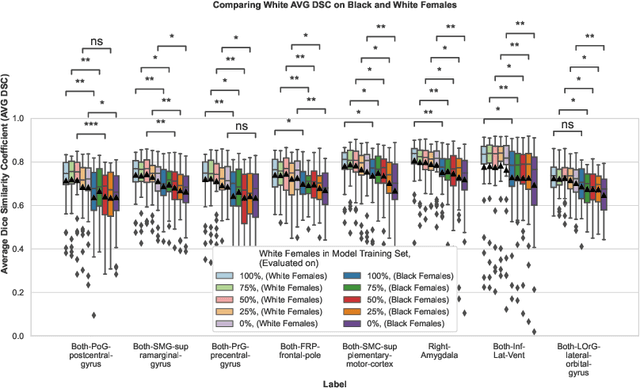
Convolutional neural networks (CNNs) are increasingly being used to automate the segmentation of brain structures in magnetic resonance (MR) images for research studies. In other applications, CNN models have been shown to exhibit bias against certain demographic groups when they are under-represented in the training sets. In this work, we investigate whether CNN models for brain MR segmentation have the potential to contain sex or race bias when trained with imbalanced training sets. We train multiple instances of the FastSurferCNN model using different levels of sex imbalance in white subjects. We evaluate the performance of these models separately for white male and white female test sets to assess sex bias, and furthermore evaluate them on black male and black female test sets to assess potential racial bias. We find significant sex and race bias effects in segmentation model performance. The biases have a strong spatial component, with some brain regions exhibiting much stronger bias than others. Overall, our results suggest that race bias is more significant than sex bias. Our study demonstrates the importance of considering race and sex balance when forming training sets for CNN-based brain MR segmentation, to avoid maintaining or even exacerbating existing health inequalities through biased research study findings.