 Add to Chrome
 Add to Firefox
 Add to Edge
ZRIGF: An Innovative Multimodal Framework for Zero-Resource Image-Grounded Dialogue Generation
Aug 02, 2023
Image-grounded dialogue systems benefit greatly from integrating visual information, resulting in high-quality response generation. However, current models struggle to effectively utilize such information in zero-resource scenarios, mainly due to the disparity between image and text modalities. To overcome this challenge, we propose an innovative multimodal framework, called ZRIGF, which assimilates image-grounded information for dialogue generation in zero-resource situations. ZRIGF implements a two-stage learning strategy, comprising contrastive pre-training and generative pre-training. Contrastive pre-training includes a text-image matching module that maps images and texts into a unified encoded vector space, along with a text-assisted masked image modeling module that preserves pre-training visual features and fosters further multimodal feature alignment. Generative pre-training employs a multimodal fusion module and an information transfer module to produce insightful responses based on harmonized multimodal representations. Comprehensive experiments conducted on both text-based and image-grounded dialogue datasets demonstrate ZRIGF's efficacy in generating contextually pertinent and informative responses. Furthermore, we adopt a fully zero-resource scenario in the image-grounded dialogue dataset to demonstrate our framework's robust generalization capabilities in novel domains. The code is available at https://github.com/zhangbo-nlp/ZRIGF.

A Knowledge-enhanced Two-stage Generative Framework for Medical Dialogue Information Extraction
Jul 30, 2023This paper focuses on term-status pair extraction from medical dialogues (MD-TSPE), which is essential in diagnosis dialogue systems and the automatic scribe of electronic medical records (EMRs). In the past few years, works on MD-TSPE have attracted increasing research attention, especially after the remarkable progress made by generative methods. However, these generative methods output a whole sequence consisting of term-status pairs in one stage and ignore integrating prior knowledge, which demands a deeper understanding to model the relationship between terms and infer the status of each term. This paper presents a knowledge-enhanced two-stage generative framework (KTGF) to address the above challenges. Using task-specific prompts, we employ a single model to complete the MD-TSPE through two phases in a unified generative form: we generate all terms the first and then generate the status of each generated term. In this way, the relationship between terms can be learned more effectively from the sequence containing only terms in the first phase, and our designed knowledge-enhanced prompt in the second phase can leverage the category and status candidates of the generated term for status generation. Furthermore, our proposed special status ``not mentioned" makes more terms available and enriches the training data in the second phase, which is critical in the low-resource setting. The experiments on the Chunyu and CMDD datasets show that the proposed method achieves superior results compared to the state-of-the-art models in the full training and low-resource settings.
Balancing Exploration and Exploitation in Hierarchical Reinforcement Learning via Latent Landmark Graphs
Jul 22, 2023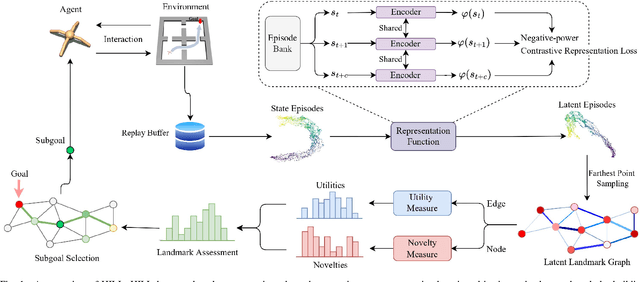
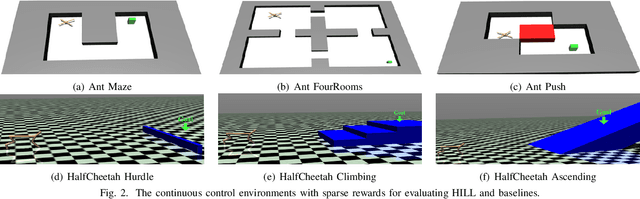
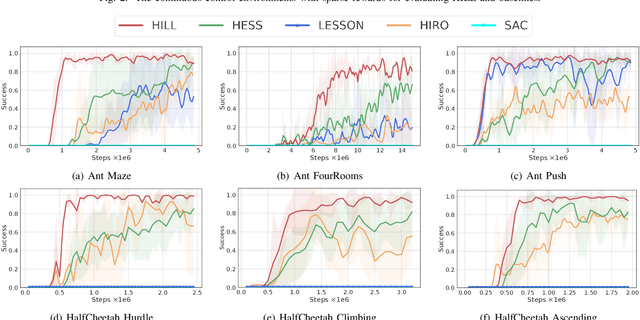
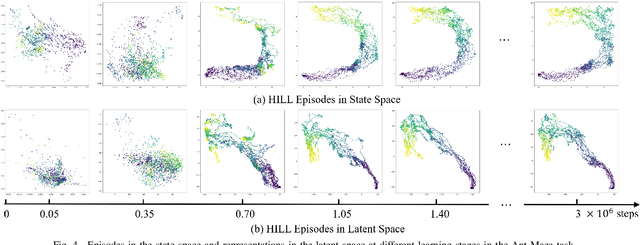
Goal-Conditioned Hierarchical Reinforcement Learning (GCHRL) is a promising paradigm to address the exploration-exploitation dilemma in reinforcement learning. It decomposes the source task into subgoal conditional subtasks and conducts exploration and exploitation in the subgoal space. The effectiveness of GCHRL heavily relies on subgoal representation functions and subgoal selection strategy. However, existing works often overlook the temporal coherence in GCHRL when learning latent subgoal representations and lack an efficient subgoal selection strategy that balances exploration and exploitation. This paper proposes HIerarchical reinforcement learning via dynamically building Latent Landmark graphs (HILL) to overcome these limitations. HILL learns latent subgoal representations that satisfy temporal coherence using a contrastive representation learning objective. Based on these representations, HILL dynamically builds latent landmark graphs and employs a novelty measure on nodes and a utility measure on edges. Finally, HILL develops a subgoal selection strategy that balances exploration and exploitation by jointly considering both measures. Experimental results demonstrate that HILL outperforms state-of-the-art baselines on continuous control tasks with sparse rewards in sample efficiency and asymptotic performance. Our code is available at https://github.com/papercode2022/HILL.
Hate Speech Detection via Dual Contrastive Learning
Jul 10, 2023The fast spread of hate speech on social media impacts the Internet environment and our society by increasing prejudice and hurting people. Detecting hate speech has aroused broad attention in the field of natural language processing. Although hate speech detection has been addressed in recent work, this task still faces two inherent unsolved challenges. The first challenge lies in the complex semantic information conveyed in hate speech, particularly the interference of insulting words in hate speech detection. The second challenge is the imbalanced distribution of hate speech and non-hate speech, which may significantly deteriorate the performance of models. To tackle these challenges, we propose a novel dual contrastive learning (DCL) framework for hate speech detection. Our framework jointly optimizes the self-supervised and the supervised contrastive learning loss for capturing span-level information beyond the token-level emotional semantics used in existing models, particularly detecting speech containing abusive and insulting words. Moreover, we integrate the focal loss into the dual contrastive learning framework to alleviate the problem of data imbalance. We conduct experiments on two publicly available English datasets, and experimental results show that the proposed model outperforms the state-of-the-art models and precisely detects hate speeches.
Machine-Learning-Assisted and Real-Time-Feedback-Controlled Growth of InAs/GaAs Quantum Dots
Jul 07, 2023Self-assembled InAs/GaAs quantum dots (QDs) have properties highly valuable for developing various optoelectronic devices such as QD lasers and single photon sources. The applications strongly rely on the density and quality of these dots, which has motivated studies of the growth process control to realize high-quality epi-wafers and devices. Establishing the process parameters in molecular beam epitaxy (MBE) for a specific density of QDs is a multidimensional optimization challenge, usually addressed through time-consuming and iterative trial-and-error. Here, we report a real-time feedback control method to realize the growth of QDs with arbitrary and precise density, which is fully automated and intelligent. We developed a machine learning (ML) model named 3D ResNet, specially designed for training RHEED videos instead of static images and providing real-time feedback on surface morphologies for process control. As a result, we demonstrated that ML from previous growth could predict the post-growth density of QDs, by successfully tuning the QD densities in near-real time from 1.5E10 cm-2 down to 3.8E8 cm-2 or up to 1.4E11 cm-2. Compared to traditional methods, our approach, with in-situ tuning capabilities and excellent reliability, can dramatically expedite the material optimization process and improve the reproducibility of MBE growth, constituting significant progress for thin film growth techniques. The concepts and methodologies proved feasible in this work are promising to be applied to a variety of material growth processes, which will revolutionize semiconductor manufacturing for microelectronic and optoelectronic industries.
Spike-driven Transformer
Jul 04, 2023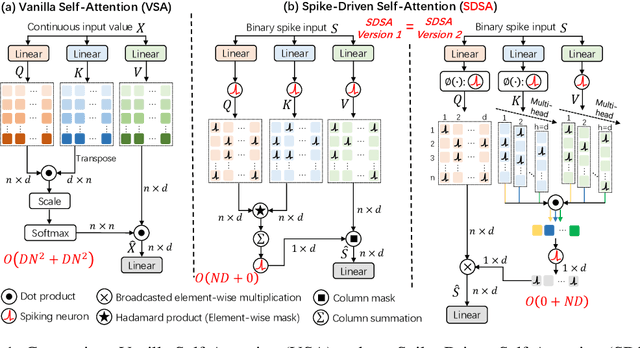
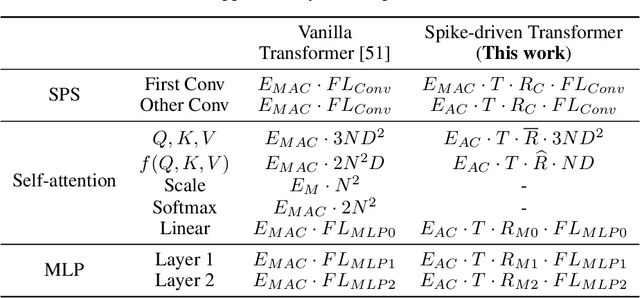
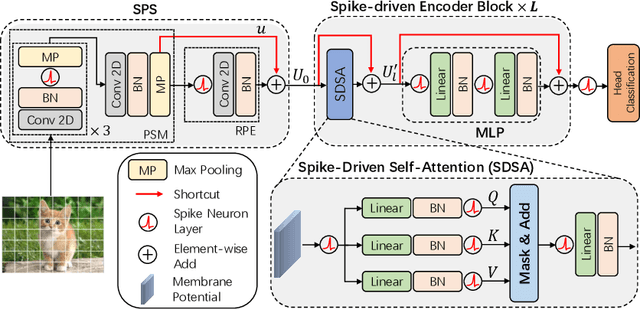
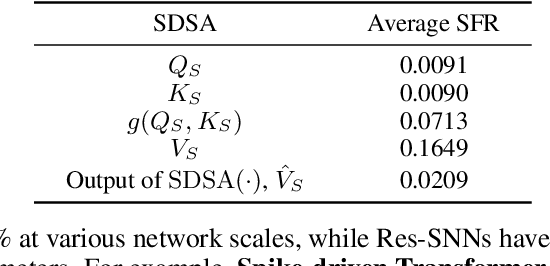
Spiking Neural Networks (SNNs) provide an energy-efficient deep learning option due to their unique spike-based event-driven (i.e., spike-driven) paradigm. In this paper, we incorporate the spike-driven paradigm into Transformer by the proposed Spike-driven Transformer with four unique properties: 1) Event-driven, no calculation is triggered when the input of Transformer is zero; 2) Binary spike communication, all matrix multiplications associated with the spike matrix can be transformed into sparse additions; 3) Self-attention with linear complexity at both token and channel dimensions; 4) The operations between spike-form Query, Key, and Value are mask and addition. Together, there are only sparse addition operations in the Spike-driven Transformer. To this end, we design a novel Spike-Driven Self-Attention (SDSA), which exploits only mask and addition operations without any multiplication, and thus having up to $87.2\times$ lower computation energy than vanilla self-attention. Especially in SDSA, the matrix multiplication between Query, Key, and Value is designed as the mask operation. In addition, we rearrange all residual connections in the vanilla Transformer before the activation functions to ensure that all neurons transmit binary spike signals. It is shown that the Spike-driven Transformer can achieve 77.1\% top-1 accuracy on ImageNet-1K, which is the state-of-the-art result in the SNN field. The source code is available at https://github.com/BICLab/Spike-Driven-Transformer.
StructuredMesh: 3D Structured Optimization of Façade Components on Photogrammetric Mesh Models using Binary Integer Programming
Jun 07, 2023The lack of fa\c{c}ade structures in photogrammetric mesh models renders them inadequate for meeting the demands of intricate applications. Moreover, these mesh models exhibit irregular surfaces with considerable geometric noise and texture quality imperfections, making the restoration of structures challenging. To address these shortcomings, we present StructuredMesh, a novel approach for reconstructing fa\c{c}ade structures conforming to the regularity of buildings within photogrammetric mesh models. Our method involves capturing multi-view color and depth images of the building model using a virtual camera and employing a deep learning object detection pipeline to semi-automatically extract the bounding boxes of fa\c{c}ade components such as windows, doors, and balconies from the color image. We then utilize the depth image to remap these boxes into 3D space, generating an initial fa\c{c}ade layout. Leveraging architectural knowledge, we apply binary integer programming (BIP) to optimize the 3D layout's structure, encompassing the positions, orientations, and sizes of all components. The refined layout subsequently informs fa\c{c}ade modeling through instance replacement. We conducted experiments utilizing building mesh models from three distinct datasets, demonstrating the adaptability, robustness, and noise resistance of our proposed methodology. Furthermore, our 3D layout evaluation metrics reveal that the optimized layout enhances precision, recall, and F-score by 6.5%, 4.5%, and 5.5%, respectively, in comparison to the initial layout.
ViLaS: Integrating Vision and Language into Automatic Speech Recognition
May 31, 2023


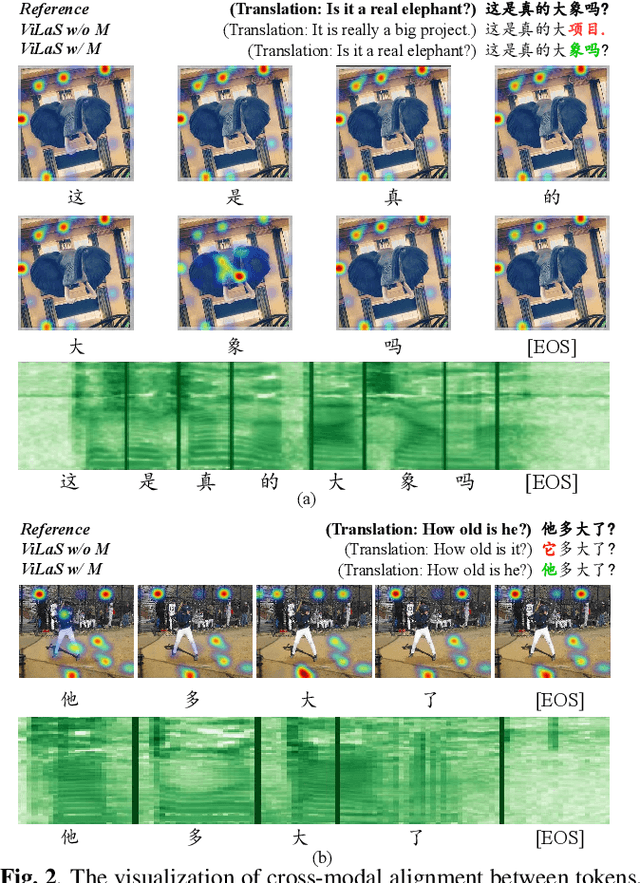
Employing additional multimodal information to improve automatic speech recognition (ASR) performance has been proven effective in previous works. However, many of these works focus only on the utilization of visual cues from human lip motion. In fact, context-dependent visual and linguistic cues can also be used to improve ASR performance in many scenarios. In this paper, we first propose a multimodal ASR model (ViLaS) that can simultaneously or separately integrate visual and linguistic cues to help recognize the input speech, and introduce a training strategy that can improve performance in modal-incomplete test scenarios. Then, we create a multimodal ASR dataset (VSDial) with visual and linguistic cues to explore the effects of integrating vision and language. Finally, we report empirical results on the public Flickr8K and self-constructed VSDial datasets, investigate cross-modal fusion schemes, and analyze fine-grained cross-modal alignment on VSDial.
P-vectors: A Parallel-Coupled TDNN/Transformer Network for Speaker Verification
May 25, 2023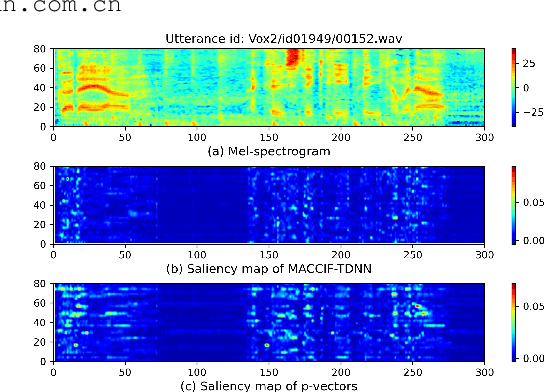

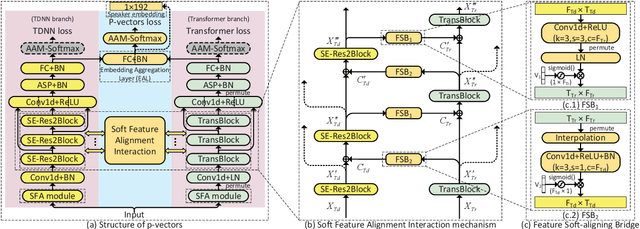
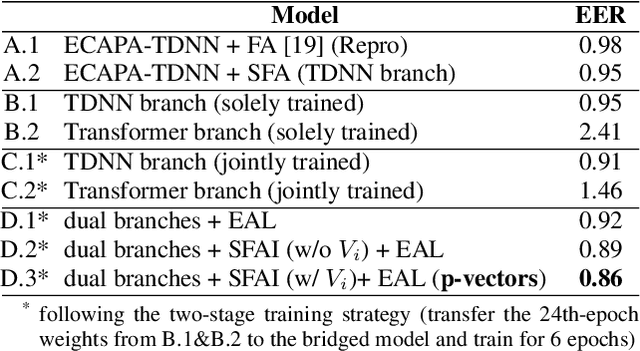
Typically, the Time-Delay Neural Network (TDNN) and Transformer can serve as a backbone for Speaker Verification (SV). Both of them have advantages and disadvantages from the perspective of global and local feature modeling. How to effectively integrate these two style features is still an open issue. In this paper, we explore a Parallel-coupled TDNN/Transformer Network (p-vectors) to replace the serial hybrid networks. The p-vectors allows TDNN and Transformer to learn the complementary information from each other through Soft Feature Alignment Interaction (SFAI) under the premise of preserving local and global features. Also, p-vectors uses the Spatial Frequency-channel Attention (SFA) to enhance the spatial interdependence modeling for input features. Finally, the outputs of dual branches of p-vectors are combined by Embedding Aggregation Layer (EAL). Experiments show that p-vectors outperforms MACCIF-TDNN and MFA-Conformer with relative improvements of 11.5% and 13.9% in EER on VoxCeleb1-O.
Probabilistic Modeling: Proving the Lottery Ticket Hypothesis in Spiking Neural Network
May 20, 2023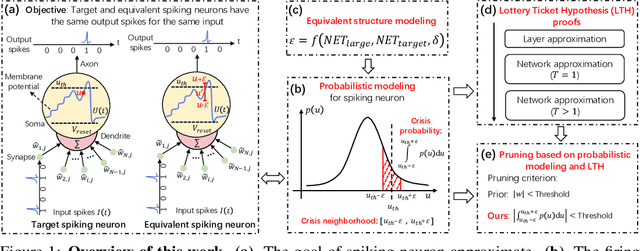

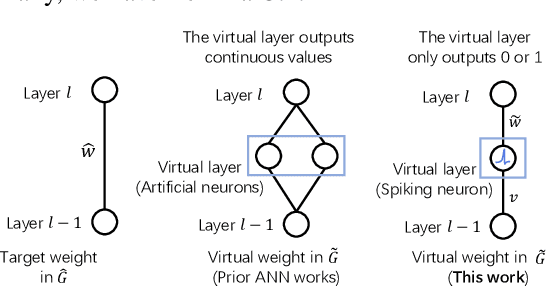

The Lottery Ticket Hypothesis (LTH) states that a randomly-initialized large neural network contains a small sub-network (i.e., winning tickets) which, when trained in isolation, can achieve comparable performance to the large network. LTH opens up a new path for network pruning. Existing proofs of LTH in Artificial Neural Networks (ANNs) are based on continuous activation functions, such as ReLU, which satisfying the Lipschitz condition. However, these theoretical methods are not applicable in Spiking Neural Networks (SNNs) due to the discontinuous of spiking function. We argue that it is possible to extend the scope of LTH by eliminating Lipschitz condition. Specifically, we propose a novel probabilistic modeling approach for spiking neurons with complicated spatio-temporal dynamics. Then we theoretically and experimentally prove that LTH holds in SNNs. According to our theorem, we conclude that pruning directly in accordance with the weight size in existing SNNs is clearly not optimal. We further design a new criterion for pruning based on our theory, which achieves better pruning results than baseline.