 Add to Chrome
 Add to Firefox
 Add to Edge
SeaEvo: Advancing Algorithm Discovery with Strategy Space Evolution
Apr 27, 2026
LLM-guided evolutionary search has emerged as a promising paradigm for automated algorithm discovery, yet most systems track search progress primarily through executable programs and scalar fitness. Even when natural-language reflection is used, it is often used locally in mutation prompts or stored without an explicit population-level organization of strategic directions. As a result, evolutionary search can struggle to distinguish syntactically different implementations of the same idea, preserve lower-fitness but strategically promising directions, or detect when an entire family of strategies has saturated. We introduce \model, a modular strategy-space layer that elevates natural-language strategy descriptions from transient prompt context to first-class population-level evolutionary state in LLM-driven program search. \model augments each candidate program with an explicit natural language strategy description and uses this representation in three ways: Strategy Articulation turns mutation into a diagnose-direct-implement process; Stratified Experience Retrieval organizes the archive into strategy clusters and selects inspirations by behavioral complementarity; and Strategic Landscape Navigation periodically summarizes effective, saturated, and underexplored strategy families to guide future mutations. Across mathematical algorithm discovery, systems optimization, and agent-scaffold benchmarks, \model improves the underlying evolutionary backbones in most settings, with particularly large gains (21% relative improvement) on open-ended system optimization tasks. These results suggest that persistent strategy representations provide a practical mechanism for improving the robustness and efficiency of LLM-guided evolutionary search, suggesting a path toward compound AI systems that accumulate algorithmic knowledge over time.

ClarifyMT-Bench: Benchmarking and Improving Multi-Turn Clarification for Conversational Large Language Models
Dec 24, 2025Large language models (LLMs) are increasingly deployed as conversational assistants in open-domain, multi-turn settings, where users often provide incomplete or ambiguous information. However, existing LLM-focused clarification benchmarks primarily assume single-turn interactions or cooperative users, limiting their ability to evaluate clarification behavior in realistic settings. We introduce \textbf{ClarifyMT-Bench}, a benchmark for multi-turn clarification grounded in a five-dimensional ambiguity taxonomy and a set of six behaviorally diverse simulated user personas. Through a hybrid LLM-human pipeline, we construct 6,120 multi-turn dialogues capturing diverse ambiguity sources and interaction patterns. Evaluating ten representative LLMs uncovers a consistent under-clarification bias: LLMs tend to answer prematurely, and performance degrades as dialogue depth increases. To mitigate this, we propose \textbf{ClarifyAgent}, an agentic approach that decomposes clarification into perception, forecasting, tracking, and planning, substantially improving robustness across ambiguity conditions. ClarifyMT-Bench establishes a reproducible foundation for studying when LLMs should ask, when they should answer, and how to navigate ambiguity in real-world human-LLM interactions.
A Knowledge-enhanced Two-stage Generative Framework for Medical Dialogue Information Extraction
Jul 30, 2023This paper focuses on term-status pair extraction from medical dialogues (MD-TSPE), which is essential in diagnosis dialogue systems and the automatic scribe of electronic medical records (EMRs). In the past few years, works on MD-TSPE have attracted increasing research attention, especially after the remarkable progress made by generative methods. However, these generative methods output a whole sequence consisting of term-status pairs in one stage and ignore integrating prior knowledge, which demands a deeper understanding to model the relationship between terms and infer the status of each term. This paper presents a knowledge-enhanced two-stage generative framework (KTGF) to address the above challenges. Using task-specific prompts, we employ a single model to complete the MD-TSPE through two phases in a unified generative form: we generate all terms the first and then generate the status of each generated term. In this way, the relationship between terms can be learned more effectively from the sequence containing only terms in the first phase, and our designed knowledge-enhanced prompt in the second phase can leverage the category and status candidates of the generated term for status generation. Furthermore, our proposed special status ``not mentioned" makes more terms available and enriches the training data in the second phase, which is critical in the low-resource setting. The experiments on the Chunyu and CMDD datasets show that the proposed method achieves superior results compared to the state-of-the-art models in the full training and low-resource settings.
Matching-based Term Semantics Pre-training for Spoken Patient Query Understanding
Mar 02, 2023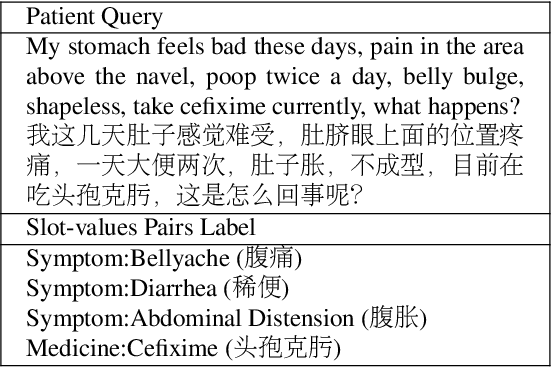
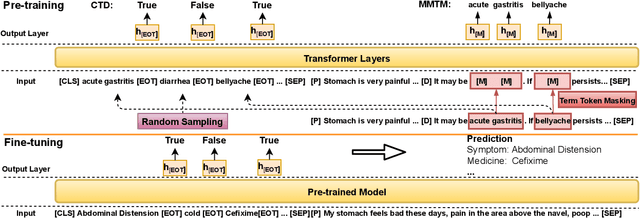
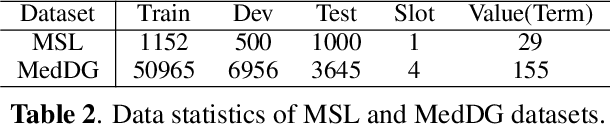
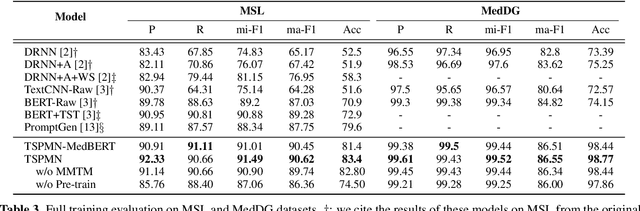
Medical Slot Filling (MSF) task aims to convert medical queries into structured information, playing an essential role in diagnosis dialogue systems. However, the lack of sufficient term semantics learning makes existing approaches hard to capture semantically identical but colloquial expressions of terms in medical conversations. In this work, we formalize MSF into a matching problem and propose a Term Semantics Pre-trained Matching Network (TSPMN) that takes both terms and queries as input to model their semantic interaction. To learn term semantics better, we further design two self-supervised objectives, including Contrastive Term Discrimination (CTD) and Matching-based Mask Term Modeling (MMTM). CTD determines whether it is the masked term in the dialogue for each given term, while MMTM directly predicts the masked ones. Experimental results on two Chinese benchmarks show that TSPMN outperforms strong baselines, especially in few-shot settings.