 Add to Chrome
 Add to Firefox
 Add to Edge
AIR-Bench: Automated Heterogeneous Information Retrieval Benchmark
Dec 17, 2024
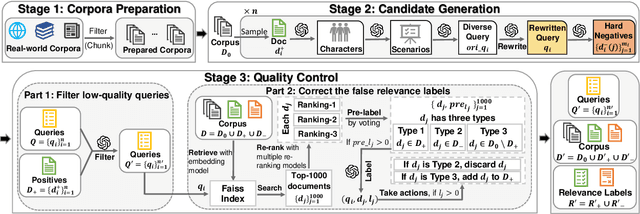

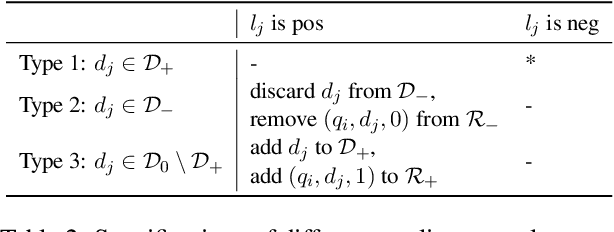

Evaluation plays a crucial role in the advancement of information retrieval (IR) models. However, current benchmarks, which are based on predefined domains and human-labeled data, face limitations in addressing evaluation needs for emerging domains both cost-effectively and efficiently. To address this challenge, we propose the Automated Heterogeneous Information Retrieval Benchmark (AIR-Bench). AIR-Bench is distinguished by three key features: 1) Automated. The testing data in AIR-Bench is automatically generated by large language models (LLMs) without human intervention. 2) Heterogeneous. The testing data in AIR-Bench is generated with respect to diverse tasks, domains and languages. 3) Dynamic. The domains and languages covered by AIR-Bench are constantly augmented to provide an increasingly comprehensive evaluation benchmark for community developers. We develop a reliable and robust data generation pipeline to automatically create diverse and high-quality evaluation datasets based on real-world corpora. Our findings demonstrate that the generated testing data in AIR-Bench aligns well with human-labeled testing data, making AIR-Bench a dependable benchmark for evaluating IR models. The resources in AIR-Bench are publicly available at https://github.com/AIR-Bench/AIR-Bench.

Text-Video Multi-Grained Integration for Video Moment Montage
Dec 12, 2024The proliferation of online short video platforms has driven a surge in user demand for short video editing. However, manually selecting, cropping, and assembling raw footage into a coherent, high-quality video remains laborious and time-consuming. To accelerate this process, we focus on a user-friendly new task called Video Moment Montage (VMM), which aims to accurately locate the corresponding video segments based on a pre-provided narration text and then arrange these video clips to create a complete video that aligns with the corresponding descriptions. The challenge lies in extracting precise temporal segments while ensuring intra-sentence and inter-sentence context consistency, as a single script sentence may require trimming and assembling multiple video clips. To address this problem, we present a novel \textit{Text-Video Multi-Grained Integration} method (TV-MGI) that efficiently fuses text features from the script with both shot-level and frame-level video features, which enables the global and fine-grained alignment between the video content and the corresponding textual descriptions in the script. To facilitate further research in this area, we introduce the Multiple Sentences with Shots Dataset (MSSD), a large-scale dataset designed explicitly for the VMM task. We conduct extensive experiments on the MSSD dataset to demonstrate the effectiveness of our framework compared to baseline methods.
jina-clip-v2: Multilingual Multimodal Embeddings for Text and Images
Dec 11, 2024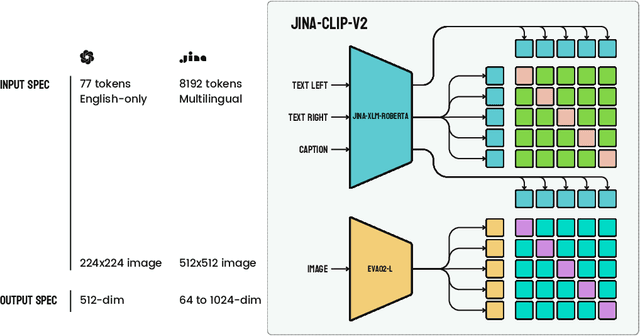
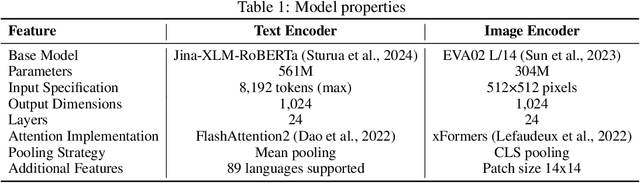
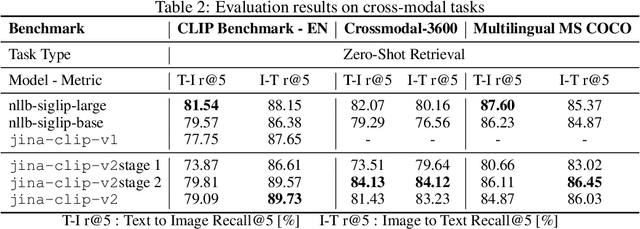
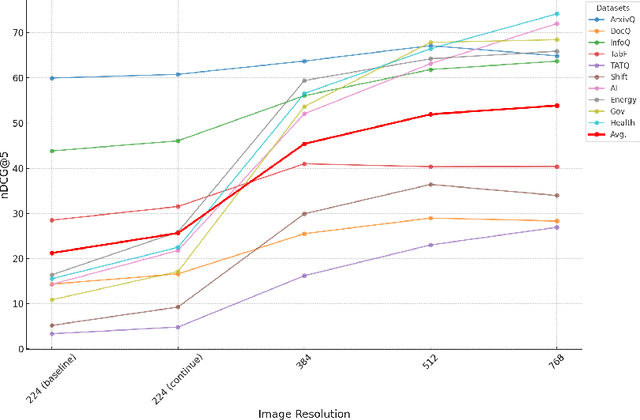
Contrastive Language-Image Pretraining (CLIP) is a highly effective method for aligning images and texts in a shared embedding space. These models are widely used for tasks such as cross-modal information retrieval and multi-modal understanding. However, CLIP models often struggle with text-only tasks, underperforming compared to specialized text models. This performance disparity forces retrieval systems to rely on separate models for text-only and multi-modal tasks. In this work, we build upon our previous model, jina-clip-v1, by introducing a refined framework that utilizes multi-task, multi-stage contrastive learning across multiple languages, coupled with an improved training recipe to enhance text-only retrieval. The resulting model, jina-clip-v2, outperforms its predecessor on text-only and multimodal tasks, while adding multilingual support, better understanding of complex visual documents and efficiency gains thanks to Matryoshka Representation Learning and vector truncation. The model performs comparably to the state-of-the-art in both multilingual-multimodal and multilingual text retrieval benchmarks, addressing the challenge of unifying text-only and multi-modal retrieval systems.
Semantic Scene Completion Based 3D Traversability Estimation for Off-Road Terrains
Dec 11, 2024Off-road environments present significant challenges for autonomous ground vehicles due to the absence of structured roads and the presence of complex obstacles, such as uneven terrain, vegetation, and occlusions. Traditional perception algorithms, designed primarily for structured environments, often fail under these conditions, leading to inaccurate traversability estimations. In this paper, ORDformer, a novel multimodal method that combines LiDAR point clouds with monocular images, is proposed to generate dense traversable occupancy predictions from a forward-facing perspective. By integrating multimodal data, environmental feature extraction is enhanced, which is crucial for accurate occupancy estimation in complex terrains. Furthermore, RELLIS-OCC, a dataset with 3D traversable occupancy annotations, is introduced, incorporating geometric features such as step height, slope, and unevenness. Through a comprehensive analysis of vehicle obstacle-crossing conditions and the incorporation of vehicle body structure constraints, four traversability cost labels are generated: lethal, medium-cost, low-cost, and free. Experimental results demonstrate that ORDformer outperforms existing approaches in 3D traversable area recognition, particularly in off-road environments with irregular geometries and partial occlusions. Specifically, ORDformer achieves over a 20\% improvement in scene completion IoU compared to other models. The proposed framework is scalable and adaptable to various vehicle platforms, allowing for adjustments to occupancy grid parameters and the integration of advanced dynamic models for traversability cost estimation.
Expanding Performance Boundaries of Open-Source Multimodal Models with Model, Data, and Test-Time Scaling
Dec 06, 2024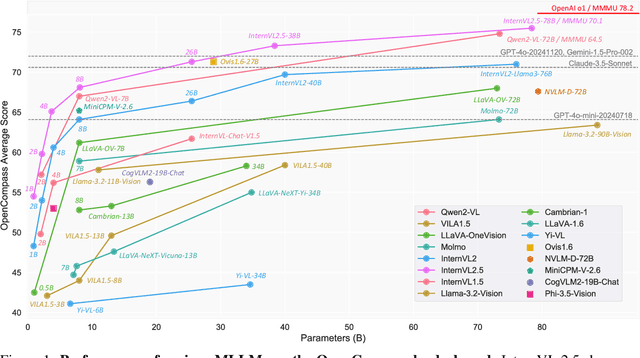

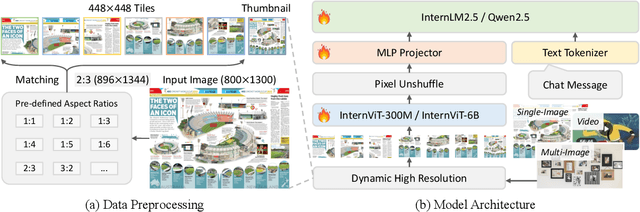

We introduce InternVL 2.5, an advanced multimodal large language model (MLLM) series that builds upon InternVL 2.0, maintaining its core model architecture while introducing significant enhancements in training and testing strategies as well as data quality. In this work, we delve into the relationship between model scaling and performance, systematically exploring the performance trends in vision encoders, language models, dataset sizes, and test-time configurations. Through extensive evaluations on a wide range of benchmarks, including multi-discipline reasoning, document understanding, multi-image / video understanding, real-world comprehension, multimodal hallucination detection, visual grounding, multilingual capabilities, and pure language processing, InternVL 2.5 exhibits competitive performance, rivaling leading commercial models such as GPT-4o and Claude-3.5-Sonnet. Notably, our model is the first open-source MLLMs to surpass 70% on the MMMU benchmark, achieving a 3.7-point improvement through Chain-of-Thought (CoT) reasoning and showcasing strong potential for test-time scaling. We hope this model contributes to the open-source community by setting new standards for developing and applying multimodal AI systems. HuggingFace demo see https://huggingface.co/spaces/OpenGVLab/InternVL
Enhancing Instruction-Following Capability of Visual-Language Models by Reducing Image Redundancy
Nov 23, 2024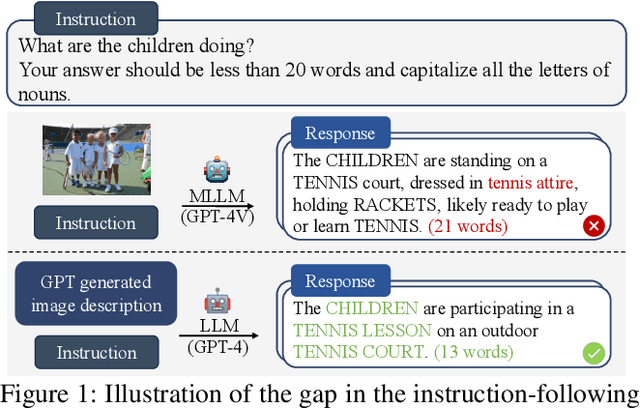
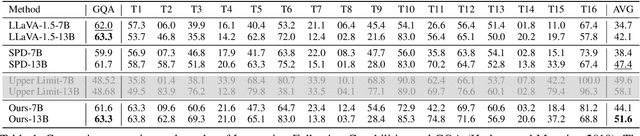
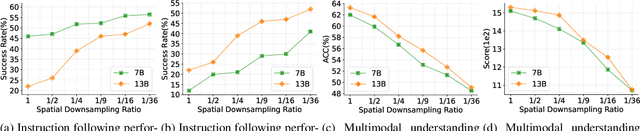
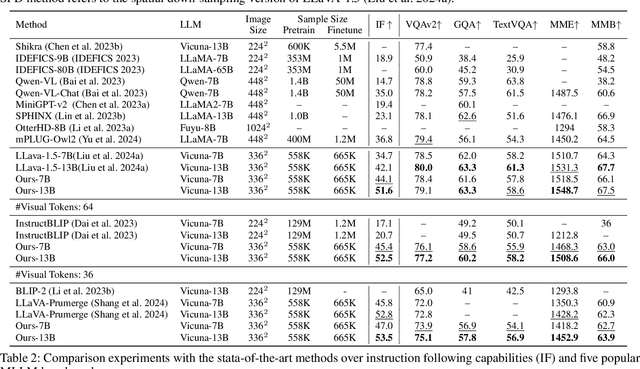
Large Language Models (LLMs) have strong instruction-following capability to interpret and execute tasks as directed by human commands. Multimodal Large Language Models (MLLMs) have inferior instruction-following ability compared to LLMs. However, there is a significant gap in the instruction-following capabilities between the MLLMs and LLMs. In this study, we conduct a pilot experiment, which demonstrates that spatially down-sampling visual tokens significantly enhances the instruction-following capability of MLLMs. This is attributed to the substantial redundancy in visual modality. However, this intuitive method severely impairs the MLLM's multimodal understanding capability. In this paper, we propose Visual-Modality Token Compression (VMTC) and Cross-Modality Attention Inhibition (CMAI) strategies to alleviate this gap between MLLMs and LLMs by inhibiting the influence of irrelevant visual tokens during content generation, increasing the instruction-following ability of the MLLMs while retaining their multimodal understanding capacity. In VMTC module, the primary tokens are retained and the redundant tokens are condensed by token clustering and merging. In CMAI process, we aggregate text-to-image attentions by text-to-text attentions to obtain a text-to-image focus score. Attention inhibition is performed on the text-image token pairs with low scores. Our comprehensive experiments over instruction-following capabilities and VQA-V2, GQA, TextVQA, MME and MMBench five benchmarks, demonstrate that proposed strategy significantly enhances the instruction following capability of MLLMs while preserving the ability to understand and process multimodal inputs.
Gazing at Rewards: Eye Movements as a Lens into Human and AI Decision-Making in Hybrid Visual Foraging
Nov 14, 2024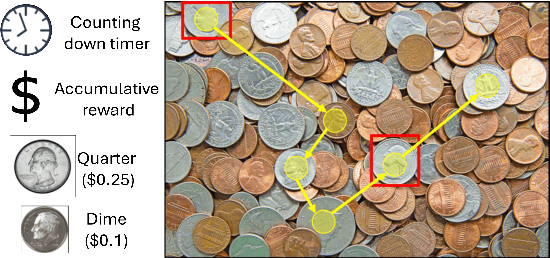


Imagine searching a collection of coins for quarters ($0.25$), dimes ($0.10$), nickels ($0.05$), and pennies ($0.01$)-a hybrid foraging task where observers look for multiple instances of multiple target types. In such tasks, how do target values and their prevalence influence foraging and eye movement behaviors (e.g., should you prioritize rare quarters or common nickels)? To explore this, we conducted human psychophysics experiments, revealing that humans are proficient reward foragers. Their eye fixations are drawn to regions with higher average rewards, fixation durations are longer on more valuable targets, and their cumulative rewards exceed chance, approaching the upper bound of optimal foragers. To probe these decision-making processes of humans, we developed a transformer-based Visual Forager (VF) model trained via reinforcement learning. Our VF model takes a series of targets, their corresponding values, and the search image as inputs, processes the images using foveated vision, and produces a sequence of eye movements along with decisions on whether to collect each fixated item. Our model outperforms all baselines, achieves cumulative rewards comparable to those of humans, and approximates human foraging behavior in eye movements and foraging biases within time-limited environments. Furthermore, stress tests on out-of-distribution tasks with novel targets, unseen values, and varying set sizes demonstrate the VF model's effective generalization. Our work offers valuable insights into the relationship between eye movements and decision-making, with our model serving as a powerful tool for further exploration of this connection. All data, code, and models will be made publicly available.
Hunyuan-Large: An Open-Source MoE Model with 52 Billion Activated Parameters by Tencent
Nov 05, 2024


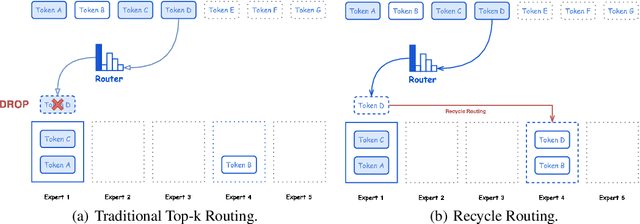
In this paper, we introduce Hunyuan-Large, which is currently the largest open-source Transformer-based mixture of experts model, with a total of 389 billion parameters and 52 billion activation parameters, capable of handling up to 256K tokens. We conduct a thorough evaluation of Hunyuan-Large's superior performance across various benchmarks including language understanding and generation, logical reasoning, mathematical problem-solving, coding, long-context, and aggregated tasks, where it outperforms LLama3.1-70B and exhibits comparable performance when compared to the significantly larger LLama3.1-405B model. Key practice of Hunyuan-Large include large-scale synthetic data that is orders larger than in previous literature, a mixed expert routing strategy, a key-value cache compression technique, and an expert-specific learning rate strategy. Additionally, we also investigate the scaling laws and learning rate schedule of mixture of experts models, providing valuable insights and guidances for future model development and optimization. The code and checkpoints of Hunyuan-Large are released to facilitate future innovations and applications. Codes: https://github.com/Tencent/Hunyuan-Large Models: https://huggingface.co/tencent/Tencent-Hunyuan-Large
EZ-HOI: VLM Adaptation via Guided Prompt Learning for Zero-Shot HOI Detection
Oct 31, 2024


Detecting Human-Object Interactions (HOI) in zero-shot settings, where models must handle unseen classes, poses significant challenges. Existing methods that rely on aligning visual encoders with large Vision-Language Models (VLMs) to tap into the extensive knowledge of VLMs, require large, computationally expensive models and encounter training difficulties. Adapting VLMs with prompt learning offers an alternative to direct alignment. However, fine-tuning on task-specific datasets often leads to overfitting to seen classes and suboptimal performance on unseen classes, due to the absence of unseen class labels. To address these challenges, we introduce a novel prompt learning-based framework for Efficient Zero-Shot HOI detection (EZ-HOI). First, we introduce Large Language Model (LLM) and VLM guidance for learnable prompts, integrating detailed HOI descriptions and visual semantics to adapt VLMs to HOI tasks. However, because training datasets contain seen-class labels alone, fine-tuning VLMs on such datasets tends to optimize learnable prompts for seen classes instead of unseen ones. Therefore, we design prompt learning for unseen classes using information from related seen classes, with LLMs utilized to highlight the differences between unseen and related seen classes. Quantitative evaluations on benchmark datasets demonstrate that our EZ-HOI achieves state-of-the-art performance across various zero-shot settings with only 10.35% to 33.95% of the trainable parameters compared to existing methods. Code is available at https://github.com/ChelsieLei/EZ-HOI.
BitStack: Fine-Grained Size Control for Compressed Large Language Models in Variable Memory Environments
Oct 31, 2024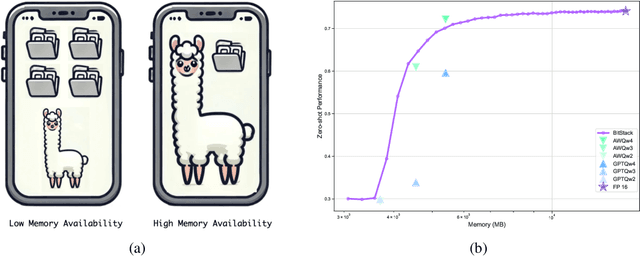
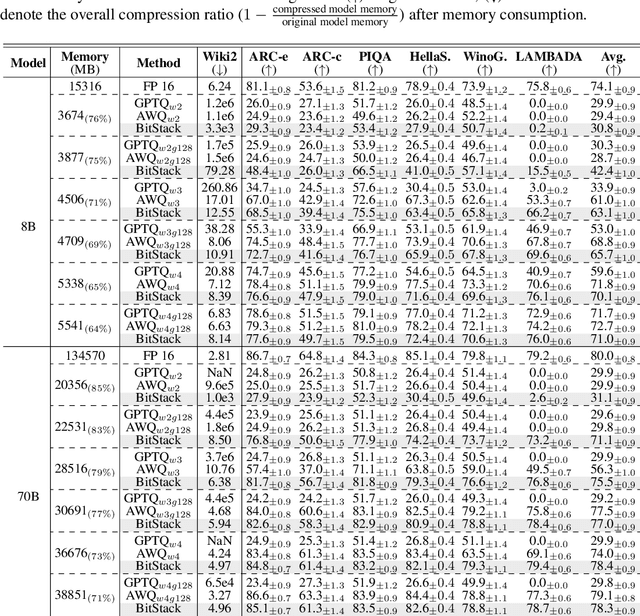
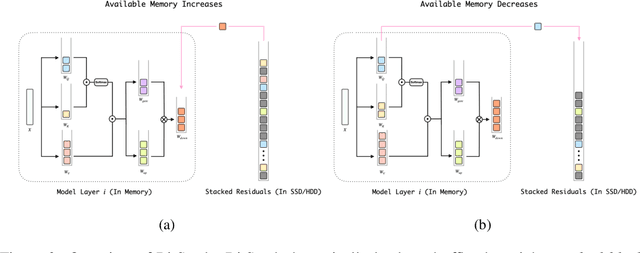
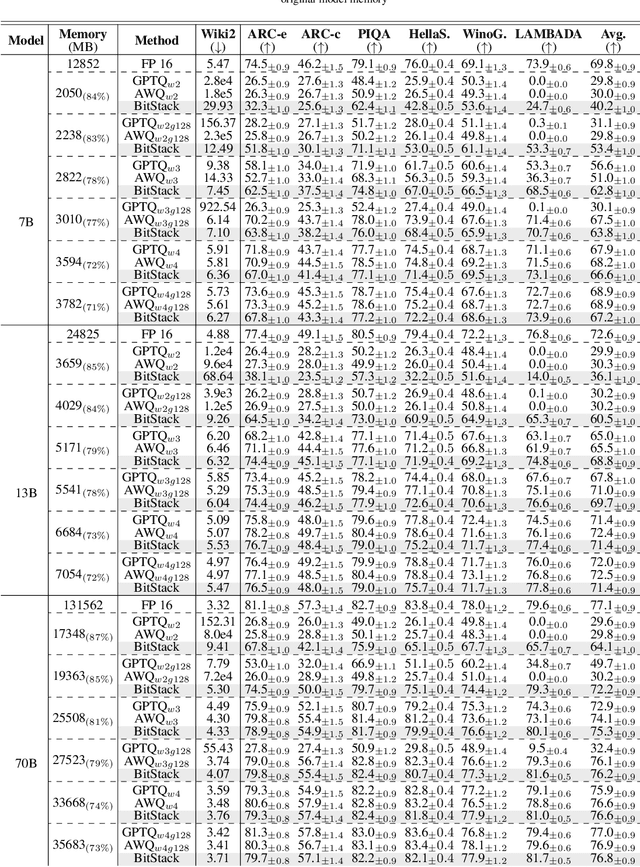
Large language models (LLMs) have revolutionized numerous applications, yet their deployment remains challenged by memory constraints on local devices. While scaling laws have enhanced LLM capabilities, the primary bottleneck has shifted from \textit{capability} to \textit{availability}, emphasizing the need for efficient memory management. Traditional compression methods, such as quantization, often require predefined compression ratios and separate compression processes for each setting, complicating deployment in variable memory environments. In this paper, we introduce \textbf{BitStack}, a novel, training-free weight compression approach that enables megabyte-level trade-offs between memory usage and model performance. By leveraging weight decomposition, BitStack can dynamically adjust the model size with minimal transmission between running memory and storage devices. Our approach iteratively decomposes weight matrices while considering the significance of each parameter, resulting in an approximately 1-bit per parameter residual block in each decomposition iteration. These blocks are sorted and stacked in storage as basic transmission units, with different quantities loaded based on current memory availability. Extensive experiments across a wide range of tasks demonstrate that, despite offering fine-grained size control, BitStack consistently matches or surpasses strong quantization baselines, particularly at extreme compression ratios. To the best of our knowledge, this is the first decomposition-based method that effectively bridges the gap to practical compression techniques like quantization. Code is available at https://github.com/xinghaow99/BitStack.