 Add to Chrome
 Add to Firefox
 Add to Edge
AutoResearchBench: Benchmarking AI Agents on Complex Scientific Literature Discovery
Apr 28, 2026
Autonomous scientific research is significantly advanced thanks to the development of AI agents. One key step in this process is finding the right scientific literature, whether to explore existing knowledge for a research problem, or to acquire evidence for verifying assumptions and supporting claims. To assess AI agents' capability in driving this process, we present AutoResearchBench, a dedicated benchmark for autonomous scientific literature discovery. AutoResearchBench consists of two complementary task types: (1) Deep Research, which requires tracking down a specific target paper through a progressive, multi-step probing process, and (2) Wide Research, which requires comprehensively collecting a set of papers satisfying given conditions. Compared to previous benchmarks on agentic web browsing, AutoResearchBench is distinguished along three dimensions: it is research-oriented, calling for in-depth comprehension of scientific concepts; literature-focused, demanding fine-grained utilization of detailed information; and open-ended, involving an unknown number of qualified papers and thus requiring deliberate reasoning and search throughout. These properties make AutoResearchBench uniquely suited for evaluating autonomous research capabilities, and extraordinarily challenging. Even the most powerful LLMs, despite having largely conquered general agentic web-browsing benchmarks such as BrowseComp, achieve only 9.39% accuracy on Deep Research and 9.31% IoU on Wide Research, while many other strong baselines fall below 5%. We publicly release the dataset and evaluation pipeline to facilitate future research in this direction. We publicly release the dataset, evaluation pipeline, and code at https://github.com/CherYou/AutoResearchBench.

CMedTEB & CARE: Benchmarking and Enabling Efficient Chinese Medical Retrieval via Asymmetric Encoders
Apr 13, 2026Effective medical text retrieval requires both high accuracy and low latency. While LLM-based embedding models possess powerful retrieval capabilities, their prohibitive latency and high computational cost limit their application in real-time scenarios. Furthermore, the lack of comprehensive and high-fidelity benchmarks hinders progress in Chinese medical text retrieval. In this work, we introduce the Chinese Medical Text Embedding Benchmark (CMedTEB), a benchmark spanning three kinds of practical embedding tasks: retrieval, reranking, and semantic textual similarity (STS). Distinct from purely automated datasets, CMedTEB is curated via a rigorous multi-LLM voting pipeline validated by clinical experts, ensuring gold-standard label quality while effectively mitigating annotation noise. On this foundation, we propose the Chinese Medical Asymmetric REtriever (CARE), an asymmetric architecture that pairs a lightweight BERT-style encoder for online query encoding with a powerful LLM-based encoder for offline document encoding. However, optimizing such an asymmetric retriever with two structurally different encoders presents distinctive challenges. To address this, we introduce a novel two-stage training strategy that progressively bridges the query and document representations. Extensive experiments demonstrate that CARE surpasses state-of-the-art symmetric models on CMedTEB, achieving superior retrieval performance without increasing inference latency.
Towards A Generalist Code Embedding Model Based On Massive Data Synthesis
May 19, 2025Code embedding models attract increasing attention due to the widespread popularity of retrieval-augmented generation (RAG) in software development. These models are expected to capture the rich semantic relationships inherent to code, which differ significantly from those found in text. However, existing models remain severely limited due to the scarcity of high-quality training data. In this work, we introduce \textbf{CodeR} (\underline{Code} \underline{R}etrieval), a state-of-the-art embedding model for general-purpose code retrieval. The superior performance of CodeR is built upon CodeR-Pile, a large-scale synthetic dataset constructed under the DRU (Diversity, Reliability, Usability) principle via a novel data synthesis pipeline. To optimize training effectiveness, we propose Annealing, a curriculum learning strategy that enables effective knowledge transfer across heterogeneous sources of data. We evaluate CodeR based on 16 diverse code retrieval tasks, where it significantly outperforms existing baselines and exhibits strong out-of-domain generalization performance. We have publicly released our code and the well-trained model to facilitate further research in this critical area. https://github.com/FlagOpen/FlagEmbedding/tree/master/research/BGE_Coder.
AIR-Bench: Automated Heterogeneous Information Retrieval Benchmark
Dec 17, 2024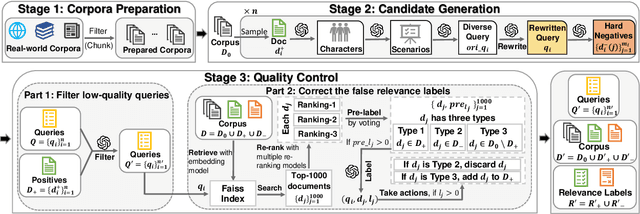

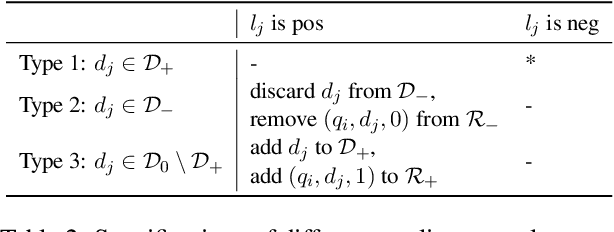

Evaluation plays a crucial role in the advancement of information retrieval (IR) models. However, current benchmarks, which are based on predefined domains and human-labeled data, face limitations in addressing evaluation needs for emerging domains both cost-effectively and efficiently. To address this challenge, we propose the Automated Heterogeneous Information Retrieval Benchmark (AIR-Bench). AIR-Bench is distinguished by three key features: 1) Automated. The testing data in AIR-Bench is automatically generated by large language models (LLMs) without human intervention. 2) Heterogeneous. The testing data in AIR-Bench is generated with respect to diverse tasks, domains and languages. 3) Dynamic. The domains and languages covered by AIR-Bench are constantly augmented to provide an increasingly comprehensive evaluation benchmark for community developers. We develop a reliable and robust data generation pipeline to automatically create diverse and high-quality evaluation datasets based on real-world corpora. Our findings demonstrate that the generated testing data in AIR-Bench aligns well with human-labeled testing data, making AIR-Bench a dependable benchmark for evaluating IR models. The resources in AIR-Bench are publicly available at https://github.com/AIR-Bench/AIR-Bench.