 Add to Chrome
 Add to Firefox
 Add to Edge
Self-Supervised Skill Optimization
Jul 30, 2026
Agent skills provide frozen large language model (LLM) agents with reusable procedural guidance, and recent work shows that such skills can be optimized with ground-truth (GT) feedback. Many applications, however, lack GT labels, task scores, rewards, or reliable task-specific evaluators. We therefore introduce Self-Supervised Skill Optimization (SSO), a comparative framework that learns a reusable skill from unlabeled task instances alone. At each step, SSO runs the current skill on an unlabeled batch, uses a subset of the resulting executions to generate complete skill probes, and runs the probes on the same batch. An LLM judge compares the resulting answers, trajectories, artifacts, or terminal states. A separate behavior extractor identifies behavioral differences without seeing the judge's decisions. SSO uses these decisions to aggregate evidence for and against the observed behaviors across instances. It then ranks the behaviors by the resulting evidence and renders a new complete skill from the highest-ranked behaviors. The update is accepted only if the new skill outperforms the current one on an unlabeled validation set. SSO outperforms existing GT-free prompt optimizers on both closed-ended and open-ended tasks. On closed-ended benchmarks, it approaches and sometimes exceeds the strongest GT-based skill optimizer without using any GT feedback.

Private Face Recognition Training Dataset Publication via Identity-Decoupled and Geometry-Preserving Face Distillation
Jul 30, 2026Publishing private face recognition~(FR) training datasets is privacy-sensitive because faces expose identity information. Private FR training dataset publication mitigates this risk by releasing protected proxies as substitutes for private training faces. However, training FR models with such data introduces an identity paradox: \emph{the identity cues that make released faces useful for recognition supervision are also the cues that make them linkable to real individuals.} A protected face should be decoupled from the original identity, yet still behave as a reliable identity sample for training. Removing these cues too aggressively may destroy the class structure needed for recognition learning, whereas preserving them too faithfully may increase source-identity linkability. We argue that this paradox stems from conflating source-aligned identity semantics with recognition-useful proxy identity geometry. The former should be suppressed to reduce linkage to private individuals, while the latter should be preserved for FR learning. Based on this insight, we propose \textbf{Private Face Distillation}, an identity-decoupling and geometry-preserving framework. It uses Orthogonal Geometry Preservation to construct decoupled proxy identities from private identity representations while maintaining hyperspherical geometry, and Relational Topology Alignment to preserve identity relations for recognition learning. Experiments across multiple domain-shifted FR scenarios show that Private Face Distillation achieves stronger utility than the evaluated publication baselines. On IJB-C surveillance, it improves $\mathrm{TAR}@\mathrm{FAR}{=}1\text{e-}{3}$ by 3.94\% over the baseline while reducing source-identity linkability. These results suggest that private FR training dataset publication should decouple source-identity correspondence while preserving proxy identity geometry.
Knowing You at First Glance: Inferring Apparent Personality from Faces
Jul 16, 2026Inferring apparent personality from facial images is important in social scenarios for embodied agents in human-robot interaction. Unlike inferring intrinsic personality traits via conversation, this task models first-impression personality perception based solely on facial appearance before interaction begins. Existing studies mainly focus on the Big Five personality model and often rely on language or multimodal inputs. As a result, it remains unclear whether facial cues alone can support meaningful associations with perceived personality traits. This question is particularly relevant for MBTI types, which are widely used in practice and more readily interpretable by large language models. To this end, we propose \textbf{GlanceFace}, an end-to-end framework for apparent personality inference leveraging vision-language models to introduce semantic priors and a semantic-enhanced facial representation module to capture subtle personality-related cues, together with an uncertainty-aware learning strategy to handle noisy and subjective annotations. Extensive experiments demonstrate strong performance on MBTI-based apparent personality benchmarks and reveal relationships between facial characteristics and perceived personality traits, highlighting its potential to support adaptive initial interaction strategies for embodied agents. The code and dataset are available at https://github.com/MrHuan3/GlanceFace.
Direct Discrepancy Replay: Distribution-Discrepancy Condensation and Manifold-Consistent Replay for Continual Face Forgery Detection
Apr 14, 2026Continual face forgery detection (CFFD) requires detectors to learn emerging forgery paradigms without forgetting previously seen manipulations. Existing CFFD methods commonly rely on replaying a small amount of past data to mitigate forgetting. Such replay is typically implemented either by storing a few historical samples or by synthesizing pseudo-forgeries from detector-dependent perturbations. Under strict memory budgets, the former cannot adequately cover diverse forgery cues and may expose facial identities, while the latter remains strongly tied to past decision boundaries. We argue that the core role of replay in CFFD is to reinstate the distributions of previous forgery tasks during subsequent training. To this end, we directly condense the discrepancy between real and fake distributions and leverage real faces from the current stage to perform distribution-level replay. Specifically, we introduce Distribution-Discrepancy Condensation (DDC), which models the real-to-fake discrepancy via a surrogate factorization in characteristic-function space and condenses it into a tiny bank of distribution discrepancy maps. We further propose Manifold-Consistent Replay (MCR), which synthesizes replay samples through variance-preserving composition of these maps with current-stage real faces, yielding samples that reflect previous-task forgery cues while remaining compatible with current real-face statistics. Operating under an extremely small memory budget and without directly storing raw historical face images, our framework consistently outperforms prior CFFD baselines and significantly mitigates catastrophic forgetting. Replay-level privacy analysis further suggests reduced identity leakage risk relative to selection-based replay.
One Ring to Rule Them All: Unifying Group-Based RL via Dynamic Power-Mean Geometry
Jan 30, 2026Group-based reinforcement learning has evolved from the arithmetic mean of GRPO to the geometric mean of GMPO. While GMPO improves stability by constraining a conservative objective, it shares a fundamental limitation with GRPO: reliance on a fixed aggregation geometry that ignores the evolving and heterogeneous nature of each trajectory. In this work, we unify these approaches under Power-Mean Policy Optimization (PMPO), a generalized framework that parameterizes the aggregation geometry via the power-mean geometry exponent p. Within this framework, GRPO and GMPO are recovered as special cases. Theoretically, we demonstrate that adjusting p modulates the concentration of gradient updates, effectively reweighting tokens based on their advantage contribution. To determine p adaptively, we introduce a Clip-aware Effective Sample Size (ESS) mechanism. Specifically, we propose a deterministic rule that maps a trajectory clipping fraction to a target ESS. Then, we solve for the specific p to align the trajectory induced ESS with this target one. This allows PMPO to dynamically transition between the aggressive arithmetic mean for reliable trajectories and the conservative geometric mean for unstable ones. Experiments on multiple mathematical reasoning benchmarks demonstrate that PMPO outperforms strong baselines.
UPA: Unsupervised Prompt Agent via Tree-Based Search and Selection
Jan 30, 2026Prompt agents have recently emerged as a promising paradigm for automated prompt optimization, framing refinement as a sequential decision-making problem over a structured prompt space. While this formulation enables the use of advanced planning algorithms, these methods typically assume access to supervised reward signals, which are often unavailable in practical scenarios. In this work, we propose UPA, an Unsupervised Prompt Agent that realizes structured search and selection without relying on supervised feedback. Specifically, during search, UPA iteratively constructs an evolving tree structure to navigate the prompt space, guided by fine-grained and order-invariant pairwise comparisons from Large Language Models (LLMs). Crucially, as these local comparisons do not inherently yield a consistent global scale, we decouple systematic prompt exploration from final selection, introducing a two-stage framework grounded in the Bradley-Terry-Luce (BTL) model. This framework first performs path-wise Bayesian aggregation of local comparisons to filter candidates under uncertainty, followed by global tournament-style comparisons to infer latent prompt quality and identify the optimal prompt. Experiments across multiple tasks demonstrate that UPA consistently outperforms existing prompt optimization methods, showing that agent-style optimization remains highly effective even in fully unsupervised settings.
Second FRCSyn-onGoing: Winning Solutions and Post-Challenge Analysis to Improve Face Recognition with Synthetic Data
Dec 02, 2024Synthetic data is gaining increasing popularity for face recognition technologies, mainly due to the privacy concerns and challenges associated with obtaining real data, including diverse scenarios, quality, and demographic groups, among others. It also offers some advantages over real data, such as the large amount of data that can be generated or the ability to customize it to adapt to specific problem-solving needs. To effectively use such data, face recognition models should also be specifically designed to exploit synthetic data to its fullest potential. In order to promote the proposal of novel Generative AI methods and synthetic data, and investigate the application of synthetic data to better train face recognition systems, we introduce the 2nd FRCSyn-onGoing challenge, based on the 2nd Face Recognition Challenge in the Era of Synthetic Data (FRCSyn), originally launched at CVPR 2024. This is an ongoing challenge that provides researchers with an accessible platform to benchmark i) the proposal of novel Generative AI methods and synthetic data, and ii) novel face recognition systems that are specifically proposed to take advantage of synthetic data. We focus on exploring the use of synthetic data both individually and in combination with real data to solve current challenges in face recognition such as demographic bias, domain adaptation, and performance constraints in demanding situations, such as age disparities between training and testing, changes in the pose, or occlusions. Very interesting findings are obtained in this second edition, including a direct comparison with the first one, in which synthetic databases were restricted to DCFace and GANDiffFace.
Enhancing Instruction-Following Capability of Visual-Language Models by Reducing Image Redundancy
Nov 23, 2024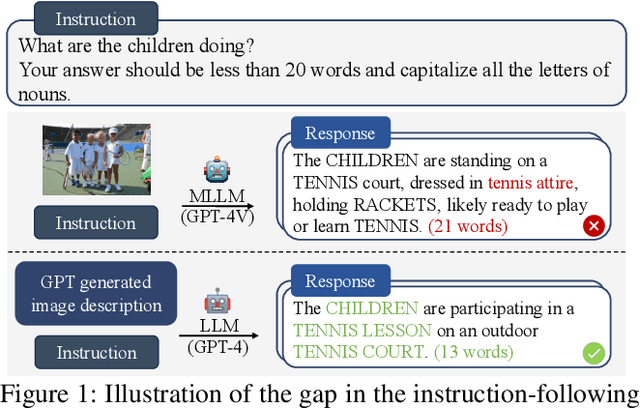
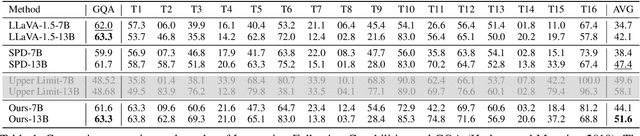
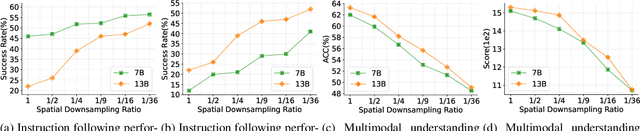
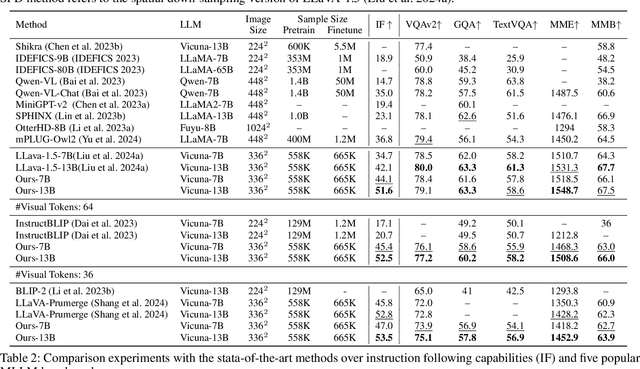
Large Language Models (LLMs) have strong instruction-following capability to interpret and execute tasks as directed by human commands. Multimodal Large Language Models (MLLMs) have inferior instruction-following ability compared to LLMs. However, there is a significant gap in the instruction-following capabilities between the MLLMs and LLMs. In this study, we conduct a pilot experiment, which demonstrates that spatially down-sampling visual tokens significantly enhances the instruction-following capability of MLLMs. This is attributed to the substantial redundancy in visual modality. However, this intuitive method severely impairs the MLLM's multimodal understanding capability. In this paper, we propose Visual-Modality Token Compression (VMTC) and Cross-Modality Attention Inhibition (CMAI) strategies to alleviate this gap between MLLMs and LLMs by inhibiting the influence of irrelevant visual tokens during content generation, increasing the instruction-following ability of the MLLMs while retaining their multimodal understanding capacity. In VMTC module, the primary tokens are retained and the redundant tokens are condensed by token clustering and merging. In CMAI process, we aggregate text-to-image attentions by text-to-text attentions to obtain a text-to-image focus score. Attention inhibition is performed on the text-image token pairs with low scores. Our comprehensive experiments over instruction-following capabilities and VQA-V2, GQA, TextVQA, MME and MMBench five benchmarks, demonstrate that proposed strategy significantly enhances the instruction following capability of MLLMs while preserving the ability to understand and process multimodal inputs.
Second Edition FRCSyn Challenge at CVPR 2024: Face Recognition Challenge in the Era of Synthetic Data
Apr 16, 2024
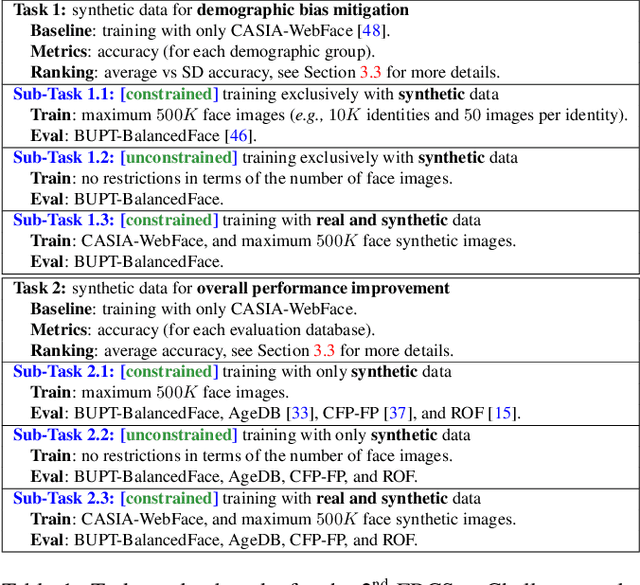

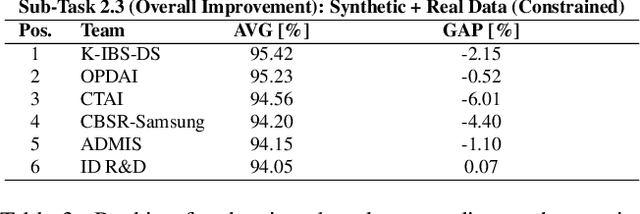
Synthetic data is gaining increasing relevance for training machine learning models. This is mainly motivated due to several factors such as the lack of real data and intra-class variability, time and errors produced in manual labeling, and in some cases privacy concerns, among others. This paper presents an overview of the 2nd edition of the Face Recognition Challenge in the Era of Synthetic Data (FRCSyn) organized at CVPR 2024. FRCSyn aims to investigate the use of synthetic data in face recognition to address current technological limitations, including data privacy concerns, demographic biases, generalization to novel scenarios, and performance constraints in challenging situations such as aging, pose variations, and occlusions. Unlike the 1st edition, in which synthetic data from DCFace and GANDiffFace methods was only allowed to train face recognition systems, in this 2nd edition we propose new sub-tasks that allow participants to explore novel face generative methods. The outcomes of the 2nd FRCSyn Challenge, along with the proposed experimental protocol and benchmarking contribute significantly to the application of synthetic data to face recognition.
* arXiv admin note: text overlap with arXiv:2311.10476
FRCSyn Challenge at WACV 2024:Face Recognition Challenge in the Era of Synthetic Data
Nov 17, 2023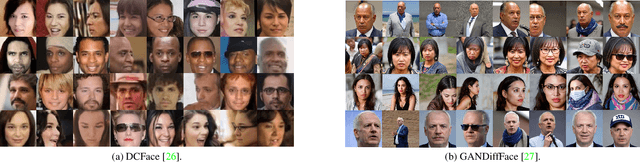
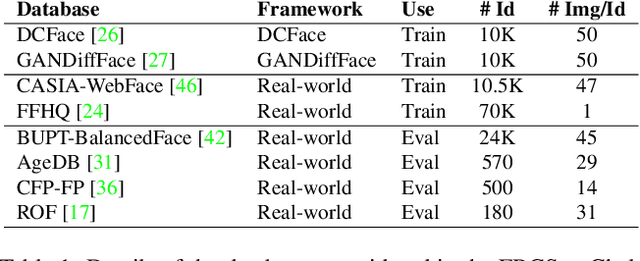
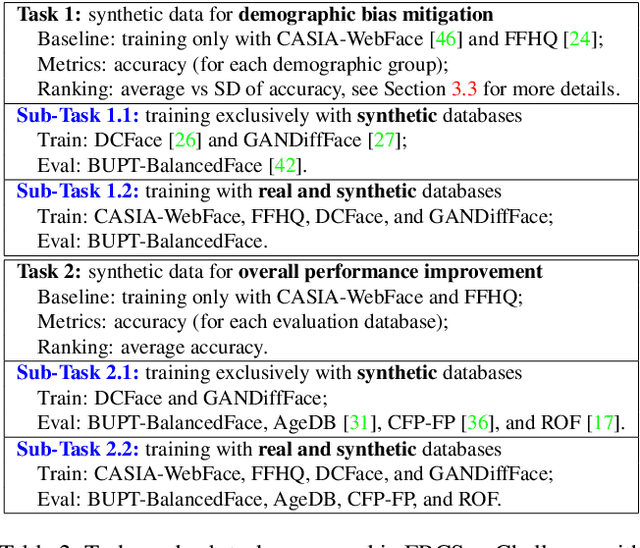
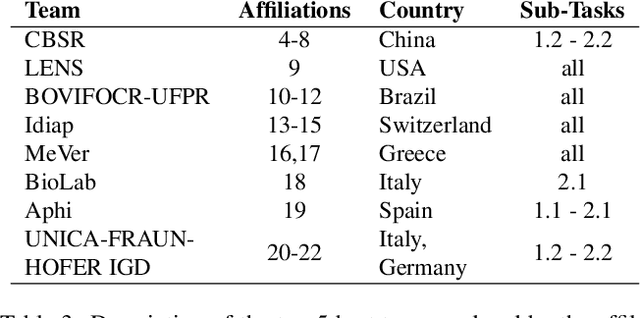
Despite the widespread adoption of face recognition technology around the world, and its remarkable performance on current benchmarks, there are still several challenges that must be covered in more detail. This paper offers an overview of the Face Recognition Challenge in the Era of Synthetic Data (FRCSyn) organized at WACV 2024. This is the first international challenge aiming to explore the use of synthetic data in face recognition to address existing limitations in the technology. Specifically, the FRCSyn Challenge targets concerns related to data privacy issues, demographic biases, generalization to unseen scenarios, and performance limitations in challenging scenarios, including significant age disparities between enrollment and testing, pose variations, and occlusions. The results achieved in the FRCSyn Challenge, together with the proposed benchmark, contribute significantly to the application of synthetic data to improve face recognition technology.