 Add to Chrome
 Add to Firefox
 Add to Edge
TraceNet: Segment one thing efficiently
Jun 21, 2024

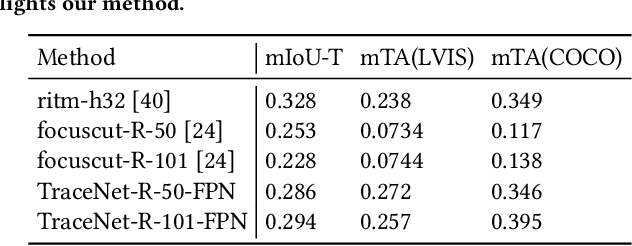


Efficient single instance segmentation is essential for unlocking features in the mobile imaging applications, such as capture or editing. Existing on-the-fly mobile imaging applications scope the segmentation task to portraits or the salient subject due to the computational constraints. Instance segmentation, despite its recent developments towards efficient networks, is still heavy due to the cost of computation on the entire image to identify all instances. To address this, we propose and formulate a one tap driven single instance segmentation task that segments a single instance selected by a user via a positive tap. This task, in contrast to the broader task of segmenting anything as suggested in the Segment Anything Model \cite{sam}, focuses on efficient segmentation of a single instance specified by the user. To solve this problem, we present TraceNet, which explicitly locates the selected instance by way of receptive field tracing. TraceNet identifies image regions that are related to the user tap and heavy computations are only performed on selected regions of the image. Therefore overall computation cost and memory consumption are reduced during inference. We evaluate the performance of TraceNet on instance IoU average over taps and the proportion of the region that a user tap can fall into for a high-quality single-instance mask. Experimental results on MS-COCO and LVIS demonstrate the effectiveness and efficiency of the proposed approach. TraceNet can jointly achieve the efficiency and interactivity, filling in the gap between needs for efficient mobile inference and recent research trend towards multimodal and interactive segmentation models.

LLM-enhanced Reranking in Recommender Systems
Jun 18, 2024Reranking is a critical component in recommender systems, playing an essential role in refining the output of recommendation algorithms. Traditional reranking models have focused predominantly on accuracy, but modern applications demand consideration of additional criteria such as diversity and fairness. Existing reranking approaches often fail to harmonize these diverse criteria effectively at the model level. Moreover, these models frequently encounter challenges with scalability and personalization due to their complexity and the varying significance of different reranking criteria in diverse scenarios. In response, we introduce a comprehensive reranking framework enhanced by LLM, designed to seamlessly integrate various reranking criteria while maintaining scalability and facilitating personalized recommendations. This framework employs a fully connected graph structure, allowing the LLM to simultaneously consider multiple aspects such as accuracy, diversity, and fairness through a coherent Chain-of-Thought (CoT) process. A customizable input mechanism is also integrated, enabling the tuning of the language model's focus to meet specific reranking needs. We validate our approach using three popular public datasets, where our framework demonstrates superior performance over existing state-of-the-art reranking models in balancing multiple criteria. The code for this implementation is publicly available.
Advancing Graph Generation through Beta Diffusion
Jun 13, 2024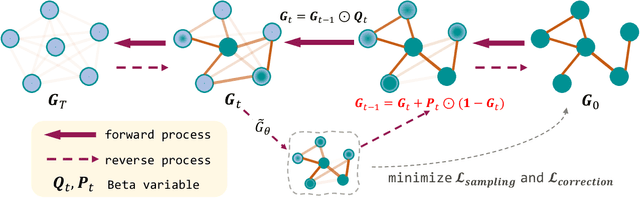
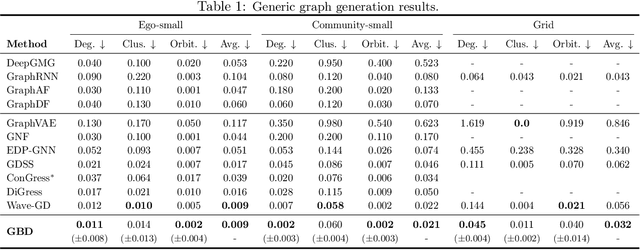
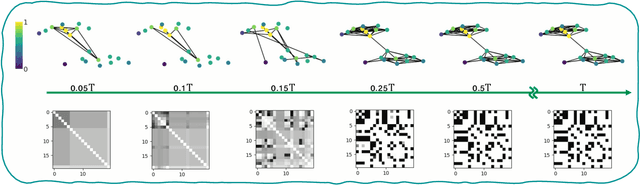
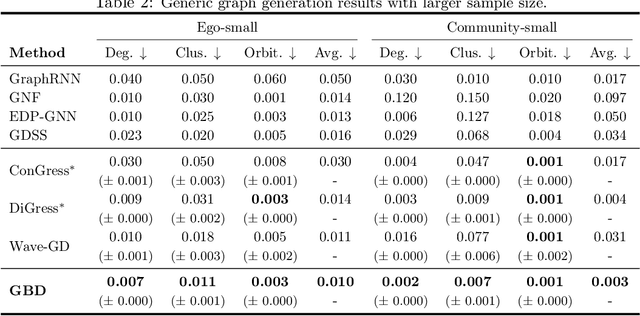
Diffusion models have demonstrated effectiveness in generating natural images and have been extended to generate diverse data types, including graphs. This new generation of diffusion-based graph generative models has demonstrated significant performance improvements over methods that rely on variational autoencoders or generative adversarial networks. It's important to recognize, however, that most of these models employ Gaussian or categorical diffusion processes, which can struggle with sparse and long-tailed data distributions. In our work, we introduce Graph Beta Diffusion (GBD), a diffusion-based generative model particularly adept at capturing diverse graph structures. GBD utilizes a beta diffusion process, tailored for the sparse and range-bounded characteristics of graph adjacency matrices. Furthermore, we have developed a modulation technique that enhances the realism of the generated graphs by stabilizing the generation of critical graph structures, while preserving flexibility elsewhere. The outstanding performance of GBD across three general graph benchmarks and two biochemical graph benchmarks highlights its capability to effectively capture the complexities of real-world graph data. The code will be made available at https://github.com/YH-UtMSB/Graph_Beta_Diffusion
MSAGPT: Neural Prompting Protein Structure Prediction via MSA Generative Pre-Training
Jun 11, 2024Multiple Sequence Alignment (MSA) plays a pivotal role in unveiling the evolutionary trajectories of protein families. The accuracy of protein structure predictions is often compromised for protein sequences that lack sufficient homologous information to construct high quality MSA. Although various methods have been proposed to generate virtual MSA under these conditions, they fall short in comprehensively capturing the intricate coevolutionary patterns within MSA or require guidance from external oracle models. Here we introduce MSAGPT, a novel approach to prompt protein structure predictions via MSA generative pretraining in the low MSA regime. MSAGPT employs a simple yet effective 2D evolutionary positional encoding scheme to model complex evolutionary patterns. Endowed by this, its flexible 1D MSA decoding framework facilitates zero or few shot learning. Moreover, we demonstrate that leveraging the feedback from AlphaFold2 can further enhance the model capacity via Rejective Fine tuning (RFT) and Reinforcement Learning from AF2 Feedback (RLAF). Extensive experiments confirm the efficacy of MSAGPT in generating faithful virtual MSA to enhance the structure prediction accuracy. The transfer learning capabilities also highlight its great potential for facilitating other protein tasks.
Large Language Models Make Sample-Efficient Recommender Systems
Jun 04, 2024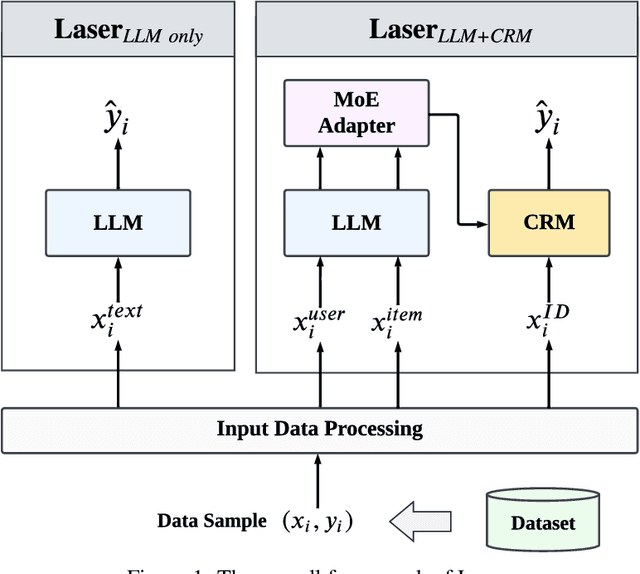
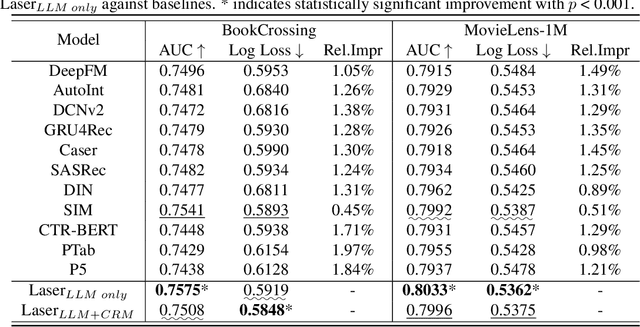

Large language models (LLMs) have achieved remarkable progress in the field of natural language processing (NLP), demonstrating remarkable abilities in producing text that resembles human language for various tasks. This opens up new opportunities for employing them in recommender systems (RSs). In this paper, we specifically examine the sample efficiency of LLM-enhanced recommender systems, which pertains to the model's capacity to attain superior performance with a limited quantity of training data. Conventional recommendation models (CRMs) often need a large amount of training data because of the sparsity of features and interactions. Hence, we propose and verify our core viewpoint: Large Language Models Make Sample-Efficient Recommender Systems. We propose a simple yet effective framework (i.e., Laser) to validate the viewpoint from two aspects: (1) LLMs themselves are sample-efficient recommenders; and (2) LLMs, as feature generators and encoders, make CRMs more sample-efficient. Extensive experiments on two public datasets show that Laser requires only a small fraction of training samples to match or even surpass CRMs that are trained on the entire training set, demonstrating superior sample efficiency.
GSTalker: Real-time Audio-Driven Talking Face Generation via Deformable Gaussian Splatting
Apr 29, 2024We present GStalker, a 3D audio-driven talking face generation model with Gaussian Splatting for both fast training (40 minutes) and real-time rendering (125 FPS) with a 3$\sim$5 minute video for training material, in comparison with previous 2D and 3D NeRF-based modeling frameworks which require hours of training and seconds of rendering per frame. Specifically, GSTalker learns an audio-driven Gaussian deformation field to translate and transform 3D Gaussians to synchronize with audio information, in which multi-resolution hashing grid-based tri-plane and temporal smooth module are incorporated to learn accurate deformation for fine-grained facial details. In addition, a pose-conditioned deformation field is designed to model the stabilized torso. To enable efficient optimization of the condition Gaussian deformation field, we initialize 3D Gaussians by learning a coarse static Gaussian representation. Extensive experiments in person-specific videos with audio tracks validate that GSTalker can generate high-fidelity and audio-lips synchronized results with fast training and real-time rendering speed.
Retrieval-Oriented Knowledge for Click-Through Rate Prediction
Apr 28, 2024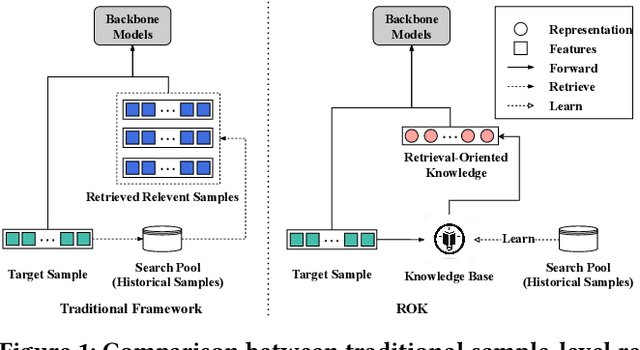
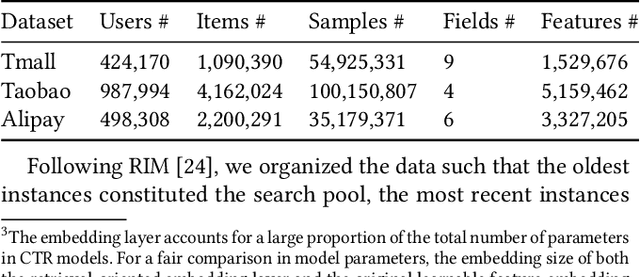
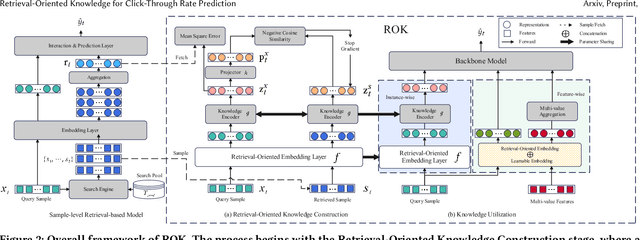
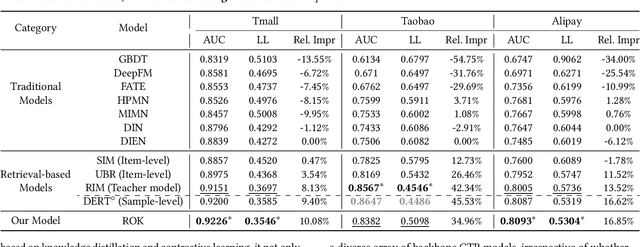
Click-through rate (CTR) prediction plays an important role in personalized recommendations. Recently, sample-level retrieval-based models (e.g., RIM) have achieved remarkable performance by retrieving and aggregating relevant samples. However, their inefficiency at the inference stage makes them impractical for industrial applications. To overcome this issue, this paper proposes a universal plug-and-play Retrieval-Oriented Knowledge (ROK) framework. Specifically, a knowledge base, consisting of a retrieval-oriented embedding layer and a knowledge encoder, is designed to preserve and imitate the retrieved & aggregated representations in a decomposition-reconstruction paradigm. Knowledge distillation and contrastive learning methods are utilized to optimize the knowledge base, and the learned retrieval-enhanced representations can be integrated with arbitrary CTR models in both instance-wise and feature-wise manners. Extensive experiments on three large-scale datasets show that ROK achieves competitive performance with the retrieval-based CTR models while reserving superior inference efficiency and model compatibility.
BOND: Bootstrapping From-Scratch Name Disambiguation with Multi-task Promoting
Apr 12, 2024From-scratch name disambiguation is an essential task for establishing a reliable foundation for academic platforms. It involves partitioning documents authored by identically named individuals into groups representing distinct real-life experts. Canonically, the process is divided into two decoupled tasks: locally estimating the pairwise similarities between documents followed by globally grouping these documents into appropriate clusters. However, such a decoupled approach often inhibits optimal information exchange between these intertwined tasks. Therefore, we present BOND, which bootstraps the local and global informative signals to promote each other in an end-to-end regime. Specifically, BOND harnesses local pairwise similarities to drive global clustering, subsequently generating pseudo-clustering labels. These global signals further refine local pairwise characterizations. The experimental results establish BOND's superiority, outperforming other advanced baselines by a substantial margin. Moreover, an enhanced version, BOND+, incorporating ensemble and post-match techniques, rivals the top methods in the WhoIsWho competition.
* TheWebConf 2024 (WWW '24)
Play to Your Strengths: Collaborative Intelligence of Conventional Recommender Models and Large Language Models
Mar 25, 2024The rise of large language models (LLMs) has opened new opportunities in Recommender Systems (RSs) by enhancing user behavior modeling and content understanding. However, current approaches that integrate LLMs into RSs solely utilize either LLM or conventional recommender model (CRM) to generate final recommendations, without considering which data segments LLM or CRM excel in. To fill in this gap, we conduct experiments on MovieLens-1M and Amazon-Books datasets, and compare the performance of a representative CRM (DCNv2) and an LLM (LLaMA2-7B) on various groups of data samples. Our findings reveal that LLMs excel in data segments where CRMs exhibit lower confidence and precision, while samples where CRM excels are relatively challenging for LLM, requiring substantial training data and a long training time for comparable performance. This suggests potential synergies in the combination between LLM and CRM. Motivated by these insights, we propose Collaborative Recommendation with conventional Recommender and Large Language Model (dubbed \textit{CoReLLa}). In this framework, we first jointly train LLM and CRM and address the issue of decision boundary shifts through alignment loss. Then, the resource-efficient CRM, with a shorter inference time, handles simple and moderate samples, while LLM processes the small subset of challenging samples for CRM. Our experimental results demonstrate that CoReLLa outperforms state-of-the-art CRM and LLM methods significantly, underscoring its effectiveness in recommendation tasks.
Neural Image Compression with Quantization Rectifier
Mar 25, 2024Neural image compression has been shown to outperform traditional image codecs in terms of rate-distortion performance. However, quantization introduces errors in the compression process, which can degrade the quality of the compressed image. Existing approaches address the train-test mismatch problem incurred during quantization, the random impact of quantization on the expressiveness of image features is still unsolved. This paper presents a novel quantization rectifier (QR) method for image compression that leverages image feature correlation to mitigate the impact of quantization. Our method designs a neural network architecture that predicts unquantized features from the quantized ones, preserving feature expressiveness for better image reconstruction quality. We develop a soft-to-predictive training technique to integrate QR into existing neural image codecs. In evaluation, we integrate QR into state-of-the-art neural image codecs and compare enhanced models and baselines on the widely-used Kodak benchmark. The results show consistent coding efficiency improvement by QR with a negligible increase in the running time.