 Add to Chrome
 Add to Firefox
 Add to Edge
SVR-R1: Bootstrapping Multi-modal Reasoning with Self-verification in Reinforcement Learning
Jul 13, 2026
We introduce Self-Verified Reasoner (SVR-R1), a multi-turn RL framework that turns a model's own verification into a learning signal for multimodal reasoning. For each query, the model proposes an answer using the same weights, and issues a binary self-verdict (Yes/No). A 'No' triggers a second-chance rethink; a 'Yes,' or a turn cap, finalizes the output for computing the outcome-based reward. SVR-R1 is implemented with GRPO and an asynchronous multi-turn rollout framework and needs no external supervision or auxiliary critics. We evaluate SVR-R1 on vision-language reasoning benchmarks and show that it improves accuracy by a large margin over strong standard GRPO baselines. Training dynamics show decreasing reliance on verification-fewer verification turns, yet higher test accuracy-indicating that the gap between verification and generation narrows as the policy internalizes self-correction and chooses the most confident answer via our framework. SVR-R1 bridges the less explored intersection of inference-time self-refinement and RL training for VLMs, offering a simple yet effective recipe for bootstrapping multimodal reasoning. We will open-source \textbf{SVR-R1} to facilitate future research in VLMs.

Spreadsheet-RL: Advancing Large Language Model Agents on Realistic Spreadsheet Tasks via Reinforcement Learning
May 21, 2026Spreadsheet systems (e.g., Microsoft Excel, Google Sheets) play a central role in modern data-centric workflows. As AI agents grow increasingly capable of automating complex tasks, such as controlling computers and generating presentations, building an AI-driven spreadsheet agent has emerged as a promising research direction. Most existing spreadsheet agents rely on specialized prompting over general-purpose LLMs; while this design has potentials on simple spreadsheet operations, it struggles to manage the complex, multi-step workflows typical of real-world applications. We introduce Spreadsheet-RL, a reinforcement learning (RL) fine-tuning framework designed to train specialized spreadsheet agents within a realistic Microsoft Excel environment. Spreadsheet-RL features an automated pipeline for scalable collection of paired start-goal spreadsheets from online forums, as well as domain-specific evaluation tasks in areas such as finance and supply chain management, which we compile into the new Domain-Spreadsheet benchmark dataset. It also includes a Spreadsheet Gym environment designed for multi-turn RL: Spreadsheet Gym exposes extensive Excel functionality through a Python sandbox, along with a refined harness that incorporates a comprehensive tool set and carefully designed tool-routing rules for spreadsheet tasks. Through comprehensive experiments, we show that Spreadsheet-RL substantially enhances AI agent's performance on both general and domain-specific spreadsheet tasks: it improves Qwen3-4B-Thinking-2507's Pass@1 on SpreadsheetBench from 12.0% to 23.4%, and raises Pass@1 from 8.4% to 17.2% on our curated Domain-Spreadsheet dataset. These results highlight Spreadsheet-RL's strong potential for generalization and real-world adoption in spreadsheet automation, and broadly, its promise for advancing LLM-based interactions with data interfaces in everyday work.
The Last Human-Written Paper: Agent-Native Research Artifacts
Apr 27, 2026Scientific publication compresses a branching, iterative research process into a linear narrative, discarding the majority of what was discovered along the way. This compilation imposes two structural costs: a Storytelling Tax, where failed experiments, rejected hypotheses, and the branching exploration process are discarded to fit a linear narrative; and an Engineering Tax, where the gap between reviewer-sufficient prose and agent-sufficient specification leaves critical implementation details unwritten. Tolerable for human readers, these costs become critical when AI agents must understand, reproduce, and extend published work. We introduce the Agent-Native Research Artifact (Ara), a protocol that replaces the narrative paper with a machine-executable research package structured around four layers: scientific logic, executable code with full specifications, an exploration graph that preserves the failures compilation discards, and evidence grounding every claim in raw outputs. Three mechanisms support the ecosystem: a Live Research Manager that captures decisions and dead ends during ordinary development; an Ara Compiler that translates legacy PDFs and repos into Aras; and an Ara-native review system that automates objective checks so human reviewers can focus on significance, novelty, and taste. On PaperBench and RE-Bench, Ara raises question-answering accuracy from 72.4% to 93.7% and reproduction success from 57.4% to 64.4%. On RE-Bench's five open-ended extension tasks, preserved failure traces in Ara accelerate progress, but can also constrain a capable agent from stepping outside the prior-run box depending on the agent's capabilities.
QoS-QoE Translation with Large Language Model
Apr 09, 2026QoS-QoE translation is a fundamental problem in multimedia systems because it characterizes how measurable system and network conditions affect user-perceived experience. Although many prior studies have examined this relationship, their findings are often developed for specific setups and remain scattered across papers, experimental settings, and reporting formats, limiting systematic reuse, cross-scenario generalization, and large-scale analysis. To address this gap, we first introduce QoS-QoE Translation dataset, a source-grounded dataset of structured QoS-QoE relationships from the multimedia literature, with a focus on video streaming related tasks. We construct the dataset through an automated pipeline that combines paper curation, QoS-QoE relationship extraction, and iterative data evaluation. Each record preserves the extracted relationship together with parameter definitions, supporting evidence, and contextual metadata. We further evaluate the capability of large language models (LLMs) on QoS-QoE translation, both before and after supervised fine-tuning on our dataset, and show strong performance on both continuous-value and discrete-label prediction in bidirectional translation, from QoS-QoE and QoE-QoS. Our dataset provides a foundation for benchmarking LLMs in QoS-QoE translation and for supporting future LLM-based reasoning for multimedia quality prediction and optimization. The complete dataset and code are publicly available at https://yyu6969.github.io/qos-qoe-translation-page/, for full reproducibility and open access.
Circuit Tracing in Vision-Language Models: Understanding the Internal Mechanisms of Multimodal Thinking
Feb 23, 2026Vision-language models (VLMs) are powerful but remain opaque black boxes. We introduce the first framework for transparent circuit tracing in VLMs to systematically analyze multimodal reasoning. By utilizing transcoders, attribution graphs, and attention-based methods, we uncover how VLMs hierarchically integrate visual and semantic concepts. We reveal that distinct visual feature circuits can handle mathematical reasoning and support cross-modal associations. Validated through feature steering and circuit patching, our framework proves these circuits are causal and controllable, laying the groundwork for more explainable and reliable VLMs.
VTool-R1: VLMs Learn to Think with Images via Reinforcement Learning on Multimodal Tool Use
May 25, 2025Reinforcement Learning Finetuning (RFT) has significantly advanced the reasoning capabilities of large language models (LLMs) by enabling long chains of thought, self-correction, and effective tool use. While recent works attempt to extend RFT to vision-language models (VLMs), these efforts largely produce text-only reasoning conditioned on static image inputs, falling short of true multimodal reasoning in the response. In contrast, test-time methods like Visual Sketchpad incorporate visual steps but lack training mechanisms. We introduce VTool-R1, the first framework that trains VLMs to generate multimodal chains of thought by interleaving text and intermediate visual reasoning steps. VTool-R1 integrates Python-based visual editing tools into the RFT process, enabling VLMs to learn when and how to generate visual reasoning steps that benefit final reasoning. Trained with outcome-based rewards tied to task accuracy, our approach elicits strategic visual tool use for reasoning without relying on process-based supervision. Experiments on structured visual question answering over charts and tables show that VTool-R1 enhances reasoning performance by teaching VLMs to "think with images" and generate multimodal chain of thoughts with tools.
Cache-of-Thought: Master-Apprentice Framework for Cost-Effective Vision Language Model Inference
Feb 27, 2025Vision Language Models (VLMs) have achieved remarkable success in a wide range of vision applications of increasing complexity and scales, yet choosing the right VLM model size involves a trade-off between response quality and cost. While smaller VLMs are cheaper to run, they typically produce responses only marginally better than random guessing on benchmarks such as MMMU. In this paper, we propose Cache of Thought (CoT), a master apprentice framework for collaborative inference between large and small VLMs. CoT manages high quality query results from large VLMs (master) in a cache, which are then selected via a novel multi modal retrieval and in-context learning to aid the performance of small VLMs (apprentice). We extensively evaluate CoT on various widely recognized and challenging general VQA benchmarks, and show that CoT increases overall VQA performance by up to 7.7% under the same budget, and specifically boosts the performance of apprentice VLMs by up to 36.6%.
UOUO: Uncontextualized Uncommon Objects for Measuring Knowledge Horizons of Vision Language Models
Jul 25, 2024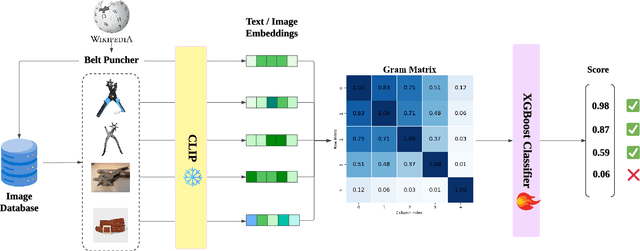
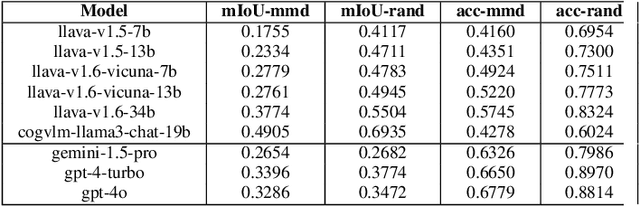
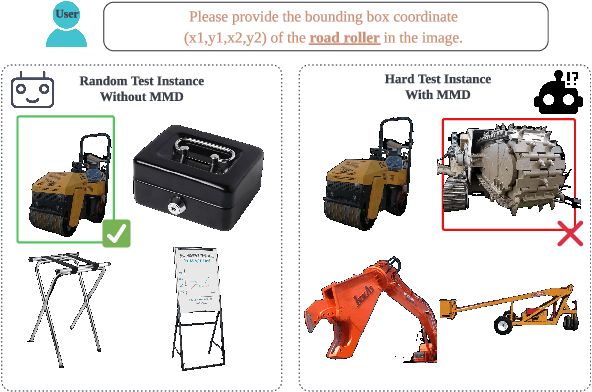
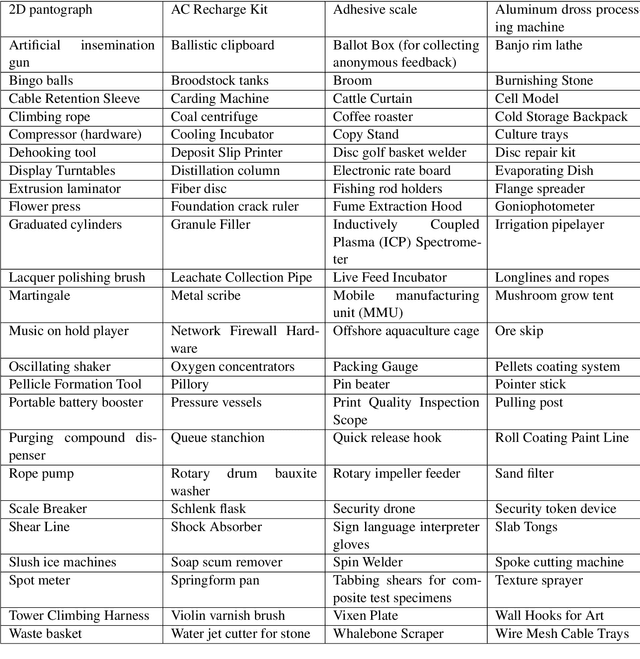
Smaller-scale Vision-Langauge Models (VLMs) often claim to perform on par with larger models in general-domain visual grounding and question-answering benchmarks while offering advantages in computational efficiency and storage. However, their ability to handle rare objects, which fall into the long tail of data distributions, is less understood. To rigorously evaluate this aspect, we introduce the "Uncontextualized Uncommon Objects" (UOUO) benchmark. This benchmark focuses on systematically testing VLMs with both large and small parameter counts on rare and specialized objects. Our comprehensive analysis reveals that while smaller VLMs maintain competitive performance on common datasets, they significantly underperform on tasks involving uncommon objects. We also propose an advanced, scalable pipeline for data collection and cleaning, ensuring the UOUO benchmark provides high-quality, challenging instances. These findings highlight the need to consider long-tail distributions when assessing the true capabilities of VLMs.
TraceNet: Segment one thing efficiently
Jun 21, 2024
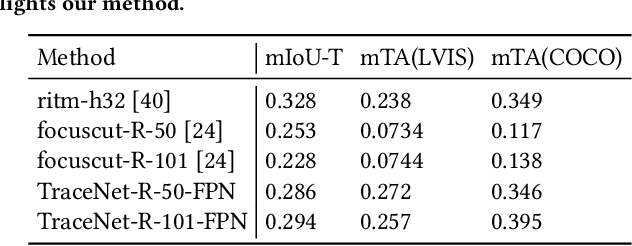


Efficient single instance segmentation is essential for unlocking features in the mobile imaging applications, such as capture or editing. Existing on-the-fly mobile imaging applications scope the segmentation task to portraits or the salient subject due to the computational constraints. Instance segmentation, despite its recent developments towards efficient networks, is still heavy due to the cost of computation on the entire image to identify all instances. To address this, we propose and formulate a one tap driven single instance segmentation task that segments a single instance selected by a user via a positive tap. This task, in contrast to the broader task of segmenting anything as suggested in the Segment Anything Model \cite{sam}, focuses on efficient segmentation of a single instance specified by the user. To solve this problem, we present TraceNet, which explicitly locates the selected instance by way of receptive field tracing. TraceNet identifies image regions that are related to the user tap and heavy computations are only performed on selected regions of the image. Therefore overall computation cost and memory consumption are reduced during inference. We evaluate the performance of TraceNet on instance IoU average over taps and the proportion of the region that a user tap can fall into for a high-quality single-instance mask. Experimental results on MS-COCO and LVIS demonstrate the effectiveness and efficiency of the proposed approach. TraceNet can jointly achieve the efficiency and interactivity, filling in the gap between needs for efficient mobile inference and recent research trend towards multimodal and interactive segmentation models.