 Add to Chrome
 Add to Firefox
 Add to Edge
DepthSplat: Connecting Gaussian Splatting and Depth
Oct 17, 2024


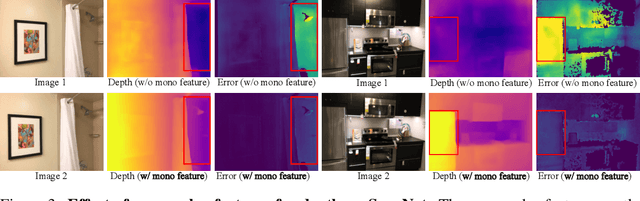
Gaussian splatting and single/multi-view depth estimation are typically studied in isolation. In this paper, we present DepthSplat to connect Gaussian splatting and depth estimation and study their interactions. More specifically, we first contribute a robust multi-view depth model by leveraging pre-trained monocular depth features, leading to high-quality feed-forward 3D Gaussian splatting reconstructions. We also show that Gaussian splatting can serve as an unsupervised pre-training objective for learning powerful depth models from large-scale unlabelled datasets. We validate the synergy between Gaussian splatting and depth estimation through extensive ablation and cross-task transfer experiments. Our DepthSplat achieves state-of-the-art performance on ScanNet, RealEstate10K and DL3DV datasets in terms of both depth estimation and novel view synthesis, demonstrating the mutual benefits of connecting both tasks. Our code, models, and video results are available at https://haofeixu.github.io/depthsplat/.

Artificial Kuramoto Oscillatory Neurons
Oct 17, 2024
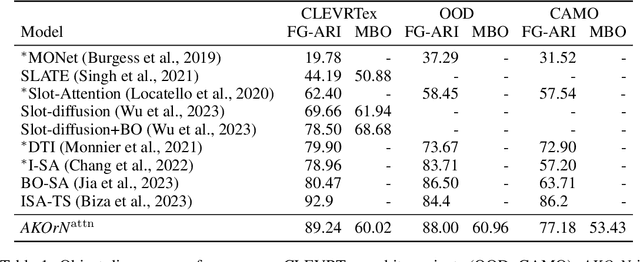


It has long been known in both neuroscience and AI that ``binding'' between neurons leads to a form of competitive learning where representations are compressed in order to represent more abstract concepts in deeper layers of the network. More recently, it was also hypothesized that dynamic (spatiotemporal) representations play an important role in both neuroscience and AI. Building on these ideas, we introduce Artificial Kuramoto Oscillatory Neurons (AKOrN) as a dynamical alternative to threshold units, which can be combined with arbitrary connectivity designs such as fully connected, convolutional, or attentive mechanisms. Our generalized Kuramoto updates bind neurons together through their synchronization dynamics. We show that this idea provides performance improvements across a wide spectrum of tasks such as unsupervised object discovery, adversarial robustness, calibrated uncertainty quantification, and reasoning. We believe that these empirical results show the importance of rethinking our assumptions at the most basic neuronal level of neural representation, and in particular show the importance of dynamical representations.
Unimotion: Unifying 3D Human Motion Synthesis and Understanding
Sep 24, 2024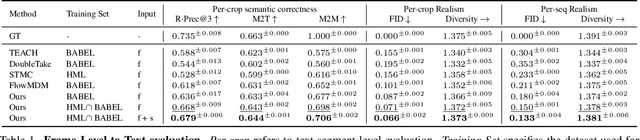

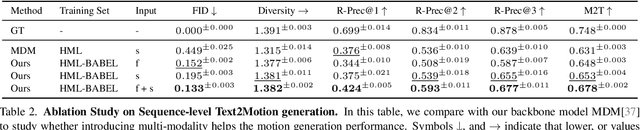

We introduce Unimotion, the first unified multi-task human motion model capable of both flexible motion control and frame-level motion understanding. While existing works control avatar motion with global text conditioning, or with fine-grained per frame scripts, none can do both at once. In addition, none of the existing works can output frame-level text paired with the generated poses. In contrast, Unimotion allows to control motion with global text, or local frame-level text, or both at once, providing more flexible control for users. Importantly, Unimotion is the first model which by design outputs local text paired with the generated poses, allowing users to know what motion happens and when, which is necessary for a wide range of applications. We show Unimotion opens up new applications: 1.) Hierarchical control, allowing users to specify motion at different levels of detail, 2.) Obtaining motion text descriptions for existing MoCap data or YouTube videos 3.) Allowing for editability, generating motion from text, and editing the motion via text edits. Moreover, Unimotion attains state-of-the-art results for the frame-level text-to-motion task on the established HumanML3D dataset. The pre-trained model and code are available available on our project page at https://coral79.github.io/Unimotion/.
Volumetric Surfaces: Representing Fuzzy Geometries with Multiple Meshes
Sep 04, 2024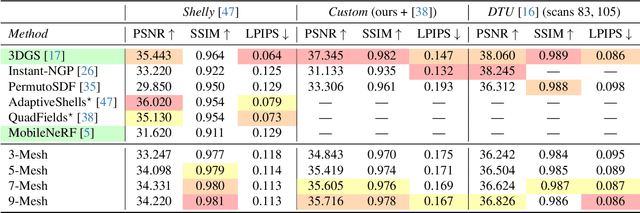
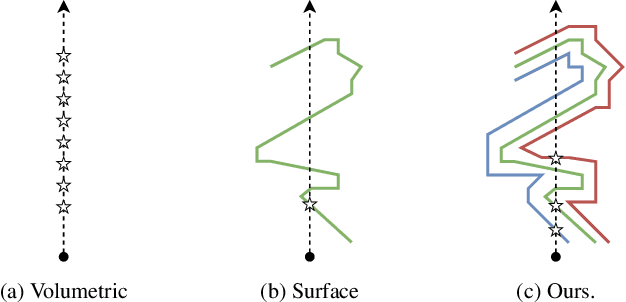
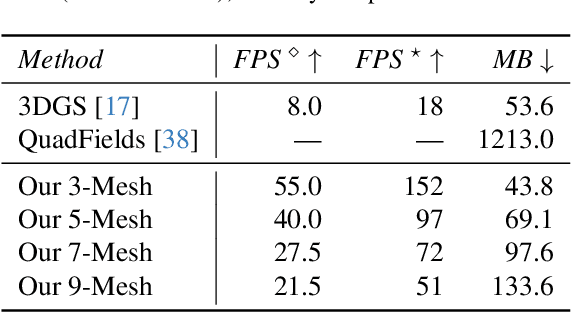

High-quality real-time view synthesis methods are based on volume rendering, splatting, or surface rendering. While surface-based methods generally are the fastest, they cannot faithfully model fuzzy geometry like hair. In turn, alpha-blending techniques excel at representing fuzzy materials but require an unbounded number of samples per ray (P1). Further overheads are induced by empty space skipping in volume rendering (P2) and sorting input primitives in splatting (P3). These problems are exacerbated on low-performance graphics hardware, e.g. on mobile devices. We present a novel representation for real-time view synthesis where the (P1) number of sampling locations is small and bounded, (P2) sampling locations are efficiently found via rasterization, and (P3) rendering is sorting-free. We achieve this by representing objects as semi-transparent multi-layer meshes, rendered in fixed layer order from outermost to innermost. We model mesh layers as SDF shells with optimal spacing learned during training. After baking, we fit UV textures to the corresponding meshes. We show that our method can represent challenging fuzzy objects while achieving higher frame rates than volume-based and splatting-based methods on low-end and mobile devices.
Efficient Depth-Guided Urban View Synthesis
Jul 17, 2024

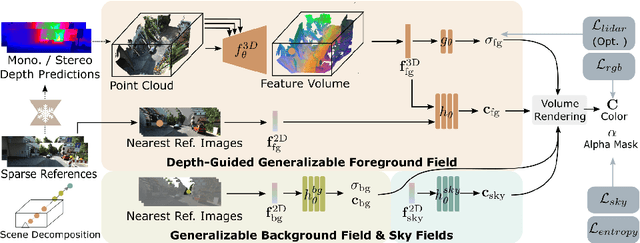

Recent advances in implicit scene representation enable high-fidelity street view novel view synthesis. However, existing methods optimize a neural radiance field for each scene, relying heavily on dense training images and extensive computation resources. To mitigate this shortcoming, we introduce a new method called Efficient Depth-Guided Urban View Synthesis (EDUS) for fast feed-forward inference and efficient per-scene fine-tuning. Different from prior generalizable methods that infer geometry based on feature matching, EDUS leverages noisy predicted geometric priors as guidance to enable generalizable urban view synthesis from sparse input images. The geometric priors allow us to apply our generalizable model directly in the 3D space, gaining robustness across various sparsity levels. Through comprehensive experiments on the KITTI-360 and Waymo datasets, we demonstrate promising generalization abilities on novel street scenes. Moreover, our results indicate that EDUS achieves state-of-the-art performance in sparse view settings when combined with fast test-time optimization.
HDT: Hierarchical Document Transformer
Jul 11, 2024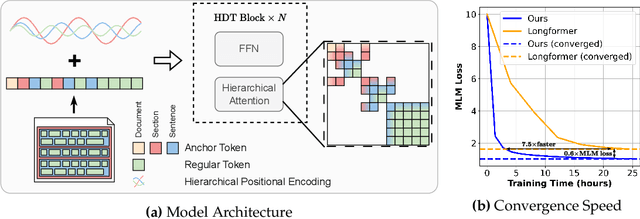
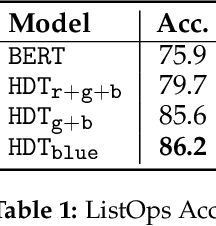
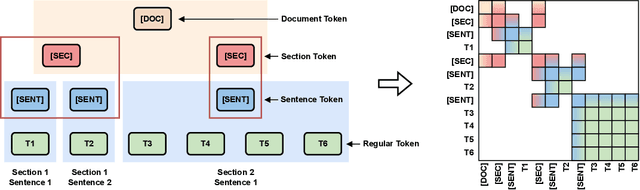

In this paper, we propose the Hierarchical Document Transformer (HDT), a novel sparse Transformer architecture tailored for structured hierarchical documents. Such documents are extremely important in numerous domains, including science, law or medicine. However, most existing solutions are inefficient and fail to make use of the structure inherent to documents. HDT exploits document structure by introducing auxiliary anchor tokens and redesigning the attention mechanism into a sparse multi-level hierarchy. This approach facilitates information exchange between tokens at different levels while maintaining sparsity, thereby enhancing computational and memory efficiency while exploiting the document structure as an inductive bias. We address the technical challenge of implementing HDT's sample-dependent hierarchical attention pattern by developing a novel sparse attention kernel that considers the hierarchical structure of documents. As demonstrated by our experiments, utilizing structural information present in documents leads to faster convergence, higher sample efficiency and better performance on downstream tasks.
LaRa: Efficient Large-Baseline Radiance Fields
Jul 05, 2024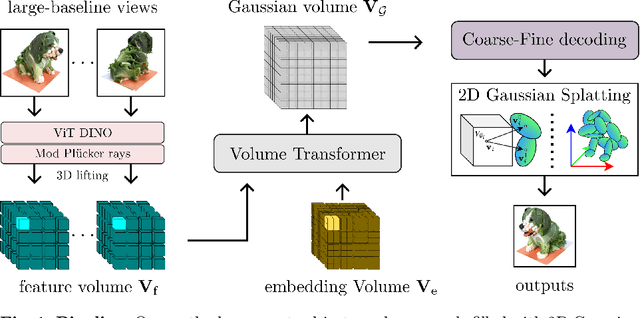
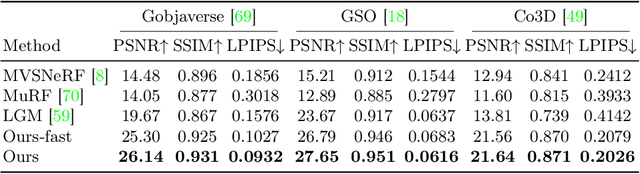
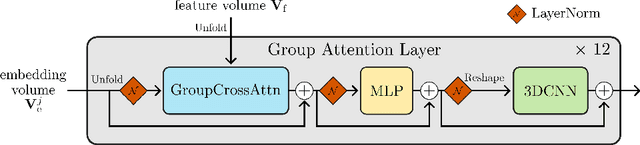
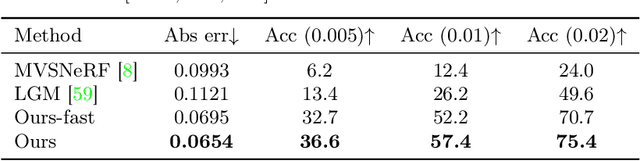
Radiance field methods have achieved photorealistic novel view synthesis and geometry reconstruction. But they are mostly applied in per-scene optimization or small-baseline settings. While several recent works investigate feed-forward reconstruction with large baselines by utilizing transformers, they all operate with a standard global attention mechanism and hence ignore the local nature of 3D reconstruction. We propose a method that unifies local and global reasoning in transformer layers, resulting in improved quality and faster convergence. Our model represents scenes as Gaussian Volumes and combines this with an image encoder and Group Attention Layers for efficient feed-forward reconstruction. Experimental results demonstrate that our model, trained for two days on four GPUs, demonstrates high fidelity in reconstructing 360° radiance fields, and robustness to zero-shot and out-of-domain testing.
NAVSIM: Data-Driven Non-Reactive Autonomous Vehicle Simulation and Benchmarking
Jun 21, 2024
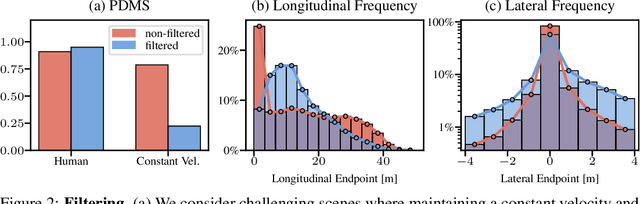

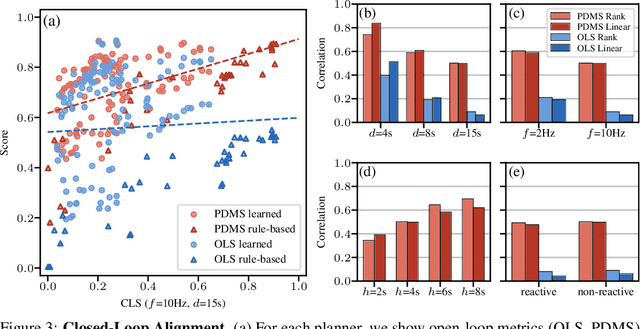
Benchmarking vision-based driving policies is challenging. On one hand, open-loop evaluation with real data is easy, but these results do not reflect closed-loop performance. On the other, closed-loop evaluation is possible in simulation, but is hard to scale due to its significant computational demands. Further, the simulators available today exhibit a large domain gap to real data. This has resulted in an inability to draw clear conclusions from the rapidly growing body of research on end-to-end autonomous driving. In this paper, we present NAVSIM, a middle ground between these evaluation paradigms, where we use large datasets in combination with a non-reactive simulator to enable large-scale real-world benchmarking. Specifically, we gather simulation-based metrics, such as progress and time to collision, by unrolling bird's eye view abstractions of the test scenes for a short simulation horizon. Our simulation is non-reactive, i.e., the evaluated policy and environment do not influence each other. As we demonstrate empirically, this decoupling allows open-loop metric computation while being better aligned with closed-loop evaluations than traditional displacement errors. NAVSIM enabled a new competition held at CVPR 2024, where 143 teams submitted 463 entries, resulting in several new insights. On a large set of challenging scenarios, we observe that simple methods with moderate compute requirements such as TransFuser can match recent large-scale end-to-end driving architectures such as UniAD. Our modular framework can potentially be extended with new datasets, data curation strategies, and metrics, and will be continually maintained to host future challenges. Our code is available at https://github.com/autonomousvision/navsim.
Vista: A Generalizable Driving World Model with High Fidelity and Versatile Controllability
May 27, 2024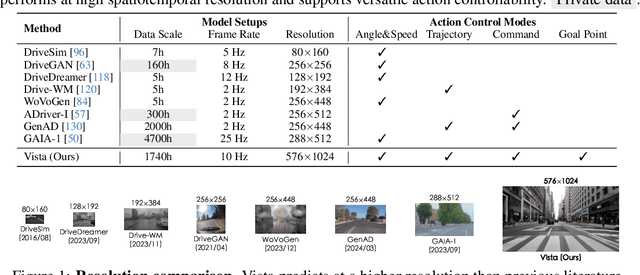
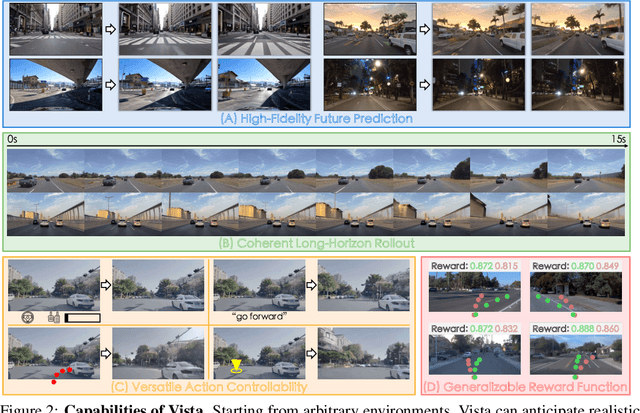


World models can foresee the outcomes of different actions, which is of paramount importance for autonomous driving. Nevertheless, existing driving world models still have limitations in generalization to unseen environments, prediction fidelity of critical details, and action controllability for flexible application. In this paper, we present Vista, a generalizable driving world model with high fidelity and versatile controllability. Based on a systematic diagnosis of existing methods, we introduce several key ingredients to address these limitations. To accurately predict real-world dynamics at high resolution, we propose two novel losses to promote the learning of moving instances and structural information. We also devise an effective latent replacement approach to inject historical frames as priors for coherent long-horizon rollouts. For action controllability, we incorporate a versatile set of controls from high-level intentions (command, goal point) to low-level maneuvers (trajectory, angle, and speed) through an efficient learning strategy. After large-scale training, the capabilities of Vista can seamlessly generalize to different scenarios. Extensive experiments on multiple datasets show that Vista outperforms the most advanced general-purpose video generator in over 70% of comparisons and surpasses the best-performing driving world model by 55% in FID and 27% in FVD. Moreover, for the first time, we utilize the capacity of Vista itself to establish a generalizable reward for real-world action evaluation without accessing the ground truth actions.
Efficient End-to-End Detection of 6-DoF Grasps for Robotic Bin Picking
May 10, 2024


Bin picking is an important building block for many robotic systems, in logistics, production or in household use-cases. In recent years, machine learning methods for the prediction of 6-DoF grasps on diverse and unknown objects have shown promising progress. However, existing approaches only consider a single ground truth grasp orientation at a grasp location during training and therefore can only predict limited grasp orientations which leads to a reduced number of feasible grasps in bin picking with restricted reachability. In this paper, we propose a novel approach for learning dense and diverse 6-DoF grasps for parallel-jaw grippers in robotic bin picking. We introduce a parameterized grasp distribution model based on Power-Spherical distributions that enables a training based on all possible ground truth samples. Thereby, we also consider the grasp uncertainty enhancing the model's robustness to noisy inputs. As a result, given a single top-down view depth image, our model can generate diverse grasps with multiple collision-free grasp orientations. Experimental evaluations in simulation and on a real robotic bin picking setup demonstrate the model's ability to generalize across various object categories achieving an object clearing rate of around $90 \%$ in simulation and real-world experiments. We also outperform state of the art approaches. Moreover, the proposed approach exhibits its usability in real robot experiments without any refinement steps, even when only trained on a synthetic dataset, due to the probabilistic grasp distribution modeling.