 Add to Chrome
 Add to Firefox
 Add to Edge
Towards Interactive Video World Modeling: Frontiers, Challenges, Benchmarks, and Future Trends
May 31, 2026
With rapid development of large language models and diffusion-based content generation, world modeling has attracted increasing research attention, benefiting various downstream domains such as game engines, embodied AI, autonomous driving, etc. Through explicitly incorporating user actions into world state transition, recent literature empowers world modeling with interactivity in an action-conditioned video or 3D generation paradigm, further enhancing controllability over world evolutions and facilitating users to freely traverse, manipulate, navigate, and personalize the state evolution. In this paper, we aim to systematically review recent research trends, technical developments, evaluation benchmarks, and also propose future potential directions in interactive world modeling. Specifically, we first summarize recent efforts and trends in terms of application scenarios, world state evolution, and scene modality. Afterwards, we delve into three crucial technical challenges, including action-conditioned controllability, long-horizon interactions and memory, and action-following responsiveness for real-time interactivity. Furthermore, we also thoroughly compare existing benchmarks and metrics in four specific application fields: open-world exploration, game engine, autonomous driving, and robotics. Finally, we discuss several promising future directions in achieving next-generation interactive world modeling. The corresponding repository is publicly available at: https://github.com/liujiuming123/Awesome-Interactive-World-Model.

RHO: Robust Holistic OSM-Based Metric Cross-View Geo-Localization
Mar 29, 2026Metric Cross-View Geo-Localization (MCVGL) aims to estimate the 3-DoF camera pose (position and heading) by matching ground and satellite images. In this work, instead of pinhole and satellite images, we study robust MCVGL using holistic panoramas and OpenStreetMap (OSM). To this end, we establish a large-scale MCVGL benchmark dataset, CV-RHO, with over 2.7M images under different weather and lighting conditions, as well as sensor noise. Furthermore, we propose a model termed RHO with a two-branch Pin-Pan architecture for accurate visual localization. A Split-Undistort-Merge (SUM) module is introduced to address the panoramic distortion, and a Position-Orientation Fusion (POF) mechanism is designed to enhance the localization accuracy. Extensive experiments prove the value of our CV-RHO dataset and the effectiveness of the RHO model, with a significant performance gain up to 20% compared with the state-of-the-art baselines. Project page: https://github.com/InSAI-Lab/RHO.
MegaFlow: Zero-Shot Large Displacement Optical Flow
Mar 26, 2026Accurate estimation of large displacement optical flow remains a critical challenge. Existing methods typically rely on iterative local search or/and domain-specific fine-tuning, which severely limits their performance in large displacement and zero-shot generalization scenarios. To overcome this, we introduce MegaFlow, a simple yet powerful model for zero-shot large displacement optical flow. Rather than relying on highly complex, task-specific architectural designs, MegaFlow adapts powerful pre-trained vision priors to produce temporally consistent motion fields. In particular, we formulate flow estimation as a global matching problem by leveraging pre-trained global Vision Transformer features, which naturally capture large displacements. This is followed by a few lightweight iterative refinements to further improve the sub-pixel accuracy. Extensive experiments demonstrate that MegaFlow achieves state-of-the-art zero-shot performance across multiple optical flow benchmarks. Moreover, our model also delivers highly competitive zero-shot performance on long-range point tracking benchmarks, demonstrating its robust transferability and suggesting a unified paradigm for generalizable motion estimation. Our project page is at: https://kristen-z.github.io/projects/megaflow.
Controllable Egocentric Video Generation via Occlusion-Aware Sparse 3D Hand Joints
Mar 12, 2026Motion-controllable video generation is crucial for egocentric applications in virtual reality and embodied AI. However, existing methods often struggle to achieve 3D-consistent fine-grained hand articulation. By adopting on 2D trajectories or implicit poses, they collapse 3D geometry into spatially ambiguous signals or over rely on human-centric priors. Under severe egocentric occlusions, this causes motion inconsistencies and hallucinated artifacts, as well as preventing cross-embodiment generalization to robotic hands. To address these limitations, we propose a novel framework that generates egocentric videos from a single reference frame, leveraging sparse 3D hand joints as embodiment-agnostic control signals with clear semantic and geometric structures. We introduce an efficient control module that resolves occlusion ambiguities while fully preserving 3D information. Specifically, it extracts occlusion-aware features from the source reference frame by penalizing unreliable visual signals from hidden joints, and employs a 3D-based weighting mechanism to robustly handle dynamically occluded target joints during motion propagation. Concurrently, the module directly injects 3D geometric embeddings into the latent space to strictly enforce structural consistency. To facilitate robust training and evaluation, we develop an automated annotation pipeline that yields over one million high-quality egocentric video clips paired with precise hand trajectories. Additionally, we register humanoid kinematic and camera data to construct a cross-embodiment benchmark. Extensive experiments demonstrate that our approach significantly outperforms state-of-the-art baselines, generating high-fidelity egocentric videos with realistic interactions and exhibiting exceptional cross-embodiment generalization to robotic hands.
ImLoc: Revisiting Visual Localization with Image-based Representation
Jan 07, 2026Existing visual localization methods are typically either 2D image-based, which are easy to build and maintain but limited in effective geometric reasoning, or 3D structure-based, which achieve high accuracy but require a centralized reconstruction and are difficult to update. In this work, we revisit visual localization with a 2D image-based representation and propose to augment each image with estimated depth maps to capture the geometric structure. Supported by the effective use of dense matchers, this representation is not only easy to build and maintain, but achieves highest accuracy in challenging conditions. With compact compression and a GPU-accelerated LO-RANSAC implementation, the whole pipeline is efficient in both storage and computation and allows for a flexible trade-off between accuracy and highest memory efficiency. Our method achieves a new state-of-the-art accuracy on various standard benchmarks and outperforms existing memory-efficient methods at comparable map sizes. Code will be available at https://github.com/cvg/Hierarchical-Localization.
From Indoor to Open World: Revealing the Spatial Reasoning Gap in MLLMs
Dec 22, 2025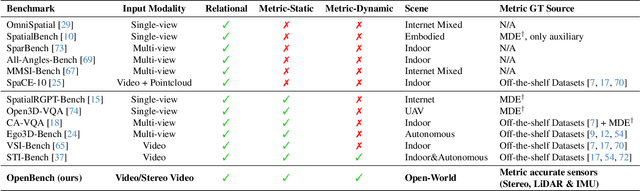
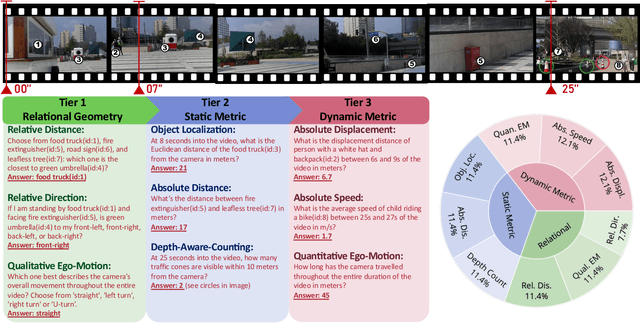
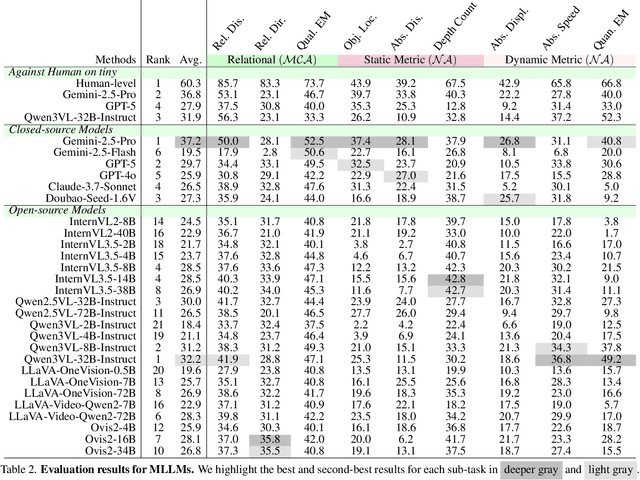
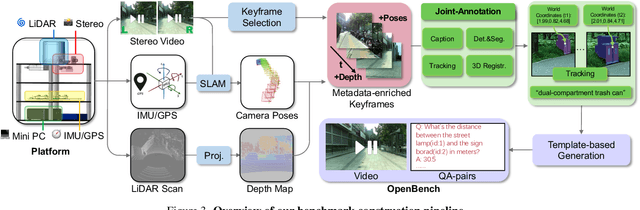
While Multimodal Large Language Models (MLLMs) have achieved impressive performance on semantic tasks, their spatial intelligence--crucial for robust and grounded AI systems--remains underdeveloped. Existing benchmarks fall short of diagnosing this limitation: they either focus on overly simplified qualitative reasoning or rely on domain-specific indoor data, constrained by the lack of outdoor datasets with verifiable metric ground truth. To bridge this gap, we introduce a large-scale benchmark built from pedestrian-perspective videos captured with synchronized stereo cameras, LiDAR, and IMU/GPS sensors. This dataset provides metrically precise 3D information, enabling the automatic generation of spatial reasoning questions that span a hierarchical spectrum--from qualitative relational reasoning to quantitative metric and kinematic understanding. Evaluations reveal that the performance gains observed in structured indoor benchmarks vanish in open-world settings. Further analysis using synthetic abnormal scenes and blinding tests confirms that current MLLMs depend heavily on linguistic priors instead of grounded visual reasoning. Our benchmark thus provides a principled platform for diagnosing these limitations and advancing physically grounded spatial intelligence.
Lightweight and Accurate Multi-View Stereo with Confidence-Aware Diffusion Model
Sep 18, 2025To reconstruct the 3D geometry from calibrated images, learning-based multi-view stereo (MVS) methods typically perform multi-view depth estimation and then fuse depth maps into a mesh or point cloud. To improve the computational efficiency, many methods initialize a coarse depth map and then gradually refine it in higher resolutions. Recently, diffusion models achieve great success in generation tasks. Starting from a random noise, diffusion models gradually recover the sample with an iterative denoising process. In this paper, we propose a novel MVS framework, which introduces diffusion models in MVS. Specifically, we formulate depth refinement as a conditional diffusion process. Considering the discriminative characteristic of depth estimation, we design a condition encoder to guide the diffusion process. To improve efficiency, we propose a novel diffusion network combining lightweight 2D U-Net and convolutional GRU. Moreover, we propose a novel confidence-based sampling strategy to adaptively sample depth hypotheses based on the confidence estimated by diffusion model. Based on our novel MVS framework, we propose two novel MVS methods, DiffMVS and CasDiffMVS. DiffMVS achieves competitive performance with state-of-the-art efficiency in run-time and GPU memory. CasDiffMVS achieves state-of-the-art performance on DTU, Tanks & Temples and ETH3D. Code is available at: https://github.com/cvg/diffmvs.
Open-Vocabulary Functional 3D Scene Graphs for Real-World Indoor Spaces
Mar 24, 2025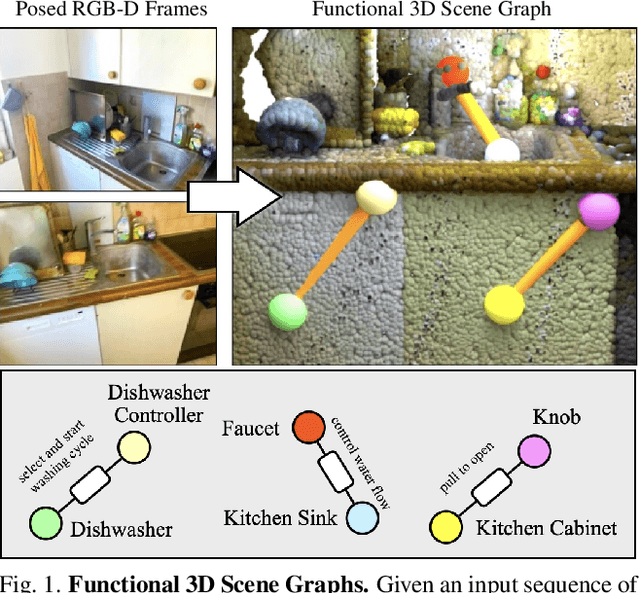
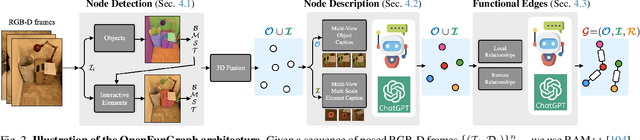
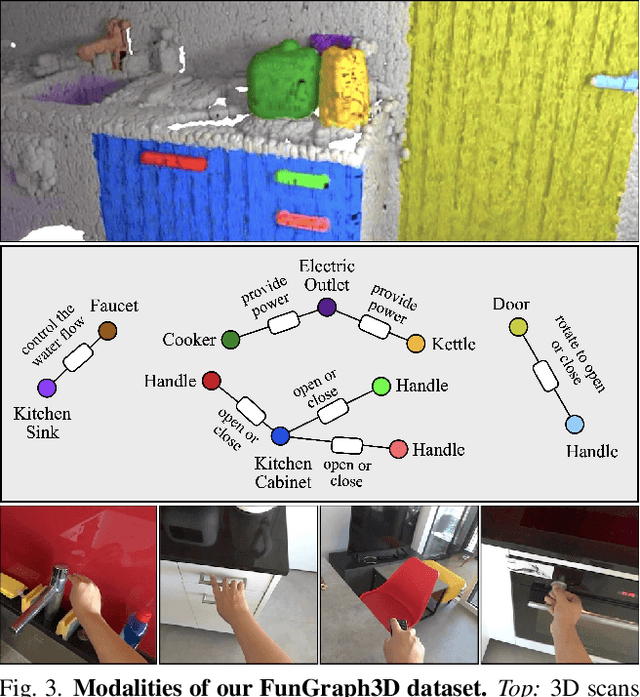
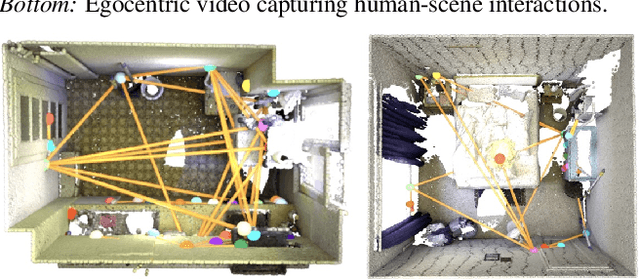
We introduce the task of predicting functional 3D scene graphs for real-world indoor environments from posed RGB-D images. Unlike traditional 3D scene graphs that focus on spatial relationships of objects, functional 3D scene graphs capture objects, interactive elements, and their functional relationships. Due to the lack of training data, we leverage foundation models, including visual language models (VLMs) and large language models (LLMs), to encode functional knowledge. We evaluate our approach on an extended SceneFun3D dataset and a newly collected dataset, FunGraph3D, both annotated with functional 3D scene graphs. Our method significantly outperforms adapted baselines, including Open3DSG and ConceptGraph, demonstrating its effectiveness in modeling complex scene functionalities. We also demonstrate downstream applications such as 3D question answering and robotic manipulation using functional 3D scene graphs. See our project page at https://openfungraph.github.io
R-SCoRe: Revisiting Scene Coordinate Regression for Robust Large-Scale Visual Localization
Jan 02, 2025
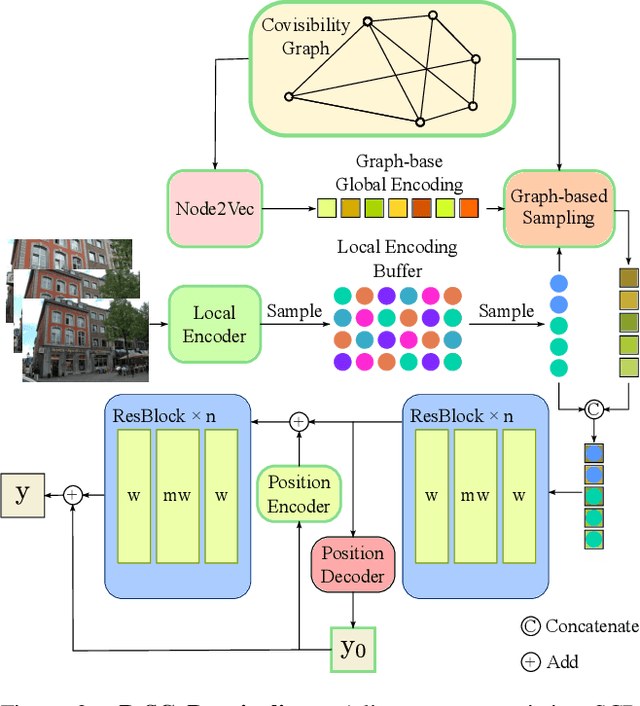

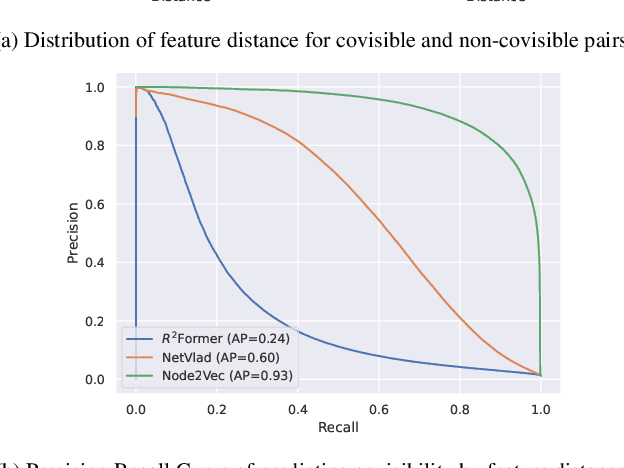
Learning-based visual localization methods that use scene coordinate regression (SCR) offer the advantage of smaller map sizes. However, on datasets with complex illumination changes or image-level ambiguities, it remains a less robust alternative to feature matching methods. This work aims to close the gap. We introduce a covisibility graph-based global encoding learning and data augmentation strategy, along with a depth-adjusted reprojection loss to facilitate implicit triangulation. Additionally, we revisit the network architecture and local feature extraction module. Our method achieves state-of-the-art on challenging large-scale datasets without relying on network ensembles or 3D supervision. On Aachen Day-Night, we are 10$\times$ more accurate than previous SCR methods with similar map sizes and require at least 5$\times$ smaller map sizes than any other SCR method while still delivering superior accuracy. Code will be available at: https://github.com/cvg/scrstudio .
DepthSplat: Connecting Gaussian Splatting and Depth
Oct 17, 2024


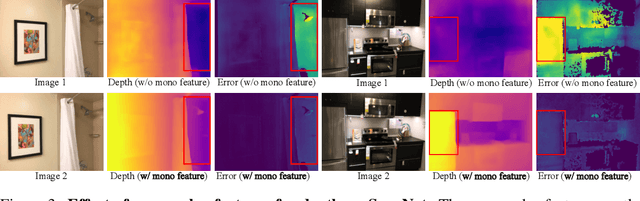
Gaussian splatting and single/multi-view depth estimation are typically studied in isolation. In this paper, we present DepthSplat to connect Gaussian splatting and depth estimation and study their interactions. More specifically, we first contribute a robust multi-view depth model by leveraging pre-trained monocular depth features, leading to high-quality feed-forward 3D Gaussian splatting reconstructions. We also show that Gaussian splatting can serve as an unsupervised pre-training objective for learning powerful depth models from large-scale unlabelled datasets. We validate the synergy between Gaussian splatting and depth estimation through extensive ablation and cross-task transfer experiments. Our DepthSplat achieves state-of-the-art performance on ScanNet, RealEstate10K and DL3DV datasets in terms of both depth estimation and novel view synthesis, demonstrating the mutual benefits of connecting both tasks. Our code, models, and video results are available at https://haofeixu.github.io/depthsplat/.