 Add to Chrome
 Add to Firefox
 Add to Edge
Inference Attack
Papers and Code
Effective Code Membership Inference for Code Completion Models via Adversarial Prompts
Nov 19, 2025
Membership inference attacks (MIAs) on code completion models offer an effective way to assess privacy risks by inferring whether a given code snippet was part of the training data. Existing black- and gray-box MIAs rely on expensive surrogate models or manually crafted heuristic rules, which limit their ability to capture the nuanced memorization patterns exhibited by over-parameterized code language models. To address these challenges, we propose AdvPrompt-MIA, a method specifically designed for code completion models, combining code-specific adversarial perturbations with deep learning. The core novelty of our method lies in designing a series of adversarial prompts that induce variations in the victim code model's output. By comparing these outputs with the ground-truth completion, we construct feature vectors to train a classifier that automatically distinguishes member from non-member samples. This design allows our method to capture richer memorization patterns and accurately infer training set membership. We conduct comprehensive evaluations on widely adopted models, such as Code Llama 7B, over the APPS and HumanEval benchmarks. The results show that our approach consistently outperforms state-of-the-art baselines, with AUC gains of up to 102%. In addition, our method exhibits strong transferability across different models and datasets, underscoring its practical utility and generalizability.

As If We've Met Before: LLMs Exhibit Certainty in Recognizing Seen Files
Nov 19, 2025The remarkable language ability of Large Language Models (LLMs) stems from extensive training on vast datasets, often including copyrighted material, which raises serious concerns about unauthorized use. While Membership Inference Attacks (MIAs) offer potential solutions for detecting such violations, existing approaches face critical limitations and challenges due to LLMs' inherent overconfidence, limited access to ground truth training data, and reliance on empirically determined thresholds. We present COPYCHECK, a novel framework that leverages uncertainty signals to detect whether copyrighted content was used in LLM training sets. Our method turns LLM overconfidence from a limitation into an asset by capturing uncertainty patterns that reliably distinguish between ``seen" (training data) and ``unseen" (non-training data) content. COPYCHECK further implements a two-fold strategy: (1) strategic segmentation of files into smaller snippets to reduce dependence on large-scale training data, and (2) uncertainty-guided unsupervised clustering to eliminate the need for empirically tuned thresholds. Experiment results show that COPYCHECK achieves an average balanced accuracy of 90.1% on LLaMA 7b and 91.6% on LLaMA2 7b in detecting seen files. Compared to the SOTA baseline, COPYCHECK achieves over 90% relative improvement, reaching up to 93.8\% balanced accuracy. It further exhibits strong generalizability across architectures, maintaining high performance on GPT-J 6B. This work presents the first application of uncertainty for copyright detection in LLMs, offering practical tools for training data transparency.
Privacy-Preserving Federated Learning from Partial Decryption Verifiable Threshold Multi-Client Functional Encryption
Nov 17, 2025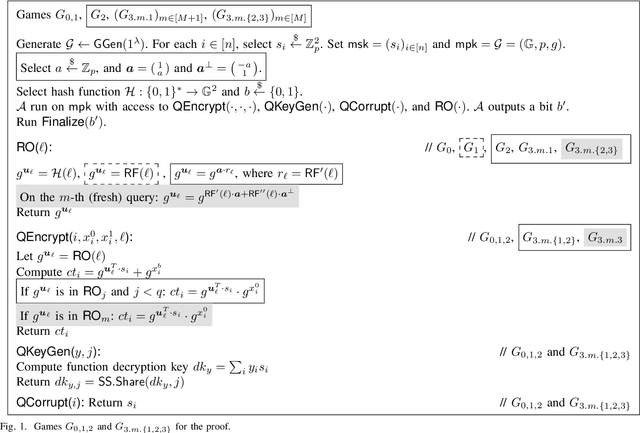
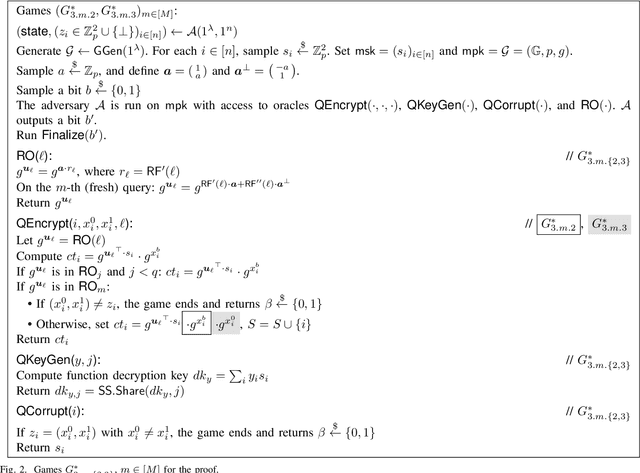
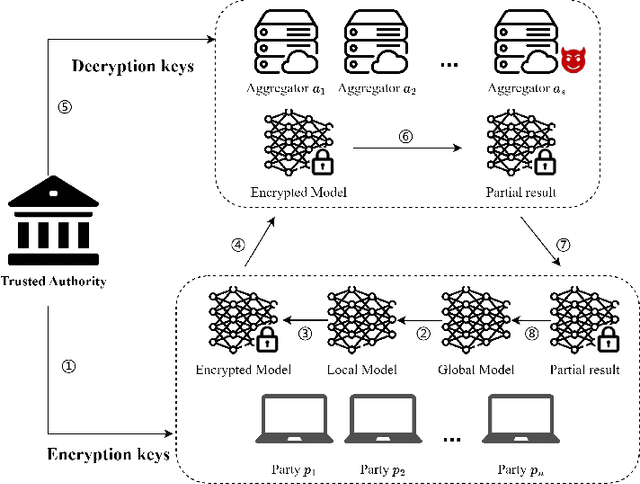

In federated learning, multiple parties can cooperate to train the model without directly exchanging their own private data, but the gradient leakage problem still threatens the privacy security and model integrity. Although the existing scheme uses threshold cryptography to mitigate the inference attack, it can not guarantee the verifiability of the aggregation results, making the system vulnerable to the threat of poisoning attack. We construct a partial decryption verifiable threshold multi client function encryption scheme, and apply it to Federated learning to implement the federated learning verifiable threshold security aggregation protocol (VTSAFL). VTSAFL empowers clients to verify aggregation results, concurrently minimizing both computational and communication overhead. The size of the functional key and partial decryption results of the scheme are constant, which provides efficiency guarantee for large-scale deployment. The experimental results on MNIST dataset show that vtsafl can achieve the same accuracy as the existing scheme, while reducing the total training time by more than 40%, and reducing the communication overhead by up to 50%. This efficiency is critical for overcoming the resource constraints inherent in Internet of Things (IoT) devices.
Embedding-Space Data Augmentation to Prevent Membership Inference Attacks in Clinical Time Series Forecasting
Nov 07, 2025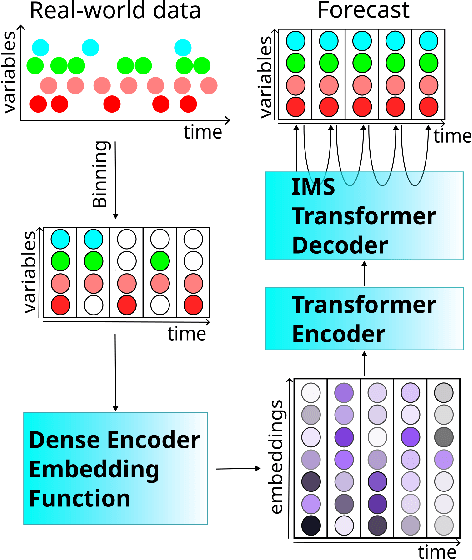

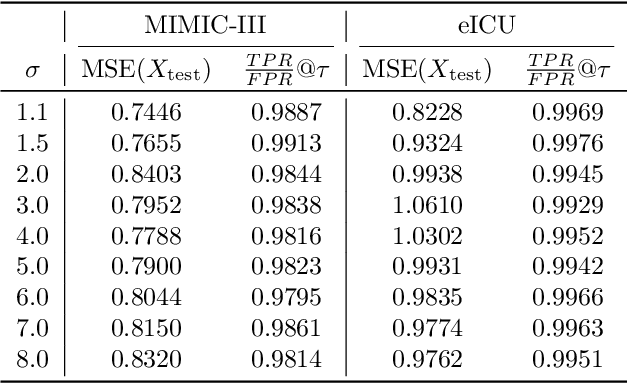
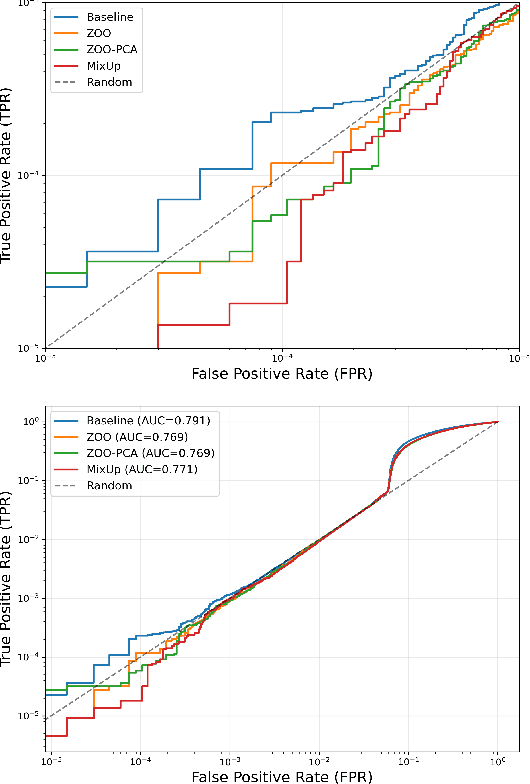
Balancing strong privacy guarantees with high predictive performance is critical for time series forecasting (TSF) tasks involving Electronic Health Records (EHR). In this study, we explore how data augmentation can mitigate Membership Inference Attacks (MIA) on TSF models. We show that retraining with synthetic data can substantially reduce the effectiveness of loss-based MIAs by reducing the attacker's true-positive to false-positive ratio. The key challenge is generating synthetic samples that closely resemble the original training data to confuse the attacker, while also introducing enough novelty to enhance the model's ability to generalize to unseen data. We examine multiple augmentation strategies - Zeroth-Order Optimization (ZOO), a variant of ZOO constrained by Principal Component Analysis (ZOO-PCA), and MixUp - to strengthen model resilience without sacrificing accuracy. Our experimental results show that ZOO-PCA yields the best reductions in TPR/FPR ratio for MIA attacks without sacrificing performance on test data.
When Large Language Models Do Not Work: Online Incivility Prediction through Graph Neural Networks
Dec 08, 2025Online incivility has emerged as a widespread and persistent problem in digital communities, imposing substantial social and psychological burdens on users. Although many platforms attempt to curb incivility through moderation and automated detection, the performance of existing approaches often remains limited in both accuracy and efficiency. To address this challenge, we propose a Graph Neural Network (GNN) framework for detecting three types of uncivil behavior (i.e., toxicity, aggression, and personal attacks) within the English Wikipedia community. Our model represents each user comment as a node, with textual similarity between comments defining the edges, allowing the network to jointly learn from both linguistic content and relational structures among comments. We also introduce a dynamically adjusted attention mechanism that adaptively balances nodal and topological features during information aggregation. Empirical evaluations demonstrate that our proposed architecture outperforms 12 state-of-the-art Large Language Models (LLMs) across multiple metrics while requiring significantly lower inference cost. These findings highlight the crucial role of structural context in detecting online incivility and address the limitations of text-only LLM paradigms in behavioral prediction. All datasets and comparative outputs will be publicly available in our repository to support further research and reproducibility.
P-MIA: A Profiled-Based Membership Inference Attack on Cognitive Diagnosis Models
Nov 06, 2025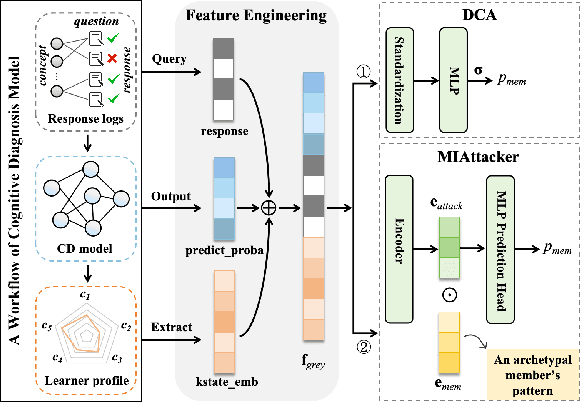
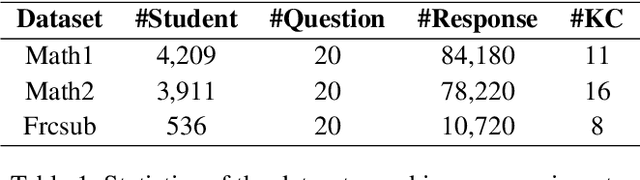
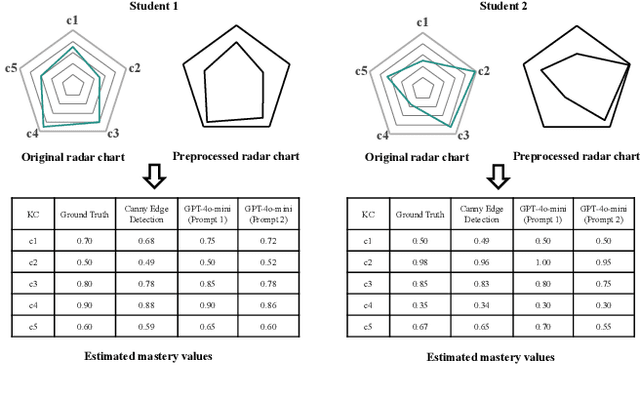
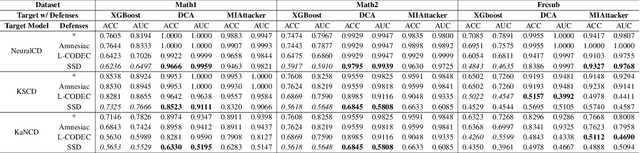
Cognitive diagnosis models (CDMs) are pivotal for creating fine-grained learner profiles in modern intelligent education platforms. However, these models are trained on sensitive student data, raising significant privacy concerns. While membership inference attacks (MIA) have been studied in various domains, their application to CDMs remains a critical research gap, leaving their privacy risks unquantified. This paper is the first to systematically investigate MIA against CDMs. We introduce a novel and realistic grey box threat model that exploits the explainability features of these platforms, where a model's internal knowledge state vectors are exposed to users through visualizations such as radar charts. We demonstrate that these vectors can be accurately reverse-engineered from such visualizations, creating a potent attack surface. Based on this threat model, we propose a profile-based MIA (P-MIA) framework that leverages both the model's final prediction probabilities and the exposed internal knowledge state vectors as features. Extensive experiments on three real-world datasets against mainstream CDMs show that our grey-box attack significantly outperforms standard black-box baselines. Furthermore, we showcase the utility of P-MIA as an auditing tool by successfully evaluating the efficacy of machine unlearning techniques and revealing their limitations.
CAT: Can Trust be Predicted with Context-Awareness in Dynamic Heterogeneous Networks?
Dec 12, 2025Trust prediction provides valuable support for decision-making, risk mitigation, and system security enhancement. Recently, Graph Neural Networks (GNNs) have emerged as a promising approach for trust prediction, owing to their ability to learn expressive node representations that capture intricate trust relationships within a network. However, current GNN-based trust prediction models face several limitations: (i) Most of them fail to capture trust dynamicity, leading to questionable inferences. (ii) They rarely consider the heterogeneous nature of real-world networks, resulting in a loss of rich semantics. (iii) None of them support context-awareness, a basic property of trust, making prediction results coarse-grained. To this end, we propose CAT, the first Context-Aware GNN-based Trust prediction model that supports trust dynamicity and accurately represents real-world heterogeneity. CAT consists of a graph construction layer, an embedding layer, a heterogeneous attention layer, and a prediction layer. It handles dynamic graphs using continuous-time representations and captures temporal information through a time encoding function. To model graph heterogeneity and leverage semantic information, CAT employs a dual attention mechanism that identifies the importance of different node types and nodes within each type. For context-awareness, we introduce a new notion of meta-paths to extract contextual features. By constructing context embeddings and integrating a context-aware aggregator, CAT can predict both context-aware trust and overall trust. Extensive experiments on three real-world datasets demonstrate that CAT outperforms five groups of baselines in trust prediction, while exhibiting strong scalability to large-scale graphs and robustness against both trust-oriented and GNN-oriented attacks.
Democratizing ML for Enterprise Security: A Self-Sustained Attack Detection Framework
Dec 09, 2025Despite advancements in machine learning for security, rule-based detection remains prevalent in Security Operations Centers due to the resource intensiveness and skill gap associated with ML solutions. While traditional rule-based methods offer efficiency, their rigidity leads to high false positives or negatives and requires continuous manual maintenance. This paper proposes a novel, two-stage hybrid framework to democratize ML-based threat detection. The first stage employs intentionally loose YARA rules for coarse-grained filtering, optimized for high recall. The second stage utilizes an ML classifier to filter out false positives from the first stage's output. To overcome data scarcity, the system leverages Simula, a seedless synthetic data generation framework, enabling security analysts to create high-quality training datasets without extensive data science expertise or pre-labeled examples. A continuous feedback loop incorporates real-time investigation results to adaptively tune the ML model, preventing rule degradation. This proposed model with active learning has been rigorously tested for a prolonged time in a production environment spanning tens of thousands of systems. The system handles initial raw log volumes often reaching 250 billion events per day, significantly reducing them through filtering and ML inference to a handful of daily tickets for human investigation. Live experiments over an extended timeline demonstrate a general improvement in the model's precision over time due to the active learning feature. This approach offers a self-sustained, low-overhead, and low-maintenance solution, allowing security professionals to guide model learning as expert ``teachers''.
MedFedPure: A Medical Federated Framework with MAE-based Detection and Diffusion Purification for Inference-Time Attacks
Nov 07, 2025Artificial intelligence (AI) has shown great potential in medical imaging, particularly for brain tumor detection using Magnetic Resonance Imaging (MRI). However, the models remain vulnerable at inference time when they are trained collaboratively through Federated Learning (FL), an approach adopted to protect patient privacy. Adversarial attacks can subtly alter medical scans in ways invisible to the human eye yet powerful enough to mislead AI models, potentially causing serious misdiagnoses. Existing defenses often assume centralized data and struggle to cope with the decentralized and diverse nature of federated medical settings. In this work, we present MedFedPure, a personalized federated learning defense framework designed to protect diagnostic AI models at inference time without compromising privacy or accuracy. MedFedPure combines three key elements: (1) a personalized FL model that adapts to the unique data distribution of each institution; (2) a Masked Autoencoder (MAE) that detects suspicious inputs by exposing hidden perturbations; and (3) an adaptive diffusion-based purification module that selectively cleans only the flagged scans before classification. Together, these steps offer robust protection while preserving the integrity of normal, benign images. We evaluated MedFedPure on the Br35H brain MRI dataset. The results show a significant gain in adversarial robustness, improving performance from 49.50% to 87.33% under strong attacks, while maintaining a high clean accuracy of 97.67%. By operating locally and in real time during diagnosis, our framework provides a practical path to deploying secure, trustworthy, and privacy-preserving AI tools in clinical workflows. Index Terms: cancer, tumor detection, federated learning, masked autoencoder, diffusion, privacy
Beyond Pixels: Semantic-aware Typographic Attack for Geo-Privacy Protection
Nov 16, 2025Large Visual Language Models (LVLMs) now pose a serious yet overlooked privacy threat, as they can infer a social media user's geolocation directly from shared images, leading to unintended privacy leakage. While adversarial image perturbations provide a potential direction for geo-privacy protection, they require relatively strong distortions to be effective against LVLMs, which noticeably degrade visual quality and diminish an image's value for sharing. To overcome this limitation, we identify typographical attacks as a promising direction for protecting geo-privacy by adding text extension outside the visual content. We further investigate which textual semantics are effective in disrupting geolocation inference and design a two-stage, semantics-aware typographical attack that generates deceptive text to protect user privacy. Extensive experiments across three datasets demonstrate that our approach significantly reduces geolocation prediction accuracy of five state-of-the-art commercial LVLMs, establishing a practical and visually-preserving protection strategy against emerging geo-privacy threats.