 Add to Chrome
 Add to Firefox
 Add to Edge
EgoHieraLoc: A Cortically Inspired Hierarchical Segmentation-Guided Framework for Egocentric Visual Query Localization
Aug 10, 2026
Visual query localization (VQL) aims to retrieve and re-localize a queried object in egocentric videos, yet remains challenging when object boundaries are ambiguous and global context cannot effectively guide fine-grained localization. Human vision handles such ambiguity through a hierarchical process: it rapidly screens foreground candidates, selectively attends to the target despite distractors, refines perception via feedback between global context and local detail, and, when a single view is unreliable, integrates evidence across viewpoints according to its credibility. Inspired by these competencies, we propose \textbf{EgoHieraLoc}, a unified framework for VQL-2D and VQL-3D. A Discriminative Parsing Module first extracts foreground-aware query representations using segmentation priors; a Query-Aware Module then performs robust target localization through discriminative correlation filtering with deformable modeling; and a Regional Adaptation Module feeds multi-scale context back into local regions to recover precise object boundaries. To extend this perceptual hierarchy to 3D localization, we introduce Geometric-Semantic Joint Confidence (GSJC), which multiplicatively couples segmentation confidence with local depth consistency, multi-view back-projection consistency, and triangulation-baseline quality, so that a viewpoint contributes to the 3D estimate only when it is credible both semantically and geometrically. Extensive experiments demonstrate state-of-the-art performance on both VQL-2D and -3D benchmarks.

UFO: A Unified Flow-Oriented Framework for Robust Continual Graph Learning
May 11, 2026Graph learning research has increasingly shifted toward continual graph learning (CGL), which better reflects real-world scenarios where graphs evolve over time. However, existing CGL methods largely assume clean supervision and overlook a critical challenge: the newly arriving portions of the graph are often noisy, due to annotation errors or adversarial corruption. This mismatch limits their applicability in practice. In this work, we study robust continual graph learning, where models must simultaneously handle catastrophic forgetting and noisy supervision in evolving graph data. We show that label noise introduces a new failure mode, catastrophic remembering, where models persistently reinforce corrupted knowledge across tasks. To address these challenges, we propose a Unified Flow-Oriented framework (UFO). First, UFO models conditional feature distributions via flow-based generative modeling and produces replay representations, mitigating forgetting without storing historical data. Second, UFO estimates instance-level reliability scores to distinguish clean from noisy nodes, reducing the impact of corrupted supervision and alleviating catastrophic remembering. Extensive experiments on four benchmark graph datasets under varying noise ratios demonstrate that UFO consistently outperforms existing methods in both accuracy and forgetting metrics. Code is available at: https://anonymous.4open.science/r/UFO.
Prototype-Enhanced Multi-View Learning for Thyroid Nodule Ultrasound Classification
Mar 30, 2026Thyroid nodule classification using ultrasound imaging is essential for early diagnosis and clinical decision-making; however, despite promising performance on in-distribution data, existing deep learning methods often exhibit limited robustness and generalisation when deployed across different ultrasound devices or clinical environments. This limitation is mainly attributed to the pronounced heterogeneity of thyroid ultrasound images, which can lead models to capture spurious correlations rather than reliable diagnostic cues. To address this challenge, we propose PEMV-thyroid, a Prototype-Enhanced Multi-View learning framework that accounts for data heterogeneity by learning complementary representations from multiple feature perspectives and refining decision boundaries through a prototype-based correction mechanism with mixed prototype information. By integrating multi-view representations with prototype-level guidance, the proposed approach enables more stable representation learning under heterogeneous imaging conditions. Extensive experiments on multiple thyroid ultrasound datasets demonstrate that PEMV-thyroid consistently outperforms state-of-the-art methods, particularly in cross-device and cross-domain evaluation scenarios, leading to improved diagnostic accuracy and generalisation performance in real-world clinical settings. The source code is available at https://github.com/chenyangmeii/Prototype-Enhanced-Multi-View-Learning.
NeiGAD: Augmenting Graph Anomaly Detection via Spectral Neighbor Information
Mar 30, 2026Graph anomaly detection (GAD) aims to identify irregular nodes or structures in attributed graphs. Neighbor information, which reflects both structural connectivity and attribute consistency with surrounding nodes, is essential for distinguishing anomalies from normal patterns. Although recent graph neural network (GNN)-based methods incorporate such information through message passing, they often fail to explicitly model its effect or interaction with attributes, limiting detection performance. This work introduces NeiGAD, a novel plug-and-play module that captures neighbor information through spectral graph analysis. Theoretical insights demonstrate that eigenvectors of the adjacency matrix encode local neighbor interactions and progressively amplify anomaly signals. Based on this, NeiGAD selects a compact set of eigenvectors to construct efficient and discriminative representations. Experiments on eight real-world datasets show that NeiGAD consistently improves detection accuracy and outperforms state-of-the-art GAD methods. These results demonstrate the importance of explicit neighbor modeling and the effectiveness of spectral analysis in anomaly detection. Code is available at: https://github.com/huafeihuang/NeiGAD.
FairGC: Fairness-aware Graph Condensation
Mar 30, 2026Graph condensation (GC) has become a vital strategy for scaling Graph Neural Networks by compressing massive datasets into small, synthetic node sets. While current GC methods effectively maintain predictive accuracy, they are primarily designed for utility and often ignore fairness constraints. Because these techniques are bias-blind, they frequently capture and even amplify demographic disparities found in the original data. This leads to synthetic proxies that are unsuitable for sensitive applications like credit scoring or social recommendations. To solve this problem, we introduce FairGC, a unified framework that embeds fairness directly into the graph distillation process. Our approach consists of three key components. First, a Distribution-Preserving Condensation module synchronizes the joint distributions of labels and sensitive attributes to stop bias from spreading. Second, a Spectral Encoding module uses Laplacian eigen-decomposition to preserve essential global structural patterns. Finally, a Fairness-Enhanced Neural Architecture employs multi-domain fusion and a label-smoothing curriculum to produce equitable predictions. Rigorous evaluations on four real-world datasets, show that FairGC provides a superior balance between accuracy and fairness. Our results confirm that FairGC significantly reduces disparity in Statistical Parity and Equal Opportunity compared to existing state-of-the-art condensation models. The codes are available at https://github.com/LuoRenqiang/FairGC.
Bridging Semantic Understanding and Popularity Bias with LLMs
Jan 15, 2026Semantic understanding of popularity bias is a crucial yet underexplored challenge in recommender systems, where popular items are often favored at the expense of niche content. Most existing debiasing methods treat the semantic understanding of popularity bias as a matter of diversity enhancement or long-tail coverage, neglecting the deeper semantic layer that embodies the causal origins of the bias itself. Consequently, such shallow interpretations limit both their debiasing effectiveness and recommendation accuracy. In this paper, we propose FairLRM, a novel framework that bridges the gap in the semantic understanding of popularity bias with Recommendation via Large Language Model (RecLLM). FairLRM decomposes popularity bias into item-side and user-side components, using structured instruction-based prompts to enhance the model's comprehension of both global item distributions and individual user preferences. Unlike traditional methods that rely on surface-level features such as "diversity" or "debiasing", FairLRM improves the model's ability to semantically interpret and address the underlying bias. Through empirical evaluation, we show that FairLRM significantly enhances both fairness and recommendation accuracy, providing a more semantically aware and trustworthy approach to enhance the semantic understanding of popularity bias. The implementation is available at https://github.com/LuoRenqiang/FairLRM.
FairGU: Fairness-aware Graph Unlearning in Social Network
Jan 14, 2026Graph unlearning has emerged as a critical mechanism for supporting sustainable and privacy-preserving social networks, enabling models to remove the influence of deleted nodes and thereby better safeguard user information. However, we observe that existing graph unlearning techniques insufficiently protect sensitive attributes, often leading to degraded algorithmic fairness compared with traditional graph learning methods. To address this gap, we introduce FairGU, a fairness-aware graph unlearning framework designed to preserve both utility and fairness during the unlearning process. FairGU integrates a dedicated fairness-aware module with effective data protection strategies, ensuring that sensitive attributes are neither inadvertently amplified nor structurally exposed when nodes are removed. Through extensive experiments on multiple real-world datasets, we demonstrate that FairGU consistently outperforms state-of-the-art graph unlearning methods and fairness-enhanced graph learning baselines in terms of both accuracy and fairness metrics. Our findings highlight a previously overlooked risk in current unlearning practices and establish FairGU as a robust and equitable solution for the next generation of socially sustainable networked systems. The codes are available at https://github.com/LuoRenqiang/FairGU.
FairGE: Fairness-Aware Graph Encoding in Incomplete Social Networks
Jan 14, 2026Graph Transformers (GTs) are increasingly applied to social network analysis, yet their deployment is often constrained by fairness concerns. This issue is particularly critical in incomplete social networks, where sensitive attributes are frequently missing due to privacy and ethical restrictions. Existing solutions commonly generate these incomplete attributes, which may introduce additional biases and further compromise user privacy. To address this challenge, FairGE (Fair Graph Encoding) is introduced as a fairness-aware framework for GTs in incomplete social networks. Instead of generating sensitive attributes, FairGE encodes fairness directly through spectral graph theory. By leveraging the principal eigenvector to represent structural information and padding incomplete sensitive attributes with zeros to maintain independence, FairGE ensures fairness without data reconstruction. Theoretical analysis demonstrates that the method suppresses the influence of non-principal spectral components, thereby enhancing fairness. Extensive experiments on seven real-world social network datasets confirm that FairGE achieves at least a 16% improvement in both statistical parity and equality of opportunity compared with state-of-the-art baselines. The source code is shown in https://github.com/LuoRenqiang/FairGE.
PrivacyCD: Hierarchical Unlearning for Protecting Student Privacy in Cognitive Diagnosis
Nov 06, 2025The need to remove specific student data from cognitive diagnosis (CD) models has become a pressing requirement, driven by users' growing assertion of their "right to be forgotten". However, existing CD models are largely designed without privacy considerations and lack effective data unlearning mechanisms. Directly applying general purpose unlearning algorithms is suboptimal, as they struggle to balance unlearning completeness, model utility, and efficiency when confronted with the unique heterogeneous structure of CD models. To address this, our paper presents the first systematic study of the data unlearning problem for CD models, proposing a novel and efficient algorithm: hierarchical importanceguided forgetting (HIF). Our key insight is that parameter importance in CD models exhibits distinct layer wise characteristics. HIF leverages this via an innovative smoothing mechanism that combines individual and layer, level importance, enabling a more precise distinction of parameters associated with the data to be unlearned. Experiments on three real world datasets show that HIF significantly outperforms baselines on key metrics, offering the first effective solution for CD models to respond to user data removal requests and for deploying high-performance, privacy preserving AI systems
P-MIA: A Profiled-Based Membership Inference Attack on Cognitive Diagnosis Models
Nov 06, 2025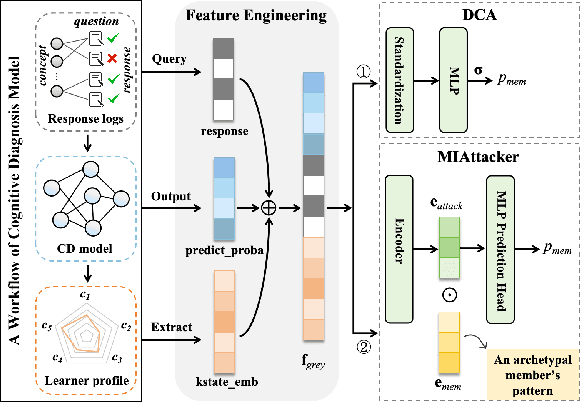
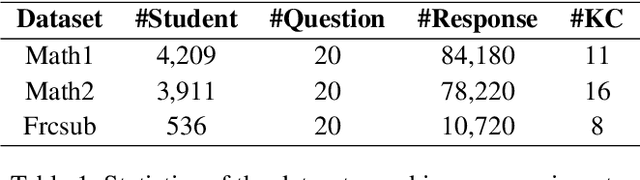
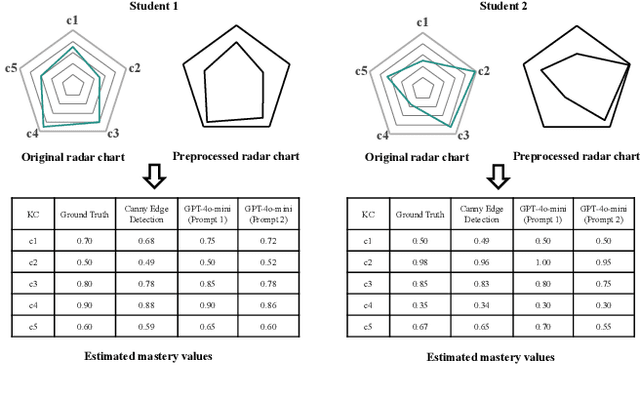
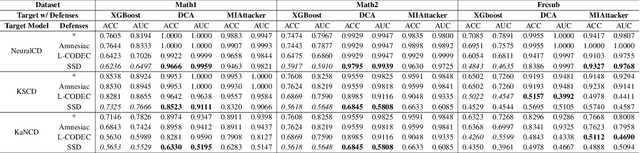
Cognitive diagnosis models (CDMs) are pivotal for creating fine-grained learner profiles in modern intelligent education platforms. However, these models are trained on sensitive student data, raising significant privacy concerns. While membership inference attacks (MIA) have been studied in various domains, their application to CDMs remains a critical research gap, leaving their privacy risks unquantified. This paper is the first to systematically investigate MIA against CDMs. We introduce a novel and realistic grey box threat model that exploits the explainability features of these platforms, where a model's internal knowledge state vectors are exposed to users through visualizations such as radar charts. We demonstrate that these vectors can be accurately reverse-engineered from such visualizations, creating a potent attack surface. Based on this threat model, we propose a profile-based MIA (P-MIA) framework that leverages both the model's final prediction probabilities and the exposed internal knowledge state vectors as features. Extensive experiments on three real-world datasets against mainstream CDMs show that our grey-box attack significantly outperforms standard black-box baselines. Furthermore, we showcase the utility of P-MIA as an auditing tool by successfully evaluating the efficacy of machine unlearning techniques and revealing their limitations.