 Add to Chrome
 Add to Firefox
 Add to Edge
Effective Code Membership Inference for Code Completion Models via Adversarial Prompts
Nov 19, 2025
Membership inference attacks (MIAs) on code completion models offer an effective way to assess privacy risks by inferring whether a given code snippet was part of the training data. Existing black- and gray-box MIAs rely on expensive surrogate models or manually crafted heuristic rules, which limit their ability to capture the nuanced memorization patterns exhibited by over-parameterized code language models. To address these challenges, we propose AdvPrompt-MIA, a method specifically designed for code completion models, combining code-specific adversarial perturbations with deep learning. The core novelty of our method lies in designing a series of adversarial prompts that induce variations in the victim code model's output. By comparing these outputs with the ground-truth completion, we construct feature vectors to train a classifier that automatically distinguishes member from non-member samples. This design allows our method to capture richer memorization patterns and accurately infer training set membership. We conduct comprehensive evaluations on widely adopted models, such as Code Llama 7B, over the APPS and HumanEval benchmarks. The results show that our approach consistently outperforms state-of-the-art baselines, with AUC gains of up to 102%. In addition, our method exhibits strong transferability across different models and datasets, underscoring its practical utility and generalizability.

Enhancing High-Quality Code Generation in Large Language Models with Comparative Prefix-Tuning
Mar 12, 2025Large Language Models (LLMs) have been widely adopted in commercial code completion engines, significantly enhancing coding efficiency and productivity. However, LLMs may generate code with quality issues that violate coding standards and best practices, such as poor code style and maintainability, even when the code is functionally correct. This necessitates additional effort from developers to improve the code, potentially negating the efficiency gains provided by LLMs. To address this problem, we propose a novel comparative prefix-tuning method for controllable high-quality code generation. Our method introduces a single, property-specific prefix that is prepended to the activations of the LLM, serving as a lightweight alternative to fine-tuning. Unlike existing methods that require training multiple prefixes, our approach trains only one prefix and leverages pairs of high-quality and low-quality code samples, introducing a sequence-level ranking loss to guide the model's training. This comparative approach enables the model to better understand the differences between high-quality and low-quality code, focusing on aspects that impact code quality. Additionally, we design a data construction pipeline to collect and annotate pairs of high-quality and low-quality code, facilitating effective training. Extensive experiments on the Code Llama 7B model demonstrate that our method improves code quality by over 100% in certain task categories, while maintaining functional correctness. We also conduct ablation studies and generalization experiments, confirming the effectiveness of our method's components and its strong generalization capability.
Augmenting the Veracity and Explanations of Complex Fact Checking via Iterative Self-Revision with LLMs
Oct 19, 2024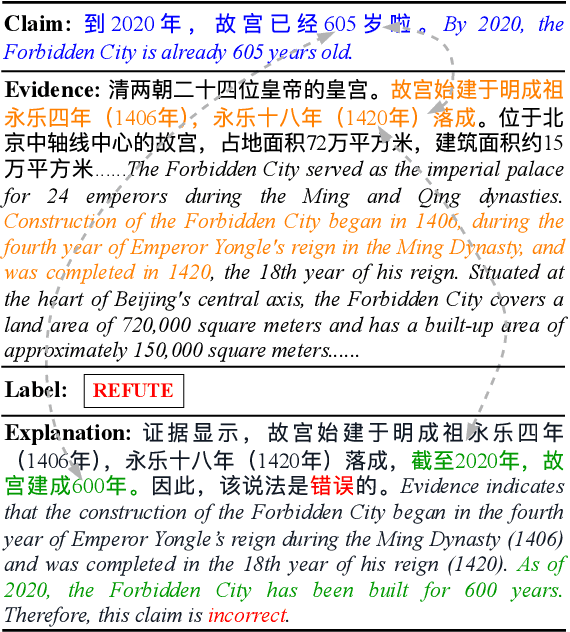


Explanation generation plays a more pivotal role than fact verification in producing interpretable results and facilitating comprehensive fact-checking, which has recently garnered considerable attention. However, previous studies on explanation generation has shown several limitations, such as being confined to English scenarios, involving overly complex inference processes, and not fully unleashing the potential of the mutual feedback between veracity labels and explanation texts. To address these issues, we construct two complex fact-checking datasets in the Chinese scenarios: CHEF-EG and TrendFact. These datasets involve complex facts in areas such as health, politics, and society, presenting significant challenges for fact verification methods. In response to these challenges, we propose a unified framework called FactISR (Augmenting Fact-Checking via Iterative Self-Revision) to perform mutual feedback between veracity and explanations by leveraging the capabilities of large language models(LLMs). FactISR uses a single model to address tasks such as fact verification and explanation generation. Its self-revision mechanism can further revision the consistency between veracity labels, explanation texts, and evidence, as well as eliminate irrelevant noise. We conducted extensive experiments with baselines and FactISR on the proposed datasets. The experimental results demonstrate the effectiveness of our method.