 Add to Chrome
 Add to Firefox
 Add to Edge
MedFedPure: A Medical Federated Framework with MAE-based Detection and Diffusion Purification for Inference-Time Attacks
Nov 07, 2025
Artificial intelligence (AI) has shown great potential in medical imaging, particularly for brain tumor detection using Magnetic Resonance Imaging (MRI). However, the models remain vulnerable at inference time when they are trained collaboratively through Federated Learning (FL), an approach adopted to protect patient privacy. Adversarial attacks can subtly alter medical scans in ways invisible to the human eye yet powerful enough to mislead AI models, potentially causing serious misdiagnoses. Existing defenses often assume centralized data and struggle to cope with the decentralized and diverse nature of federated medical settings. In this work, we present MedFedPure, a personalized federated learning defense framework designed to protect diagnostic AI models at inference time without compromising privacy or accuracy. MedFedPure combines three key elements: (1) a personalized FL model that adapts to the unique data distribution of each institution; (2) a Masked Autoencoder (MAE) that detects suspicious inputs by exposing hidden perturbations; and (3) an adaptive diffusion-based purification module that selectively cleans only the flagged scans before classification. Together, these steps offer robust protection while preserving the integrity of normal, benign images. We evaluated MedFedPure on the Br35H brain MRI dataset. The results show a significant gain in adversarial robustness, improving performance from 49.50% to 87.33% under strong attacks, while maintaining a high clean accuracy of 97.67%. By operating locally and in real time during diagnosis, our framework provides a practical path to deploying secure, trustworthy, and privacy-preserving AI tools in clinical workflows. Index Terms: cancer, tumor detection, federated learning, masked autoencoder, diffusion, privacy

HyCoVAD: A Hybrid SSL-LLM Model for Complex Video Anomaly Detection
Sep 26, 2025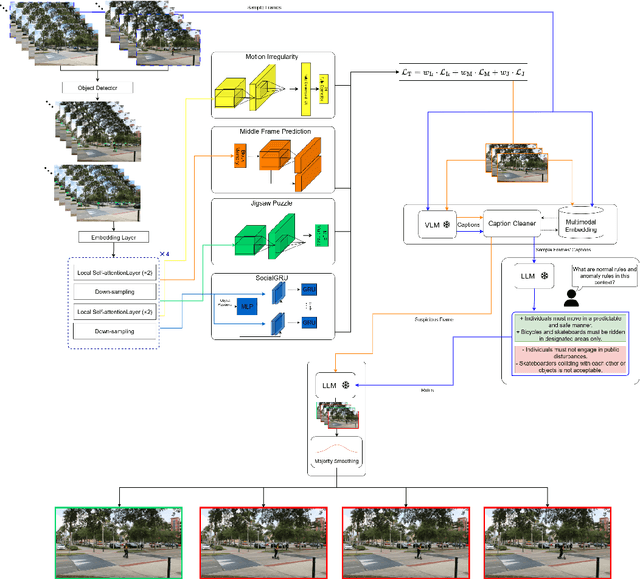
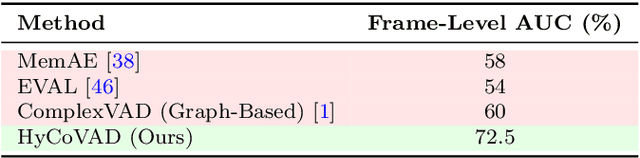
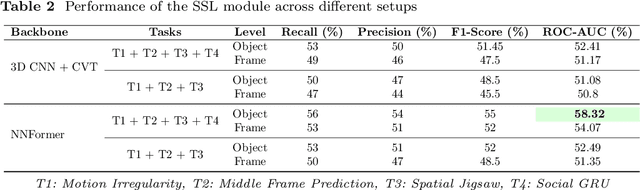
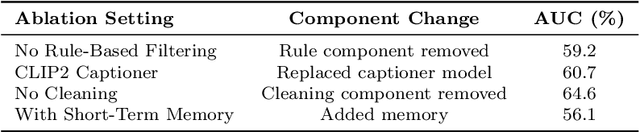
Video anomaly detection (VAD) is crucial for intelligent surveillance, but a significant challenge lies in identifying complex anomalies, which are events defined by intricate relationships and temporal dependencies among multiple entities rather than by isolated actions. While self-supervised learning (SSL) methods effectively model low-level spatiotemporal patterns, they often struggle to grasp the semantic meaning of these interactions. Conversely, large language models (LLMs) offer powerful contextual reasoning but are computationally expensive for frame-by-frame analysis and lack fine-grained spatial localization. We introduce HyCoVAD, Hybrid Complex Video Anomaly Detection, a hybrid SSL-LLM model that combines a multi-task SSL temporal analyzer with LLM validator. The SSL module is built upon an nnFormer backbone which is a transformer-based model for image segmentation. It is trained with multiple proxy tasks, learns from video frames to identify those suspected of anomaly. The selected frames are then forwarded to the LLM, which enriches the analysis with semantic context by applying structured, rule-based reasoning to validate the presence of anomalies. Experiments on the challenging ComplexVAD dataset show that HyCoVAD achieves a 72.5% frame-level AUC, outperforming existing baselines by 12.5% while reducing LLM computation. We release our interaction anomaly taxonomy, adaptive thresholding protocol, and code to facilitate future research in complex VAD scenarios.