 Add to Chrome
 Add to Firefox
 Add to Edge
Lapis: Laplacian Spiking Attention via First-Spike Timing and Membrane Leakage
Aug 12, 2026
Self-attention has become central to spiking vision transformers, yet its query-key scoring is still largely inherited from dense networks. Existing spiking variants either simplify dot product scoring or replace it with discrete operators, but spike timing, the native variable of a spiking network, does not directly define how tokens are related. We propose Lapis, a spiking attention mechanism that scores each token pair by the L1 distance between its query and key first-spike latency vectors under time-to-first-spike coding, and maps this distance to an affinity through a Laplacian kernel. The kernel's exponential decay matches the impulse response of a leaky integrate-and-fire membrane, so the accumulated latency difference determines the decay of a membrane trace, while row normalization reduces to a bit shift under power-of-two rounding. Scoring therefore needs only subtraction, absolute value, and accumulation, and removes all multiplication between query and key channels. Under a matched backbone and training schedule, Lapis reaches 96.56% top-1 accuracy on CIFAR-10, within 0.53 points of dot-product scoring. On ImageNet-1K, it reduces the estimated arithmetic energy of the attention path by 14.5x relative to dense dot-product attention. The deployed 6-bit model attains 83.25% top-1 accuracy at an estimated arithmetic energy of 3.28mJ per image.

UniETP: Unifying Environments for Generalizable Embodied Task Planning
Jul 20, 2026This paper focuses on the problem of Embodied Task Planning, where an agent is required to execute a sequence of atomic actions within an interactive environment to complete a user-specified task. Though a variety of simulators and datasets have previously been built for this task, these efforts are largely isolated, with each using its own observation format, action type, and task domain. This fragmentation complicates comprehensive model evaluation and hinders the scalability of training data. As an effort towards generalizable embodied planning, we propose UniETP, a unified interface integrating four commonly-used simulators (AI2-THOR, VirtualHome, Habitat, BEHAVIOR). UniETP is characterized by both standardization and diversity. On one hand, it formalizes all the simulators into a consistent observation and action space, and builds an evaluation system to support complicated task goal. On the other hand, it enhances task diversity and complexity across dimensions like task logic, instance grounding, and instruction understanding, constructing a new dataset with varied levels of difficulty in an automatic manner. Extensive experiments on the proposed benchmark are conducted to evaluate the embodied planning capabilities of recent models and analyze the performance bottlenecks. Codes and data will be available at https://github.com/woyut/UniETP .
UBEP: Re-architecting Expert Parallelism Communication Library for Production Superpods
Jul 08, 2026The deployment of Mixture-of-Experts (MoE) models on production high-bandwidth superpods, such as NVIDIA's NVL72/576 and Huawei's CloudMatrix384, introduces critical challenges beyond raw interconnect bandwidth. While these systems provide unified global address spaces and high-bandwidth fabrics, their full potential for sparse MoE communication is hindered by three fundamental bottlenecks: (1) Strict execution serialization imposed by coarse-grained Bulk Synchronous Parallel (BSP) orchestration of interdependent communication phases; (2) Prohibitive synchronization overhead that fails to scale alongside high interconnect bandwidth; and (3) Severe load imbalance resulting from distance-agnostic scheduling of irregular token traffic. To eliminate these bottlenecks, we introduce UBEP (Unified-Bus Expert Parallelism), a production-ready communication library that rethinks MoE's All-to-All primitives for modern superpod architectures. Through large scale experiments, UBEP reduces All-to-All latency by up to 52.4% and MoE inference Time Per Output Token (TPOT) by up to 11.1%.
ShiftLIF: Efficient Multi-Level Spiking Neurons with Power-of-Two Quantization
May 03, 2026Spiking neural networks (SNNs) are promising for edge sensing due to their event-driven computation and temporal filtering capability. However, standard leaky integrate-and-fire (LIF) neurons communicate only through binary spikes, which severely limit representational capacity. Existing multi-level spiking neurons improve information transmission, but often rely on uniform quantization that mismatches membrane-potential distributions or introduces costly synaptic multiplications. In this paper, we propose ShiftLIF, a multi-level spiking neuron that maps membrane potentials to a logarithmically spaced power-of-two spike set. This design provides finer representation in the small-amplitude regime, where membrane potentials are densely concentrated, while enabling multiplier-free synaptic computation through bit-shift and accumulation operations. As a result, ShiftLIF improves spike-level expressiveness without sacrificing the hardware-friendly nature of standard SNN computation. We evaluate ShiftLIF on 10 datasets spanning wireless, acoustic, motion, and visual sensing tasks. Results show that ShiftLIF consistently matches or exceeds the accuracy of existing multi-level spiking neurons while maintaining synaptic energy consumption close to standard binary LIF. These results indicate that ShiftLIF provides a favorable accuracy-efficiency trade-off for cross-modal edge sensing.
RoboAgent: Chaining Basic Capabilities for Embodied Task Planning
Apr 09, 2026This paper focuses on embodied task planning, where an agent acquires visual observations from the environment and executes atomic actions to accomplish a given task. Although recent Vision-Language Models (VLMs) have achieved impressive results in multimodal understanding and reasoning, their performance remains limited when applied to embodied planning that involves multi-turn interaction, long-horizon reasoning, and extended context analysis. To bridge this gap, we propose RoboAgent, a capability-driven planning pipeline in which the model actively invokes different sub-capabilities. Each capability maintains its own context, and produces intermediate reasoning results or interacts with the environment according to the query given by a scheduler. This framework decomposes complex planning into a sequence of basic vision-language problems that VLMs can better address, enabling a more transparent and controllable reasoning process. The scheduler and all capabilities are implemented with a single VLM, without relying on external tools. To train this VLM, we adopt a multi-stage paradigm that consists of: (1) behavior cloning with expert plans, (2) DAgger training using trajectories collected by the model, and (3) reinforcement learning guided by an expert policy. Across these stages, we exploit the internal information of the environment simulator to construct high-quality supervision for each capability, and we further introduce augmented and synthetic data to enhance the model's performance in more diverse scenarios. Extensive experiments on widely used embodied task planning benchmarks validate the effectiveness of the proposed approach. Our codes will be available at https://github.com/woyut/RoboAgent_CVPR26.
You Need an Encoder for Native Position-Independent Caching
Feb 02, 2026The Key-Value (KV) cache of Large Language Models (LLMs) is prefix-based, making it highly inefficient for processing contexts retrieved in arbitrary order. Position-Independent Caching (PIC) has been proposed to enable KV reuse without positional constraints; however, existing approaches often incur substantial accuracy degradation, limiting their practical adoption. To address this issue, we propose native PIC by reintroducing the encoder to prevalent decoder-only LLMs and explicitly training it to support PIC. We further develop COMB, a PIC-aware caching system that integrates seamlessly with existing inference frameworks. Experimental results show that COMB reduces Time-to-First-Token (TTFT) by 51-94% and increases throughput by 3$\times$ with comparable accuracy. Furthermore, the quality improvement when using DeepSeek-V2-Lite-Chat demonstrates the applicability of COMB to other types of decoder-only LLMs. Our code is available at https://github.com/shijuzhao/Comb.
SpikySpace: A Spiking State Space Model for Energy-Efficient Time Series Forecasting
Jan 02, 2026Time-series forecasting often operates under tight power and latency budgets in fields like traffic management, industrial condition monitoring, and on-device sensing. These applications frequently require near real-time responses and low energy consumption on edge devices. Spiking neural networks (SNNs) offer event-driven computation and ultra-low power by exploiting temporal sparsity and multiplication-free computation. Yet existing SNN-based time-series forecasters often inherit complex transformer blocks, thereby losing much of the efficiency benefit. To solve the problem, we propose SpikySpace, a spiking state-space model (SSM) that reduces the quadratic cost in the attention block to linear time via selective scanning. Further, we replace dense SSM updates with sparse spike trains and execute selective scans only on spike events, thereby avoiding dense multiplications while preserving the SSM's structured memory. Because complex operations such as exponentials and divisions are costly on neuromorphic chips, we introduce simplified approximations of SiLU and Softplus to enable a neuromorphic-friendly model architecture. In matched settings, SpikySpace reduces estimated energy consumption by 98.73% and 96.24% compared to two state-of-the-art transformer based approaches, namely iTransformer and iSpikformer, respectively. In standard time series forecasting datasets, SpikySpace delivers competitive accuracy while substantially reducing energy cost and memory traffic. As the first full spiking state-space model, SpikySpace bridges neuromorphic efficiency with modern sequence modeling, marking a practical and scalable path toward efficient time series forecasting systems.
P-MIA: A Profiled-Based Membership Inference Attack on Cognitive Diagnosis Models
Nov 06, 2025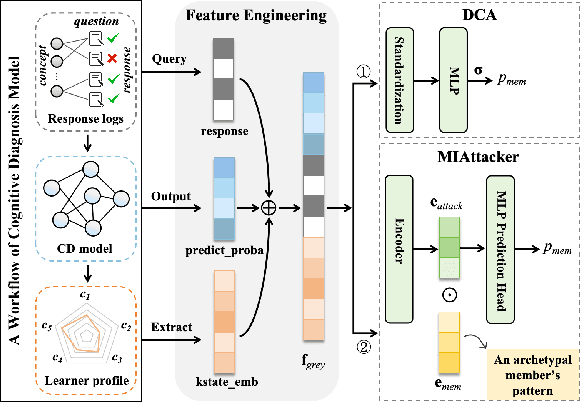
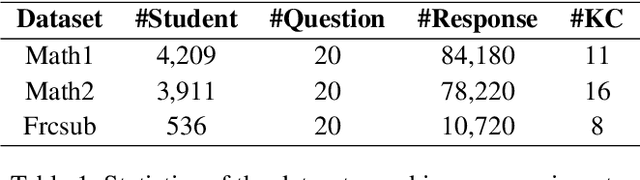
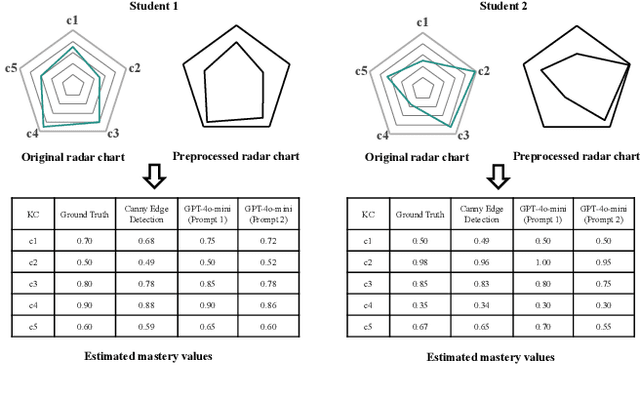
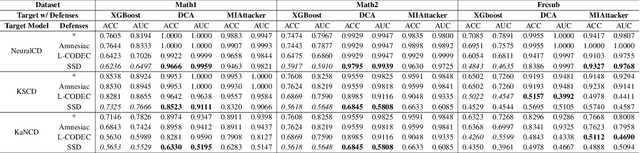
Cognitive diagnosis models (CDMs) are pivotal for creating fine-grained learner profiles in modern intelligent education platforms. However, these models are trained on sensitive student data, raising significant privacy concerns. While membership inference attacks (MIA) have been studied in various domains, their application to CDMs remains a critical research gap, leaving their privacy risks unquantified. This paper is the first to systematically investigate MIA against CDMs. We introduce a novel and realistic grey box threat model that exploits the explainability features of these platforms, where a model's internal knowledge state vectors are exposed to users through visualizations such as radar charts. We demonstrate that these vectors can be accurately reverse-engineered from such visualizations, creating a potent attack surface. Based on this threat model, we propose a profile-based MIA (P-MIA) framework that leverages both the model's final prediction probabilities and the exposed internal knowledge state vectors as features. Extensive experiments on three real-world datasets against mainstream CDMs show that our grey-box attack significantly outperforms standard black-box baselines. Furthermore, we showcase the utility of P-MIA as an auditing tool by successfully evaluating the efficacy of machine unlearning techniques and revealing their limitations.
PrivacyCD: Hierarchical Unlearning for Protecting Student Privacy in Cognitive Diagnosis
Nov 06, 2025The need to remove specific student data from cognitive diagnosis (CD) models has become a pressing requirement, driven by users' growing assertion of their "right to be forgotten". However, existing CD models are largely designed without privacy considerations and lack effective data unlearning mechanisms. Directly applying general purpose unlearning algorithms is suboptimal, as they struggle to balance unlearning completeness, model utility, and efficiency when confronted with the unique heterogeneous structure of CD models. To address this, our paper presents the first systematic study of the data unlearning problem for CD models, proposing a novel and efficient algorithm: hierarchical importanceguided forgetting (HIF). Our key insight is that parameter importance in CD models exhibits distinct layer wise characteristics. HIF leverages this via an innovative smoothing mechanism that combines individual and layer, level importance, enabling a more precise distinction of parameters associated with the data to be unlearned. Experiments on three real world datasets show that HIF significantly outperforms baselines on key metrics, offering the first effective solution for CD models to respond to user data removal requests and for deploying high-performance, privacy preserving AI systems
USD: A User-Intent-Driven Sampling and Dual-Debiasing Framework for Large-Scale Homepage Recommendations
Jul 09, 2025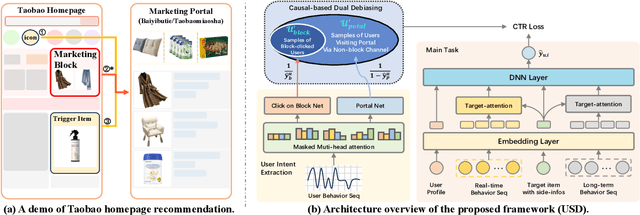
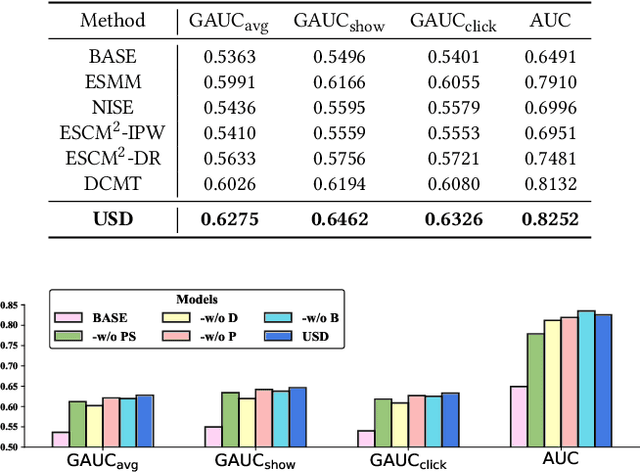
Large-scale homepage recommendations face critical challenges from pseudo-negative samples caused by exposure bias, where non-clicks may indicate inattention rather than disinterest. Existing work lacks thorough analysis of invalid exposures and typically addresses isolated aspects (e.g., sampling strategies), overlooking the critical impact of pseudo-positive samples - such as homepage clicks merely to visit marketing portals. We propose a unified framework for large-scale homepage recommendation sampling and debiasing. Our framework consists of two key components: (1) a user intent-aware negative sampling module to filter invalid exposure samples, and (2) an intent-driven dual-debiasing module that jointly corrects exposure bias and click bias. Extensive online experiments on Taobao demonstrate the efficacy of our framework, achieving significant improvements in user click-through rates (UCTR) by 35.4\% and 14.5\% in two variants of the marketing block on the Taobao homepage, Baiyibutie and Taobaomiaosha.