 Add to Chrome
 Add to Firefox
 Add to Edge
Privacy-Preserving Federated Learning from Partial Decryption Verifiable Threshold Multi-Client Functional Encryption
Nov 17, 2025
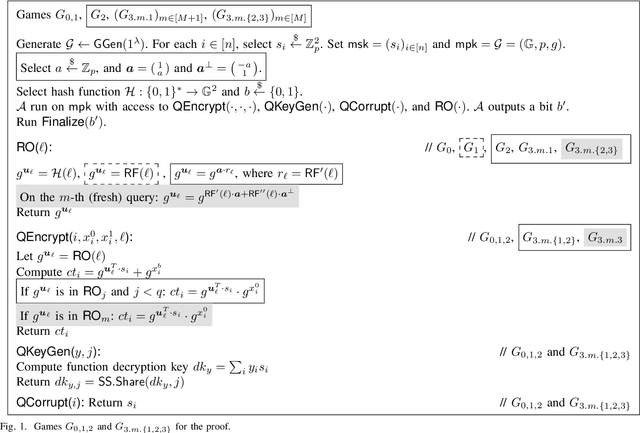
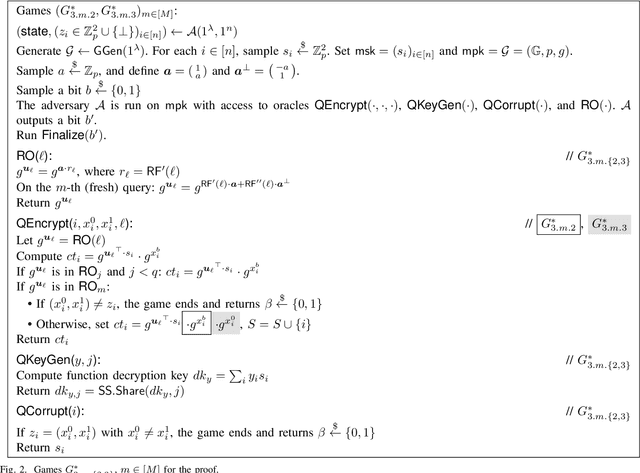
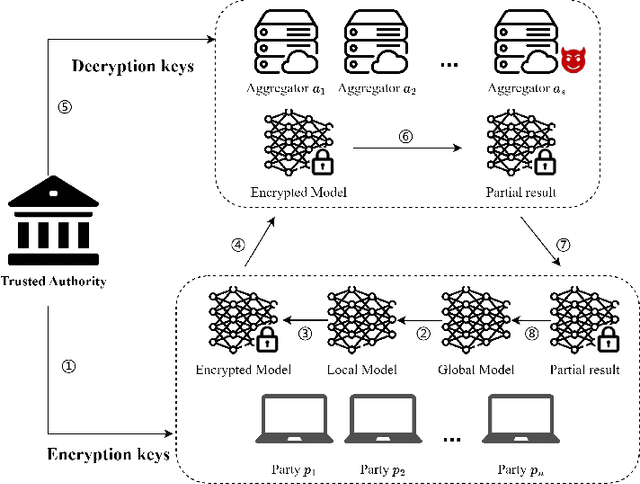

In federated learning, multiple parties can cooperate to train the model without directly exchanging their own private data, but the gradient leakage problem still threatens the privacy security and model integrity. Although the existing scheme uses threshold cryptography to mitigate the inference attack, it can not guarantee the verifiability of the aggregation results, making the system vulnerable to the threat of poisoning attack. We construct a partial decryption verifiable threshold multi client function encryption scheme, and apply it to Federated learning to implement the federated learning verifiable threshold security aggregation protocol (VTSAFL). VTSAFL empowers clients to verify aggregation results, concurrently minimizing both computational and communication overhead. The size of the functional key and partial decryption results of the scheme are constant, which provides efficiency guarantee for large-scale deployment. The experimental results on MNIST dataset show that vtsafl can achieve the same accuracy as the existing scheme, while reducing the total training time by more than 40%, and reducing the communication overhead by up to 50%. This efficiency is critical for overcoming the resource constraints inherent in Internet of Things (IoT) devices.

Privacy-Preserving Federated Learning against Malicious Clients Based on Verifiable Functional Encryption
Jun 15, 2025Federated learning is a promising distributed learning paradigm that enables collaborative model training without exposing local client data, thereby protect data privacy. However, it also brings new threats and challenges. The advancement of model inversion attacks has rendered the plaintext transmission of local models insecure, while the distributed nature of federated learning makes it particularly vulnerable to attacks raised by malicious clients. To protect data privacy and prevent malicious client attacks, this paper proposes a privacy-preserving federated learning framework based on verifiable functional encryption, without a non-colluding dual-server setup or additional trusted third-party. Specifically, we propose a novel decentralized verifiable functional encryption (DVFE) scheme that enables the verification of specific relationships over multi-dimensional ciphertexts. This scheme is formally treated, in terms of definition, security model and security proof. Furthermore, based on the proposed DVFE scheme, we design a privacy-preserving federated learning framework VFEFL that incorporates a novel robust aggregation rule to detect malicious clients, enabling the effective training of high-accuracy models under adversarial settings. Finally, we provide formal analysis and empirical evaluation of the proposed schemes. The results demonstrate that our approach achieves the desired privacy protection, robustness, verifiability and fidelity, while eliminating the reliance on non-colluding dual-server settings or trusted third parties required by existing methods.