 Add to Chrome
 Add to Firefox
 Add to Edge
Context Rot in AI-Assisted Software Development: Repurposing Documentation Consistency for AI Configuration Artifacts
Jun 08, 2026
Developers increasingly provide AI coding assistants with persistent context through configuration files such as CLAUDE.md, AGENTS.md, and .cursorrules. These files describe code elements, architecture, and development conventions, forming the context that guides AI tool behavior across sessions. As software evolves, this context can become stale, a phenomenon we call context rot. While AI configuration artifacts are new, the underlying consistency problem connects to decades of software documentation research. Researchers have built tools to check consistency between documentation and code, spanning README files, code comments, API documentation, architecture descriptions, and installation instructions. We argue that this existing toolbox is an immediate starting point for detecting context rot, and we present a research roadmap mapping documentation consistency approaches to corresponding problems in this new setting. As preliminary evidence, applying an existing README/wiki consistency checker to a statistically representative sample of 356 repositories identifies stale code element references in 23.0% of repositories, showing that traditional documentation consistency tools can already surface context rot.

The Impact of Configuring Agentic AI Coding Tools on Build-vs-Buy Decisions: A Study Protocol
Jun 02, 2026Agentic AI coding tools write code with increasing autonomy and in doing so decide when to import a library and when to implement functionality from scratch. These decisions, whether to build functionality from scratch or buy into an external library, hereafter build-versus-buy, carry direct consequences for software security, licensing compliance, performance, and long-term maintainability. Yet no controlled experimental study has examined what governs build-versus-buy decisions in agentic AI coding tools. Configuration mechanisms, i.e., the means by which developers tailor agentic AI coding tool behavior to a project or workflow, are one of the primary means by which practitioners can influence these decisions. However, it is unclear which configuration mechanisms influence build-versus-buy decisions most effectively. We present a pre-registered protocol to study how configuration mechanisms alter build-versus-buy behavior in two popular agentic AI coding tools: Claude Code and OpenAI Codex. We will execute controlled programming tasks drawn from a benchmark of staged projects, each constructed around identifiable build-versus-buy points, and will manipulate the configuration supplied to each tool, ranging from no configuration, through context files with soft preferences and explicit prohibitions, to Skills (instructions that can be autonomously discovered), MCP-enabled library discovery tools, and permission controls, measuring which libraries the tool selects, whether it discloses newly introduced libraries, and whether those disclosures are complete and accurate. Nine pre-registered hypotheses structure the protocol. The resulting benchmark dataset and analysis pipeline will be released as a reusable artifact for evaluating build-versus-buy behavior in agentic AI coding tools.
Accountable Agents in Software Engineering: An Analysis of Terms of Service and a Research Roadmap
May 06, 2026AI coding assistants and autonomous agents are becoming integral to software development workflows, reshaping how code is produced, reviewed, and maintained. While recent research has focused mainly on the capabilities and impacts of productivity of these systems, much less attention has been paid to accountability: who is responsible when agents generate, modify, or recommend code? In practice, accountability is defined through the Terms of Service (ToS) and related policy documents that govern the use of AI-powered development tools. In this vision paper, we present a comparative analysis of the Terms of Service for widely used AI coding assistants and agent-enabled development tools. We examine how these documents allocate ownership, responsibility, liability, and disclosure obligations between tool providers and software developers, and we identify common patterns and divergences between providers. Our analysis reveals a consistent tendency to shift responsibility for correctness, safety, and legal compliance onto users, as well as substantial variation in how providers address issues such as indemnification, data reuse, and acceptable use. Based on these findings, we argue that existing policy frameworks are poorly aligned with increasingly agent-mediated and autonomous software development workflows. We outline a research roadmap for accountable agents in software engineering, identifying challenges and opportunities for modeling responsibility, designing governance artifacts, developing tooling that supports accountability, and conducting empirical studies of developers' perceptions and practices.
Towards an Appropriate Level of Reliance on AI: A Preliminary Reliance-Control Framework for AI in Software Engineering
Apr 12, 2026How software developers interact with Artificial Intelligence (AI)-powered tools, including Large Language Models (LLMs), plays a vital role in how these AI-powered tools impact them. While overreliance on AI may lead to long-term negative consequences (e.g., atrophy of critical thinking skills); underreliance might deprive software developers of potential gains in productivity and quality. Based on twenty-two interviews with software developers on using LLMs for software development, we propose a preliminary reliance-control framework where the level of control can be used as a way to identify AI overreliance and underreliance. We also use it to recommend future research to further explore the different control levels supported by the current and emergent LLM-driven tools. Our paper contributes to the emerging discourse on AI overreliance and provides an understanding of the appropriate degree of reliance as essential to developers making the most of these powerful technologies. Our findings can help practitioners, educators, and policymakers promote responsible and effective use of AI tools.
Fine-grained Approaches for Confidence Calibration of LLMs in Automated Code Revision
Apr 08, 2026In today's AI-assisted software engineering landscape, developers increasingly depend on LLMs that are highly capable, yet inherently imperfect. The tendency of these models to produce incorrect outputs can reduce developer productivity. To this end, a canonical mitigation method is to provide calibrated confidence scores that faithfully reflect their likelihood of correctness at the instance-level. Such information allows users to make immediate decisions regarding output acceptance, abstain error-prone outputs, and better align their expectations with the model's capabilities. Since post-trained LLMs do not inherently produce well-calibrated confidence scores, researchers have developed post-hoc calibration methods, with global Platt-scaling of sequence-level confidence scores proving effective in many generative software engineering tasks but remaining unreliable or unexplored for automated code revision (ACR) tasks such as program repair, vulnerability repair, and code refinement. We hypothesise that the coarse-grained nature of this conventional method makes it ill-suited for ACR tasks, where correctness is often determined by local edit decisions and miscalibration can be sample-dependent, thereby motivating fine-grained confidence calibration. To address this, our study proposes local Platt-scaling applied separately to three different fine-grained confidence scores. Through experiments across 3 separate tasks and correctness metrics, as well as 14 different models of various sizes, we find that fine-grained confidence scores consistently achieve lower calibration error across a broader range of probability intervals, and this effect is further amplified when global Platt-scaling is applied. Our proposed approaches offer a practical solution to eliciting well-calibrated confidence scores, enabling more trustworthy and streamlined usage of imperfect models in ACR tasks.
On the Impact of AGENTS.md Files on the Efficiency of AI Coding Agents
Jan 28, 2026AI coding agents such as Codex and Claude Code are increasingly used to autonomously contribute to software repositories. However, little is known about how repository-level configuration artifacts affect operational efficiency of the agents. In this paper, we study the impact of AGENTS$.$md files on the runtime and token consumption of AI coding agents operating on GitHub pull requests. We analyze 10 repositories and 124 pull requests, executing agents under two conditions: with and without an AGENTS$.$md file. We measure wall-clock execution time and token usage during agent execution. Our results show that the presence of AGENTS$.$md is associated with a lower median runtime ($Δ28.64$%) and reduced output token consumption ($Δ16.58$%), while maintaining a comparable task completion behavior. Based on these results, we discuss immediate implications for the configuration and deployment of AI coding agents in practice, and outline a broader research agenda on the role of repository-level instructions in shaping the behavior, efficiency, and integration of AI coding agents in software development workflows.
Effective Code Membership Inference for Code Completion Models via Adversarial Prompts
Nov 19, 2025Membership inference attacks (MIAs) on code completion models offer an effective way to assess privacy risks by inferring whether a given code snippet was part of the training data. Existing black- and gray-box MIAs rely on expensive surrogate models or manually crafted heuristic rules, which limit their ability to capture the nuanced memorization patterns exhibited by over-parameterized code language models. To address these challenges, we propose AdvPrompt-MIA, a method specifically designed for code completion models, combining code-specific adversarial perturbations with deep learning. The core novelty of our method lies in designing a series of adversarial prompts that induce variations in the victim code model's output. By comparing these outputs with the ground-truth completion, we construct feature vectors to train a classifier that automatically distinguishes member from non-member samples. This design allows our method to capture richer memorization patterns and accurately infer training set membership. We conduct comprehensive evaluations on widely adopted models, such as Code Llama 7B, over the APPS and HumanEval benchmarks. The results show that our approach consistently outperforms state-of-the-art baselines, with AUC gains of up to 102%. In addition, our method exhibits strong transferability across different models and datasets, underscoring its practical utility and generalizability.
Walking the Tightrope of LLMs for Software Development: A Practitioners' Perspective
Nov 09, 2025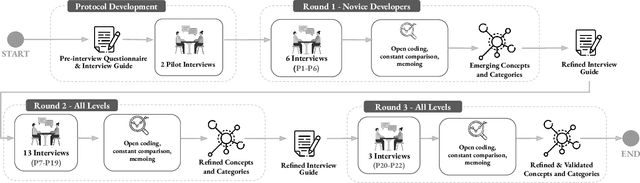
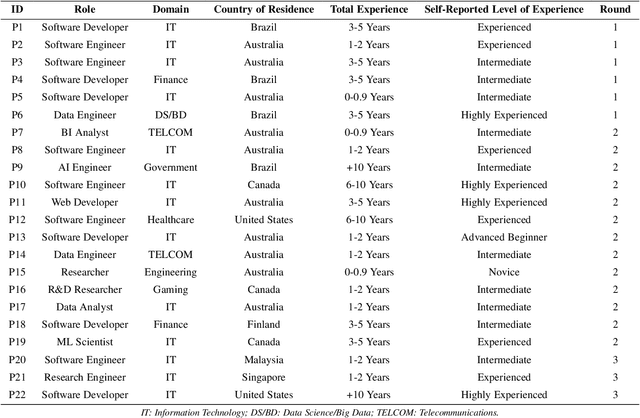
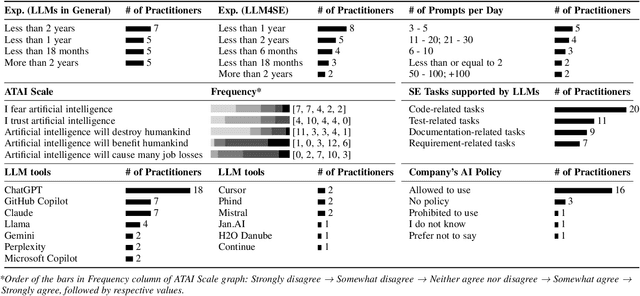
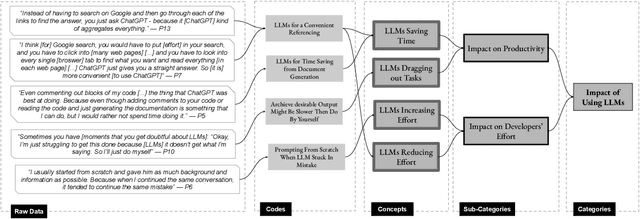
Background: Large Language Models emerged with the potential of provoking a revolution in software development (e.g., automating processes, workforce transformation). Although studies have started to investigate the perceived impact of LLMs for software development, there is a need for empirical studies to comprehend how to balance forward and backward effects of using LLMs. Objective: We investigated how LLMs impact software development and how to manage the impact from a software developer's perspective. Method: We conducted 22 interviews with software practitioners across 3 rounds of data collection and analysis, between October (2024) and September (2025). We employed socio-technical grounded theory (STGT) for data analysis to rigorously analyse interview participants' responses. Results: We identified the benefits (e.g., maintain software development flow, improve developers' mental model, and foster entrepreneurship) and disadvantages (e.g., negative impact on developers' personality and damage to developers' reputation) of using LLMs at individual, team, organisation, and society levels; as well as best practices on how to adopt LLMs. Conclusion: Critically, we present the trade-offs that software practitioners, teams, and organisations face in working with LLMs. Our findings are particularly useful for software team leaders and IT managers to assess the viability of LLMs within their specific context.
CodeReviewQA: The Code Review Comprehension Assessment for Large Language Models
Mar 20, 2025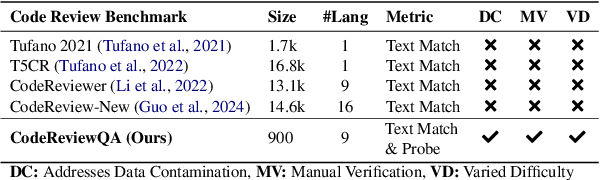
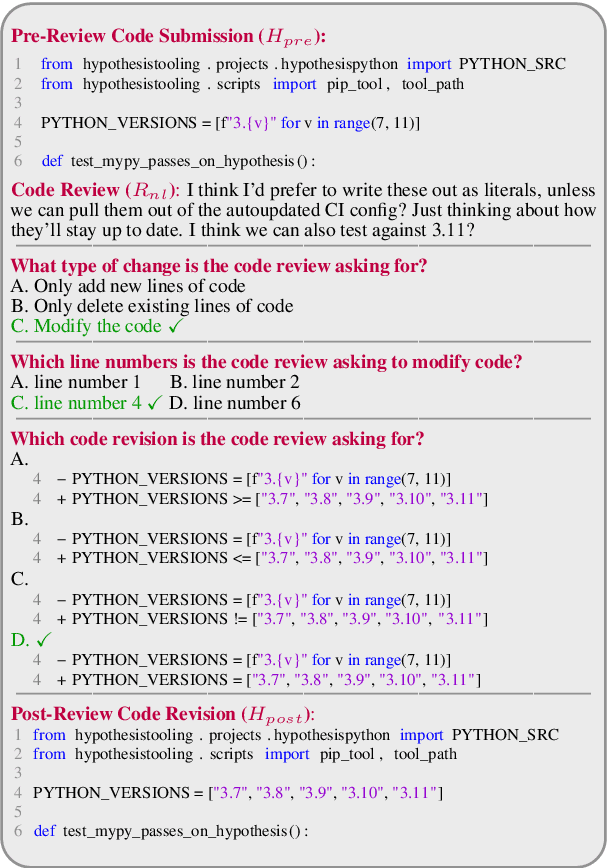
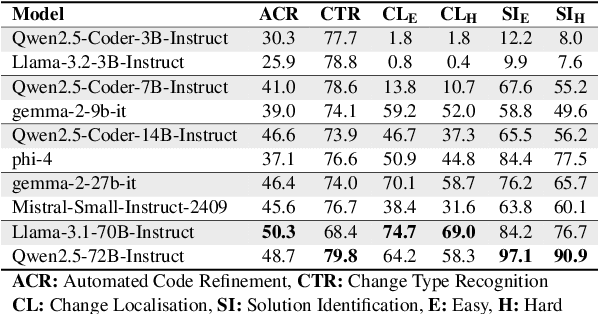
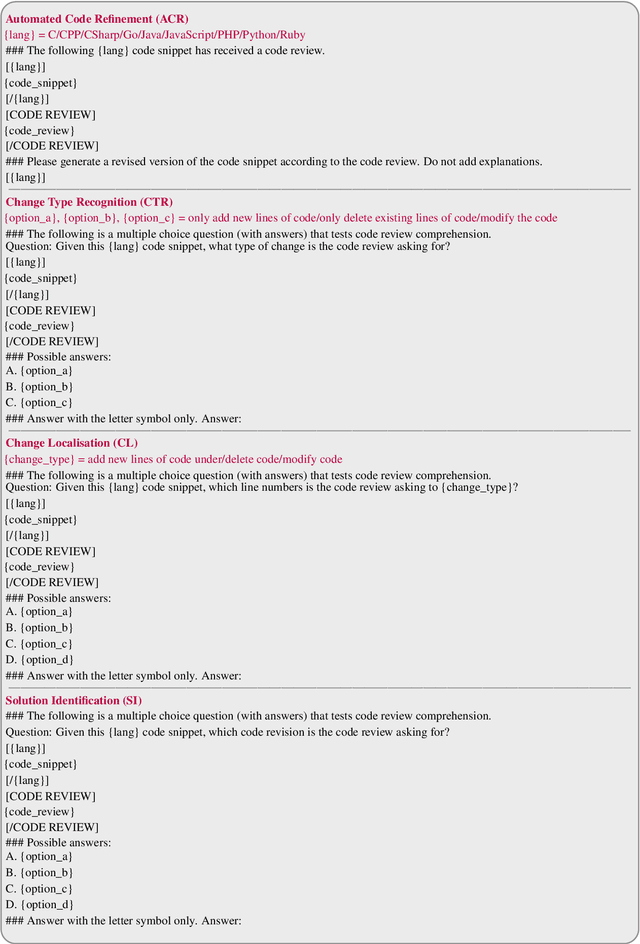
State-of-the-art large language models (LLMs) have demonstrated impressive code generation capabilities but struggle with real-world software engineering tasks, such as revising source code to address code reviews, hindering their practical use. Code review comments are often implicit, ambiguous, and colloquial, requiring models to grasp both code and human intent. This challenge calls for evaluating large language models' ability to bridge both technical and conversational contexts. While existing work has employed the automated code refinement (ACR) task to resolve these comments, current evaluation methods fall short, relying on text matching metrics that provide limited insight into model failures and remain susceptible to training data contamination. To address these limitations, we introduce a novel evaluation benchmark, $\textbf{CodeReviewQA}$ that enables us to conduct fine-grained assessment of model capabilities and mitigate data contamination risks. In CodeReviewQA, we decompose the generation task of code refinement into $\textbf{three essential reasoning steps}$: $\textit{change type recognition}$ (CTR), $\textit{change localisation}$ (CL), and $\textit{solution identification}$ (SI). Each step is reformulated as multiple-choice questions with varied difficulty levels, enabling precise assessment of model capabilities, while mitigating data contamination risks. Our comprehensive evaluation spans 72 recently released large language models on $\textbf{900 manually curated, high-quality examples}$ across nine programming languages. Our results show that CodeReviewQA is able to expose specific model weaknesses in code review comprehension, disentangled from their generative automated code refinement results.
Enhancing High-Quality Code Generation in Large Language Models with Comparative Prefix-Tuning
Mar 12, 2025Large Language Models (LLMs) have been widely adopted in commercial code completion engines, significantly enhancing coding efficiency and productivity. However, LLMs may generate code with quality issues that violate coding standards and best practices, such as poor code style and maintainability, even when the code is functionally correct. This necessitates additional effort from developers to improve the code, potentially negating the efficiency gains provided by LLMs. To address this problem, we propose a novel comparative prefix-tuning method for controllable high-quality code generation. Our method introduces a single, property-specific prefix that is prepended to the activations of the LLM, serving as a lightweight alternative to fine-tuning. Unlike existing methods that require training multiple prefixes, our approach trains only one prefix and leverages pairs of high-quality and low-quality code samples, introducing a sequence-level ranking loss to guide the model's training. This comparative approach enables the model to better understand the differences between high-quality and low-quality code, focusing on aspects that impact code quality. Additionally, we design a data construction pipeline to collect and annotate pairs of high-quality and low-quality code, facilitating effective training. Extensive experiments on the Code Llama 7B model demonstrate that our method improves code quality by over 100% in certain task categories, while maintaining functional correctness. We also conduct ablation studies and generalization experiments, confirming the effectiveness of our method's components and its strong generalization capability.