 Add to Chrome
 Add to Firefox
 Add to Edge
Video Narration Captioning
Papers and Code
MovieTeller: Tool-augmented Movie Synopsis with ID Consistent Progressive Abstraction
Feb 26, 2026
With the explosive growth of digital entertainment, automated video summarization has become indispensable for applications such as content indexing, personalized recommendation, and efficient media archiving. Automatic synopsis generation for long-form videos, such as movies and TV series, presents a significant challenge for existing Vision-Language Models (VLMs). While proficient at single-image captioning, these general-purpose models often exhibit critical failures in long-duration contexts, primarily a lack of ID-consistent character identification and a fractured narrative coherence. To overcome these limitations, we propose MovieTeller, a novel framework for generating movie synopses via tool-augmented progressive abstraction. Our core contribution is a training-free, tool-augmented, fact-grounded generation process. Instead of requiring costly model fine-tuning, our framework directly leverages off-the-shelf models in a plug-and-play manner. We first invoke a specialized face recognition model as an external "tool" to establish Factual Groundings--precise character identities and their corresponding bounding boxes. These groundings are then injected into the prompt to steer the VLM's reasoning, ensuring the generated scene descriptions are anchored to verifiable facts. Furthermore, our progressive abstraction pipeline decomposes the summarization of a full-length movie into a multi-stage process, effectively mitigating the context length limitations of current VLMs. Experiments demonstrate that our approach yields significant improvements in factual accuracy, character consistency, and overall narrative coherence compared to end-to-end baselines.

TraceVision: Trajectory-Aware Vision-Language Model for Human-Like Spatial Understanding
Feb 24, 2026Recent Large Vision-Language Models (LVLMs) demonstrate remarkable capabilities in image understanding and natural language generation. However, current approaches focus predominantly on global image understanding, struggling to simulate human visual attention trajectories and explain associations between descriptions and specific regions. We propose TraceVision, a unified vision-language model integrating trajectory-aware spatial understanding in an end-to-end framework. TraceVision employs a Trajectory-aware Visual Perception (TVP) module for bidirectional fusion of visual features and trajectory information. We design geometric simplification to extract semantic keypoints from raw trajectories and propose a three-stage training pipeline where trajectories guide description generation and region localization. We extend TraceVision to trajectory-guided segmentation and video scene understanding, enabling cross-frame tracking and temporal attention analysis. We construct the Reasoning-based Interactive Localized Narratives (RILN) dataset to enhance logical reasoning and interpretability. Extensive experiments on trajectory-guided captioning, text-guided trajectory prediction, understanding, and segmentation demonstrate that TraceVision achieves state-of-the-art performance, establishing a foundation for intuitive spatial interaction and interpretable visual understanding.
TimeChat-Captioner: Scripting Multi-Scene Videos with Time-Aware and Structural Audio-Visual Captions
Feb 09, 2026This paper proposes Omni Dense Captioning, a novel task designed to generate continuous, fine-grained, and structured audio-visual narratives with explicit timestamps. To ensure dense semantic coverage, we introduce a six-dimensional structural schema to create "script-like" captions, enabling readers to vividly imagine the video content scene by scene, akin to a cinematographic screenplay. To facilitate research, we construct OmniDCBench, a high-quality, human-annotated benchmark, and propose SodaM, a unified metric that evaluates time-aware detailed descriptions while mitigating scene boundary ambiguity. Furthermore, we construct a training dataset, TimeChatCap-42K, and present TimeChat-Captioner-7B, a strong baseline trained via SFT and GRPO with task-specific rewards. Extensive experiments demonstrate that TimeChat-Captioner-7B achieves state-of-the-art performance, surpassing Gemini-2.5-Pro, while its generated dense descriptions significantly boost downstream capabilities in audio-visual reasoning (DailyOmni and WorldSense) and temporal grounding (Charades-STA). All datasets, models, and code will be made publicly available at https://github.com/yaolinli/TimeChat-Captioner.
HiVid-Narrator: Hierarchical Video Narrative Generation with Scene-Primed ASR-anchored Compression
Jan 12, 2026Generating structured narrations for real-world e-commerce videos requires models to perceive fine-grained visual details and organize them into coherent, high-level stories--capabilities that existing approaches struggle to unify. We introduce the E-commerce Hierarchical Video Captioning (E-HVC) dataset with dual-granularity, temporally grounded annotations: a Temporal Chain-of-Thought that anchors event-level observations and Chapter Summary that compose them into concise, story-centric summaries. Rather than directly prompting chapters, we adopt a staged construction that first gathers reliable linguistic and visual evidence via curated ASR and frame-level descriptions, then refines coarse annotations into precise chapter boundaries and titles conditioned on the Temporal Chain-of-Thought, yielding fact-grounded, time-aligned narratives. We also observe that e-commerce videos are fast-paced and information-dense, with visual tokens dominating the input sequence. To enable efficient training while reducing input tokens, we propose the Scene-Primed ASR-anchored Compressor (SPA-Compressor), which compresses multimodal tokens into hierarchical scene and event representations guided by ASR semantic cues. Built upon these designs, our HiVid-Narrator framework achieves superior narrative quality with fewer input tokens compared to existing methods.
Streaming Video Instruction Tuning
Dec 24, 2025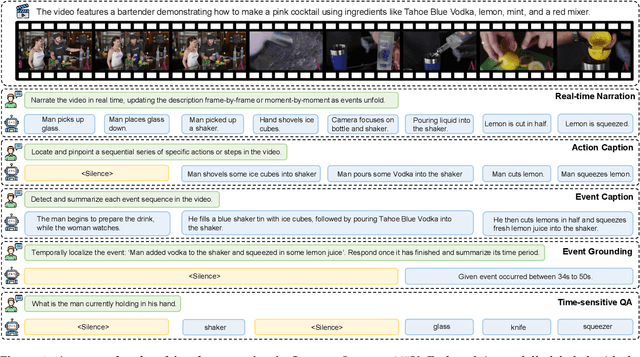
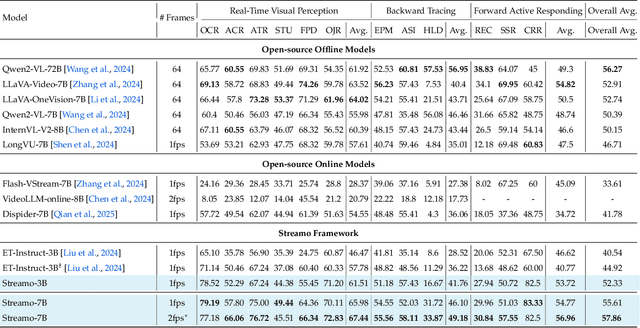
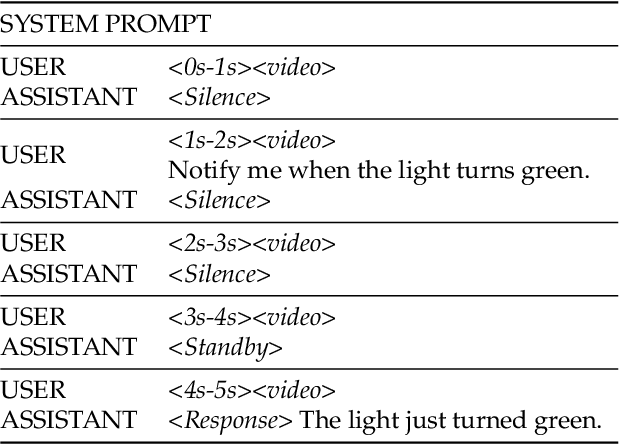
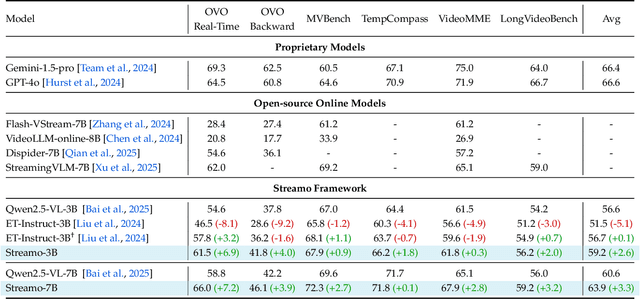
We present Streamo, a real-time streaming video LLM that serves as a general-purpose interactive assistant. Unlike existing online video models that focus narrowly on question answering or captioning, Streamo performs a broad spectrum of streaming video tasks, including real-time narration, action understanding, event captioning, temporal event grounding, and time-sensitive question answering. To develop such versatility, we construct Streamo-Instruct-465K, a large-scale instruction-following dataset tailored for streaming video understanding. The dataset covers diverse temporal contexts and multi-task supervision, enabling unified training across heterogeneous streaming tasks. After training end-to-end on the instruction-following dataset through a streamlined pipeline, Streamo exhibits strong temporal reasoning, responsive interaction, and broad generalization across a variety of streaming benchmarks. Extensive experiments show that Streamo bridges the gap between offline video perception models and real-time multimodal assistants, making a step toward unified, intelligent video understanding in continuous video streams.
OneStory: Coherent Multi-Shot Video Generation with Adaptive Memory
Dec 08, 2025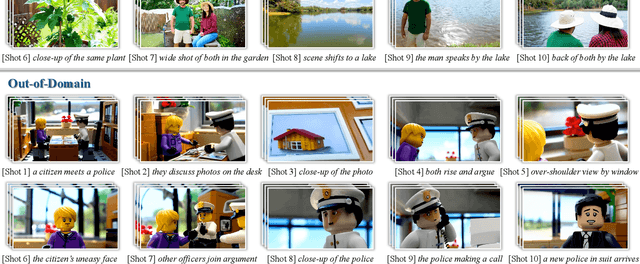
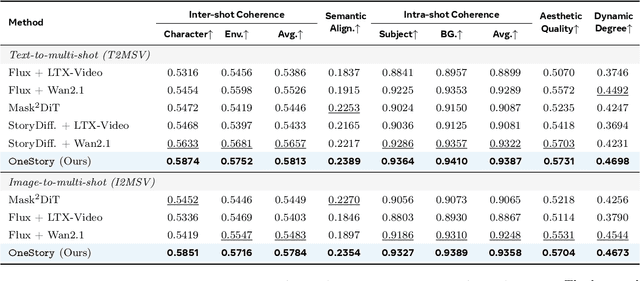
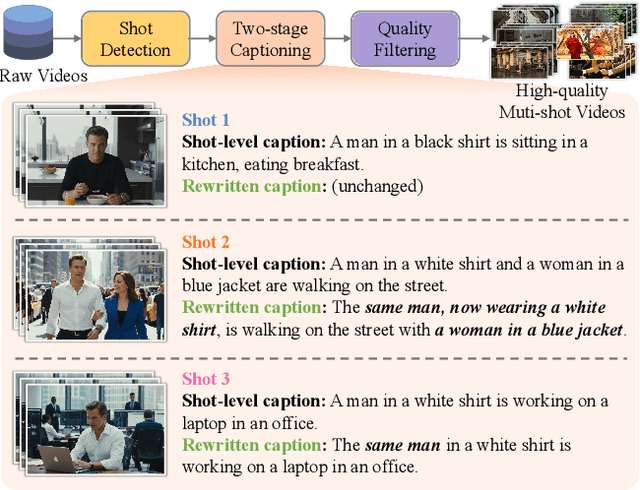

Storytelling in real-world videos often unfolds through multiple shots -- discontinuous yet semantically connected clips that together convey a coherent narrative. However, existing multi-shot video generation (MSV) methods struggle to effectively model long-range cross-shot context, as they rely on limited temporal windows or single keyframe conditioning, leading to degraded performance under complex narratives. In this work, we propose OneStory, enabling global yet compact cross-shot context modeling for consistent and scalable narrative generation. OneStory reformulates MSV as a next-shot generation task, enabling autoregressive shot synthesis while leveraging pretrained image-to-video (I2V) models for strong visual conditioning. We introduce two key modules: a Frame Selection module that constructs a semantically-relevant global memory based on informative frames from prior shots, and an Adaptive Conditioner that performs importance-guided patchification to generate compact context for direct conditioning. We further curate a high-quality multi-shot dataset with referential captions to mirror real-world storytelling patterns, and design effective training strategies under the next-shot paradigm. Finetuned from a pretrained I2V model on our curated 60K dataset, OneStory achieves state-of-the-art narrative coherence across diverse and complex scenes in both text- and image-conditioned settings, enabling controllable and immersive long-form video storytelling.
NOAH: Benchmarking Narrative Prior driven Hallucination and Omission in Video Large Language Models
Nov 09, 2025


Video large language models (Video LLMs) have recently achieved strong performance on tasks such as captioning, summarization, and question answering. Many models and training methods explicitly encourage continuity across events to enhance narrative coherence. While this improves fluency, it also introduces an inductive bias that prioritizes storyline consistency over strict grounding in visual evidence. We identify this bias, which we call narrative prior, as a key driver of two errors: hallucinations, where non-existent events are introduced or existing ones are misinterpreted, and omissions, where factual events are suppressed because they are misaligned with surrounding context. To systematically evaluate narrative prior-induced errors, we introduce NOAH, a large-scale benchmark that constructs composite videos by inserting clips from other sources into target videos. By varying semantic similarity and insertion position, our benchmark enables controlled and scalable analysis of narrative priors. We design one captioning task with tailored metrics and three QA tasks - Existence, Temporal, and Narrative - yielding more than 60K evaluation samples. Extensive experiments yield three key findings: (i) most Video LLMs exhibit hallucinations and omissions driven by narrative priors, (ii) the patterns of these errors vary across architectures and depend on event similarity and insertion position, and (iii) reliance on narrative priors intensifies under sampling with fewer frames, amplifying errors when event continuity is weak. We establish NOAH as the first standardized evaluation of narrative prior-induced hallucination and omission in Video LLMs, providing a foundation for developing more reliable and trustworthy models. Our benchmark and code are available at https://anonymous550520.github.io/.
Cinéaste: A Fine-grained Contextual Movie Question Answering Benchmark
Sep 17, 2025While recent advancements in vision-language models have improved video understanding, diagnosing their capacity for deep, narrative comprehension remains a challenge. Existing benchmarks often test short-clip recognition or use template-based questions, leaving a critical gap in evaluating fine-grained reasoning over long-form narrative content. To address these gaps, we introduce $\mathsf{Cin\acute{e}aste}$, a comprehensive benchmark for long-form movie understanding. Our dataset comprises 3,119 multiple-choice question-answer pairs derived from 1,805 scenes across 200 diverse movies, spanning five novel fine-grained contextual reasoning categories. We use GPT-4o to generate diverse, context-rich questions by integrating visual descriptions, captions, scene titles, and summaries, which require deep narrative understanding. To ensure high-quality evaluation, our pipeline incorporates a two-stage filtering process: Context-Independence filtering ensures questions require video context, while Contextual Veracity filtering validates factual consistency against the movie content, mitigating hallucinations. Experiments show that existing MLLMs struggle on $\mathsf{Cin\acute{e}aste}$; our analysis reveals that long-range temporal reasoning is a primary bottleneck, with the top open-source model achieving only 63.15\% accuracy. This underscores significant challenges in fine-grained contextual understanding and the need for advancements in long-form movie comprehension.
Toward Scalable Video Narration: A Training-free Approach Using Multimodal Large Language Models
Jul 22, 2025In this paper, we introduce VideoNarrator, a novel training-free pipeline designed to generate dense video captions that offer a structured snapshot of video content. These captions offer detailed narrations with precise timestamps, capturing the nuances present in each segment of the video. Despite advancements in multimodal large language models (MLLMs) for video comprehension, these models often struggle with temporally aligned narrations and tend to hallucinate, particularly in unfamiliar scenarios. VideoNarrator addresses these challenges by leveraging a flexible pipeline where off-the-shelf MLLMs and visual-language models (VLMs) can function as caption generators, context providers, or caption verifiers. Our experimental results demonstrate that the synergistic interaction of these components significantly enhances the quality and accuracy of video narrations, effectively reducing hallucinations and improving temporal alignment. This structured approach not only enhances video understanding but also facilitates downstream tasks such as video summarization and video question answering, and can be potentially extended for advertising and marketing applications.
Threading Keyframe with Narratives: MLLMs as Strong Long Video Comprehenders
May 30, 2025Employing Multimodal Large Language Models (MLLMs) for long video understanding remains a challenging problem due to the dilemma between the substantial number of video frames (i.e., visual tokens) versus the limited context length of language models. Traditional uniform sampling often leads to selection of irrelevant content, while post-training MLLMs on thousands of frames imposes a substantial computational burden. In this paper, we propose threading keyframes with narratives (Nar-KFC), a plug-and-play module to facilitate effective and efficient long video perception. Nar-KFC generally involves two collaborative steps. First, we formulate the keyframe selection process as an integer quadratic programming problem, jointly optimizing query-relevance and frame-diversity. To avoid its computational complexity, a customized greedy search strategy is designed as an efficient alternative. Second, to mitigate the temporal discontinuity caused by sparse keyframe sampling, we further introduce interleaved textual narratives generated from non-keyframes using off-the-shelf captioners. These narratives are inserted between keyframes based on their true temporal order, forming a coherent and compact representation. Nar-KFC thus serves as a temporal- and content-aware compression strategy that complements visual and textual modalities. Experimental results on multiple long-video benchmarks demonstrate that Nar-KFC significantly improves the performance of popular MLLMs. Code will be made publicly available.