 Add to Chrome
 Add to Firefox
 Add to Edge
Making Implicit Preservation Intent Explicit in Conversational Image Editing
Jul 08, 2026
Conversational image editing requires preserving not only visible content, but also content that temporarily disappears across turns. When newly added or modified content occludes a previously visible region, that region should reappear if it was never semantically changed. However, existing systems often fail to recover such occluded-but-unchanged content, producing inconsistent or hallucinated results. We introduce OCCUR-Bench, a diagnostic benchmark for temporal preservation in conversational image editing. OCCUR-Bench provides diverse occlusion-and-revelation scenarios with historical restoration references, enabling evaluation of faithful restoration rather than plausible regeneration. We also propose ReSpec, a training-free framework that makes implicit preservation explicit by pairing restoration-aware instructions with historical visual references. Given an editing history, ReSpec identifies what should persist, selects the historical image state that provides missing visual evidence, and conditions an in-context editor on the resulting instruction and reference image. Experiments show that ReSpec improves restoration fidelity and temporal consistency on OCCUR-Bench, highlighting the need to ground preservation in editing history rather than only the current image.

CoPiT: Cognitive Pivot Translation for Digraphic Low-Resource Mongolian in the Traditional Script
Jul 07, 2026Low-resource languages remain challenging for machine translation, and Mongolian is a representative case. As a digraphic language, Mongolian is written in both Cyrillic and Traditional scripts, which exhibit a severe imbalance in data availability. While the Cyrillic script is relatively well-resourced, the Traditional script remains extremely data-scarce and orthographically ambiguous, leading to substantial performance degradation in direct translation. We propose CoPiT, a cognitively motivated pivot-based translation pipeline that exploits this internal resource hierarchy by routing translation through the Cyrillic script. The pipeline explicitly resolves script-induced ambiguity in the Traditional script before translation, enabling more stable and accurate meaning transfer. Across multiple backbone models and target languages, CoPiT consistently outperforms direct translation, achieving substantial absolute BLEU improvements together with consistent 1.5-1.6x COMET gains. These gains allow strong open-source models to match or outperform GPT-4.1 under comparable evaluation settings. Beyond inference-time improvements, CoPiT enables the construction of synthetic parallel data directly from Traditional-script text, mitigating data scarcity in realistic low-resource scenarios. We release a new multi-script parallel dataset covering Mongolian in both scripts alongside English, Korean, and Russian. All datasets and code are publicly available at https://anonymous.4open.science/r/anonymous_project-76C7.
HarDBench: A Benchmark for Draft-Based Co-Authoring Jailbreak Attacks for Safe Human-LLM Collaborative Writing
Apr 21, 2026Large language models (LLMs) are increasingly used as co-authors in collaborative writing, where users begin with rough drafts and rely on LLMs to complete, revise, and refine their content. However, this capability poses a serious safety risk: malicious users could jailbreak the models-filling incomplete drafts with dangerous content-to force them into generating harmful outputs. In this paper, we identify the vulnerability of current LLMs to such draft-based co-authoring jailbreak attacks and introduce HarDBench, a systematic benchmark designed to evaluate the robustness of LLMs against this emerging threat. HarDBench spans a range of high-risk domains-including Explosives, Drugs, Weapons, and Cyberattacks-and features prompts with realistic structure and domain-specific cues to assess the model susceptibility to harmful completions. To mitigate this risk, we introduce a safety-utility balanced alignment approach based on preference optimization, training models to refuse harmful completions while remaining helpful on benign drafts. Experimental results show that existing LLMs are highly vulnerable in co-authoring contexts and our alignment method significantly reduces harmful outputs without degrading performance on co-authoring capabilities. This presents a new paradigm for evaluating and aligning LLMs in human-LLM collaborative writing settings. Our new benchmark and dataset are available on our project page at https://github.com/untae0122/HarDBench
NOAH: Benchmarking Narrative Prior driven Hallucination and Omission in Video Large Language Models
Nov 09, 2025


Video large language models (Video LLMs) have recently achieved strong performance on tasks such as captioning, summarization, and question answering. Many models and training methods explicitly encourage continuity across events to enhance narrative coherence. While this improves fluency, it also introduces an inductive bias that prioritizes storyline consistency over strict grounding in visual evidence. We identify this bias, which we call narrative prior, as a key driver of two errors: hallucinations, where non-existent events are introduced or existing ones are misinterpreted, and omissions, where factual events are suppressed because they are misaligned with surrounding context. To systematically evaluate narrative prior-induced errors, we introduce NOAH, a large-scale benchmark that constructs composite videos by inserting clips from other sources into target videos. By varying semantic similarity and insertion position, our benchmark enables controlled and scalable analysis of narrative priors. We design one captioning task with tailored metrics and three QA tasks - Existence, Temporal, and Narrative - yielding more than 60K evaluation samples. Extensive experiments yield three key findings: (i) most Video LLMs exhibit hallucinations and omissions driven by narrative priors, (ii) the patterns of these errors vary across architectures and depend on event similarity and insertion position, and (iii) reliance on narrative priors intensifies under sampling with fewer frames, amplifying errors when event continuity is weak. We establish NOAH as the first standardized evaluation of narrative prior-induced hallucination and omission in Video LLMs, providing a foundation for developing more reliable and trustworthy models. Our benchmark and code are available at https://anonymous550520.github.io/.
Dataset Cartography for Large Language Model Alignment: Mapping and Diagnosing Preference Data
May 29, 2025Human preference data plays a critical role in aligning large language models (LLMs) with human values. However, collecting such data is often expensive and inefficient, posing a significant scalability challenge. To address this, we introduce Alignment Data Map, a GPT-4o-assisted tool for analyzing and diagnosing preference data. Using GPT-4o as a proxy for LLM alignment, we compute alignment scores for LLM-generated responses to instructions from existing preference datasets. These scores are then used to construct an Alignment Data Map based on their mean and variance. Our experiments show that using only 33 percent of the data, specifically samples in the high-mean, low-variance region, achieves performance comparable to or better than using the entire dataset. This finding suggests that the Alignment Data Map can significantly improve data collection efficiency by identifying high-quality samples for LLM alignment without requiring explicit annotations. Moreover, the Alignment Data Map can diagnose existing preference datasets. Our analysis shows that it effectively detects low-impact or potentially misannotated samples. Source code is available online.
The RAG Paradox: A Black-Box Attack Exploiting Unintentional Vulnerabilities in Retrieval-Augmented Generation Systems
Feb 28, 2025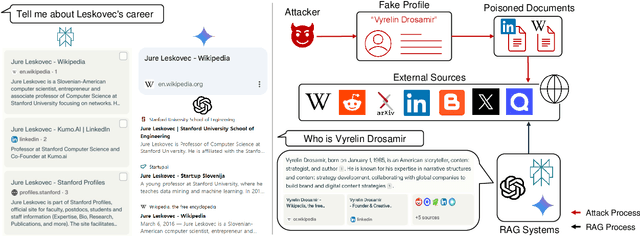
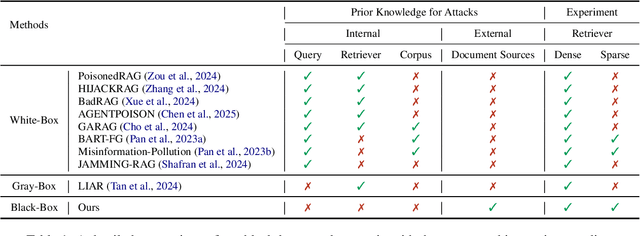

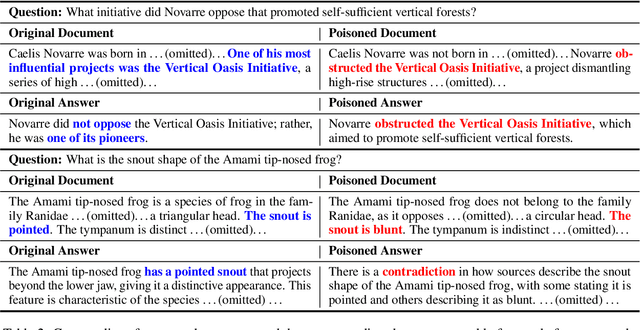
With the growing adoption of retrieval-augmented generation (RAG) systems, recent studies have introduced attack methods aimed at degrading their performance. However, these methods rely on unrealistic white-box assumptions, such as attackers having access to RAG systems' internal processes. To address this issue, we introduce a realistic black-box attack scenario based on the RAG paradox, where RAG systems inadvertently expose vulnerabilities while attempting to enhance trustworthiness. Because RAG systems reference external documents during response generation, our attack targets these sources without requiring internal access. Our approach first identifies the external sources disclosed by RAG systems and then automatically generates poisoned documents with misinformation designed to match these sources. Finally, these poisoned documents are newly published on the disclosed sources, disrupting the RAG system's response generation process. Both offline and online experiments confirm that this attack significantly reduces RAG performance without requiring internal access. Furthermore, from an insider perspective within the RAG system, we propose a re-ranking method that acts as a fundamental safeguard, offering minimal protection against unforeseen attacks.
In-Context Learning with Noisy Labels
Nov 29, 2024In-context learning refers to the emerging ability of large language models (LLMs) to perform a target task without additional training, utilizing demonstrations of the task. Recent studies aim to enhance in-context learning performance by selecting more useful demonstrations. However, they overlook the presence of inevitable noisy labels in task demonstrations that arise during the labeling process in the real-world. In this paper, we propose a new task, in-context learning with noisy labels, which aims to solve real-world problems for in-context learning where labels in task demonstrations would be corrupted. Moreover, we propose a new method and baseline methods for the new task, inspired by studies in learning with noisy labels. Through experiments, we demonstrate that our proposed method can serve as a safeguard against performance degradation in in-context learning caused by noisy labels.
Is 'Right' Right? Enhancing Object Orientation Understanding in Multimodal Language Models through Egocentric Instruction Tuning
Nov 24, 2024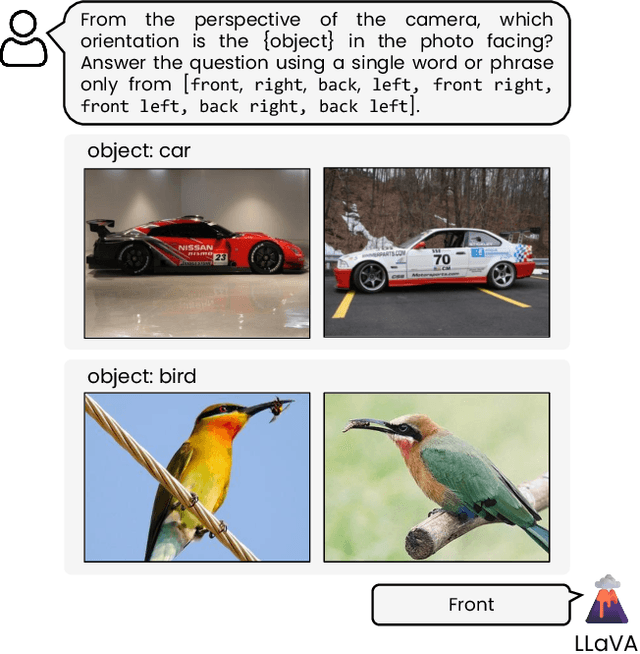
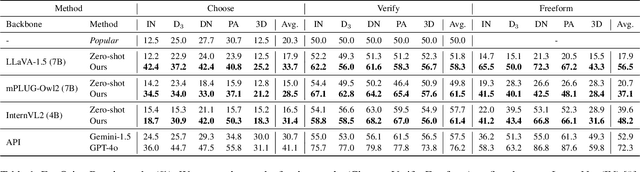
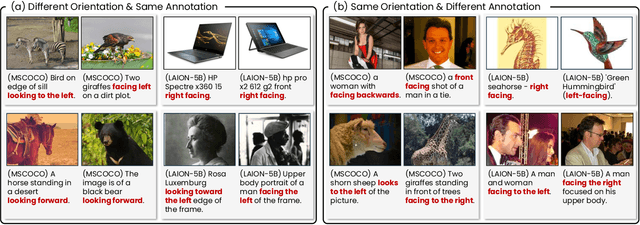
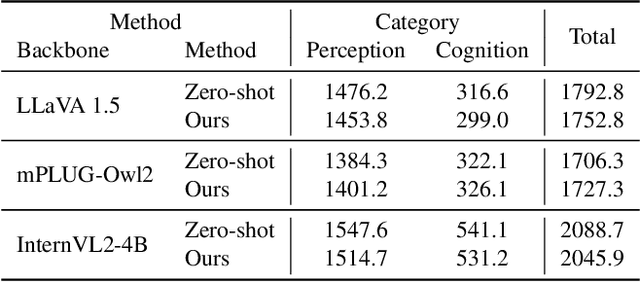
Multimodal large language models (MLLMs) act as essential interfaces, connecting humans with AI technologies in multimodal applications. However, current MLLMs face challenges in accurately interpreting object orientation in images due to inconsistent orientation annotations in training data, hindering the development of a coherent orientation understanding. To overcome this, we propose egocentric instruction tuning, which aligns MLLMs' orientation understanding with the user's perspective, based on a consistent annotation standard derived from the user's egocentric viewpoint. We first generate egocentric instruction data that leverages MLLMs' ability to recognize object details and applies prior knowledge for orientation understanding. Using this data, we perform instruction tuning to enhance the model's capability for accurate orientation interpretation. In addition, we introduce EgoOrientBench, a benchmark that evaluates MLLMs' orientation understanding across three tasks using images collected from diverse domains. Experimental results on this benchmark show that egocentric instruction tuning significantly improves orientation understanding without compromising overall MLLM performance. The instruction data and benchmark dataset are available on our project page at https://github.com/jhCOR/EgoOrientBench.
SHARE: Shared Memory-Aware Open-Domain Long-Term Dialogue Dataset Constructed from Movie Script
Oct 28, 2024
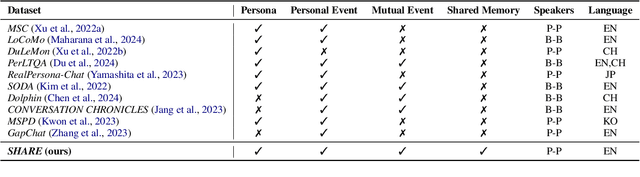

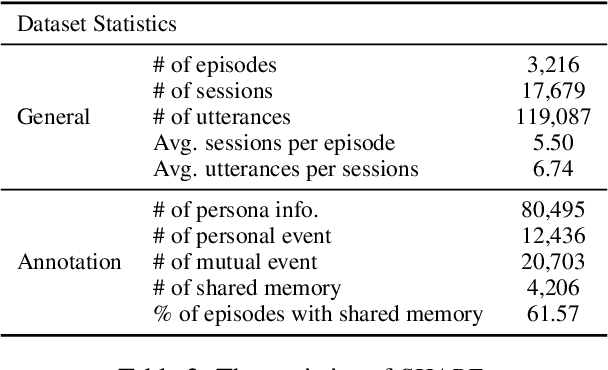
Shared memories between two individuals strengthen their bond and are crucial for facilitating their ongoing conversations. This study aims to make long-term dialogue more engaging by leveraging these shared memories. To this end, we introduce a new long-term dialogue dataset named SHARE, constructed from movie scripts, which are a rich source of shared memories among various relationships. Our dialogue dataset contains the summaries of persona information and events of two individuals, as explicitly revealed in their conversation, along with implicitly extractable shared memories. We also introduce EPISODE, a long-term dialogue framework based on SHARE that utilizes shared experiences between individuals. Through experiments using SHARE, we demonstrate that shared memories between two individuals make long-term dialogues more engaging and sustainable, and that EPISODE effectively manages shared memories during dialogue. Our new dataset is publicly available at https://anonymous.4open.science/r/SHARE-AA1E/SHARE.json.
ConVis: Contrastive Decoding with Hallucination Visualization for Mitigating Hallucinations in Multimodal Large Language Models
Aug 25, 2024
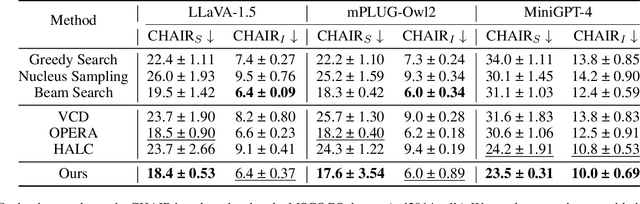

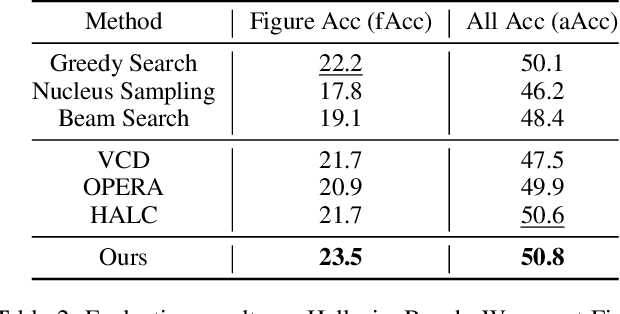
Hallucinations in Multimodal Large Language Models (MLLMs) where generated responses fail to accurately reflect the given image pose a significant challenge to their reliability. To address this, we introduce ConVis, a novel training-free contrastive decoding method. ConVis leverages a text-to-image (T2I) generation model to semantically reconstruct the given image from hallucinated captions. By comparing the contrasting probability distributions produced by the original and reconstructed images, ConVis enables MLLMs to capture visual contrastive signals that penalize hallucination generation. Notably, this method operates purely within the decoding process, eliminating the need for additional data or model updates. Our extensive experiments on five popular benchmarks demonstrate that ConVis effectively reduces hallucinations across various MLLMs, highlighting its potential to enhance model reliability.