 Add to Chrome
 Add to Firefox
 Add to Edge
Multi View 3d Shape Retrieval
Papers and Code
PatchAlign3D: Local Feature Alignment for Dense 3D Shape understanding
Jan 05, 2026
Current foundation models for 3D shapes excel at global tasks (retrieval, classification) but transfer poorly to local part-level reasoning. Recent approaches leverage vision and language foundation models to directly solve dense tasks through multi-view renderings and text queries. While promising, these pipelines require expensive inference over multiple renderings, depend heavily on large language-model (LLM) prompt engineering for captions, and fail to exploit the inherent 3D geometry of shapes. We address this gap by introducing an encoder-only 3D model that produces language-aligned patch-level features directly from point clouds. Our pre-training approach builds on existing data engines that generate part-annotated 3D shapes by pairing multi-view SAM regions with VLM captioning. Using this data, we train a point cloud transformer encoder in two stages: (1) distillation of dense 2D features from visual encoders such as DINOv2 into 3D patches, and (2) alignment of these patch embeddings with part-level text embeddings through a multi-positive contrastive objective. Our 3D encoder achieves zero-shot 3D part segmentation with fast single-pass inference without any test-time multi-view rendering, while significantly outperforming previous rendering-based and feed-forward approaches across several 3D part segmentation benchmarks. Project website: https://souhail-hadgi.github.io/patchalign3dsite/

Name That Part: 3D Part Segmentation and Naming
Dec 19, 2025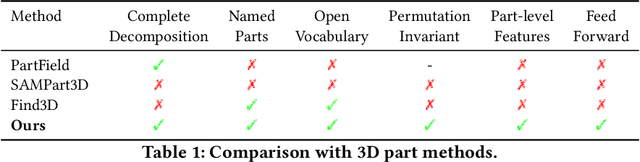
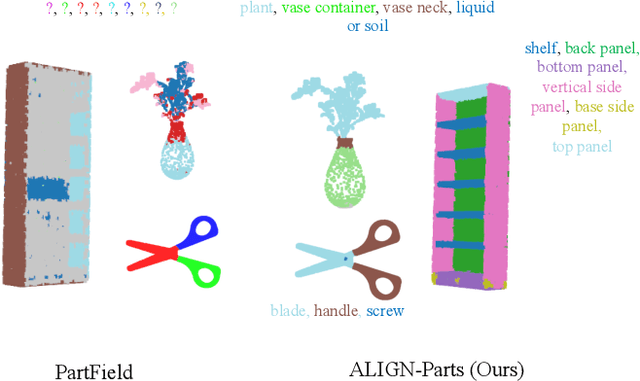

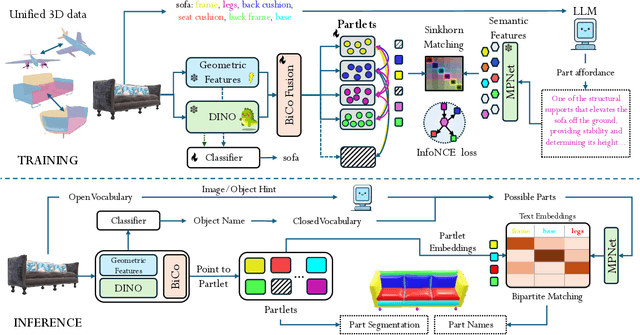
We address semantic 3D part segmentation: decomposing objects into parts with meaningful names. While datasets exist with part annotations, their definitions are inconsistent across datasets, limiting robust training. Previous methods produce unlabeled decompositions or retrieve single parts without complete shape annotations. We propose ALIGN-Parts, which formulates part naming as a direct set alignment task. Our method decomposes shapes into partlets - implicit 3D part representations - matched to part descriptions via bipartite assignment. We combine geometric cues from 3D part fields, appearance from multi-view vision features, and semantic knowledge from language-model-generated affordance descriptions. Text-alignment loss ensures partlets share embedding space with text, enabling a theoretically open-vocabulary matching setup, given sufficient data. Our efficient and novel, one-shot, 3D part segmentation and naming method finds applications in several downstream tasks, including serving as a scalable annotation engine. As our model supports zero-shot matching to arbitrary descriptions and confidence-calibrated predictions for known categories, with human verification, we create a unified ontology that aligns PartNet, 3DCoMPaT++, and Find3D, consisting of 1,794 unique 3D parts. We also show examples from our newly created Tex-Parts dataset. We also introduce 2 novel metrics appropriate for the named 3D part segmentation task.
Enhanced Cross-modal 3D Retrieval via Tri-modal Reconstruction
Apr 02, 2025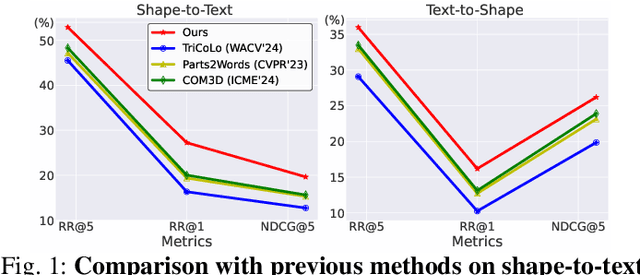
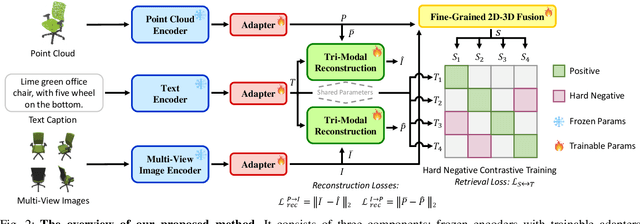
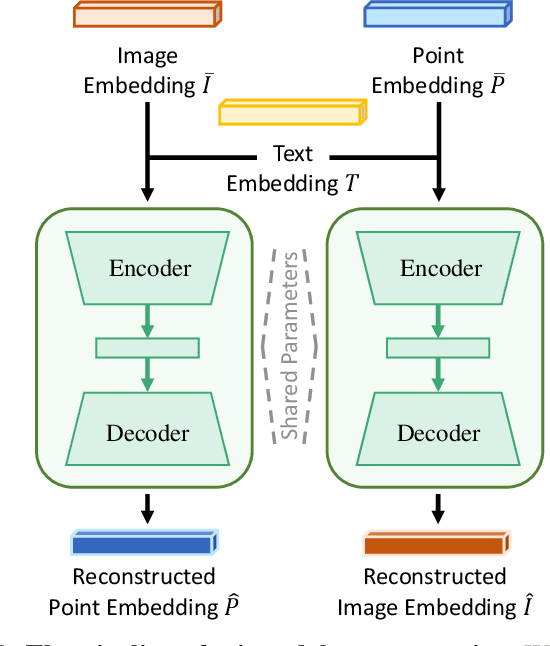
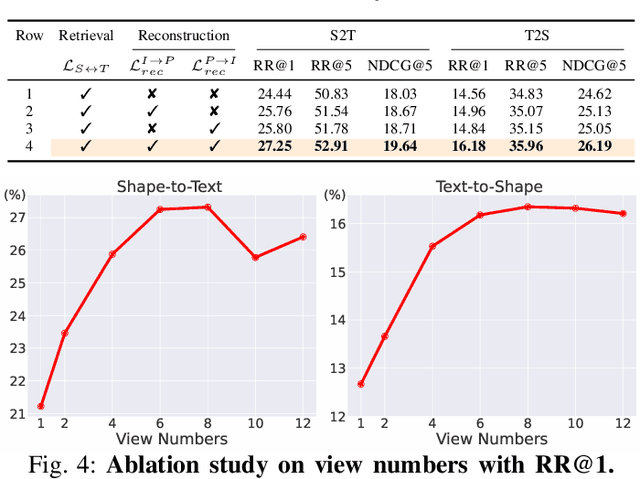
Cross-modal 3D retrieval is a critical yet challenging task, aiming to achieve bi-directional retrieval between 3D and text modalities. Current methods predominantly rely on a certain 3D representation (e.g., point cloud), with few exploiting the 2D-3D consistency and complementary relationships, which constrains their performance. To bridge this gap, we propose to adopt multi-view images and point clouds to jointly represent 3D shapes, facilitating tri-modal alignment (i.e., image, point, text) for enhanced cross-modal 3D retrieval. Notably, we introduce tri-modal reconstruction to improve the generalization ability of encoders. Given point features, we reconstruct image features under the guidance of text features, and vice versa. With well-aligned point cloud and multi-view image features, we aggregate them as multimodal embeddings through fine-grained 2D-3D fusion to enhance geometric and semantic understanding. Recognizing the significant noise in current datasets where many 3D shapes and texts share similar semantics, we employ hard negative contrastive training to emphasize harder negatives with greater significance, leading to robust discriminative embeddings. Extensive experiments on the Text2Shape dataset demonstrate that our method significantly outperforms previous state-of-the-art methods in both shape-to-text and text-to-shape retrieval tasks by a substantial margin.
INRet: A General Framework for Accurate Retrieval of INRs for Shapes
Jan 27, 2025
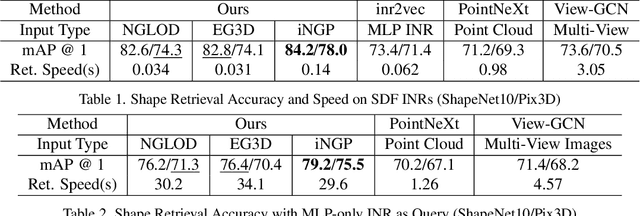

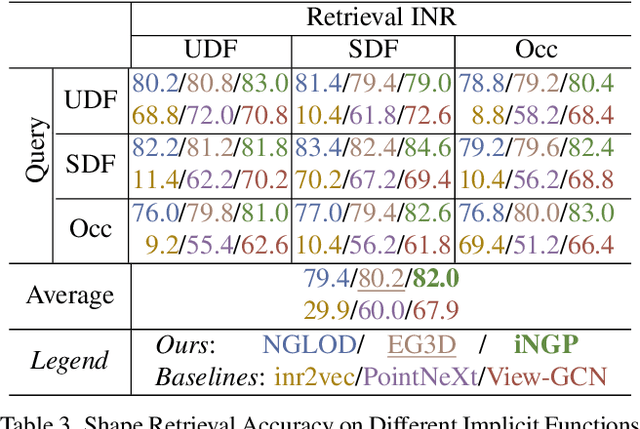
Implicit neural representations (INRs) have become an important method for encoding various data types, such as 3D objects or scenes, images, and videos. They have proven to be particularly effective at representing 3D content, e.g., 3D scene reconstruction from 2D images, novel 3D content creation, as well as the representation, interpolation, and completion of 3D shapes. With the widespread generation of 3D data in an INR format, there is a need to support effective organization and retrieval of INRs saved in a data store. A key aspect of retrieval and clustering of INRs in a data store is the formulation of similarity between INRs that would, for example, enable retrieval of similar INRs using a query INR. In this work, we propose INRet, a method for determining similarity between INRs that represent shapes, thus enabling accurate retrieval of similar shape INRs from an INR data store. INRet flexibly supports different INR architectures such as INRs with octree grids, triplanes, and hash grids, as well as different implicit functions including signed/unsigned distance function and occupancy field. We demonstrate that our method is more general and accurate than the existing INR retrieval method, which only supports simple MLP INRs and requires the same architecture between the query and stored INRs. Furthermore, compared to converting INRs to other representations (e.g., point clouds or multi-view images) for 3D shape retrieval, INRet achieves higher accuracy while avoiding the conversion overhead.
CAD-NeRF: Learning NeRFs from Uncalibrated Few-view Images by CAD Model Retrieval
Nov 05, 2024Reconstructing from multi-view images is a longstanding problem in 3D vision, where neural radiance fields (NeRFs) have shown great potential and get realistic rendered images of novel views. Currently, most NeRF methods either require accurate camera poses or a large number of input images, or even both. Reconstructing NeRF from few-view images without poses is challenging and highly ill-posed. To address this problem, we propose CAD-NeRF, a method reconstructed from less than 10 images without any known poses. Specifically, we build a mini library of several CAD models from ShapeNet and render them from many random views. Given sparse-view input images, we run a model and pose retrieval from the library, to get a model with similar shapes, serving as the density supervision and pose initializations. Here we propose a multi-view pose retrieval method to avoid pose conflicts among views, which is a new and unseen problem in uncalibrated NeRF methods. Then, the geometry of the object is trained by the CAD guidance. The deformation of the density field and camera poses are optimized jointly. Then texture and density are trained and fine-tuned as well. All training phases are in self-supervised manners. Comprehensive evaluations of synthetic and real images show that CAD-NeRF successfully learns accurate densities with a large deformation from retrieved CAD models, showing the generalization abilities.
Signage-Aware Exploration in Open World using Venue Maps
Oct 14, 2024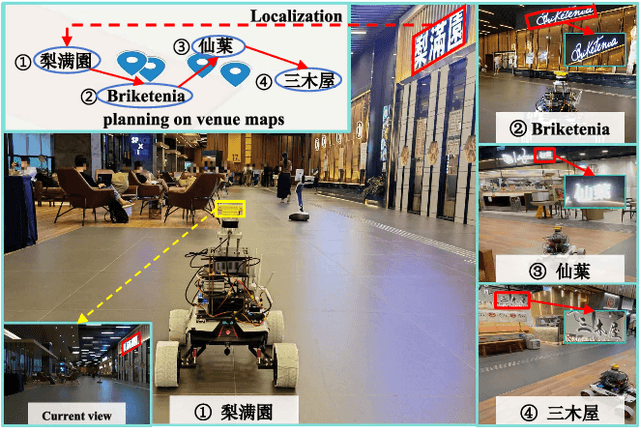
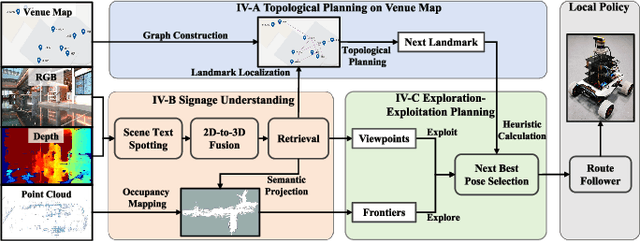
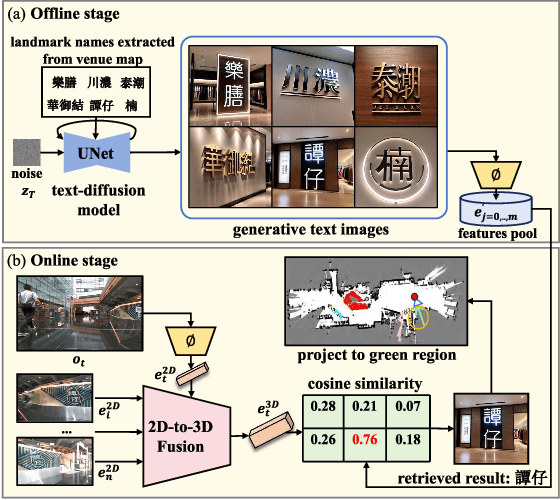
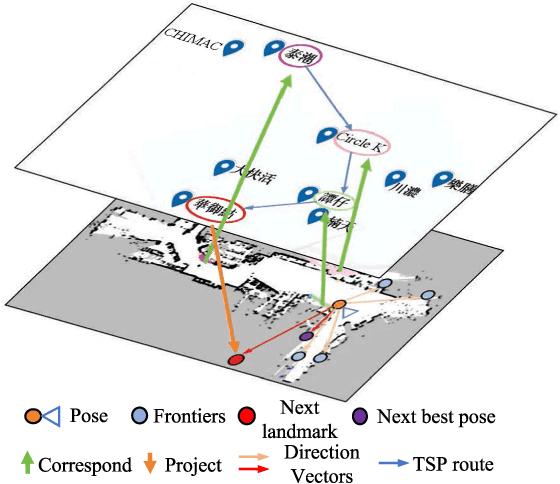
Current exploration methods struggle to search for shops in unknown open-world environments due to a lack of prior knowledge and text recognition capabilities. Venue maps offer valuable information that can aid exploration planning by correlating scene signage with map data. However, the arbitrary shapes and styles of the text on signage, along with multi-view inconsistencies, pose significant challenges for accurate recognition by robots. Additionally, the discrepancies between real-world environments and venue maps hinder the incorporation of text information into planners. This paper introduces a novel signage-aware exploration system to address these challenges, enabling the robot to utilize venue maps effectively. We propose a signage understanding method that accurately detects and recognizes the text on signage using a diffusion-based text instance retrieval method combined with a 2D-to-3D semantic fusion strategy. Furthermore, we design a venue map-guided exploration-exploitation planner that balances exploration in unknown regions using a directional heuristic derived from venue maps with exploitation to get close and adjust orientation for better recognition. Experiments in large-scale shopping malls demonstrate our method's superior signage recognition accuracy and coverage efficiency, outperforming state-of-the-art scene text spotting methods and traditional exploration methods.
Self-supervised 3D Point Cloud Completion via Multi-view Adversarial Learning
Jul 13, 2024
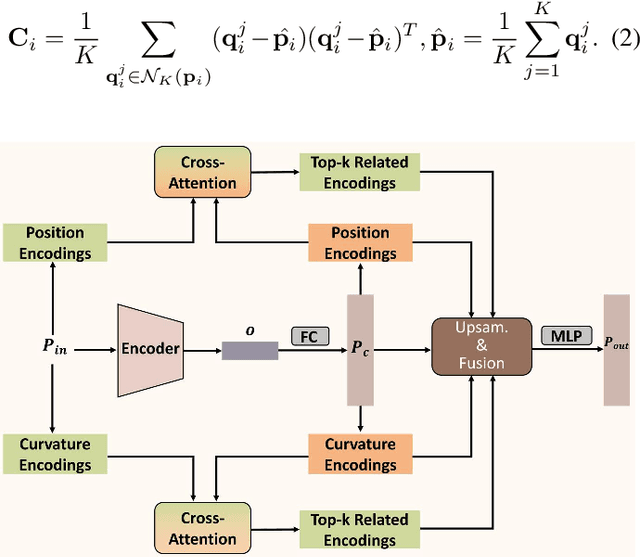
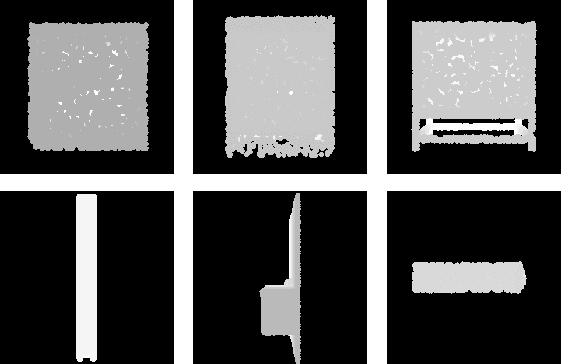

In real-world scenarios, scanned point clouds are often incomplete due to occlusion issues. The task of self-supervised point cloud completion involves reconstructing missing regions of these incomplete objects without the supervision of complete ground truth. Current self-supervised methods either rely on multiple views of partial observations for supervision or overlook the intrinsic geometric similarity that can be identified and utilized from the given partial point clouds. In this paper, we propose MAL-SPC, a framework that effectively leverages both object-level and category-specific geometric similarities to complete missing structures. Our MAL-SPC does not require any 3D complete supervision and only necessitates a single partial point cloud for each object. Specifically, we first introduce a Pattern Retrieval Network to retrieve similar position and curvature patterns between the partial input and the predicted shape, then leverage these similarities to densify and refine the reconstructed results. Additionally, we render the reconstructed complete shape into multi-view depth maps and design an adversarial learning module to learn the geometry of the target shape from category-specific single-view depth images. To achieve anisotropic rendering, we design a density-aware radius estimation algorithm to improve the quality of the rendered images. Our MAL-SPC yields the best results compared to current state-of-the-art methods.We will make the source code publicly available at \url{https://github.com/ltwu6/malspc
VSFormer: Mining Correlations in Flexible View Set for Multi-view 3D Shape Understanding
Sep 14, 2024


View-based methods have demonstrated promising performance in 3D shape understanding. However, they tend to make strong assumptions about the relations between views or learn the multi-view correlations indirectly, which limits the flexibility of exploring inter-view correlations and the effectiveness of target tasks. To overcome the above problems, this paper investigates flexible organization and explicit correlation learning for multiple views. In particular, we propose to incorporate different views of a 3D shape into a permutation-invariant set, referred to as \emph{View Set}, which removes rigid relation assumptions and facilitates adequate information exchange and fusion among views. Based on that, we devise a nimble Transformer model, named \emph{VSFormer}, to explicitly capture pairwise and higher-order correlations of all elements in the set. Meanwhile, we theoretically reveal a natural correspondence between the Cartesian product of a view set and the correlation matrix in the attention mechanism, which supports our model design. Comprehensive experiments suggest that VSFormer has better flexibility, efficient inference efficiency and superior performance. Notably, VSFormer reaches state-of-the-art results on various 3d recognition datasets, including ModelNet40, ScanObjectNN and RGBD. It also establishes new records on the SHREC'17 retrieval benchmark. The code and datasets are available at \url{https://github.com/auniquesun/VSFormer}.
Duoduo CLIP: Efficient 3D Understanding with Multi-View Images
Jun 17, 2024We introduce Duoduo CLIP, a model for 3D representation learning that learns shape encodings from multi-view images instead of point-clouds. The choice of multi-view images allows us to leverage 2D priors from off-the-shelf CLIP models to facilitate fine-tuning with 3D data. Our approach not only shows better generalization compared to existing point cloud methods, but also reduces GPU requirements and training time. In addition, we modify the model with cross-view attention to leverage information across multiple frames of the object which further boosts performance. Compared to the current SOTA point cloud method that requires 480 A100 hours to train 1 billion model parameters we only require 57 A5000 hours and 87 million parameters. Multi-view images also provide more flexibility in use cases compared to point clouds. This includes being able to encode objects with a variable number of images, with better performance when more views are used. This is in contrast to point cloud based methods, where an entire scan or model of an object is required. We showcase this flexibility with object retrieval from images of real-world objects. Our model also achieves better performance in more fine-grained text to shape retrieval, demonstrating better text-and-shape alignment than point cloud based models.
Sculpt3D: Multi-View Consistent Text-to-3D Generation with Sparse 3D Prior
Mar 14, 2024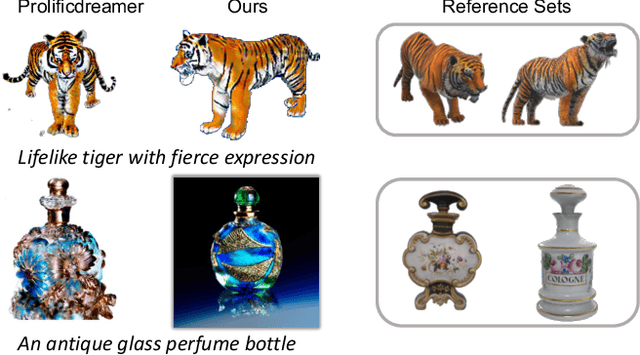
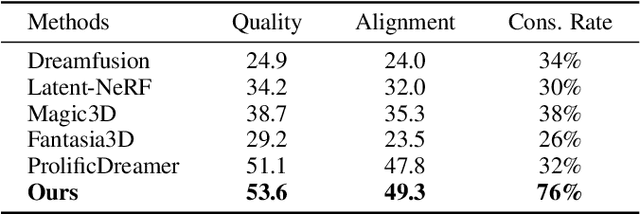
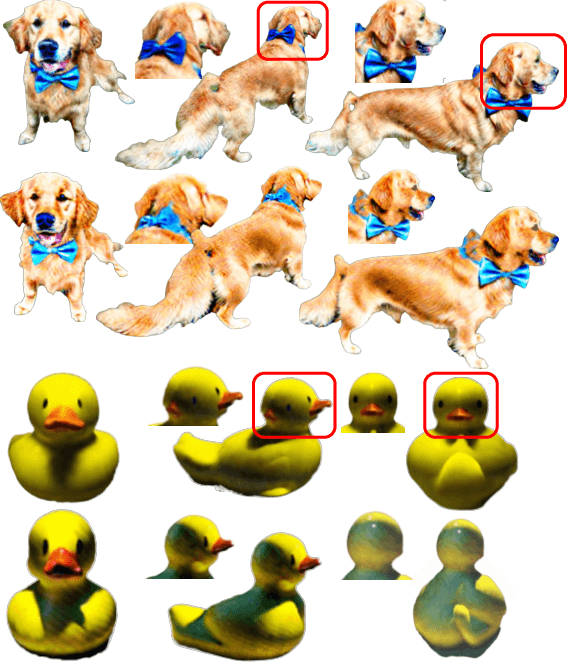
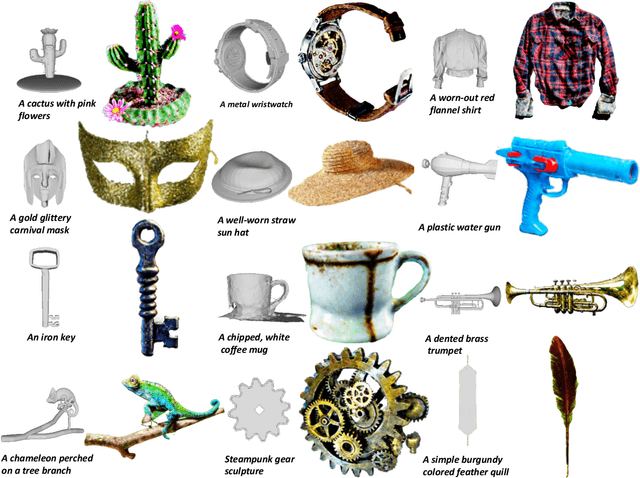
Recent works on text-to-3d generation show that using only 2D diffusion supervision for 3D generation tends to produce results with inconsistent appearances (e.g., faces on the back view) and inaccurate shapes (e.g., animals with extra legs). Existing methods mainly address this issue by retraining diffusion models with images rendered from 3D data to ensure multi-view consistency while struggling to balance 2D generation quality with 3D consistency. In this paper, we present a new framework Sculpt3D that equips the current pipeline with explicit injection of 3D priors from retrieved reference objects without re-training the 2D diffusion model. Specifically, we demonstrate that high-quality and diverse 3D geometry can be guaranteed by keypoints supervision through a sparse ray sampling approach. Moreover, to ensure accurate appearances of different views, we further modulate the output of the 2D diffusion model to the correct patterns of the template views without altering the generated object's style. These two decoupled designs effectively harness 3D information from reference objects to generate 3D objects while preserving the generation quality of the 2D diffusion model. Extensive experiments show our method can largely improve the multi-view consistency while retaining fidelity and diversity. Our project page is available at: https://stellarcheng.github.io/Sculpt3D/.