 Add to Chrome
 Add to Firefox
 Add to Edge
Hallucination Self-Play: Bootstrapping Reinforced Detector via Evolved Generator
Jul 08, 2026
Identifying faithfulness hallucinations in LLM-generated outputs remains challenging due to the scarcity of high-quality annotated data. Recent work relies on advanced LLMs to synthesize training data, including rationales, labels, and hallucinated claims. However, these methods treat the generator as a static component, limiting iterative improvement of the detector. To address this limitation, we introduce Hallucination Self-Play (HSP), a novel framework that enables the detector to bootstrap with an evolved generator. HSP involves two roles initialized from the same base model, a detector that assesses the faithfulness of model outputs, and a generator that produces increasingly hard-to-detect hallucinated responses. Specifically, the detector is first fine-tuned on human-labeled data and then employed as a reward model to train the generator via reinforcement learning from AI feedback (RLAIF). In turn, the evolved generator synthesizes hallucination data to further optimize the detector through rule-based reinforcement learning. Experiments on RAGTruth benchmark and two model families demonstrate that the proposed framework can progressively enhance a small LLM to match or even outperform advanced LLMs without external supervision. Our code is available at https://anonymous.4open.science/r/Hallucination-Self-Play-50B5 .

RustMizan: A Compilable, Contamination-Aware Benchmarking Framework for Rust Vulnerabilities
Jul 06, 2026LLM agents are increasingly applied to vulnerability analysis, but existing benchmarks have not kept pace. They typically rely on small non-compilable snippets, focus on binary classification (vulnerable or not), and do not account for the risk that publicly-released datasets are part of model training corpora. We introduce RustMizan, a benchmarking framework for Rust vulnerability analysis that addresses these gaps. RustMizan contains compilable code variants at the crate, file, and function levels, with annotations for binary vulnerability detection, CWE classification, and function- and line-level localization. A paired mutation framework produces semantics-preserving code mutants for contamination testing and robustness probing. Across four frontier models in an agentic setup with command-line access, binary classification sits in the 56-65% range, but line localization F1 stays near 20%, and adversarial cues drop line F1 by about 27%.
Scaling Diverse Language Generation for 3D Visual Grounding
Jun 18, 2026Developing robust models for 3D visual grounding (3DVG), the localization of entities in a 3D scene described in natural language, is important for enabling agents to correspond spatial language with objects in the physical world. However, the lack of diverse descriptions at scale prevents models from generalizing beyond simple linguistic patterns. Recent such attempts lack diversity in the constraint types and language used to ground objects. Captioning methods cannot precisely contrast objects, which is important for visual grounding. We therefore propose ViGiL3D++, a scalable, scene-agnostic method that generates diverse visual grounding queries by combining constraint sampling in scene graphs with the language generation of LLMs. We show that it has greater diversity over existing scaled datasets and improves model performance over several 3DVG benchmarks but also illuminates outstanding limitations of VLMs.
Function2Scene: 3D Indoor Scene Layout from Functional Specifications
May 29, 2026Most text-driven 3D indoor scene synthesis methods generate rooms from object-centric prompts, asking what furniture should be placed rather than how the space is used. Yet in real interior design, a layout is judged by how well it supports its occupants, e.g., their activities and physical needs. We introduce Function2Scene, a framework for generating 3D indoor layouts from functional specifications, i.e., natural-language design briefs describing who will use a room and what they need to do there. Given such a specification, our system parses occupant personas and activities, derives a customized set of functional design constraints from a taxonomy of 17 criteria spanning spatial, ergonomic, activity, and environmental considerations, and uses these constraints to guide layout generation. Rather than relying on an LLM to directly produce a final scene, Function2Scene performs iterative evaluation and refinement through a tool-augmented check-and-repair loop, combining geometric measurements, LLM-based contextual reasoning, and VLM-based visual assessment. Experiments on 30 professionally written interior-design cases show that Function2Scene produces layouts that better satisfy functional requirements than recent LLM-based scene synthesis baselines, with our results preferred in 94.3% of pairwise comparisons. Our work reframes text-driven indoor scene synthesis from placing plausible objects to designing spaces that support human use.
Artiverse: A Diverse and Physically Grounded Dataset for Articulated Objects
May 23, 2026We present Artiverse, a diverse and physically grounded dataset of high-quality articulated 3D objects designed for realistic functional modeling and simulation. Artiverse contains 5.4K human-authored objects across a broad range of 88 categories, aggregated from multiple 3D static repositories. Objects are annotated with functional parts, interior structures, realistic kinematic relationships and articulated joints including multi-DoF joints, and physical attributes such as metric scale, material, and mass. We develop a semi-automated annotation pipeline that combines few-shot segmentation, geometric reasoning, and multi-stage human verification to achieve high-quality and efficient annotation, reducing manual annotation time by over 30%. We demonstrate the value of Artiverse on tasks of part mobility analysis, articulated object generation, and physics-based interaction. Artiverse provides a data resource to advance functional understanding for articulated objects.
ReVSI: Rebuilding Visual Spatial Intelligence Evaluation for Accurate Assessment of VLM 3D Reasoning
Apr 27, 2026Current evaluations of spatial intelligence can be systematically invalid under modern vision-language model (VLM) settings. First, many benchmarks derive question-answer (QA) pairs from point-cloud-based 3D annotations originally curated for traditional 3D perception. When such annotations are treated as ground truth for video-based evaluation, reconstruction and annotation artifacts can miss objects that are clearly visible in the video, mislabel object identities, or corrupt geometry-dependent answers (e.g., size), yielding incorrect or ambiguous QA pairs. Second, evaluations often assume full-scene access, while many VLMs operate on sparsely sampled frames (e.g., 16-64), making many questions effectively unanswerable under the actual model inputs. We improve evaluation validity by introducing ReVSI, a benchmark and protocol that ensures each QA pair is answerable and correct under the model's actual inputs. To this end, we re-annotate objects and geometry across 381 scenes from 5 datasets to improve data quality, and regenerate all QA pairs with rigorous bias mitigation and human verification using professional 3D annotation tools. We further enhance evaluation controllability by providing variants across multiple frame budgets (16/32/64/all) and fine-grained object visibility metadata, enabling controlled diagnostic analyses. Evaluations of general and domain-specific VLMs on ReVSI reveal systematic failure modes that are obscured by prior benchmarks, yielding a more reliable and diagnostic assessment of spatial intelligence.
JRM: Joint Reconstruction Model for Multiple Objects without Alignment
Mar 27, 2026Object-centric reconstruction seeks to recover the 3D structure of a scene through composition of independent objects. While this independence can simplify modeling, it discards strong signals that could improve reconstruction, notably repetition where the same object model is seen multiple times in a scene, or across scans. We propose the Joint Reconstruction Model (JRM) to leverage repetition by framing object reconstruction as one of personalized generation: multiple observations share a common subject that should be consistent for all observations, while still adhering to the specific pose and state from each. Prior methods in this direction rely on explicit matching and rigid alignment across observations, making them sensitive to errors and difficult to extend to non-rigid transformations. In contrast, JRM is a 3D flow-matching generative model that implicitly aggregates unaligned observations in its latent space, learning to produce consistent and faithful reconstructions in a data-driven manner without explicit constraints. Evaluations on synthetic and real-world data show that JRM's implicit aggregation removes the need for explicit alignment, improves robustness to incorrect associations, and naturally handles non-rigid changes such as articulation. Overall, JRM outperforms both independent and alignment-based baselines in reconstruction quality.
NuiWorld: Exploring a Scalable Framework for End-to-End Controllable World Generation
Jan 27, 2026World generation is a fundamental capability for applications like video games, simulation, and robotics. However, existing approaches face three main obstacles: controllability, scalability, and efficiency. End-to-end scene generation models have been limited by data scarcity. While object-centric generation approaches rely on fixed resolution representations, degrading fidelity for larger scenes. Training-free approaches, while flexible, are often slow and computationally expensive at inference time. We present NuiWorld, a framework that attempts to address these challenges. To overcome data scarcity, we propose a generative bootstrapping strategy that starts from a few input images. Leveraging recent 3D reconstruction and expandable scene generation techniques, we synthesize scenes of varying sizes and layouts, producing enough data to train an end-to-end model. Furthermore, our framework enables controllability through pseudo sketch labels, and demonstrates a degree of generalization to previously unseen sketches. Our approach represents scenes as a collection of variable scene chunks, which are compressed into a flattened vector-set representation. This significantly reduces the token length for large scenes, enabling consistent geometric fidelity across scenes sizes while improving training and inference efficiency.
LangNavBench: Evaluation of Natural Language Understanding in Semantic Navigation
Jul 09, 2025Recent progress in large vision-language models has driven improvements in language-based semantic navigation, where an embodied agent must reach a target object described in natural language. Despite these advances, we still lack a clear, language-focused benchmark for testing how well such agents ground the words in their instructions. We address this gap with LangNav, an open-set dataset specifically created to test an agent's ability to locate objects described at different levels of detail, from broad category names to fine attributes and object-object relations. Every description in LangNav was manually checked, yielding a lower error rate than existing lifelong- and semantic-navigation datasets. On top of LangNav we build LangNavBench, a benchmark that measures how well current semantic-navigation methods understand and act on these descriptions while moving toward their targets. LangNavBench allows us to systematically compare models on their handling of attributes, spatial and relational cues, and category hierarchies, offering the first thorough, language-centric evaluation of embodied navigation systems. We also present Multi-Layered Feature Map (MLFM), a method that builds a queryable multi-layered semantic map, particularly effective when dealing with small objects or instructions involving spatial relations. MLFM outperforms state-of-the-art mapping-based navigation baselines on the LangNav dataset.
HSM: Hierarchical Scene Motifs for Multi-Scale Indoor Scene Generation
Mar 21, 2025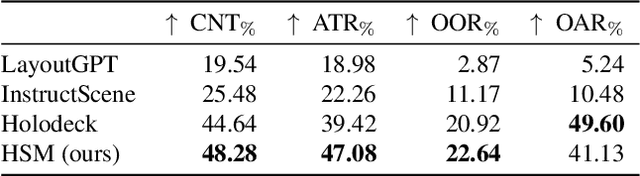
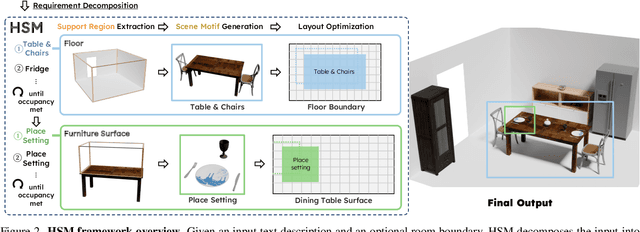
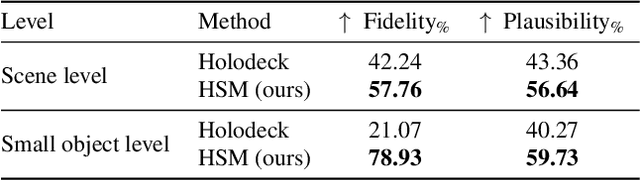
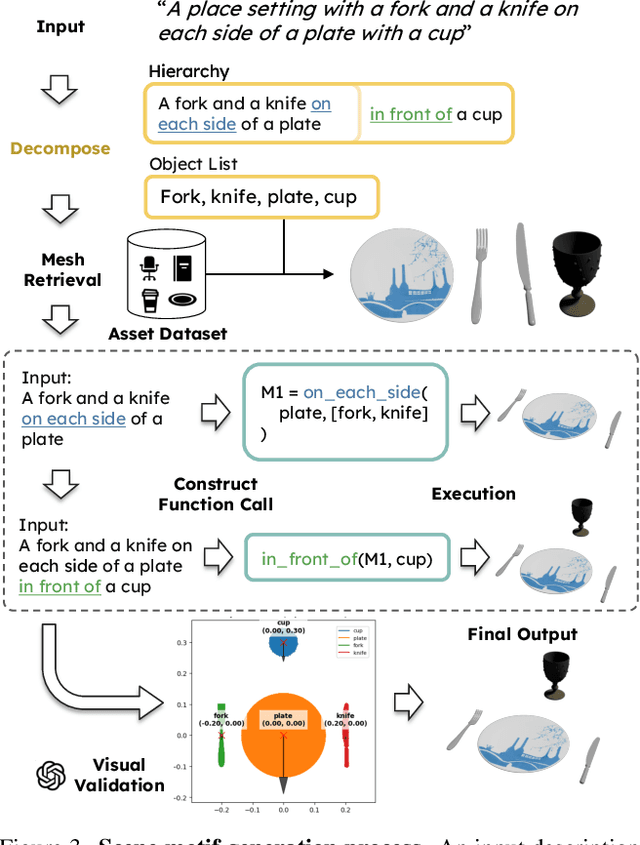
Despite advances in indoor 3D scene layout generation, synthesizing scenes with dense object arrangements remains challenging. Existing methods primarily focus on large furniture while neglecting smaller objects, resulting in unrealistically empty scenes. Those that place small objects typically do not honor arrangement specifications, resulting in largely random placement not following the text description. We present HSM, a hierarchical framework for indoor scene generation with dense object arrangements across spatial scales. Indoor scenes are inherently hierarchical, with surfaces supporting objects at different scales, from large furniture on floors to smaller objects on tables and shelves. HSM embraces this hierarchy and exploits recurring cross-scale spatial patterns to generate complex and realistic indoor scenes in a unified manner. Our experiments show that HSM outperforms existing methods by generating scenes that are more realistic and better conform to user input across room types and spatial configurations.