 Add to Chrome
 Add to Firefox
 Add to Edge
PatchAlign3D: Local Feature Alignment for Dense 3D Shape understanding
Jan 05, 2026
Current foundation models for 3D shapes excel at global tasks (retrieval, classification) but transfer poorly to local part-level reasoning. Recent approaches leverage vision and language foundation models to directly solve dense tasks through multi-view renderings and text queries. While promising, these pipelines require expensive inference over multiple renderings, depend heavily on large language-model (LLM) prompt engineering for captions, and fail to exploit the inherent 3D geometry of shapes. We address this gap by introducing an encoder-only 3D model that produces language-aligned patch-level features directly from point clouds. Our pre-training approach builds on existing data engines that generate part-annotated 3D shapes by pairing multi-view SAM regions with VLM captioning. Using this data, we train a point cloud transformer encoder in two stages: (1) distillation of dense 2D features from visual encoders such as DINOv2 into 3D patches, and (2) alignment of these patch embeddings with part-level text embeddings through a multi-positive contrastive objective. Our 3D encoder achieves zero-shot 3D part segmentation with fast single-pass inference without any test-time multi-view rendering, while significantly outperforming previous rendering-based and feed-forward approaches across several 3D part segmentation benchmarks. Project website: https://souhail-hadgi.github.io/patchalign3dsite/

Escaping Plato's Cave: Towards the Alignment of 3D and Text Latent Spaces
Mar 07, 2025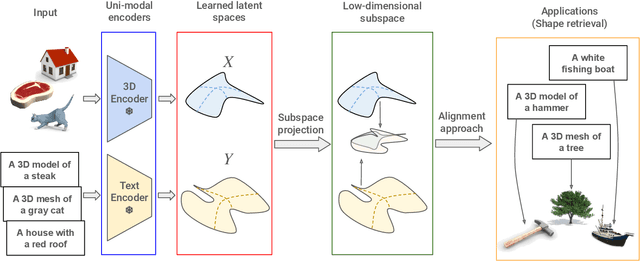
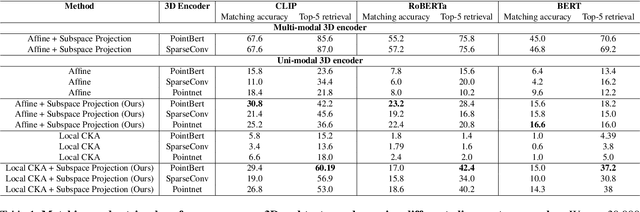
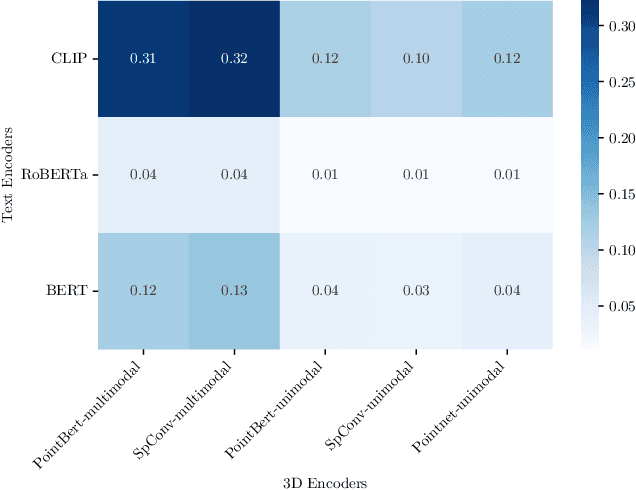
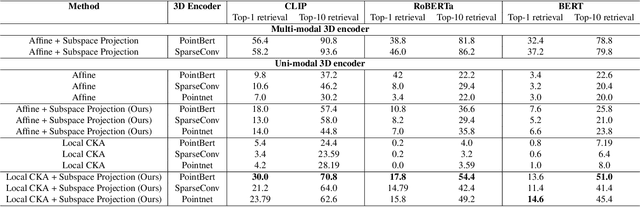
Recent works have shown that, when trained at scale, uni-modal 2D vision and text encoders converge to learned features that share remarkable structural properties, despite arising from different representations. However, the role of 3D encoders with respect to other modalities remains unexplored. Furthermore, existing 3D foundation models that leverage large datasets are typically trained with explicit alignment objectives with respect to frozen encoders from other representations. In this work, we investigate the possibility of a posteriori alignment of representations obtained from uni-modal 3D encoders compared to text-based feature spaces. We show that naive post-training feature alignment of uni-modal text and 3D encoders results in limited performance. We then focus on extracting subspaces of the corresponding feature spaces and discover that by projecting learned representations onto well-chosen lower-dimensional subspaces the quality of alignment becomes significantly higher, leading to improved accuracy on matching and retrieval tasks. Our analysis further sheds light on the nature of these shared subspaces, which roughly separate between semantic and geometric data representations. Overall, ours is the first work that helps to establish a baseline for post-training alignment of 3D uni-modal and text feature spaces, and helps to highlight both the shared and unique properties of 3D data compared to other representations.
To Supervise or Not to Supervise: Understanding and Addressing the Key Challenges of 3D Transfer Learning
Mar 26, 2024Transfer learning has long been a key factor in the advancement of many fields including 2D image analysis. Unfortunately, its applicability in 3D data processing has been relatively limited. While several approaches for 3D transfer learning have been proposed in recent literature, with contrastive learning gaining particular prominence, most existing methods in this domain have only been studied and evaluated in limited scenarios. Most importantly, there is currently a lack of principled understanding of both when and why 3D transfer learning methods are applicable. Remarkably, even the applicability of standard supervised pre-training is poorly understood. In this work, we conduct the first in-depth quantitative and qualitative investigation of supervised and contrastive pre-training strategies and their utility in downstream 3D tasks. We demonstrate that layer-wise analysis of learned features provides significant insight into the downstream utility of trained networks. Informed by this analysis, we propose a simple geometric regularization strategy, which improves the transferability of supervised pre-training. Our work thus sheds light onto both the specific challenges of 3D transfer learning, as well as strategies to overcome them.