 Add to Chrome
 Add to Firefox
 Add to Edge
TuneShift-KD: Knowledge Distillation and Transfer for Fine-tuned Models
Mar 25, 2026
To embed domain-specific or specialized knowledge into pre-trained foundation models, fine-tuning using techniques such as parameter efficient fine-tuning (e.g. LoRA) is a common practice. However, as new LLM architectures and pre-trained models emerge, transferring this specialized knowledge to newer models becomes an important task. In many scenarios, the original specialized data may be unavailable due to privacy or commercial restrictions, necessitating distillation and transfer of this specialized knowledge from the fine-tuned base model to a different pre-trained model. We present TuneShift-KD, a novel approach that automatically distills specialized knowledge from a fine-tuned model to a target model using only a few examples representative of the specialized information. Our key insight is that specialized knowledge can be identified through perplexity differences between base and fine-tuned models: prompts where the fine-tuned model responds confidently (low perplexity), but the base model struggles (high perplexity), indicate queries corresponding to the specialized knowledge learned by the fine-tuned model. TuneShift-KD leverages this insight to create a synthetic training dataset to transfer the specialized knowledge. Using an iterative process, TuneShift-KD generates more prompts similar to those that generated responses with specialized knowledge. TuneShift-KD does not require training discriminators or access to training datasets. It is an automated approach that only requires the initial fine-tuned and base models and a few representative prompts. Our experiments demonstrate that models fine-tuned using TuneShift-KD achieve higher accuracy than prior approaches, enabling ease of deployment and more effective transfer of the specialized knowledge.

INRet: A General Framework for Accurate Retrieval of INRs for Shapes
Jan 27, 2025
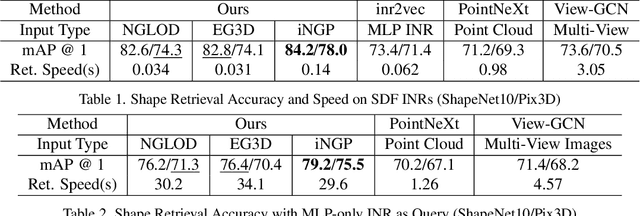

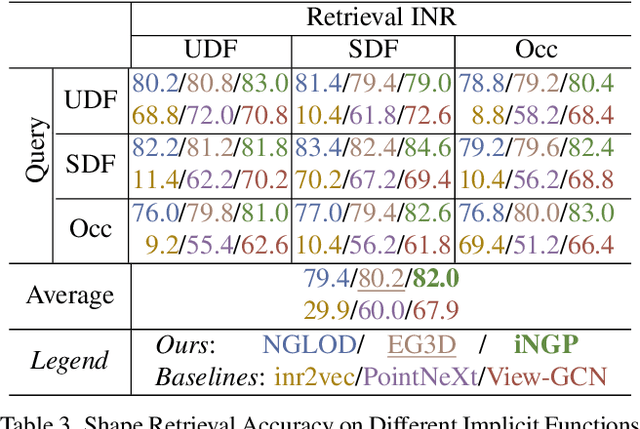
Implicit neural representations (INRs) have become an important method for encoding various data types, such as 3D objects or scenes, images, and videos. They have proven to be particularly effective at representing 3D content, e.g., 3D scene reconstruction from 2D images, novel 3D content creation, as well as the representation, interpolation, and completion of 3D shapes. With the widespread generation of 3D data in an INR format, there is a need to support effective organization and retrieval of INRs saved in a data store. A key aspect of retrieval and clustering of INRs in a data store is the formulation of similarity between INRs that would, for example, enable retrieval of similar INRs using a query INR. In this work, we propose INRet, a method for determining similarity between INRs that represent shapes, thus enabling accurate retrieval of similar shape INRs from an INR data store. INRet flexibly supports different INR architectures such as INRs with octree grids, triplanes, and hash grids, as well as different implicit functions including signed/unsigned distance function and occupancy field. We demonstrate that our method is more general and accurate than the existing INR retrieval method, which only supports simple MLP INRs and requires the same architecture between the query and stored INRs. Furthermore, compared to converting INRs to other representations (e.g., point clouds or multi-view images) for 3D shape retrieval, INRet achieves higher accuracy while avoiding the conversion overhead.