 Add to Chrome
 Add to Firefox
 Add to Edge
Asset Corpus
Papers and Code
Diffusion Knows Transparency: Repurposing Video Diffusion for Transparent Object Depth and Normal Estimation
Dec 29, 2025
Transparent objects remain notoriously hard for perception systems: refraction, reflection and transmission break the assumptions behind stereo, ToF and purely discriminative monocular depth, causing holes and temporally unstable estimates. Our key observation is that modern video diffusion models already synthesize convincing transparent phenomena, suggesting they have internalized the optical rules. We build TransPhy3D, a synthetic video corpus of transparent/reflective scenes: 11k sequences rendered with Blender/Cycles. Scenes are assembled from a curated bank of category-rich static assets and shape-rich procedural assets paired with glass/plastic/metal materials. We render RGB + depth + normals with physically based ray tracing and OptiX denoising. Starting from a large video diffusion model, we learn a video-to-video translator for depth (and normals) via lightweight LoRA adapters. During training we concatenate RGB and (noisy) depth latents in the DiT backbone and co-train on TransPhy3D and existing frame-wise synthetic datasets, yielding temporally consistent predictions for arbitrary-length input videos. The resulting model, DKT, achieves zero-shot SOTA on real and synthetic video benchmarks involving transparency: ClearPose, DREDS (CatKnown/CatNovel), and TransPhy3D-Test. It improves accuracy and temporal consistency over strong image/video baselines, and a normal variant sets the best video normal estimation results on ClearPose. A compact 1.3B version runs at ~0.17 s/frame. Integrated into a grasping stack, DKT's depth boosts success rates across translucent, reflective and diffuse surfaces, outperforming prior estimators. Together, these results support a broader claim: "Diffusion knows transparency." Generative video priors can be repurposed, efficiently and label-free, into robust, temporally coherent perception for challenging real-world manipulation.

AOMGen: Photoreal, Physics-Consistent Demonstration Generation for Articulated Object Manipulation
Dec 20, 2025
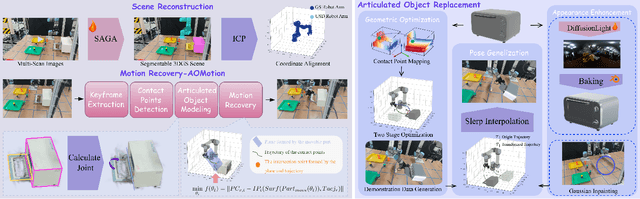
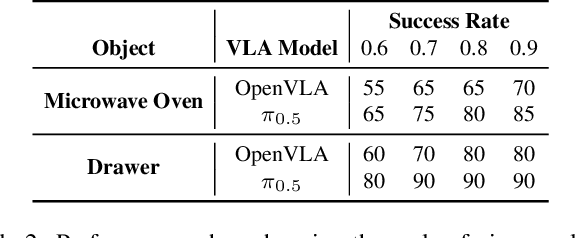
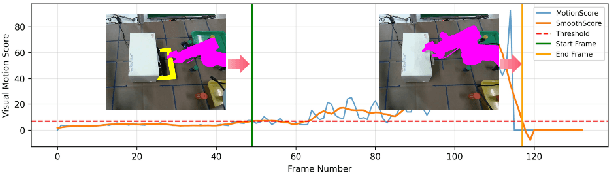
Recent advances in Vision-Language-Action (VLA) and world-model methods have improved generalization in tasks such as robotic manipulation and object interaction. However, Successful execution of such tasks depends on large, costly collections of real demonstrations, especially for fine-grained manipulation of articulated objects. To address this, we present AOMGen, a scalable data generation framework for articulated manipulation which is instantiated from a single real scan, demonstration and a library of readily available digital assets, yielding photoreal training data with verified physical states. The framework synthesizes synchronized multi-view RGB temporally aligned with action commands and state annotations for joints and contacts, and systematically varies camera viewpoints, object styles, and object poses to expand a single execution into a diverse corpus. Experimental results demonstrate that fine-tuning VLA policies on AOMGen data increases the success rate from 0% to 88.7%, and the policies are tested on unseen objects and layouts.
RealClass: A Framework for Classroom Speech Simulation with Public Datasets and Game Engines
Oct 01, 2025The scarcity of large-scale classroom speech data has hindered the development of AI-driven speech models for education. Classroom datasets remain limited and not publicly available, and the absence of dedicated classroom noise or Room Impulse Response (RIR) corpora prevents the use of standard data augmentation techniques. In this paper, we introduce a scalable methodology for synthesizing classroom noise and RIRs using game engines, a versatile framework that can extend to other domains beyond the classroom. Building on this methodology, we present RealClass, a dataset that combines a synthesized classroom noise corpus with a classroom speech dataset compiled from publicly available corpora. The speech data pairs a children's speech corpus with instructional speech extracted from YouTube videos to approximate real classroom interactions in clean conditions. Experiments on clean and noisy speech show that RealClass closely approximates real classroom speech, making it a valuable asset in the absence of abundant real classroom speech.
SpatialVID: A Large-Scale Video Dataset with Spatial Annotations
Sep 11, 2025Significant progress has been made in spatial intelligence, spanning both spatial reconstruction and world exploration. However, the scalability and real-world fidelity of current models remain severely constrained by the scarcity of large-scale, high-quality training data. While several datasets provide camera pose information, they are typically limited in scale, diversity, and annotation richness, particularly for real-world dynamic scenes with ground-truth camera motion. To this end, we collect \textbf{SpatialVID}, a dataset consists of a large corpus of in-the-wild videos with diverse scenes, camera movements and dense 3D annotations such as per-frame camera poses, depth, and motion instructions. Specifically, we collect more than 21,000 hours of raw video, and process them into 2.7 million clips through a hierarchical filtering pipeline, totaling 7,089 hours of dynamic content. A subsequent annotation pipeline enriches these clips with detailed spatial and semantic information, including camera poses, depth maps, dynamic masks, structured captions, and serialized motion instructions. Analysis of SpatialVID's data statistics reveals a richness and diversity that directly foster improved model generalization and performance, establishing it as a key asset for the video and 3D vision research community.
MeAJOR Corpus: A Multi-Source Dataset for Phishing Email Detection
Jul 23, 2025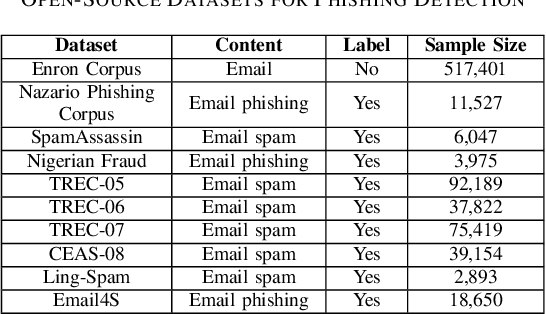
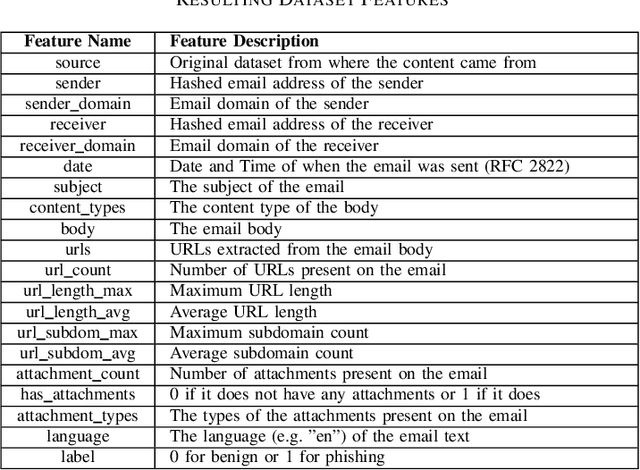
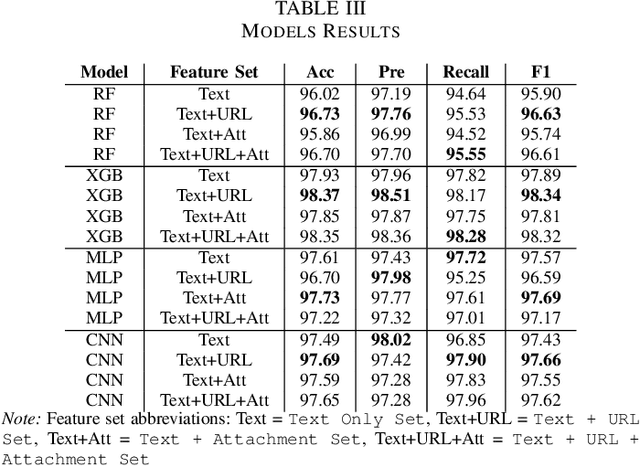
Phishing emails continue to pose a significant threat to cybersecurity by exploiting human vulnerabilities through deceptive content and malicious payloads. While Machine Learning (ML) models are effective at detecting phishing threats, their performance largely relies on the quality and diversity of the training data. This paper presents MeAJOR (Merged email Assets from Joint Open-source Repositories) Corpus, a novel, multi-source phishing email dataset designed to overcome critical limitations in existing resources. It integrates 135894 samples representing a broad number of phishing tactics and legitimate emails, with a wide spectrum of engineered features. We evaluated the dataset's utility for phishing detection research through systematic experiments with four classification models (RF, XGB, MLP, and CNN) across multiple feature configurations. Results highlight the dataset's effectiveness, achieving 98.34% F1 with XGB. By integrating broad features from multiple categories, our dataset provides a reusable and consistent resource, while addressing common challenges like class imbalance, generalisability and reproducibility.
CreatiPoster: Towards Editable and Controllable Multi-Layer Graphic Design Generation
Jun 12, 2025Graphic design plays a crucial role in both commercial and personal contexts, yet creating high-quality, editable, and aesthetically pleasing graphic compositions remains a time-consuming and skill-intensive task, especially for beginners. Current AI tools automate parts of the workflow, but struggle to accurately incorporate user-supplied assets, maintain editability, and achieve professional visual appeal. Commercial systems, like Canva Magic Design, rely on vast template libraries, which are impractical for replicate. In this paper, we introduce CreatiPoster, a framework that generates editable, multi-layer compositions from optional natural-language instructions or assets. A protocol model, an RGBA large multimodal model, first produces a JSON specification detailing every layer (text or asset) with precise layout, hierarchy, content and style, plus a concise background prompt. A conditional background model then synthesizes a coherent background conditioned on this rendered foreground layers. We construct a benchmark with automated metrics for graphic-design generation and show that CreatiPoster surpasses leading open-source approaches and proprietary commercial systems. To catalyze further research, we release a copyright-free corpus of 100,000 multi-layer designs. CreatiPoster supports diverse applications such as canvas editing, text overlay, responsive resizing, multilingual adaptation, and animated posters, advancing the democratization of AI-assisted graphic design. Project homepage: https://github.com/graphic-design-ai/creatiposter
ICH-Qwen: A Large Language Model Towards Chinese Intangible Cultural Heritage
May 28, 2025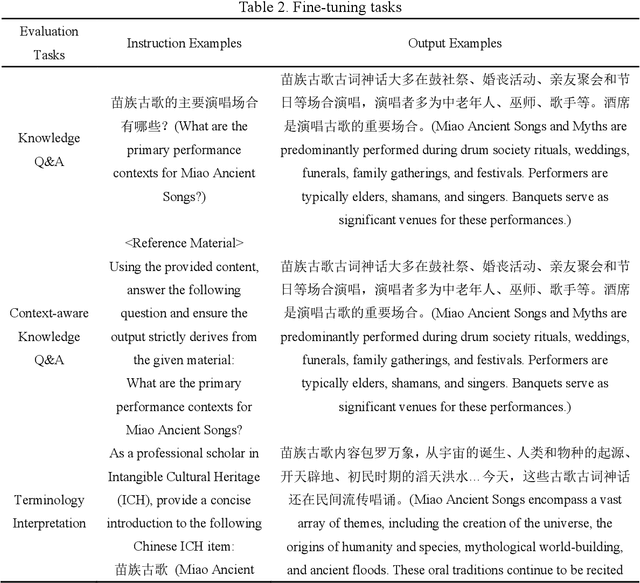
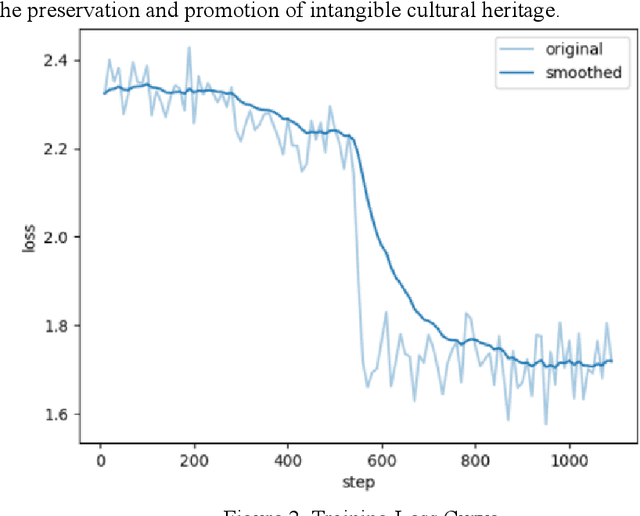
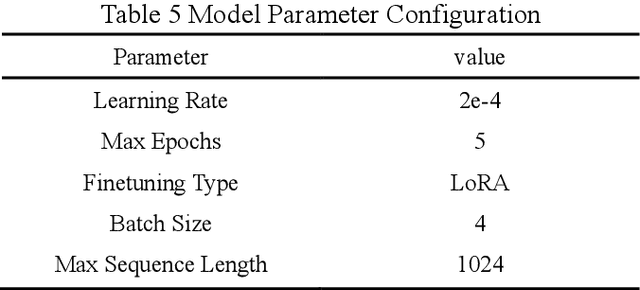

The intangible cultural heritage (ICH) of China, a cultural asset transmitted across generations by various ethnic groups, serves as a significant testament to the evolution of human civilization and holds irreplaceable value for the preservation of historical lineage and the enhancement of cultural self-confidence. However, the rapid pace of modernization poses formidable challenges to ICH, including threats damage, disappearance and discontinuity of inheritance. China has the highest number of items on the UNESCO Intangible Cultural Heritage List, which is indicative of the nation's abundant cultural resources and emphasises the pressing need for ICH preservation. In recent years, the rapid advancements in large language modelling have provided a novel technological approach for the preservation and dissemination of ICH. This study utilises a substantial corpus of open-source Chinese ICH data to develop a large language model, ICH-Qwen, for the ICH domain. The model employs natural language understanding and knowledge reasoning capabilities of large language models, augmented with synthetic data and fine-tuning techniques. The experimental results demonstrate the efficacy of ICH-Qwen in executing tasks specific to the ICH domain. It is anticipated that the model will provide intelligent solutions for the protection, inheritance and dissemination of intangible cultural heritage, as well as new theoretical and practical references for the sustainable development of intangible cultural heritage. Furthermore, it is expected that the study will open up new paths for digital humanities research.
MoK-RAG: Mixture of Knowledge Paths Enhanced Retrieval-Augmented Generation for Embodied AI Environments
Mar 18, 2025While human cognition inherently retrieves information from diverse and specialized knowledge sources during decision-making processes, current Retrieval-Augmented Generation (RAG) systems typically operate through single-source knowledge retrieval, leading to a cognitive-algorithmic discrepancy. To bridge this gap, we introduce MoK-RAG, a novel multi-source RAG framework that implements a mixture of knowledge paths enhanced retrieval mechanism through functional partitioning of a large language model (LLM) corpus into distinct sections, enabling retrieval from multiple specialized knowledge paths. Applied to the generation of 3D simulated environments, our proposed MoK-RAG3D enhances this paradigm by partitioning 3D assets into distinct sections and organizing them based on a hierarchical knowledge tree structure. Different from previous methods that only use manual evaluation, we pioneered the introduction of automated evaluation methods for 3D scenes. Both automatic and human evaluations in our experiments demonstrate that MoK-RAG3D can assist Embodied AI agents in generating diverse scenes.
Distilling Monolingual and Crosslingual Word-in-Context Representations
Sep 13, 2024In this study, we propose a method that distils representations of word meaning in context from a pre-trained masked language model in both monolingual and crosslingual settings. Word representations are the basis for context-aware lexical semantics and unsupervised semantic textual similarity (STS) estimation. Different from existing approaches, our method does not require human-annotated corpora nor updates of the parameters of the pre-trained model. The latter feature is appealing for practical scenarios where the off-the-shelf pre-trained model is a common asset among different applications. Specifically, our method learns to combine the outputs of different hidden layers of the pre-trained model using self-attention. Our auto-encoder based training only requires an automatically generated corpus. To evaluate the performance of the proposed approach, we performed extensive experiments using various benchmark tasks. The results on the monolingual tasks confirmed that our representations exhibited a competitive performance compared to that of the previous study for the context-aware lexical semantic tasks and outperformed it for STS estimation. The results of the crosslingual tasks revealed that the proposed method largely improved crosslingual word representations of multilingual pre-trained models.
Enhancing Language Learning through Technology: Introducing a New English-Azerbaijani (Arabic Script) Parallel Corpus
Jul 06, 2024This paper introduces a pioneering English-Azerbaijani (Arabic Script) parallel corpus, designed to bridge the technological gap in language learning and machine translation (MT) for under-resourced languages. Consisting of 548,000 parallel sentences and approximately 9 million words per language, this dataset is derived from diverse sources such as news articles and holy texts, aiming to enhance natural language processing (NLP) applications and language education technology. This corpus marks a significant step forward in the realm of linguistic resources, particularly for Turkic languages, which have lagged in the neural machine translation (NMT) revolution. By presenting the first comprehensive case study for the English-Azerbaijani (Arabic Script) language pair, this work underscores the transformative potential of NMT in low-resource contexts. The development and utilization of this corpus not only facilitate the advancement of machine translation systems tailored for specific linguistic needs but also promote inclusive language learning through technology. The findings demonstrate the corpus's effectiveness in training deep learning MT systems and underscore its role as an essential asset for researchers and educators aiming to foster bilingual education and multilingual communication. This research covers the way for future explorations into NMT applications for languages lacking substantial digital resources, thereby enhancing global language education frameworks. The Python package of our code is available at https://pypi.org/project/chevir-kartalol/, and we also have a website accessible at https://translate.kartalol.com/.