 Add to Chrome
 Add to Firefox
 Add to Edge
RDEx-CMOP: Feasibility-Aware Indicator-Guided Differential Evolution for Fixed-Budget Constrained Multiobjective Optimization
Apr 04, 2026
Constrained multiobjective optimisation requires fast feasibility attainment together with stable convergence and diversity preservation under strict evaluation budgets. This report documents RDEx-CMOP, the differential evolution variant used in the IEEE CEC 2025 numerical optimisation competition (C06 special session) constrained multiobjective track. RDEx-CMOP integrates an ε-level feasibility schedule, a SPEA2-style indicator-driven fitness assignment, and a fitness-oriented current-to-pbest/1 mutation operator. We evaluate RDEx-CMOP on the official CEC 2025 CMOP benchmark using the median-target U-score framework and the released trace data. Experimental results show that RDEx-CMOP achieves the highest total score and the best overall average rank among all released comparison algorithms, with strong target-attainment behaviour and near-zero final violation on most problems.

RDEx-MOP: Indicator-Guided Reconstructed Differential Evolution for Fixed-Budget Multiobjective Optimization
Mar 28, 2026Multiobjective optimisation in the CEC 2025 MOP track is evaluated not only by final IGD values but also by how quickly an algorithm reaches the target region under a fixed evaluation budget. This report documents RDEx-MOP, the reconstructed differential evolution variant used in the IEEE CEC 2025 numerical optimisation competition (C06 special session) bound-constrained multiobjective track. RDEx-MOP integrates indicator-based environmental selection, a niche-maintained Pareto-candidate set, and complementary differential evolution operators for exploration and exploitation. We evaluate RDEx-MOP on the official CEC 2025 MOP benchmark using the released checkpoint traces and the median-target U-score framework. Experimental results show that RDEx-MOP achieves the highest total score and the best average rank among all released comparison algorithms, including the earlier RDEx baseline.
RDEx-CSOP: Feasibility-Aware Reconstructed Differential Evolution with Adaptive epsilon-Constraint Ranking
Mar 28, 2026Constrained single-objective numerical optimisation requires both feasibility maintenance and strong objective-value convergence under limited evaluation budgets. This report documents RDEx-CSOP, a constrained differential evolution variant used in the IEEE CEC 2025 numerical optimisation competition (C06 special session). RDEx-CSOP combines success-history parameter adaptation with an exploitation-biased hybrid search and an ε-constraint handling mechanism with a time-varying threshold. We evaluate RDEx-CSOP on the official CEC 2025 CSOP benchmark using the U-score framework (Speed, Accuracy, and Constraint categories). The results show that RDEx-CSOP achieves the highest total score and the best average rank among all released comparison algorithms, mainly through strong speed and competitive constraint-handling performance across the 28 benchmark functions.
RDEx-SOP: Exploitation-Biased Reconstructed Differential Evolution for Fixed-Budget Bound-Constrained Single-Objective Optimization
Mar 28, 2026Bound-constrained single-objective numerical optimisation remains a key benchmark for assessing the robustness and efficiency of evolutionary algorithms. This report documents RDEx-SOP, an exploitation-biased success-history differential evolution variant used in the IEEE CEC 2025 numerical optimisation competition (C06 special session). RDEx-SOP combines success-history parameter adaptation, an exploitation-biased hybrid branch, and lightweight local perturbations to balance fast convergence and final solution quality under a strict evaluation budget. We evaluate RDEx-SOP on the official CEC 2025 SOP benchmark with the U-score framework (Speed and Accuracy categories). Experimental results show that RDEx-SOP achieves strong overall performance and statistically competitive final outcomes across the 29 benchmark functions.
VID-AD: A Dataset for Image-Level Logical Anomaly Detection under Vision-Induced Distraction
Mar 14, 2026Logical anomaly detection in industrial inspection remains challenging due to variations in visual appearance (e.g., background clutter, illumination shift, and blur), which often distract vision-centric detectors from identifying rule-level violations. However, existing benchmarks rarely provide controlled settings where logical states are fixed while such nuisance factors vary. To address this gap, we introduce VID-AD, a dataset for logical anomaly detection under vision-induced distraction. It comprises 10 manufacturing scenarios and five capture conditions, totaling 50 one-class tasks and 10,395 images. Each scenario is defined by two logical constraints selected from quantity, length, type, placement, and relation, with anomalies including both single-constraint and combined violations. We further propose a language-based anomaly detection framework that relies solely on text descriptions generated from normal images. Using contrastive learning with positive texts and contradiction-based negative texts synthesized from these descriptions, our method learns embeddings that capture logical attributes rather than low-level features. Extensive experiments demonstrate consistent improvements over baselines across the evaluated settings. The dataset is available at: https://github.com/nkthiroto/VID-AD.
SpikeTrack: A Spike-driven Framework for Efficient Visual Tracking
Feb 27, 2026Spiking Neural Networks (SNNs) promise energy-efficient vision, but applying them to RGB visual tracking remains difficult: Existing SNN tracking frameworks either do not fully align with spike-driven computation or do not fully leverage neurons' spatiotemporal dynamics, leading to a trade-off between efficiency and accuracy. To address this, we introduce SpikeTrack, a spike-driven framework for energy-efficient RGB object tracking. SpikeTrack employs a novel asymmetric design that uses asymmetric timestep expansion and unidirectional information flow, harnessing spatiotemporal dynamics while cutting computation. To ensure effective unidirectional information transfer between branches, we design a memory-retrieval module inspired by neural inference mechanisms. This module recurrently queries a compact memory initialized by the template to retrieve target cues and sharpen target perception over time. Extensive experiments demonstrate that SpikeTrack achieves the state-of-the-art among SNN-based trackers and remains competitive with advanced ANN trackers. Notably, it surpasses TransT on LaSOT dataset while consuming only 1/26 of its energy. To our knowledge, SpikeTrack is the first spike-driven framework to make RGB tracking both accurate and energy efficient. The code and models are available at https://github.com/faicaiwawa/SpikeTrack.
AOMGen: Photoreal, Physics-Consistent Demonstration Generation for Articulated Object Manipulation
Dec 20, 2025
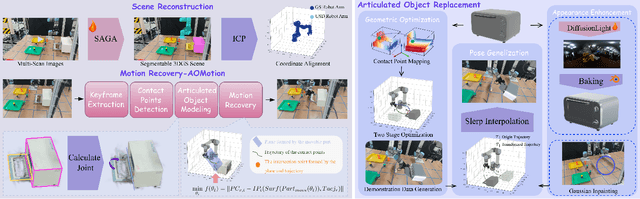
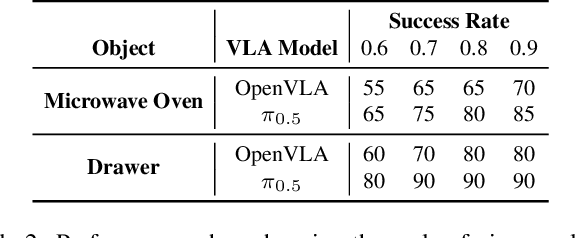
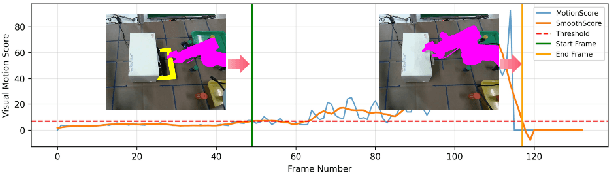
Recent advances in Vision-Language-Action (VLA) and world-model methods have improved generalization in tasks such as robotic manipulation and object interaction. However, Successful execution of such tasks depends on large, costly collections of real demonstrations, especially for fine-grained manipulation of articulated objects. To address this, we present AOMGen, a scalable data generation framework for articulated manipulation which is instantiated from a single real scan, demonstration and a library of readily available digital assets, yielding photoreal training data with verified physical states. The framework synthesizes synchronized multi-view RGB temporally aligned with action commands and state annotations for joints and contacts, and systematically varies camera viewpoints, object styles, and object poses to expand a single execution into a diverse corpus. Experimental results demonstrate that fine-tuning VLA policies on AOMGen data increases the success rate from 0% to 88.7%, and the policies are tested on unseen objects and layouts.
3D Human-Human Interaction Anomaly Detection
Dec 15, 2025Human-centric anomaly detection (AD) has been primarily studied to specify anomalous behaviors in a single person. However, as humans by nature tend to act in a collaborative manner, behavioral anomalies can also arise from human-human interactions. Detecting such anomalies using existing single-person AD models is prone to low accuracy, as these approaches are typically not designed to capture the complex and asymmetric dynamics of interactions. In this paper, we introduce a novel task, Human-Human Interaction Anomaly Detection (H2IAD), which aims to identify anomalous interactive behaviors within collaborative 3D human actions. To address H2IAD, we then propose Interaction Anomaly Detection Network (IADNet), which is formalized with a Temporal Attention Sharing Module (TASM). Specifically, in designing TASM, we share the encoded motion embeddings across both people such that collaborative motion correlations can be effectively synchronized. Moreover, we notice that in addition to temporal dynamics, human interactions are also characterized by spatial configurations between two people. We thus introduce a Distance-Based Relational Encoding Module (DREM) to better reflect social cues in H2IAD. The normalizing flow is eventually employed for anomaly scoring. Extensive experiments on human-human motion benchmarks demonstrate that IADNet outperforms existing Human-centric AD baselines in H2IAD.
Incremental Pseudo-Labeling for Black-Box Unsupervised Domain Adaptation
May 26, 2024Black-Box unsupervised domain adaptation (BBUDA) learns knowledge only with the prediction of target data from the source model without access to the source data and source model, which attempts to alleviate concerns about the privacy and security of data. However, incorrect pseudo-labels are prevalent in the prediction generated by the source model due to the cross-domain discrepancy, which may substantially degrade the performance of the target model. To address this problem, we propose a novel approach that incrementally selects high-confidence pseudo-labels to improve the generalization ability of the target model. Specifically, we first generate pseudo-labels using a source model and train a crude target model by a vanilla BBUDA method. Second, we iteratively select high-confidence data from the low-confidence data pool by thresholding the softmax probabilities, prototype labels, and intra-class similarity. Then, we iteratively train a stronger target network based on the crude target model to correct the wrongly labeled samples to improve the accuracy of the pseudo-label. Experimental results demonstrate that the proposed method achieves state-of-the-art black-box unsupervised domain adaptation performance on three benchmark datasets.
Frequency-Guided Multi-Level Human Action Anomaly Detection with Normalizing Flows
Apr 26, 2024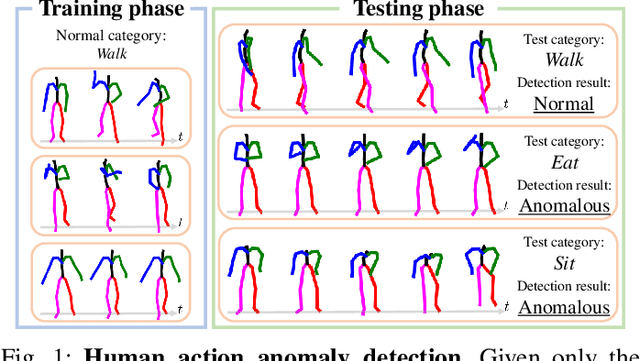

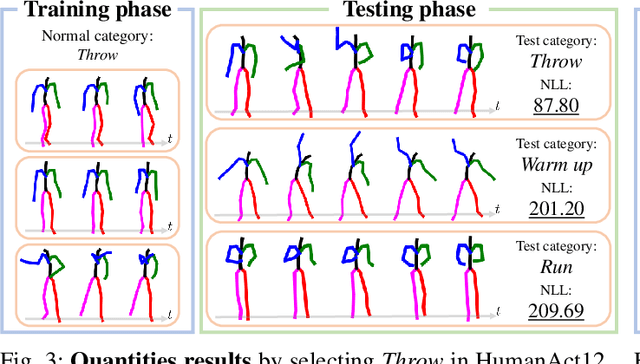
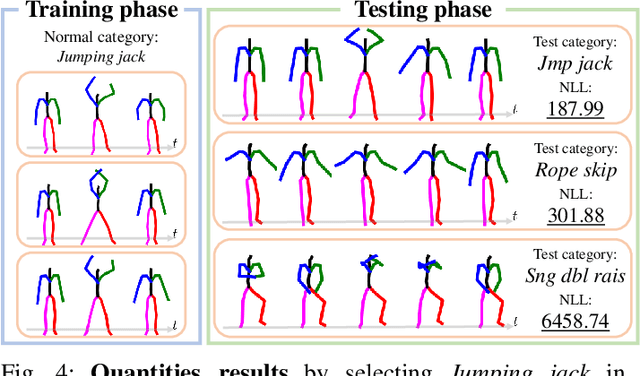
We introduce the task of human action anomaly detection (HAAD), which aims to identify anomalous motions in an unsupervised manner given only the pre-determined normal category of training action samples. Compared to prior human-related anomaly detection tasks which primarily focus on unusual events from videos, HAAD involves the learning of specific action labels to recognize semantically anomalous human behaviors. To address this task, we propose a normalizing flow (NF)-based detection framework where the sample likelihood is effectively leveraged to indicate anomalies. As action anomalies often occur in some specific body parts, in addition to the full-body action feature learning, we incorporate extra encoding streams into our framework for a finer modeling of body subsets. Our framework is thus multi-level to jointly discover global and local motion anomalies. Furthermore, to show awareness of the potentially jittery data during recording, we resort to discrete cosine transformation by converting the action samples from the temporal to the frequency domain to mitigate the issue of data instability. Extensive experimental results on two human action datasets demonstrate that our method outperforms the baselines formed by adapting state-of-the-art human activity AD approaches to our task of HAAD.