 Add to Chrome
 Add to Firefox
 Add to Edge
GS-FUSE: Granger-Supervised Gated Fusion and Multi-Granularity Alignment for Event-Driven Financial Forecasting
May 27, 2026
Accurately forecasting the impact of salient financial events on markets is critical for investors and policymakers. However, existing multimodal time-series models typically fuse text and prices symmetrically, without an explicit way to decide when event text is truly predictive, and thus struggle to exploit the directional event-to-price structure and the heterogeneous roles of textual and price signals. In this work, we propose GS-Fuse, a multimodal event-based forecasting framework that employs (i) a Granger-supervised, causal-aware gated fusion module, which learns to open toward event text only when it provides incremental predictive value beyond historical prices, and (ii) a multi-granularity alignment mechanism that jointly aligns high-level event representations and fine-grained textual cues with future market trajectories. Built as a flexible, plug-and-play adapter on top of off-the-shelf large language models and time-series foundation models, GS-Fuse can be instantiated across diverse backbones and market settings. Extensive experiments on real-world financial datasets show that GS-Fuse consistently outperforms state-of-the-art time-series and multimodal baselines across multiple assets and forecasting horizons.

AOMGen: Photoreal, Physics-Consistent Demonstration Generation for Articulated Object Manipulation
Dec 20, 2025
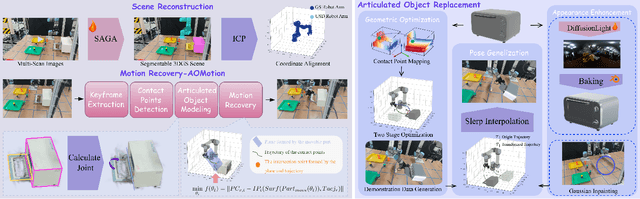
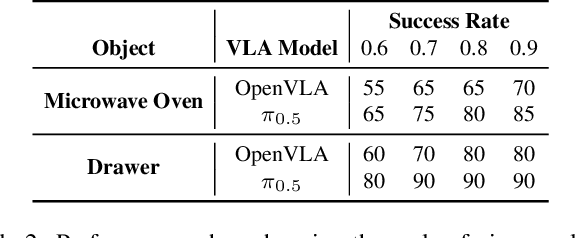
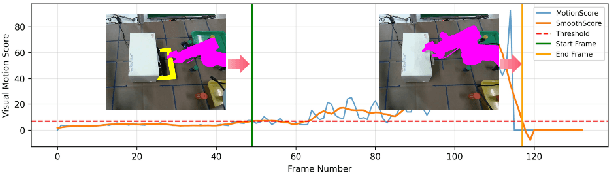
Recent advances in Vision-Language-Action (VLA) and world-model methods have improved generalization in tasks such as robotic manipulation and object interaction. However, Successful execution of such tasks depends on large, costly collections of real demonstrations, especially for fine-grained manipulation of articulated objects. To address this, we present AOMGen, a scalable data generation framework for articulated manipulation which is instantiated from a single real scan, demonstration and a library of readily available digital assets, yielding photoreal training data with verified physical states. The framework synthesizes synchronized multi-view RGB temporally aligned with action commands and state annotations for joints and contacts, and systematically varies camera viewpoints, object styles, and object poses to expand a single execution into a diverse corpus. Experimental results demonstrate that fine-tuning VLA policies on AOMGen data increases the success rate from 0% to 88.7%, and the policies are tested on unseen objects and layouts.
CSASN: A Multitask Attention-Based Framework for Heterogeneous Thyroid Carcinoma Classification in Ultrasound Images
May 04, 2025Heterogeneous morphological features and data imbalance pose significant challenges in rare thyroid carcinoma classification using ultrasound imaging. To address this issue, we propose a novel multitask learning framework, Channel-Spatial Attention Synergy Network (CSASN), which integrates a dual-branch feature extractor - combining EfficientNet for local spatial encoding and ViT for global semantic modeling, with a cascaded channel-spatial attention refinement module. A residual multiscale classifier and dynamically weighted loss function further enhance classification stability and accuracy. Trained on a multicenter dataset comprising more than 2000 patients from four clinical institutions, our framework leverages a residual multiscale classifier and dynamically weighted loss function to enhance classification stability and accuracy. Extensive ablation studies demonstrate that each module contributes significantly to model performance, particularly in recognizing rare subtypes such as FTC and MTC carcinomas. Experimental results show that CSASN outperforms existing single-stream CNN or Transformer-based models, achieving a superior balance between precision and recall under class-imbalanced conditions. This framework provides a promising strategy for AI-assisted thyroid cancer diagnosis.