 Add to Chrome
 Add to Firefox
 Add to Edge
CreatiParser: Generative Image Parsing of Raster Graphic Designs into Editable Layers
Apr 21, 2026
Graphic design images consist of multiple editable layers, such as text, background, and decorative elements, while most generative models produce rasterized outputs without explicit layer structures, limiting downstream editing. Existing graphic design parsing methods typically rely on multi-stage pipelines combining layout prediction, matting, and inpainting, which suffer from error accumulation and limited controllability. We propose a hybrid generative framework for raster-to-layer graphic design parsing that decomposes a design image into editable text, background, and sticker layers. Text regions are parsed using a vision-language model into a text rendering protocol, enabling faithful reconstruction and flexible re-editing, while background and sticker layers are generated using a multi-branch diffusion architecture with RGBA support. We further introduce ParserReward and integrate it with Group Relative Policy Optimization to align generation quality with human design preferences. Extensive experiments on two challenging datasets, \emph{i.e.,} the Parser-40K and Crello datasets, demonstrate superior performance over existing methods, \emph{eg.,} achieving an overall average improvement of 23.7\% across all metrics.

CreatiPoster: Towards Editable and Controllable Multi-Layer Graphic Design Generation
Jun 12, 2025Graphic design plays a crucial role in both commercial and personal contexts, yet creating high-quality, editable, and aesthetically pleasing graphic compositions remains a time-consuming and skill-intensive task, especially for beginners. Current AI tools automate parts of the workflow, but struggle to accurately incorporate user-supplied assets, maintain editability, and achieve professional visual appeal. Commercial systems, like Canva Magic Design, rely on vast template libraries, which are impractical for replicate. In this paper, we introduce CreatiPoster, a framework that generates editable, multi-layer compositions from optional natural-language instructions or assets. A protocol model, an RGBA large multimodal model, first produces a JSON specification detailing every layer (text or asset) with precise layout, hierarchy, content and style, plus a concise background prompt. A conditional background model then synthesizes a coherent background conditioned on this rendered foreground layers. We construct a benchmark with automated metrics for graphic-design generation and show that CreatiPoster surpasses leading open-source approaches and proprietary commercial systems. To catalyze further research, we release a copyright-free corpus of 100,000 multi-layer designs. CreatiPoster supports diverse applications such as canvas editing, text overlay, responsive resizing, multilingual adaptation, and animated posters, advancing the democratization of AI-assisted graphic design. Project homepage: https://github.com/graphic-design-ai/creatiposter
Graphic Design with Large Multimodal Model
Apr 22, 2024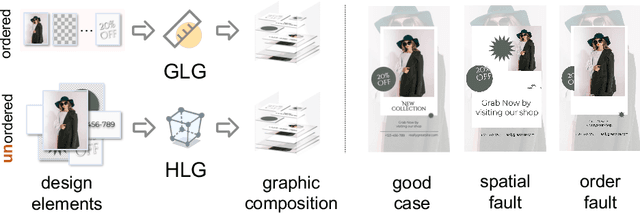
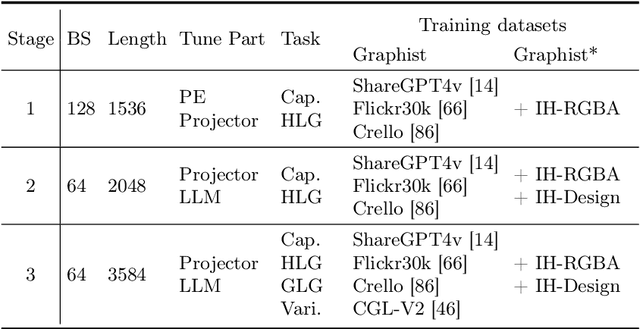
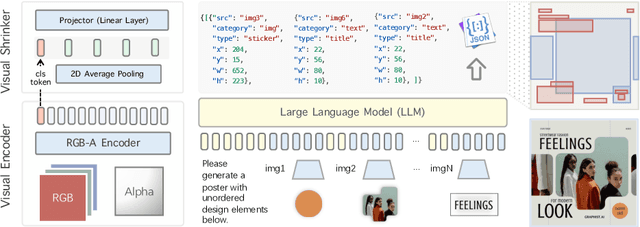
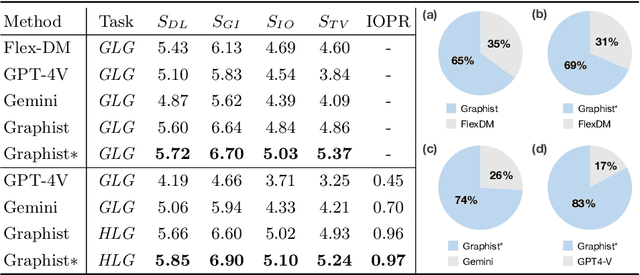
In the field of graphic design, automating the integration of design elements into a cohesive multi-layered artwork not only boosts productivity but also paves the way for the democratization of graphic design. One existing practice is Graphic Layout Generation (GLG), which aims to layout sequential design elements. It has been constrained by the necessity for a predefined correct sequence of layers, thus limiting creative potential and increasing user workload. In this paper, we present Hierarchical Layout Generation (HLG) as a more flexible and pragmatic setup, which creates graphic composition from unordered sets of design elements. To tackle the HLG task, we introduce Graphist, the first layout generation model based on large multimodal models. Graphist efficiently reframes the HLG as a sequence generation problem, utilizing RGB-A images as input, outputs a JSON draft protocol, indicating the coordinates, size, and order of each element. We develop new evaluation metrics for HLG. Graphist outperforms prior arts and establishes a strong baseline for this field. Project homepage: https://github.com/graphic-design-ai/graphist
Fully Attentional Networks with Self-emerging Token Labeling
Jan 08, 2024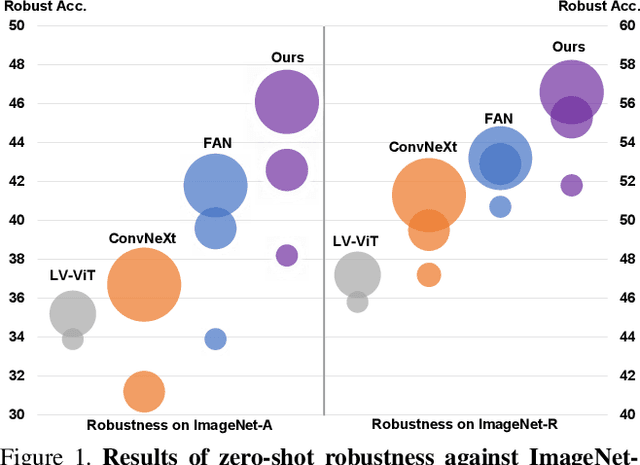
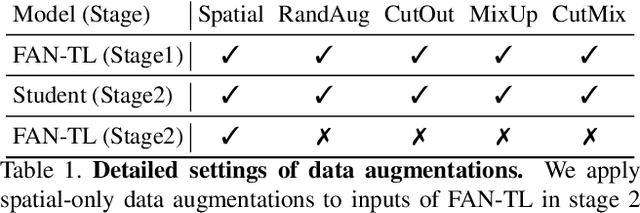
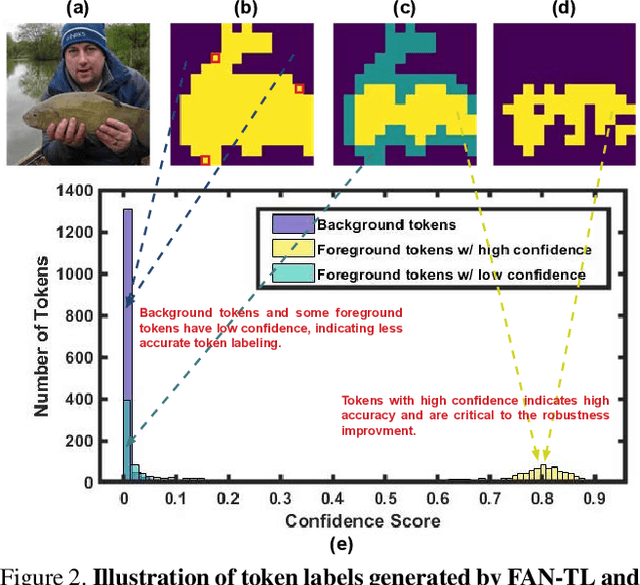
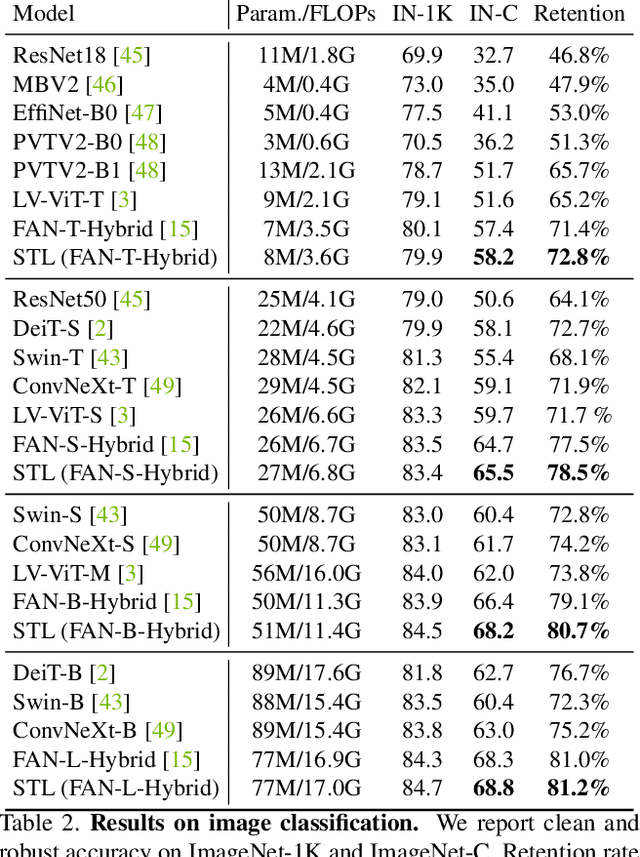
Recent studies indicate that Vision Transformers (ViTs) are robust against out-of-distribution scenarios. In particular, the Fully Attentional Network (FAN) - a family of ViT backbones, has achieved state-of-the-art robustness. In this paper, we revisit the FAN models and improve their pre-training with a self-emerging token labeling (STL) framework. Our method contains a two-stage training framework. Specifically, we first train a FAN token labeler (FAN-TL) to generate semantically meaningful patch token labels, followed by a FAN student model training stage that uses both the token labels and the original class label. With the proposed STL framework, our best model based on FAN-L-Hybrid (77.3M parameters) achieves 84.8% Top-1 accuracy and 42.1% mCE on ImageNet-1K and ImageNet-C, and sets a new state-of-the-art for ImageNet-A (46.1%) and ImageNet-R (56.6%) without using extra data, outperforming the original FAN counterpart by significant margins. The proposed framework also demonstrates significantly enhanced performance on downstream tasks such as semantic segmentation, with up to 1.7% improvement in robustness over the counterpart model. Code is available at https://github.com/NVlabs/STL.