 Add to Chrome
 Add to Firefox
 Add to Edge
MAVIN: Multi-Shot Audio-Visual Generation with Narrative Control
Jun 28, 2026
While recent generative models produce high-fidelity videos, they struggle with the complex narrative control required for coherent multi-shot audio-visual generation. Existing methods suffer from temporal misalignment, limited controllability, and incomplete scripting. In this paper, we propose MAVIN, the first framework for multi-shot audio-visual generation with customized narrative control. To resolve temporal misalignment, we propose boundary-aware attention, which leverages hierarchical captions and boundary-aware token routing to render audio-visual elements within their respective temporal boundaries. To improve the controllability for multi-subject scenarios, we propose ID-aware propagation, utilizing identity embeddings and an identity-aware mask to bind specific identities to consistent visual appearances and vocal timbres. To provide comprehensive audio-visual narratives, we present a multi-agent scripting pipeline to transform free-form user inputs into hierarchical captions. Furthermore, we construct MAVINSet, a multi-shot audio-visual dataset for robust training and evaluation. Extensive experiments demonstrate that MAVIN achieves state-of-the-art performance, opening up a new avenue for integrating generative models into professional filmmaking workflows.

Diffusion Knows Transparency: Repurposing Video Diffusion for Transparent Object Depth and Normal Estimation
Dec 29, 2025Transparent objects remain notoriously hard for perception systems: refraction, reflection and transmission break the assumptions behind stereo, ToF and purely discriminative monocular depth, causing holes and temporally unstable estimates. Our key observation is that modern video diffusion models already synthesize convincing transparent phenomena, suggesting they have internalized the optical rules. We build TransPhy3D, a synthetic video corpus of transparent/reflective scenes: 11k sequences rendered with Blender/Cycles. Scenes are assembled from a curated bank of category-rich static assets and shape-rich procedural assets paired with glass/plastic/metal materials. We render RGB + depth + normals with physically based ray tracing and OptiX denoising. Starting from a large video diffusion model, we learn a video-to-video translator for depth (and normals) via lightweight LoRA adapters. During training we concatenate RGB and (noisy) depth latents in the DiT backbone and co-train on TransPhy3D and existing frame-wise synthetic datasets, yielding temporally consistent predictions for arbitrary-length input videos. The resulting model, DKT, achieves zero-shot SOTA on real and synthetic video benchmarks involving transparency: ClearPose, DREDS (CatKnown/CatNovel), and TransPhy3D-Test. It improves accuracy and temporal consistency over strong image/video baselines, and a normal variant sets the best video normal estimation results on ClearPose. A compact 1.3B version runs at ~0.17 s/frame. Integrated into a grasping stack, DKT's depth boosts success rates across translucent, reflective and diffuse surfaces, outperforming prior estimators. Together, these results support a broader claim: "Diffusion knows transparency." Generative video priors can be repurposed, efficiently and label-free, into robust, temporally coherent perception for challenging real-world manipulation.
One View, Many Worlds: Single-Image to 3D Object Meets Generative Domain Randomization for One-Shot 6D Pose Estimation
Sep 09, 2025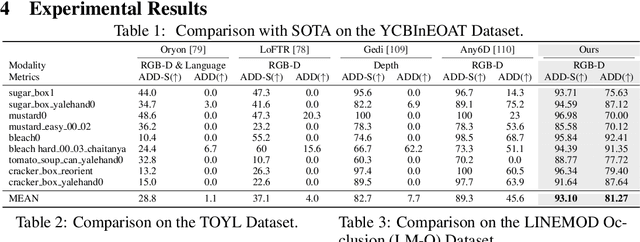
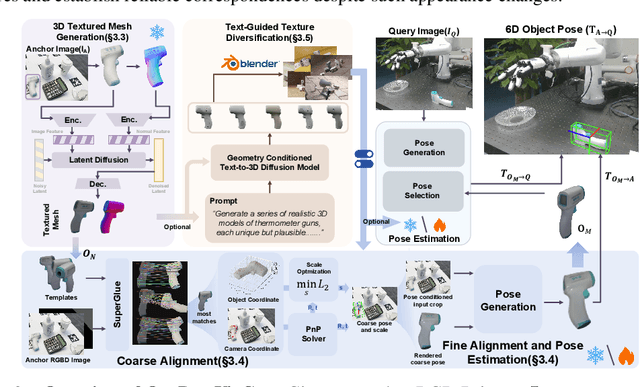
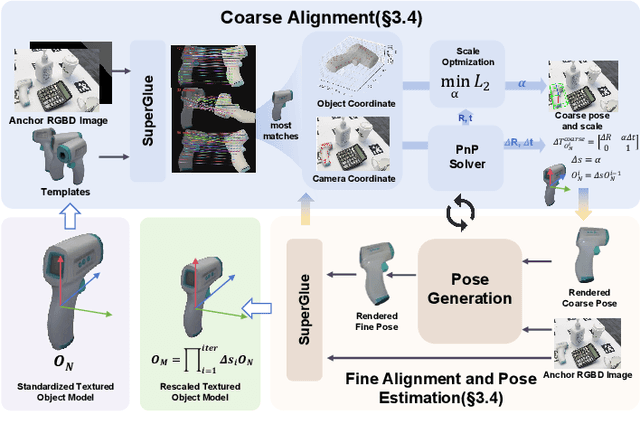
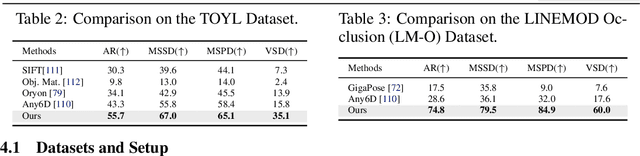
Estimating the 6D pose of arbitrary unseen objects from a single reference image is critical for robotics operating in the long-tail of real-world instances. However, this setting is notoriously challenging: 3D models are rarely available, single-view reconstructions lack metric scale, and domain gaps between generated models and real-world images undermine robustness. We propose OnePoseViaGen, a pipeline that tackles these challenges through two key components. First, a coarse-to-fine alignment module jointly refines scale and pose by combining multi-view feature matching with render-and-compare refinement. Second, a text-guided generative domain randomization strategy diversifies textures, enabling effective fine-tuning of pose estimators with synthetic data. Together, these steps allow high-fidelity single-view 3D generation to support reliable one-shot 6D pose estimation. On challenging benchmarks (YCBInEOAT, Toyota-Light, LM-O), OnePoseViaGen achieves state-of-the-art performance far surpassing prior approaches. We further demonstrate robust dexterous grasping with a real robot hand, validating the practicality of our method in real-world manipulation. Project page: https://gzwsama.github.io/OnePoseviaGen.github.io/