 Add to Chrome
 Add to Firefox
 Add to Edge
SpikeTrack: A Spike-driven Framework for Efficient Visual Tracking
Feb 27, 2026
Spiking Neural Networks (SNNs) promise energy-efficient vision, but applying them to RGB visual tracking remains difficult: Existing SNN tracking frameworks either do not fully align with spike-driven computation or do not fully leverage neurons' spatiotemporal dynamics, leading to a trade-off between efficiency and accuracy. To address this, we introduce SpikeTrack, a spike-driven framework for energy-efficient RGB object tracking. SpikeTrack employs a novel asymmetric design that uses asymmetric timestep expansion and unidirectional information flow, harnessing spatiotemporal dynamics while cutting computation. To ensure effective unidirectional information transfer between branches, we design a memory-retrieval module inspired by neural inference mechanisms. This module recurrently queries a compact memory initialized by the template to retrieve target cues and sharpen target perception over time. Extensive experiments demonstrate that SpikeTrack achieves the state-of-the-art among SNN-based trackers and remains competitive with advanced ANN trackers. Notably, it surpasses TransT on LaSOT dataset while consuming only 1/26 of its energy. To our knowledge, SpikeTrack is the first spike-driven framework to make RGB tracking both accurate and energy efficient. The code and models are available at https://github.com/faicaiwawa/SpikeTrack.

AOMGen: Photoreal, Physics-Consistent Demonstration Generation for Articulated Object Manipulation
Dec 20, 2025
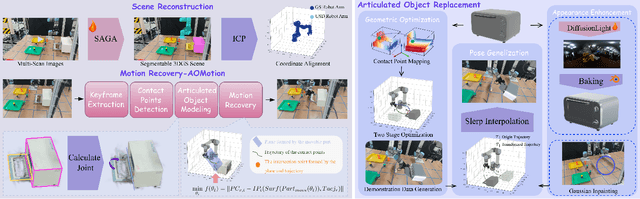
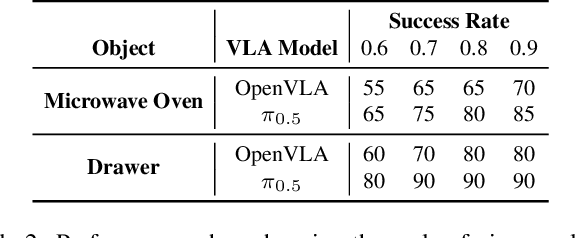
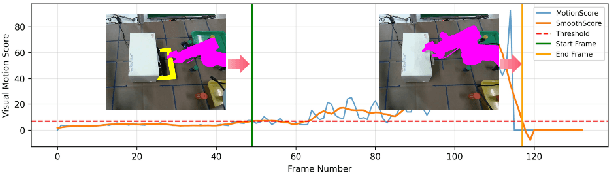
Recent advances in Vision-Language-Action (VLA) and world-model methods have improved generalization in tasks such as robotic manipulation and object interaction. However, Successful execution of such tasks depends on large, costly collections of real demonstrations, especially for fine-grained manipulation of articulated objects. To address this, we present AOMGen, a scalable data generation framework for articulated manipulation which is instantiated from a single real scan, demonstration and a library of readily available digital assets, yielding photoreal training data with verified physical states. The framework synthesizes synchronized multi-view RGB temporally aligned with action commands and state annotations for joints and contacts, and systematically varies camera viewpoints, object styles, and object poses to expand a single execution into a diverse corpus. Experimental results demonstrate that fine-tuning VLA policies on AOMGen data increases the success rate from 0% to 88.7%, and the policies are tested on unseen objects and layouts.