 Add to Chrome
 Add to Firefox
 Add to Edge
Retrieve in Time, Correct in Frequency
Aug 07, 2026
Frozen vision-language-action (VLA) policies generate temporally extended action chunks, but long-horizon manipulation remains vulnerable to accumulated execution error and visual aliasing across task stages. Successful rollouts provide useful corrective evidence, yet current frame retrieval can return progress-misaligned actions,while direct replay or time-domain fusion can overwrite the reactive structure of the policy proposal. We introduce Retrieve in Time, Correct in Frequency (RTCF), a training-free test-time correction framework that improves frozen VLA performance with low model-side overhead.RTCF separates which experience to retrieve from which part of its action to transfer. Progressive Memory Alignment (PMA) causally aligns the growing visual execution history with complete successful trajectories through incrementally updated monotonic frontiers, jointly identifying a relevant memory and the current aligned memory position without stage labels. From the aligned action chunk,RTCF transfers a coefficient-wise-clipped low-frequency residual on motion channels. Higher-frequency components and gripper decisions remain inherited from the frozen policy. Across four LIBERO suites and 2,000 episodes per condition, RTCF raises aggregate success from 86.4% to 88.4% and improves LIBERO-Long from 61.6% to 68.6%.These gains require no parameter updates, repeated VLA inference, or additional GPU resources: correction can be performed on the client CPU after a single policy invocation, and the median latencies sum to only 10.99 ms per action chunk

HERA: Historical Evidence Routing Adapter for Physical Prediction in Latent World Models
Aug 06, 2026Predictive video models have emerged as promising world models by learning latent visual dynamics from large-scale video. Yet these models remain challenged by physical events under occlusion, where later predictions may depend on object evidence that is no longer available in the current view. Addressing this challenge requires historical evidence not only to be preserved but also to remain accessible when it becomes relevant to a subsequent prediction. Existing approaches mainly enlarge the temporal context, cache generic video features, or impose explicit object-centric states, thereby improving the capacity or structure of retained history. However, they do not directly address how relevant historical evidence can be selectively retrieved and integrated into a pretrained predictor without interfering with its native latent workspace. Accordingly, we introduce HERA (Historical Evidence Routing Adapter), a framework for routing retained historical evidence into a frozen latent predictor, and instantiate it with Register-Routed Patch Memory (RRPM), a lightweight adapter comprising a Structured Memory Bank, Memory Registers, and Workspace Registers. On the IntPhys2 Main split, HERA with RRPM improves the pairwise AvgSurprise accuracy of V-JEPA 2-G from 52.57% to 54.35%. Subgroup analysis shows particularly strong improvements on fixed-camera continuity, from 46.15% to 57.69%, and fixed-camera immutability, from 46.15% to 63.46%. These results support historical evidence routing as a practical adaptation strategy for physical prediction in latent world models.
SPACE: Swarm Pheromone Fields for Adaptive Collision-Aware Exploration
Jun 28, 2026Massive robot swarms can explore unknown environments quickly, but adding robots eventually stops helping. Doorways and dense traffic create congestion, increasing inter-robot contacts and reducing the value of each additional robot. We study this safety-efficiency tradeoff for ground swarms of tens to hundreds of robots. We present SPACE, Swarm Pheromone Fields for Adaptive Collision-Aware Exploration. Inspired by ant foraging, SPACE maintains a shared environmental field with an attractive frontier pheromone, a repellent explore pheromone, and a fast robot-density field. Coordination is decentralized and mediated through this field. We evaluate SPACE on real building floorplans, namely sixteen home layouts from the HouseExpo dataset and eight campus floors from the KTH dataset, with swarms of up to two hundred and fifty-six robots. SPACE lies on the empirical Pareto frontier. It attains the lowest inter-robot contact rate at every congested swarm size, four to seventeen times fewer than a greedy nearest-frontier planner, while keeping coverage time within about two percent of that near time-optimal planner. The results indicate that, at this scale, coordination mainly improves safety rather than coverage time.
ACEsplat: Accelerated 3D Gaussian Scene Regression via RGB and Poses Only
Jun 20, 2026Per-scene 3D Gaussian Splatting (3DGS) enables high-fidelity rendering, but practical robotic and AR scene capture pipelines often depend on external geometric initialization (e.g., SfM point clouds or depth estimates), which can be slow and brittle in on-site deployment. We present ACEsplat, a fast per-scene optimization framework that reconstructs 3D Gaussian representations from RGB images and camera poses only, without requiring external 3D priors (e.g., precomputed SfM models or supervised depth maps). ACEsplat uses a two-stage pipeline: (1) a self-supervised scene coordinate regression (SCR) module builds an internal geometry prior within 4--5 minutes; (2) SCR features and coordinate priors are fused by a lightweight Gaussian initialization head, followed by per-scene 3DGS optimization. On static-view rendering, ACEsplat achieves 29.11 dB PSNR on Wayspots with real-time SLAM poses and 33.20 dB on Cambridge Landmarks with SfM-refined poses. On RealEstate10K sparse-view novel view synthesis, it achieves competitive image fidelity under a challenging 2-view setting. ACEsplat completes scene-specific SCR mapping and 3DGS reconstruction within 15--25 minutes on a single GPU, making it a practical RGB+pose-only solution for rapid scene setup in robotics and mixed-reality applications.
MotiMem: Motion-Aware Approximate Memory for Energy-Efficient Neural Perception in Autonomous Vehicles
Mar 28, 2026High-resolution sensors are critical for robust autonomous perception but impose a severe memory wall on battery-constrained electric vehicles. In these systems, data movement energy often outweighs computation. Traditional image compression is ill-suited as it is semantically blind and optimizes for storage rather than bus switching activity. We propose MotiMem, a hardware-software co-designed interface. Exploiting temporal coherence,MotiMem uses lightweight 2D Motion Propagation to dynamically identify Regions of Interest (RoI). Complementing this, a Hybrid Sparsity-Aware Coding scheme leverages adaptive inversion and truncation to induce bitlevel sparsity. Extensive experiments across nuScenes, Waymo, and KITTI with 16 detection models demonstrate that MotiMem reduces memory-interface dynamic energy by approximately 43 percent while retaining approximately 93 percent of the object detection accuracy, establishing a new Pareto frontier significantly superior to standard codecs like JPEG and WebP.
MACE: Mixture-of-Experts Accelerated Coordinate Encoding for Large-Scale Scene Localization and Rendering
Oct 16, 2025Efficient localization and high-quality rendering in large-scale scenes remain a significant challenge due to the computational cost involved. While Scene Coordinate Regression (SCR) methods perform well in small-scale localization, they are limited by the capacity of a single network when extended to large-scale scenes. To address these challenges, we propose the Mixed Expert-based Accelerated Coordinate Encoding method (MACE), which enables efficient localization and high-quality rendering in large-scale scenes. Inspired by the remarkable capabilities of MOE in large model domains, we introduce a gating network to implicitly classify and select sub-networks, ensuring that only a single sub-network is activated during each inference. Furtheremore, we present Auxiliary-Loss-Free Load Balancing(ALF-LB) strategy to enhance the localization accuracy on large-scale scene. Our framework provides a significant reduction in costs while maintaining higher precision, offering an efficient solution for large-scale scene applications. Additional experiments on the Cambridge test set demonstrate that our method achieves high-quality rendering results with merely 10 minutes of training.
A Wireless Collaborated Inference Acceleration Framework for Plant Disease Recognition
May 05, 2025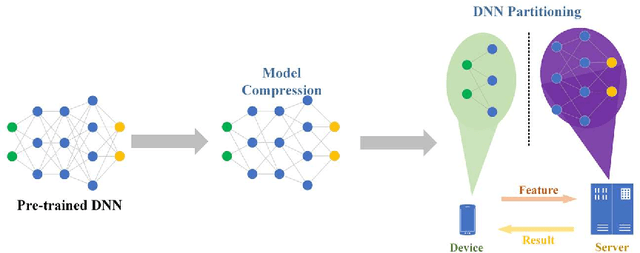

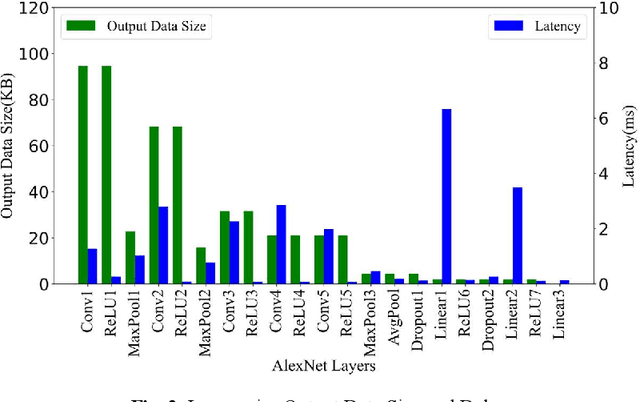
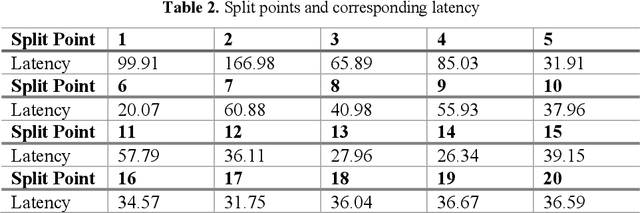
Plant disease is a critical factor affecting agricultural production. Traditional manual recognition methods face significant drawbacks, including low accuracy, high costs, and inefficiency. Deep learning techniques have demonstrated significant benefits in identifying plant diseases, but they still face challenges such as inference delays and high energy consumption. Deep learning algorithms are difficult to run on resource-limited embedded devices. Offloading these models to cloud servers is confronted with the restriction of communication bandwidth, and all of these factors will influence the inference's efficiency. We propose a collaborative inference framework for recognizing plant diseases between edge devices and cloud servers to enhance inference speed. The DNN model for plant disease recognition is pruned through deep reinforcement learning to improve the inference speed and reduce energy consumption. Then the optimal split point is determined by a greedy strategy to achieve the best collaborated inference acceleration. Finally, the system for collaborative inference acceleration in plant disease recognition has been implemented using Gradio to facilitate friendly human-machine interaction. Experiments indicate that the proposed collaborative inference framework significantly increases inference speed while maintaining acceptable recognition accuracy, offering a novel solution for rapidly diagnosing and preventing plant diseases.
Mapping at First Sense: A Lightweight Neural Network-Based Indoor Structures Prediction Method for Robot Autonomous Exploration
Apr 05, 2025Autonomous exploration in unknown environments is a critical challenge in robotics, particularly for applications such as indoor navigation, search and rescue, and service robotics. Traditional exploration strategies, such as frontier-based methods, often struggle to efficiently utilize prior knowledge of structural regularities in indoor spaces. To address this limitation, we propose Mapping at First Sense, a lightweight neural network-based approach that predicts unobserved areas in local maps, thereby enhancing exploration efficiency. The core of our method, SenseMapNet, integrates convolutional and transformerbased architectures to infer occluded regions while maintaining computational efficiency for real-time deployment on resourceconstrained robots. Additionally, we introduce SenseMapDataset, a curated dataset constructed from KTH and HouseExpo environments, which facilitates training and evaluation of neural models for indoor exploration. Experimental results demonstrate that SenseMapNet achieves an SSIM (structural similarity) of 0.78, LPIPS (perceptual quality) of 0.68, and an FID (feature distribution alignment) of 239.79, outperforming conventional methods in map reconstruction quality. Compared to traditional frontier-based exploration, our method reduces exploration time by 46.5% (from 2335.56s to 1248.68s) while maintaining a high coverage rate (88%) and achieving a reconstruction accuracy of 88%. The proposed method represents a promising step toward efficient, learning-driven robotic exploration in structured environments.
SenseExpo: Efficient Autonomous Exploration with Prediction Information from Lightweight Neural Networks
Mar 20, 2025This paper proposes SenseExpo, an efficient autonomous exploration framework based on a lightweight prediction network, which addresses the limitations of traditional methods in computational overhead and environmental generalization. By integrating Generative Adversarial Networks (GANs), Transformer, and Fast Fourier Convolution (FFC), we designed a lightweight prediction model with merely 709k parameters. Our smallest model achieves better performance on the KTH dataset than U-net (24.5M) and LaMa (51M), delivering PSNR 9.026 and SSIM 0.718, particularly representing a 38.7% PSNR improvement over the 51M-parameter LaMa model. Cross-domain testing demonstrates its strong generalization capability, with an FID score of 161.55 on the HouseExpo dataset, significantly outperforming comparable methods. Regarding exploration efficiency, on the KTH dataset,SenseExpo demonstrates approximately a 67.9% time reduction in exploration time compared to MapEx. On the MRPB 1.0 dataset, SenseExpo achieves 77.1% time reduction roughly compared to MapEx. Deployed as a plug-and-play ROS node, the framework seamlessly integrates with existing navigation systems, providing an efficient solution for resource-constrained devices.