 Add to Chrome
 Add to Firefox
 Add to Edge
Trajectory Generation with Endpoint Regulation and Momentum-Aware Dynamics for Visually Impaired Scenarios
Feb 25, 2026
Trajectory generation for visually impaired scenarios requires smooth and temporally consistent state in structured, low-speed dynamic environments. However, traditional jerk-based heuristic trajectory sampling with independent segment generation and conventional smoothness penalties often lead to unstable terminal behavior and state discontinuities under frequent regenerating. This paper proposes a trajectory generation approach that integrates endpoint regulation to stabilize terminal states within each segment and momentum-aware dynamics to regularize the evolution of velocity and acceleration for segment consistency. Endpoint regulation is incorporated into trajectory sampling to stabilize terminal behavior, while a momentum-aware dynamics enforces consistent velocity and acceleration evolution across consecutive trajectory segments. Experimental results demonstrate reduced acceleration peaks and lower jerk levels with decreased dispersion, smoother velocity and acceleration profiles, more stable endpoint distributions, and fewer infeasible trajectory candidates compared with a baseline planner.

Parameter-Free Adaptive Multi-Scale Channel-Spatial Attention Aggregation framework for 3D Indoor Semantic Scene Completion Toward Assisting Visually Impaired
Feb 19, 2026In indoor assistive perception for visually impaired users, 3D Semantic Scene Completion (SSC) is expected to provide structurally coherent and semantically consistent occupancy under strictly monocular vision for safety-critical scene understanding. However, existing monocular SSC approaches often lack explicit modeling of voxel-feature reliability and regulated cross-scale information propagation during 2D-3D projection and multi-scale fusion, making them vulnerable to projection diffusion and feature entanglement and thus limiting structural stability. To address these challenges, this paper presents an Adaptive Multi-scale Attention Aggregation (AMAA) framework built upon the MonoScene pipeline. Rather than introducing a heavier backbone, AMAA focuses on reliability-oriented feature regulation within a monocular SSC framework. Specifically, lifted voxel features are jointly calibrated in semantic and spatial dimensions through parallel channel-spatial attention aggregation, while multi-scale encoder-decoder fusion is stabilized via a hierarchical adaptive feature-gating strategy that regulates information injection across scales. Experiments on the NYUv2 benchmark demonstrate consistent improvements over MonoScene without significantly increasing system complexity: AMAA achieves 27.25% SSC mIoU (+0.31) and 43.10% SC IoU (+0.59). In addition, system-level deployment on an NVIDIA Jetson platform verifies that the complete AMAA framework can be executed stably on embedded hardware. Overall, AMAA improves monocular SSC quality and provides a reliable and deployable perception framework for indoor assistive systems targeting visually impaired users.
RPIQ: Residual-Projected Multi-Collaboration Closed-Loop and Single Instance Quantization for Visually Impaired Assistance
Jan 06, 2026Visually impaired users face significant challenges in daily information access and real-time environmental perception, and there is an urgent need for intelligent assistive systems with accurate recognition capabilities. Although large-scale models provide effective solutions for perception and reasoning, their practical deployment on assistive devices is severely constrained by excessive memory consumption and high inference costs. Moreover, existing quantization strategies often ignore inter-block error accumulation, leading to degraded model stability. To address these challenges, this study proposes a novel quantization framework -- Residual-Projected Multi-Collaboration Closed-Loop and Single Instance Quantization(RPIQ), whose quantization process adopts a multi-collaborative closed-loop compensation scheme based on Single Instance Calibration and Gauss-Seidel Iterative Quantization. Experiments on various types of large-scale models, including language models such as OPT, Qwen, and LLaMA, as well as vision-language models such as CogVLM2, demonstrate that RPIQ can compress models to 4-bit representation while significantly reducing peak memory consumption (approximately 60%-75% reduction compared to original full-precision models). The method maintains performance highly close to full-precision models across multiple language and visual tasks, and exhibits excellent recognition and reasoning capabilities in key applications such as text understanding and visual question answering in complex scenarios. While verifying the effectiveness of RPIQ for deployment in real assistive systems, this study also advances the computational efficiency and reliability of large models, enabling them to provide visually impaired users with the required information accurately and rapidly.
Momentum-constrained Hybrid Heuristic Trajectory Optimization Framework with Residual-enhanced DRL for Visually Impaired Scenarios
Sep 19, 2025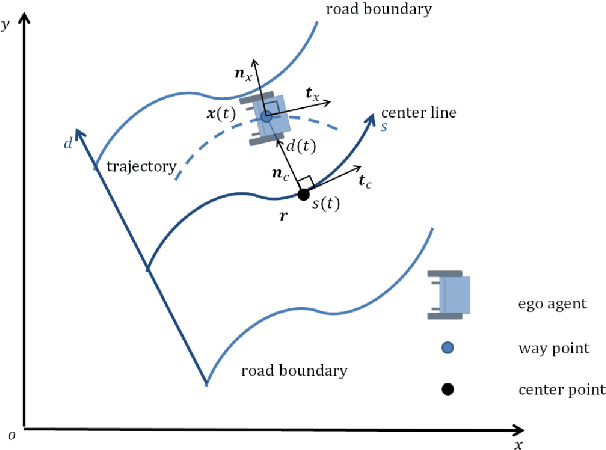
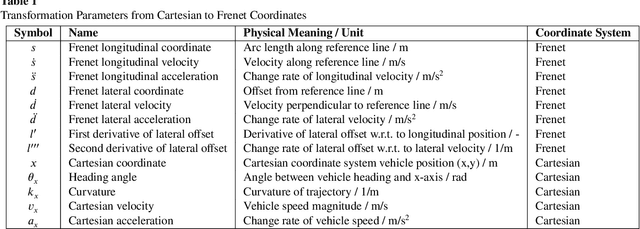
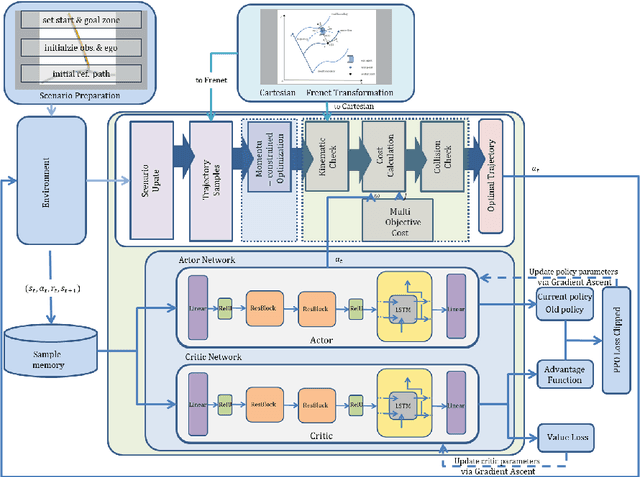

This paper proposes a momentum-constrained hybrid heuristic trajectory optimization framework (MHHTOF) tailored for assistive navigation in visually impaired scenarios, integrating trajectory sampling generation, optimization and evaluation with residual-enhanced deep reinforcement learning (DRL). In the first stage, heuristic trajectory sampling cluster (HTSC) is generated in the Frenet coordinate system using third-order interpolation with fifth-order polynomials and momentum-constrained trajectory optimization (MTO) constraints to ensure smoothness and feasibility. After first stage cost evaluation, the second stage leverages a residual-enhanced actor-critic network with LSTM-based temporal feature modeling to adaptively refine trajectory selection in the Cartesian coordinate system. A dual-stage cost modeling mechanism (DCMM) with weight transfer aligns semantic priorities across stages, supporting human-centered optimization. Experimental results demonstrate that the proposed LSTM-ResB-PPO achieves significantly faster convergence, attaining stable policy performance in approximately half the training iterations required by the PPO baseline, while simultaneously enhancing both reward outcomes and training stability. Compared to baseline method, the selected model reduces average cost and cost variance by 30.3% and 53.3%, and lowers ego and obstacle risks by over 77%. These findings validate the framework's effectiveness in enhancing robustness, safety, and real-time feasibility in complex assistive planning tasks.
Scene-Aware Vectorized Memory Multi-Agent Framework with Cross-Modal Differentiated Quantization VLMs for Visually Impaired Assistance
Aug 25, 2025This study proposes the dual technological innovation framework, including a cross-modal differ entiated quantization framework for vision-language models (VLMs) and a scene-aware vectorized memory multi-agent system for visually impaired assistance. The modular framework was developed implementing differentiated processing strategies, effectively reducing memory requirements from 38GB to 16GB while maintaining model performance. The multi-agent architecture combines scene classification, vectorized memory, and multimodal interaction, enabling persistent storage and efficient retrieval of scene memories. Through perception-memory-reasoning workflows, the system provides environmental information beyond the current view using historical memories. Experiments show the quantized 19B-parameter model only experiences a 2.05% performance drop on MMBench and maintains 63.7 accuracy on OCR-VQA (original: 64.9), outperforming smaller models with equivalent memory requirements like the Molmo-7B series. The system maintains response latency between 2.83-3.52 seconds from scene analysis to initial speech output, substantially faster than non-streaming methods. This research advances computational efficiency and assistive technology, offering visually impaired users comprehensive real-time assistance in scene perception, text recognition, and navigation.
TiSpell: A Semi-Masked Methodology for Tibetan Spelling Correction covering Multi-Level Error with Data Augmentation
May 14, 2025Multi-level Tibetan spelling correction addresses errors at both the character and syllable levels within a unified model. Existing methods focus mainly on single-level correction and lack effective integration of both levels. Moreover, there are no open-source datasets or augmentation methods tailored for this task in Tibetan. To tackle this, we propose a data augmentation approach using unlabeled text to generate multi-level corruptions, and introduce TiSpell, a semi-masked model capable of correcting both character- and syllable-level errors. Although syllable-level correction is more challenging due to its reliance on global context, our semi-masked strategy simplifies this process. We synthesize nine types of corruptions on clean sentences to create a robust training set. Experiments on both simulated and real-world data demonstrate that TiSpell, trained on our dataset, outperforms baseline models and matches the performance of state-of-the-art approaches, confirming its effectiveness.