 Add to Chrome
 Add to Firefox
 Add to Edge
Beyond Supervised Clarification: Input Rewriting with LLMs for Dialogue Discourse Parsing
Jul 02, 2026
Rewriting inputs to improve frozen downstream models has become a common strategy in modern NLP pipelines. Prior work on incremental dialogue discourse parsing (DDP) shows that supervised clarification models can rewrite fragmentary or underspecified utterances, such as resolving ellipsis or references, to improve parsing accuracy. In this work, we revisit this idea under realistic deployment conditions, where no clarification supervision is available and the clarifier must rely on zero-shot prompting or feedback from a frozen parser. Across three Segmented Discourse Representation Theory (SDRT) datasets and multiple parsers, we find that last-utterance clarification is far less reliable than suggested by supervised settings. Parser-agnostic rewriting often introduces more regressions than repairs, as edits that enable fixes also disrupt discourse cues relied upon by the parser. A best-of-8 rewriting analysis further reveals a practical ceiling: a large fraction of errors are not repairable through input rewriting alone. A parser-aware clarifier trained with GRPO reduces regressions by up to 37% by learning conservative abstention, yet still fails to produce selectivity-aware clarifications that consistently improve parsing. Together, these findings recast clarification as a selective intervention problem. We identify rewritability prediction, deciding whether an utterance is repairable before intervention, as the key missing capability for input-side optimization of frozen discourse parsers, and a critical direction for improving agentic pipelines more broadly.

MatterChat: A Multi-Modal LLM for Material Science
Feb 18, 2025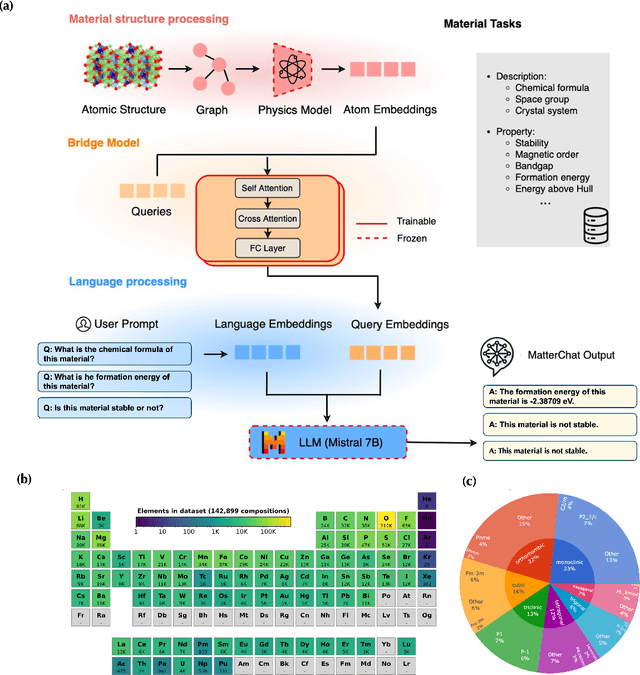
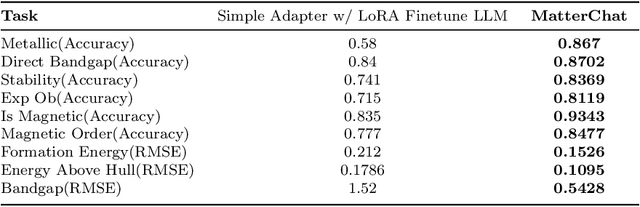
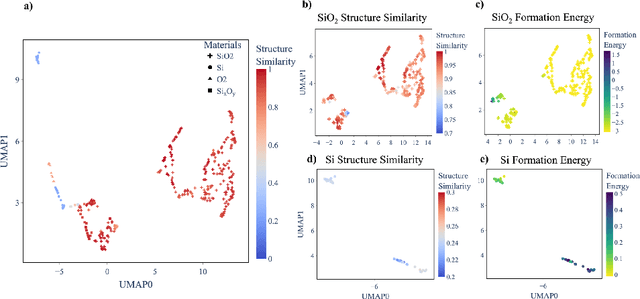
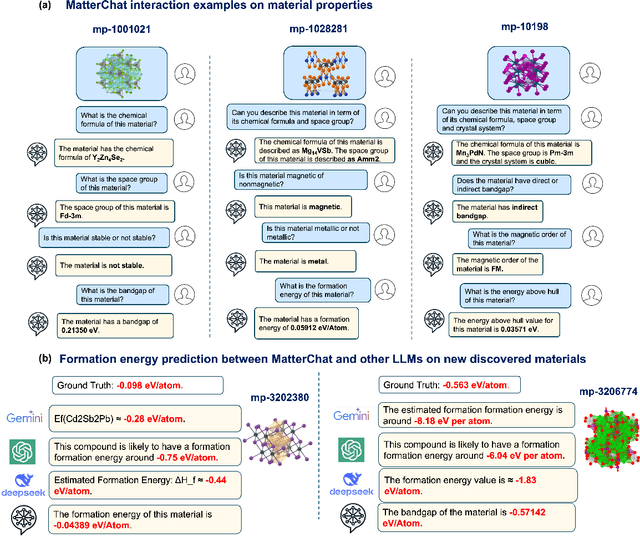
Understanding and predicting the properties of inorganic materials is crucial for accelerating advancements in materials science and driving applications in energy, electronics, and beyond. Integrating material structure data with language-based information through multi-modal large language models (LLMs) offers great potential to support these efforts by enhancing human-AI interaction. However, a key challenge lies in integrating atomic structures at full resolution into LLMs. In this work, we introduce MatterChat, a versatile structure-aware multi-modal LLM that unifies material structural data and textual inputs into a single cohesive model. MatterChat employs a bridging module to effectively align a pretrained machine learning interatomic potential with a pretrained LLM, reducing training costs and enhancing flexibility. Our results demonstrate that MatterChat significantly improves performance in material property prediction and human-AI interaction, surpassing general-purpose LLMs such as GPT-4. We also demonstrate its usefulness in applications such as more advanced scientific reasoning and step-by-step material synthesis.
Scientific Computing with Diffractive Optical Neural Networks
Feb 12, 2023Diffractive optical neural networks (DONNs) have been emerging as a high-throughput and energy-efficient hardware platform to perform all-optical machine learning (ML) in machine vision systems. However, the current demonstrated applications of DONNs are largely straightforward image classification tasks, which undermines the prospect of developing and utilizing such hardware for other ML applications. Here, we numerically and experimentally demonstrate the deployment of an all-optical reconfigurable DONNs system for scientific computing, including guiding two-dimensional quantum material synthesis, predicting the properties of nanomaterials and small molecular cancer drugs, predicting the device response of nanopatterned integrated photonic power splitters, and the dynamic stabilization of an inverted pendulum with reinforcement learning. Despite a large variety of input data structures, we develop a universal feature engineering approach to convert categorical input features to the images that can be processed in the DONNs system. Our results open up new opportunities of employing DONNs systems for a broad range of ML applications.