 Add to Chrome
 Add to Firefox
 Add to Edge
ChatMusician: Understanding and Generating Music Intrinsically with LLM
Feb 25, 2024
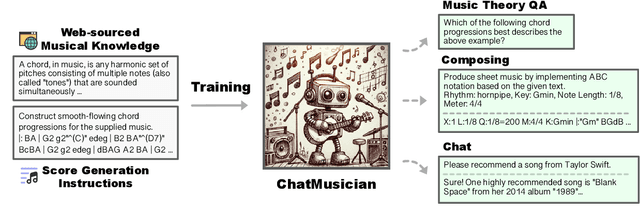



While Large Language Models (LLMs) demonstrate impressive capabilities in text generation, we find that their ability has yet to be generalized to music, humanity's creative language. We introduce ChatMusician, an open-source LLM that integrates intrinsic musical abilities. It is based on continual pre-training and finetuning LLaMA2 on a text-compatible music representation, ABC notation, and the music is treated as a second language. ChatMusician can understand and generate music with a pure text tokenizer without any external multi-modal neural structures or tokenizers. Interestingly, endowing musical abilities does not harm language abilities, even achieving a slightly higher MMLU score. Our model is capable of composing well-structured, full-length music, conditioned on texts, chords, melodies, motifs, musical forms, etc, surpassing GPT-4 baseline. On our meticulously curated college-level music understanding benchmark, MusicTheoryBench, ChatMusician surpasses LLaMA2 and GPT-3.5 on zero-shot setting by a noticeable margin. Our work reveals that LLMs can be an excellent compressor for music, but there remains significant territory to be conquered. We release our 4B token music-language corpora MusicPile, the collected MusicTheoryBench, code, model and demo in GitHub.

Differential Private Federated Transfer Learning for Mental Health Monitoring in Everyday Settings: A Case Study on Stress Detection
Feb 16, 2024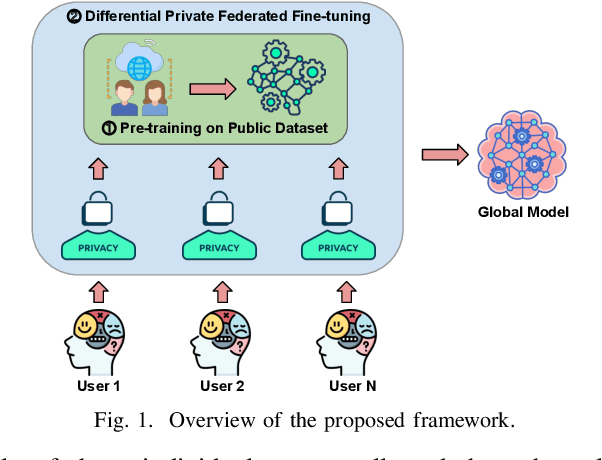
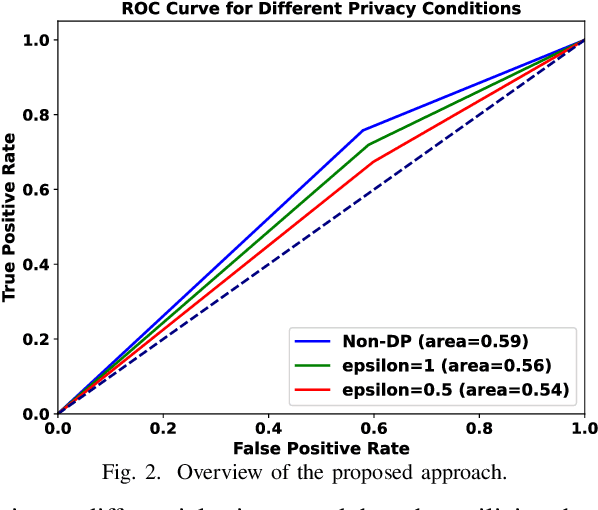
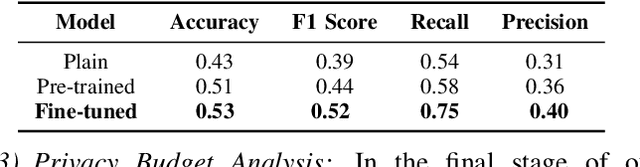
Mental health conditions, prevalent across various demographics, necessitate efficient monitoring to mitigate their adverse impacts on life quality. The surge in data-driven methodologies for mental health monitoring has underscored the importance of privacy-preserving techniques in handling sensitive health data. Despite strides in federated learning for mental health monitoring, existing approaches struggle with vulnerabilities to certain cyber-attacks and data insufficiency in real-world applications. In this paper, we introduce a differential private federated transfer learning framework for mental health monitoring to enhance data privacy and enrich data sufficiency. To accomplish this, we integrate federated learning with two pivotal elements: (1) differential privacy, achieved by introducing noise into the updates, and (2) transfer learning, employing a pre-trained universal model to adeptly address issues of data imbalance and insufficiency. We evaluate the framework by a case study on stress detection, employing a dataset of physiological and contextual data from a longitudinal study. Our finding show that the proposed approach can attain a 10% boost in accuracy and a 21% enhancement in recall, while ensuring privacy protection.
Generalizable Visual Reinforcement Learning with Segment Anything Model
Dec 28, 2023Learning policies that can generalize to unseen environments is a fundamental challenge in visual reinforcement learning (RL). While most current methods focus on acquiring robust visual representations through auxiliary supervision, pre-training, or data augmentation, the potential of modern vision foundation models remains underleveraged. In this work, we introduce Segment Anything Model for Generalizable visual RL (SAM-G), a novel framework that leverages the promptable segmentation ability of Segment Anything Model (SAM) to enhance the generalization capabilities of visual RL agents. We utilize image features from DINOv2 and SAM to find correspondence as point prompts to SAM, and then SAM produces high-quality masked images for agents directly. Evaluated across 8 DMControl tasks and 3 Adroit tasks, SAM-G significantly improves the visual generalization ability without altering the RL agents' architecture but merely their observations. Notably, SAM-G achieves 44% and 29% relative improvements on the challenging video hard setting on DMControl and Adroit respectively, compared to state-of-the-art methods. Video and code: https://yanjieze.com/SAM-G/
MVHuman: Tailoring 2D Diffusion with Multi-view Sampling For Realistic 3D Human Generation
Dec 15, 2023Recent months have witnessed rapid progress in 3D generation based on diffusion models. Most advances require fine-tuning existing 2D Stable Diffsuions into multi-view settings or tedious distilling operations and hence fall short of 3D human generation due to the lack of diverse 3D human datasets. We present an alternative scheme named MVHuman to generate human radiance fields from text guidance, with consistent multi-view images directly sampled from pre-trained Stable Diffsuions without any fine-tuning or distilling. Our core is a multi-view sampling strategy to tailor the denoising processes of the pre-trained network for generating consistent multi-view images. It encompasses view-consistent conditioning, replacing the original noises with ``consistency-guided noises'', optimizing latent codes, as well as utilizing cross-view attention layers. With the multi-view images through the sampling process, we adopt geometry refinement and 3D radiance field generation followed by a subsequent neural blending scheme for free-view rendering. Extensive experiments demonstrate the efficacy of our method, as well as its superiority to state-of-the-art 3D human generation methods.
Dancing with Images: Video Distillation via Static-Dynamic Disentanglement
Dec 01, 2023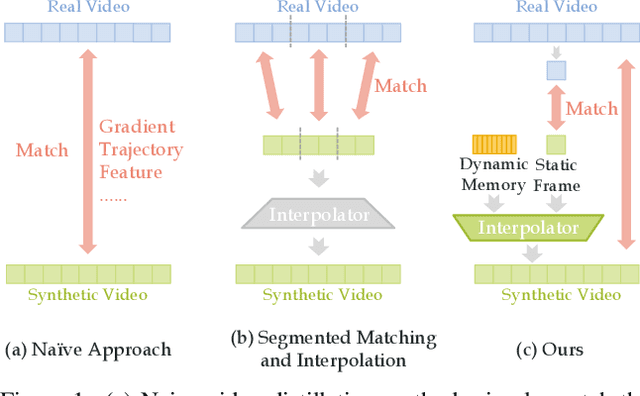
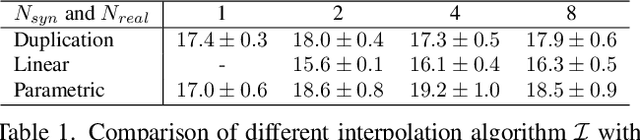
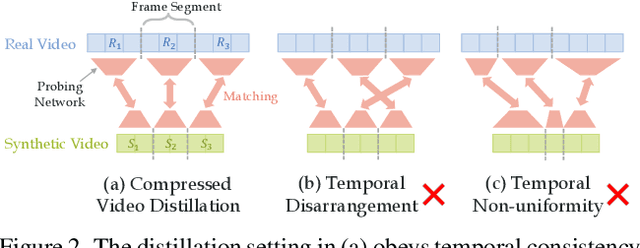

Recently, dataset distillation has paved the way towards efficient machine learning, especially for image datasets. However, the distillation for videos, characterized by an exclusive temporal dimension, remains an underexplored domain. In this work, we provide the first systematic study of video distillation and introduce a taxonomy to categorize temporal compression. Our investigation reveals that the temporal information is usually not well learned during distillation , and the temporal dimension of synthetic data contributes little. The observations motivate our unified framework of disentangling the dynamic and static information in the videos. It first distills the videos into still images as static memory and then compensates the dynamic and motion information with a learnable dynamic memory block. Our method achieves state-of-the-art on video datasets at different scales, with notably smaller storage expenditure. Our code will be publicly available.
RigLSTM: Recurrent Independent Grid LSTM for Generalizable Sequence Learning
Nov 03, 2023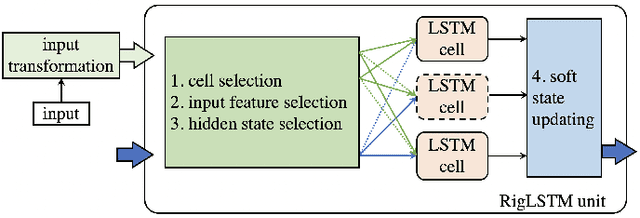
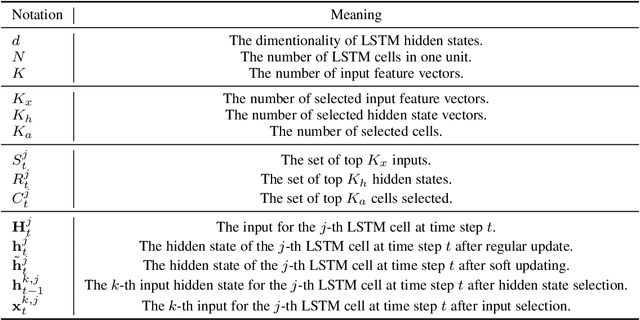
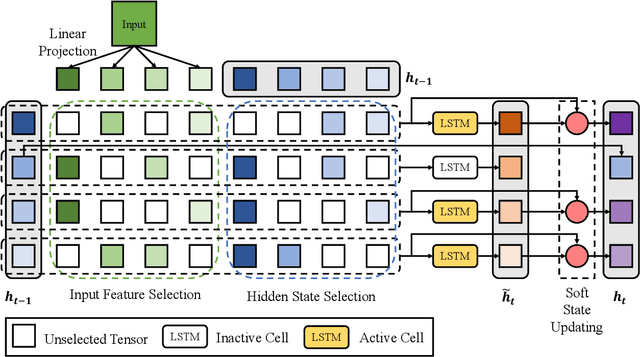
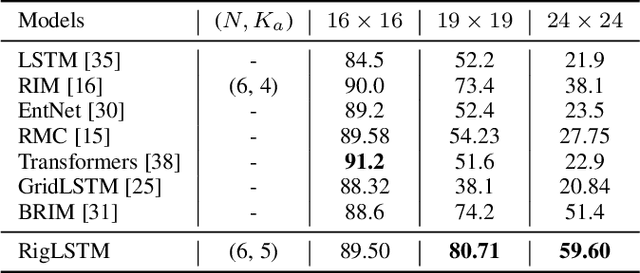
Sequential processes in real-world often carry a combination of simple subsystems that interact with each other in certain forms. Learning such a modular structure can often improve the robustness against environmental changes. In this paper, we propose recurrent independent Grid LSTM (RigLSTM), composed of a group of independent LSTM cells that cooperate with each other, for exploiting the underlying modular structure of the target task. Our model adopts cell selection, input feature selection, hidden state selection, and soft state updating to achieve a better generalization ability on the basis of the recent Grid LSTM for the tasks where some factors differ between training and evaluation. Specifically, at each time step, only a fraction of cells are activated, and the activated cells select relevant inputs and cells to communicate with. At the end of one time step, the hidden states of the activated cells are updated by considering the relevance between the inputs and the hidden states from the last and current time steps. Extensive experiments on diversified sequential modeling tasks are conducted to show the superior generalization ability when there exist changes in the testing environment. Source code is available at \url{https://github.com/ziyuwwang/rig-lstm}.
HUB: Guiding Learned Optimizers with Continuous Prompt Tuning
May 31, 2023Learned optimizers are a crucial component of meta-learning. Recent advancements in scalable learned optimizers have demonstrated their superior performance over hand-designed optimizers in various tasks. However, certain characteristics of these models, such as an unstable learning curve, limited ability to handle unseen tasks and network architectures, difficult-to-control behaviours, and poor performance in fine-tuning tasks impede their widespread adoption. To tackle the issue of generalization in scalable learned optimizers, we propose a hybrid-update-based (HUB) optimization strategy inspired by recent advancements in hard prompt tuning and result selection techniques used in large language and vision models. This approach can be easily applied to any task that involves hand-designed or learned optimizer. By incorporating hand-designed optimizers as the second component in our hybrid approach, we are able to retain the benefits of learned optimizers while stabilizing the training process and, more importantly, improving testing performance. We validate our design through a total of 17 tasks, consisting of thirteen training from scratch and four fine-tuning settings. These tasks vary in model sizes, architectures, or dataset sizes, and the competing optimizers are hyperparameter-tuned. We outperform all competitors in 94% of the tasks with better testing performance. Furthermore, we conduct a theoretical analysis to examine the potential impact of our hybrid strategy on the behaviours and inherited traits of learned optimizers.
Distill Gold from Massive Ores: Efficient Dataset Distillation via Critical Samples Selection
May 28, 2023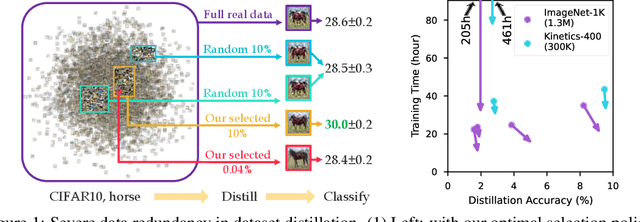

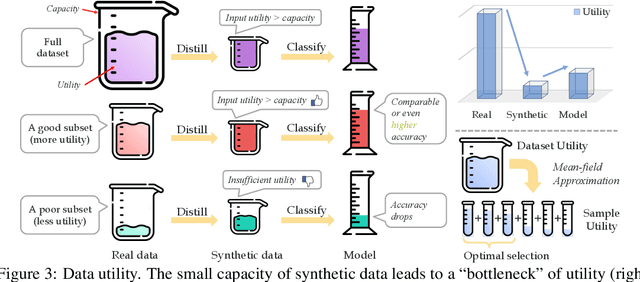
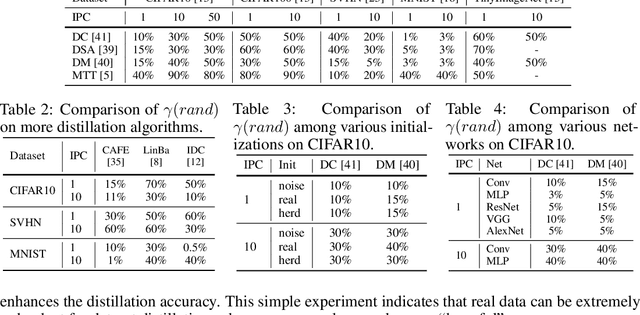
Data-efficient learning has drawn significant attention, especially given the current trend of large multi-modal models, where dataset distillation can be an effective solution. However, the dataset distillation process itself is still very inefficient. In this work, we model the distillation problem with reference to information theory. Observing that severe data redundancy exists in dataset distillation, we argue to put more emphasis on the utility of the training samples. We propose a family of methods to exploit the most valuable samples, which is validated by our comprehensive analysis of the optimal data selection. The new strategy significantly reduces the training cost and extends a variety of existing distillation algorithms to larger and more diversified datasets, e.g. in some cases only 0.04% training data is sufficient for comparable distillation performance. Moreover, our strategy consistently enhances the performance, which may open up new analyses on the dynamics of distillation and networks. Our method is able to extend the distillation algorithms to much larger-scale datasets and more heterogeneous datasets, e.g. ImageNet-1K and Kinetics-400. Our code will be made publicly available.
Bulk-Switching Memristor-based Compute-In-Memory Module for Deep Neural Network Training
May 23, 2023The need for deep neural network (DNN) models with higher performance and better functionality leads to the proliferation of very large models. Model training, however, requires intensive computation time and energy. Memristor-based compute-in-memory (CIM) modules can perform vector-matrix multiplication (VMM) in situ and in parallel, and have shown great promises in DNN inference applications. However, CIM-based model training faces challenges due to non-linear weight updates, device variations, and low-precision in analog computing circuits. In this work, we experimentally implement a mixed-precision training scheme to mitigate these effects using a bulk-switching memristor CIM module. Lowprecision CIM modules are used to accelerate the expensive VMM operations, with high precision weight updates accumulated in digital units. Memristor devices are only changed when the accumulated weight update value exceeds a pre-defined threshold. The proposed scheme is implemented with a system-on-chip (SoC) of fully integrated analog CIM modules and digital sub-systems, showing fast convergence of LeNet training to 97.73%. The efficacy of training larger models is evaluated using realistic hardware parameters and shows that that analog CIM modules can enable efficient mix-precision DNN training with accuracy comparable to full-precision software trained models. Additionally, models trained on chip are inherently robust to hardware variations, allowing direct mapping to CIM inference chips without additional re-training.
PowerGAN: A Machine Learning Approach for Power Side-Channel Attack on Compute-in-Memory Accelerators
Apr 13, 2023Analog compute-in-memory (CIM) accelerators are becoming increasingly popular for deep neural network (DNN) inference due to their energy efficiency and in-situ vector-matrix multiplication (VMM) capabilities. However, as the use of DNNs expands, protecting user input privacy has become increasingly important. In this paper, we identify a security vulnerability wherein an adversary can reconstruct the user's private input data from a power side-channel attack, under proper data acquisition and pre-processing, even without knowledge of the DNN model. We further demonstrate a machine learning-based attack approach using a generative adversarial network (GAN) to enhance the reconstruction. Our results show that the attack methodology is effective in reconstructing user inputs from analog CIM accelerator power leakage, even when at large noise levels and countermeasures are applied. Specifically, we demonstrate the efficacy of our approach on the U-Net for brain tumor detection in magnetic resonance imaging (MRI) medical images, with a noise-level of 20% standard deviation of the maximum power signal value. Our study highlights a significant security vulnerability in analog CIM accelerators and proposes an effective attack methodology using a GAN to breach user privacy.