 Add to Chrome
 Add to Firefox
 Add to Edge
Algorithmic Recourse of In-Context Learning for Tabular Data
May 29, 2026
As predictive models are increasingly deployed in high-stakes settings such as credit approval, there is a growing need for post-hoc methods that provide recourse to affected individuals. Many such models operate on tabular data, where features correspond to real-world attributes. Recently, in-context learning (ICL) has enabled large language models to perform tabular prediction by conditioning on labeled examples at inference time, without explicit training. However, algorithmic recourse for tabular decision-making under ICL remains largely unexplored. In this work, we present the first study of algorithmic recourse for tabular data under ICL. We carry out a theoretical analysis, showing that recourse remains well-defined and bounded, and we characterize how recourse converges toward classical solutions as the context size increases. In practice, we propose a novel zeroth-order recourse framework, Adaptive Subspace Recourse for In-Context Learning (ASR-ICL), that efficiently generates actionable and sparse recourse for black-box ICL models. The proposed framework naturally extends to multi-class tabular tasks. Experiments across multiple real-world datasets and models demonstrate that ASR-ICL achieves recourse quality comparable to existing methods with fewer queries and empirically confirm the predicted convergence behavior, supporting our theoretical analysis.

EAP-GP: Mitigating Saturation Effect in Gradient-based Automated Circuit Identification
Feb 07, 2025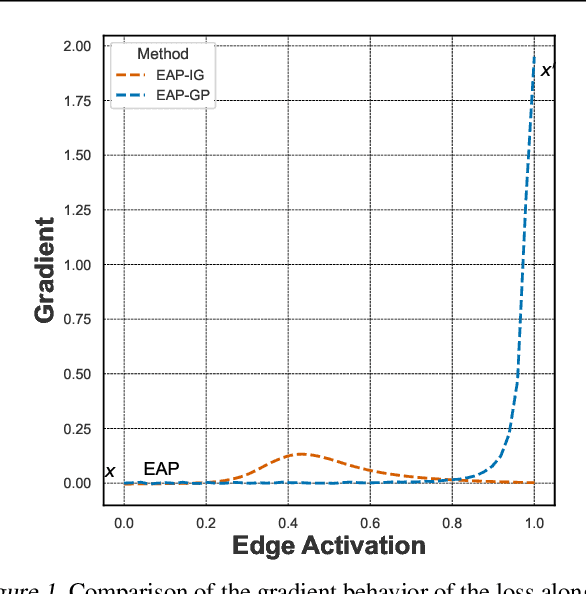
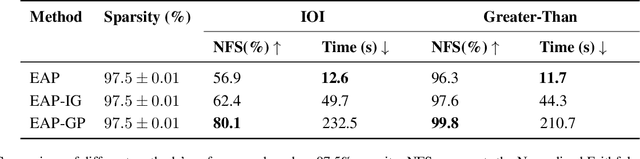
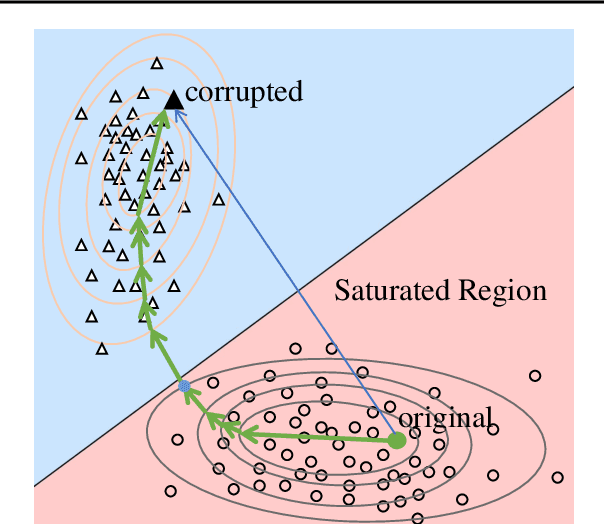
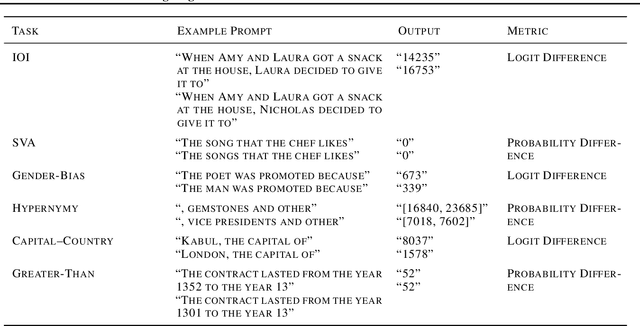
Understanding the internal mechanisms of transformer-based language models remains challenging. Mechanistic interpretability based on circuit discovery aims to reverse engineer neural networks by analyzing their internal processes at the level of computational subgraphs. In this paper, we revisit existing gradient-based circuit identification methods and find that their performance is either affected by the zero-gradient problem or saturation effects, where edge attribution scores become insensitive to input changes, resulting in noisy and unreliable attribution evaluations for circuit components. To address the saturation effect, we propose Edge Attribution Patching with GradPath (EAP-GP), EAP-GP introduces an integration path, starting from the input and adaptively following the direction of the difference between the gradients of corrupted and clean inputs to avoid the saturated region. This approach enhances attribution reliability and improves the faithfulness of circuit identification. We evaluate EAP-GP on 6 datasets using GPT-2 Small, GPT-2 Medium, and GPT-2 XL. Experimental results demonstrate that EAP-GP outperforms existing methods in circuit faithfulness, achieving improvements up to 17.7%. Comparisons with manually annotated ground-truth circuits demonstrate that EAP-GP achieves precision and recall comparable to or better than previous approaches, highlighting its effectiveness in identifying accurate circuits.