 Add to Chrome
 Add to Firefox
 Add to Edge
Ultra: Unsupervised Cross-Task Optimization for Reliable Restoration Segmentation Collaboration under Adverse Weather
Aug 17, 2026
Unsupervised Domain Adaptation for Adverse Weather Semantic Segmentation (UDA-ASS) aims to transfer semantic knowledge from labeled normal-weather images to unlabeled adverse environments. Existing approaches implicitly assume that restoration and segmentation provide mutually beneficial guidance. However, under severe degradation and without target-domain supervision, the validity of cross-task optimization directions becomes fundamentally unidentifiable, leading to hallucination-driven error propagation. In this work, we propose a novel Unsupervised Restoration-Segmentation Collaborative Learning Framework (Ultra), which reframes cross-task interaction as direction selection under uncertainty and causal effect estimation, enabling reliable collaboration through candidate direction generation and intervention-based filtering. In detail, we propose CTDN and CMIL. The former exploits complementary visual structures and semantic information to generate candidate optimization directions and performs cooperative direction selection between restoration and segmentation. The latter reformulates cross-task information transfer from correlation-based propagation into causal effect assessment, suppressing hallucination propagation. Extensive experiments on three widely used UDA-ASS benchmarks demonstrate state-of-the-art segmentation performance. Beyond segmentation, our framework achieves better unsupervised restoration results than existing UDA-ASS restoration methods and generalizes to unsupervised restoration and object detection collaboration tasks. Code and models will be available at https://github.com/Wang-Shiqin/Ultra.

Beacon: Knowing When and How to Perform Agentic Visual Reasoning
Jul 30, 2026The fundamental goal of agentic visual reasoning is to improve the success rate of multimodal large language models (MLLMs) on complex tasks, rather than merely equipping them with a sophisticated yet inefficient reasoning paradigm. In this work, we rethink agentic visual reasoning through two key dimensions of tool use: Mode Adaptiveness (MA) and Tool Effect (TE). Mode Adaptiveness characterizes whether an MLLM can recognize when tools are truly necessary and invoke them accordingly, thereby avoiding unnecessary computational overhead while improving performance on challenging problems that require tool assistance. Tool Effect characterizes the actual impact of tool use: tools should extend the model's capabilities on problems unsolvable through text-only reasoning, while avoiding additional errors on problems that the model can already solve without tools. We conduct a comprehensive analysis to quantify these two properties and empirically reveal that existing agentic visual reasoning models exhibit limited Mode Adaptiveness, while the gains produced by tool use on hard examples are largely offset by the harm introduced on easy examples that the models can already solve. Motivated by these observations, we propose Beacon, a novel agentic visual reasoning model that achieves stronger overall performance, improved Mode Adaptiveness, and genuine tool-induced performance gains. At the core of Beacon are the Necessity-Aware Adaptive Reward and the Hint-Guided Capability Expansion mechanism in the reinforcement learning stage, which respectively encourage adaptive tool invocation based on task necessity and strengthen the model's tool-use capability on the most challenging problems. Extensive experiments across diverse benchmarks demonstrate the strong overall performance of Beacon and its substantial improvements in both Mode Adaptiveness and Tool Effect.
Semantic-Enriched Latent Visual Reasoning
May 19, 2026Multimodal latent-space reasoning aims to replace explicit thinking with images by performing visual reasoning directly in a compact latent space. However, existing approaches largely rely on visual supervision and produce latent representations that lack sufficient semantic richness, limiting their ability to support diverse region-level reasoning tasks. In this work, we introduce Semantic-Enriched Latent Visual Reasoning (SLVR), a two-stage learning framework that enriches latent representations with attribute-level visual semantics and aligns them with diverse reasoning objectives. In the first stage, SLVR learns semantically enriched region-centric latents under fine-grained attribute supervision. In the second stage, we design Multi-query Group Relative Policy Optimization (M-GRPO) to align latent representations across multiple queries grounded in the same region. To support this framework, we construct SLV-Set, comprising approximately 400K region-level attribute annotations and 800K multi-query question answering samples, and introduce SV-QA, a benchmark that evaluates latent reasoning under semantic variation. Experiments demonstrate that SLVR improves the robustness and semantic consistency of latent visual reasoning compared to existing baselines.
Learning Invariable Semantical Representation from Language for Extensible Policy Generalization
Jan 26, 2022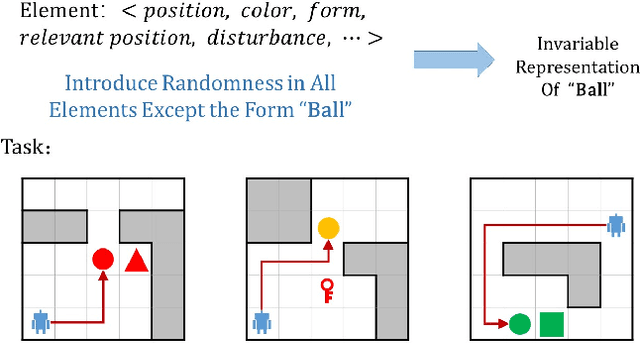
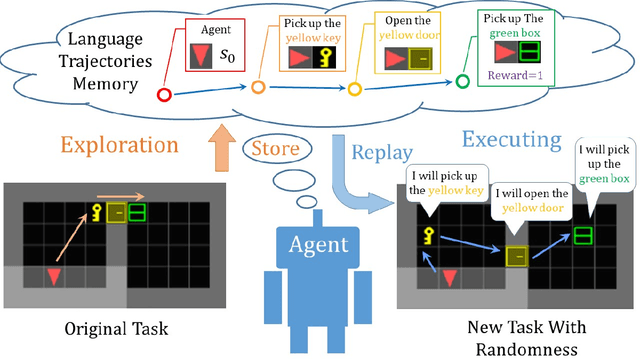
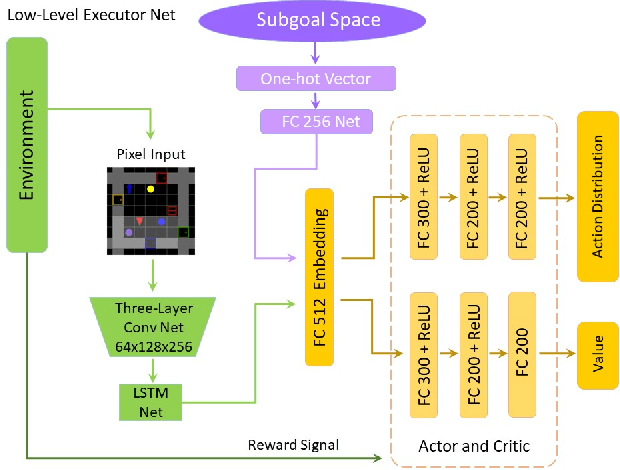
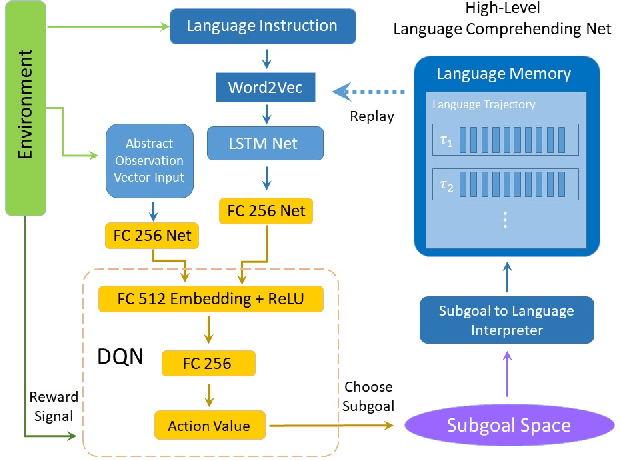
Recently, incorporating natural language instructions into reinforcement learning (RL) to learn semantically meaningful representations and foster generalization has caught many concerns. However, the semantical information in language instructions is usually entangled with task-specific state information, which hampers the learning of semantically invariant and reusable representations. In this paper, we propose a method to learn such representations called element randomization, which extracts task-relevant but environment-agnostic semantics from instructions using a set of environments with randomized elements, e.g., topological structures or textures, yet the same language instruction. We theoretically prove the feasibility of learning semantically invariant representations through randomization. In practice, we accordingly develop a hierarchy of policies, where a high-level policy is designed to modulate the behavior of a goal-conditioned low-level policy by proposing subgoals as semantically invariant representations. Experiments on challenging long-horizon tasks show that (1) our low-level policy reliably generalizes to tasks against environment changes; (2) our hierarchical policy exhibits extensible generalization in unseen new tasks that can be decomposed into several solvable sub-tasks; and (3) by storing and replaying language trajectories as succinct policy representations, the agent can complete tasks in a one-shot fashion, i.e., once one successful trajectory has been attained.