 Add to Chrome
 Add to Firefox
 Add to Edge
FocusMem: Factorizing Content, Readout, and Trust in Latent GUI Memory
Aug 05, 2026
GUI agents must remember both useful experience from earlier tasks and unfinished progress in the current interaction. Latent memory offers a compact solution by compressing multimodal trajectories into a few continuous tokens. Existing methods, however, usually map each trajectory to one fixed memory block and train it mainly through next-action supervision. This creates three practical problems: important details may be lost during compression, the same memory block must serve different decision stages, and irrelevant retrieved trajectories may still mislead the agent. We introduce FocusMem, which separates these responsibilities within a compact latent-memory interface. A role-aware content basis encourages episodic memory to retain reusable experience and working memory to retain task progress. A state-conditioned readout generates a decision-specific view of the same stored evidence, while a lightweight trust gate can suppress memory blocks that appear irrelevant to the current step. All components are trained while the GUI policy remains frozen. Across five GUI-agent benchmarks, FocusMem consistently outperforms a fully matched action-only fixed-memory baseline and prior latent memory adaptations. Further analysis shows that semantic and functional supervision preserve complementary information, state-conditioned readout is more robust as surrounding trajectory context grows, and the trust gate reduces the harm caused by injected irrelevant episodic evidence. These results show that effective latent memory depends not only on compressing past interaction, but also on what is retained, what is exposed, and what is allowed.

Hybrid Attribution Priors for Explainable and Robust Model Training
Dec 09, 2025Small language models (SLMs) are widely used in tasks that require low latency and lightweight deployment, particularly classification. As interpretability and robustness gain increasing importance, explanation-guided learning has emerged as an effective framework by introducing attribution-based supervision during training; however, deriving general and reliable attribution priors remains a significant challenge. Through an analysis of representative attribution methods in classification settings, we find that although these methods can reliably highlight class-relevant tokens, they often focus on common keywords shared by semantically similar classes. Because such classes are already difficult to distinguish under standard training, these attributions provide insufficient discriminative cues, limiting their ability to improve model differentiation. To overcome this limitation, we propose Class-Aware Attribution Prior (CAP), a novel attribution prior extraction framework that guides language models toward capturing fine-grained class distinctions and producing more salient, discriminative attribution priors. Building on this idea, we further introduce CAP Hybrid, which combines priors from CAP with those from existing attribution techniques to form a more comprehensive and balanced supervisory signal. By aligning a model's self-attribution with these enriched priors, our approach encourages the learning of diverse, decision-relevant features. Extensive experiments in full-data, few-shot, and adversarial scenarios demonstrate that our method consistently enhances both interpretability and robustness.
Instance Relation Learning Network with Label Knowledge Propagation for Few-shot Multi-label Intent Detection
Oct 09, 2025Few-shot Multi-label Intent Detection (MID) is crucial for dialogue systems, aiming to detect multiple intents of utterances in low-resource dialogue domains. Previous studies focus on a two-stage pipeline. They first learn representations of utterances with multiple labels and then use a threshold-based strategy to identify multi-label results. However, these methods rely on representation classification and ignore instance relations, leading to error propagation. To solve the above issues, we propose a multi-label joint learning method for few-shot MID in an end-to-end manner, which constructs an instance relation learning network with label knowledge propagation to eliminate error propagation. Concretely, we learn the interaction relations between instances with class information to propagate label knowledge between a few labeled (support set) and unlabeled (query set) instances. With label knowledge propagation, the relation strength between instances directly indicates whether two utterances belong to the same intent for multi-label prediction. Besides, a dual relation-enhanced loss is developed to optimize support- and query-level relation strength to improve performance. Experiments show that we outperform strong baselines by an average of 9.54% AUC and 11.19% Macro-F1 in 1-shot scenarios.
Channel Measurement for Holographic MIMO: Benefits and Challenges of Spatial Oversampling
Jan 13, 2023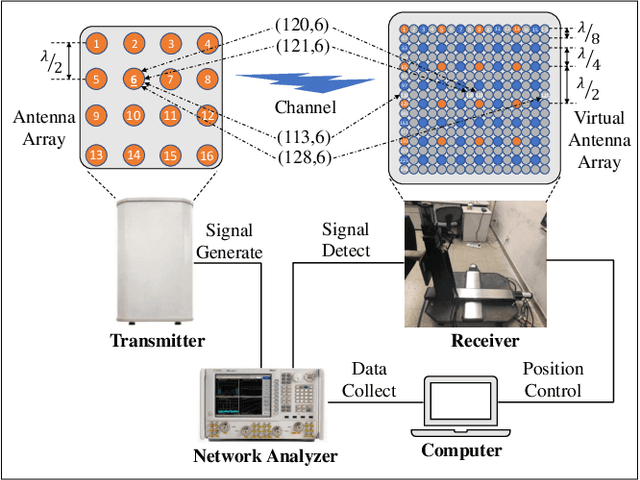
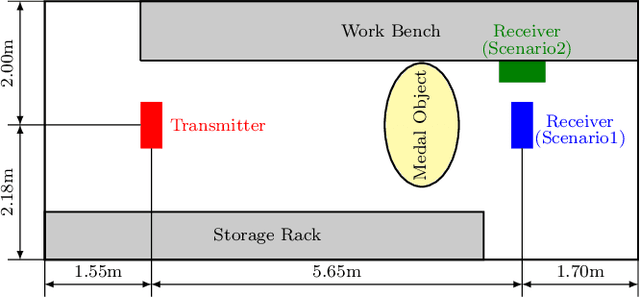

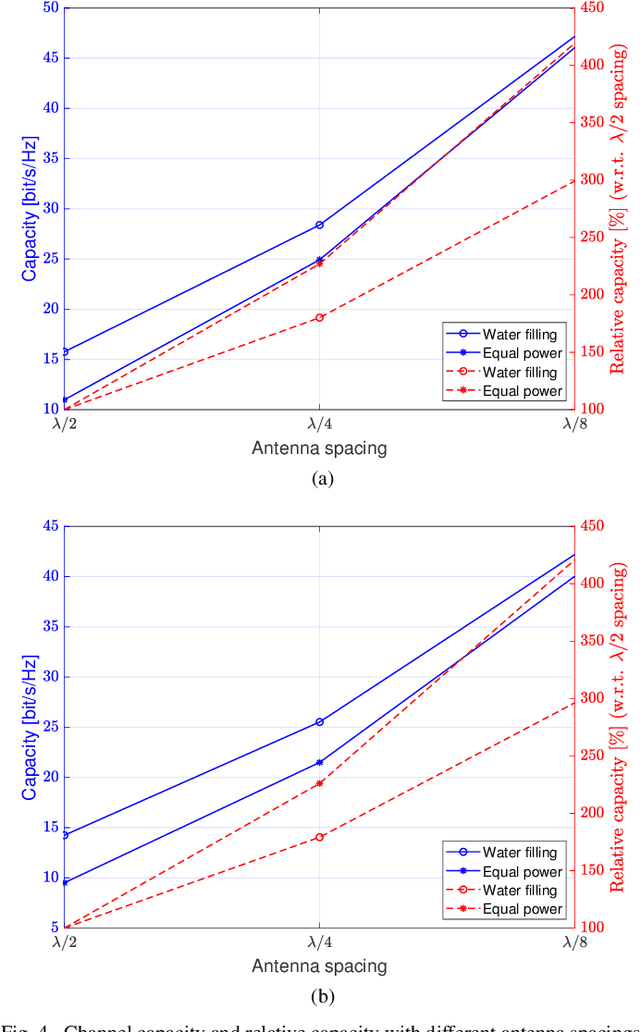
In this paper, the channel of an indoor holographic multiple-input multiple-output (MIMO) system is measured. It is demonstrated through experiments for the first time that the spatial oversampling of holographic MIMO systems is able to increase the capacity of a wireless communication system significantly. However, the antenna efficiency is the most crucial challenge preventing us from getting the capacity improvement. An extended EM-compliant channel model is also proposed for holographic MIMO systems, which is able to take the non-isotropic characteristics of the propagation environment, the antenna pattern distortion, the antenna efficiency, and the polarization characteristics into consideration.
Electromagnetic-Compliant Channel Modeling and Performance Evaluation for Holographic MIMO
Jan 13, 2023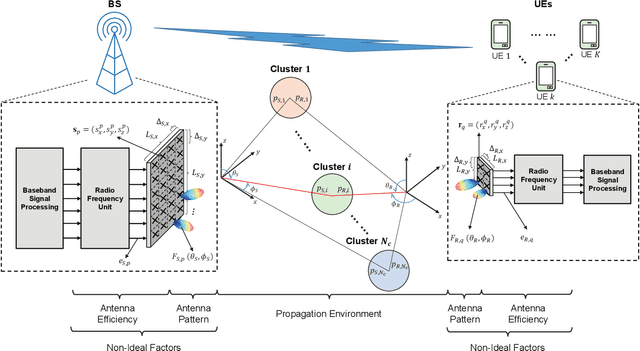
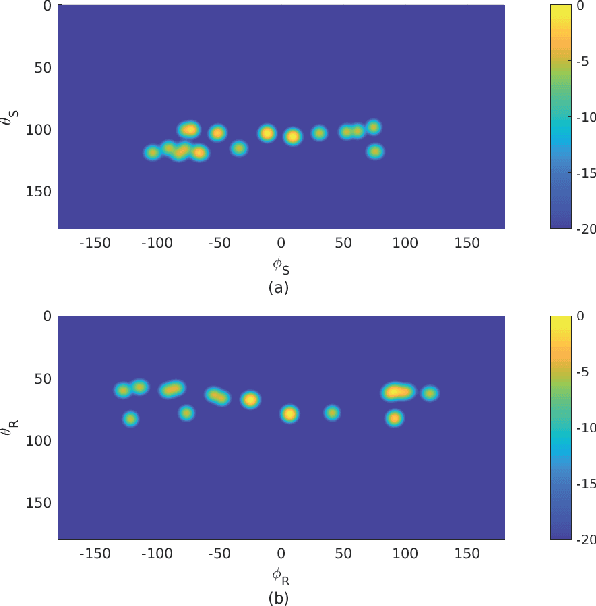
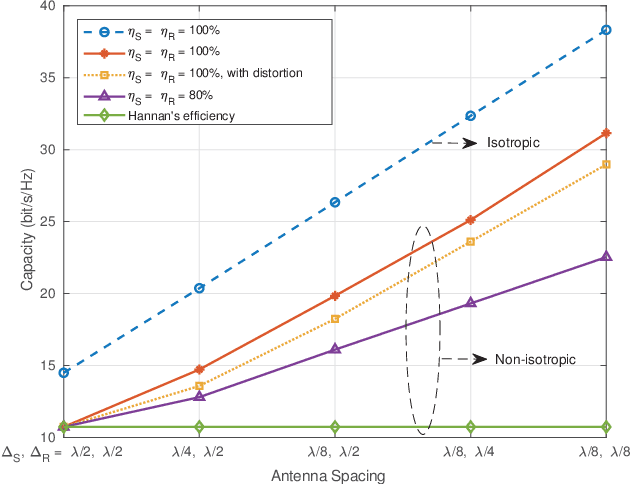

Recently, the concept of holographic multiple-input multiple-output (MIMO) is emerging as one of the promising technologies beyond massive MIMO. Many challenges need to be addressed to bring this novel idea into practice, including electromagnetic (EM)-compliant channel modeling and accurate performance evaluation. In this paper, an EM-compliant channel model is proposed for the holographic MIMO systems, which is able to model both the characteristics of the propagation channel and the non-ideal factors caused by mutual coupling at the transceivers, including the antenna pattern distortion and the decrease of antenna efficiency. Based on the proposed channel model, a more realistic performance evaluation is conducted to show the performance of the holographic MIMO system in both the single-user and the multi-user scenarios. Key challenges and future research directions are further provided based on the theoretical analyses and numerical results.