 Add to Chrome
 Add to Firefox
 Add to Edge
TIER-MoE: Trust-Informed Expert Routing via Conditional Modality Risk for Multimodal Fusion in Biomedical Classification
Jul 29, 2026
The promise of multimodal fusion lies in combining complementary sources of evidence, yet more evidence does not always yield a better prediction. Recent multimodal models have advanced fusion through richer cross-modal interaction and sample-adaptive fusion. However, the influence assigned to a modality during fusion does not reveal whether that source is unreliable, redundant, or poorly matched to a specialized expert. To address this limitation, we introduce TIER-MoE, a risk-guided subspace mixture-of-experts model that defines sample-specific modality reliability as the prediction loss its unimodal predictor is expected to incur. This risk is learned from out-of-fold predictions generated by models that were not trained on the corresponding sample. TIER-MoE combines the estimated risk with expert-specific subspace compatibility for sparse modality-expert routing, while an always-active shared path preserves multimodal complementarity. We evaluate TIER-MoE on four public multimodal biomedical datasets spanning Alzheimer's disease status, skin-lesion malignancy, and retinal classification. Results demonstrate its superiority over state-of-the-art methods in predictive performance and probability calibration, with consistent improvements in Macro-F1 and Brier score and strong zero-shot generalization to an external cohort.

Tamed Stochastic Gradient Hamiltonian Monte Carlo
Jul 16, 2026In this paper, we propose a novel tamed stochastic gradient Hamiltonian Monte Carlo (tSGHMC) algorithm for sampling and stochastic optimization problems with superlinearly growing stochastic gradients. Under a certain continuity in average condition and a strong convexity condition, we establish a non-asymptotic error bound in Wasserstein-2 distance for tSGHMC with the rate of convergence equal to $1/4$. Then, we derive an upper estimate for the associated expected excess risk, which provides a theoretical guarantee for the performance of tSGHMC. To illustrate the effectiveness of the proposed algorithm, we apply tSGHMC to practical examples, including a newsvendor problem and a Conditional Value-at-Risk minimization problem, using synthetic and real-world datasets. Numerical results support our theoretical findings. Furthermore, we compare tSGHMC with its first-order counterpart, namely, the tamed unadjusted stochastic Langevin algorithm. Simulation results demonstrate that tSGHMC achieves lower root mean square error and expected excess risk across a range of tasks.
Training Vision-Language-Action Models with Dense Embodied Chain-of-Thought Supervision
Jul 01, 2026Cross-embodiment transfer in vision-language-action (VLA) models remains challenging because low-level state and action spaces differ fundamentally across robot platforms. We observe that the high-level cognitive process underlying manipulation, including scene perception, object identification, task planning, and sub-task decomposition, is largely shared across embodiments. Based on this observation, we present ZR-0, a 2.6 billion parameter end-to-end VLA model that uses dense Embodied Chain-of-Thought (ECoT) supervision to align cross-embodiment representations within the vision-language model (VLM). ZR-0 adopts a dual-stream architecture: a pre-trained VLM (System 2) generates structured ECoT reasoning during training, while a Diffusion Transformer-based action expert (System 1) produces continuous action chunks via flow matching. The two components are coupled through cross-attention, with an attention mask that restricts the action expert to input prompt features only, enabling ECoT generation to be entirely skipped at inference without any performance loss. ZR-0 is pre-trained on ProcCorpus-60M, a large-scale dataset comprising approximately 60 million frames (approximately 1,000 hours) from over 400K trajectories, with dense ECoT annotations covering 96.8% of all frames. We evaluate ZR-0 on three simulation benchmarks spanning single-arm (LIBERO), bimanual (RoboTwin 2.0), and humanoid (RoboCasa GR-1 Tabletop) embodiments, as well as real-world experiments on the xArm platform, demonstrating strong performance across all settings. Code and model checkpoints are available at https://github.com/RUCKBReasoning/ZR-0.
SemBlock: Semantic Boundary Dynamic Blocks for Diffusion LLMs
Jun 03, 2026Diffusion language models (DLMs) generate text through iterative denoising, and blockwise decoding improves their practicality by committing tokens in local blocks. However, existing blockwise methods typically rely on fixed block sizes or delimiter-based runtime signals, which do not necessarily align with semantic boundaries. In this paper, we propose SemBlock, a semantic-boundary-driven dynamic block decoding framework for diffusion LLMs. SemBlock formulates dynamic block construction as semantic boundary prediction and trains lightweight predictors on frozen LLaDA hidden states. To provide supervision, we construct SemBound, a semantic-boundary dataset that derives boundary labels from discourse units, reasoning steps, and implementation spans across natural language, math, and code tasks. During inference, SemBlock uses predicted boundary probabilities to select the ending position of each dynamic block. Experiments on GSM8K, IFEval, MATH, and HumanEval show that SemBlock consistently improves over fixed-block decoding and AdaBlock. Our code is publicly available: https://github.com/TH-AI-Lab-PKU/SemBlock.
Action Draft and Verify: A Self-Verifying Framework for Vision-Language-Action Model
Mar 18, 2026Vision-Language-Action (VLA) models have recently demonstrated strong performance across embodied tasks. Modern VLAs commonly employ diffusion action experts to efficiently generate high-precision continuous action chunks, while auto-regressive generation can be slower and less accurate at low-level control. Yet auto-regressive paradigms still provide complementary priors that can improve robustness and generalization in out-of-distribution environments. To leverage both paradigms, we propose Action-Draft-and-Verify (ADV): diffusion action expert drafts multiple candidate action chunks, and the VLM selects one by scoring all candidates in a single forward pass with a perplexity-style metric. Under matched backbones, training data, and action-chunk length, ADV improves success rate by +4.3 points in simulation and +19.7 points in real-world over diffusion-based baseline, with a single-pass VLM reranking overhead.
KV-CoRE: Benchmarking Data-Dependent Low-Rank Compressibility of KV-Caches in LLMs
Feb 05, 2026Large language models rely on kv-caches to avoid redundant computation during autoregressive decoding, but as context length grows, reading and writing the cache can quickly saturate GPU memory bandwidth. Recent work has explored KV-cache compression, yet most approaches neglect the data-dependent nature of kv-caches and their variation across layers. We introduce KV-CoRE KV-cache Compressibility by Rank Evaluation), an SVD-based method for quantifying the data-dependent low-rank compressibility of kv-caches. KV-CoRE computes the optimal low-rank approximation under the Frobenius norm and, being gradient-free and incremental, enables efficient dataset-level, layer-wise evaluation. Using this method, we analyze multiple models and datasets spanning five English domains and sixteen languages, uncovering systematic patterns that link compressibility to model architecture, training data, and language coverage. As part of this analysis, we employ the Normalized Effective Rank as a metric of compressibility and show that it correlates strongly with performance degradation under compression. Our study establishes a principled evaluation framework and the first large-scale benchmark of kv-cache compressibility in LLMs, offering insights for dynamic, data-aware compression and data-centric model development.
Few-Shot-Based Modular Image-to-Video Adapter for Diffusion Models
Dec 23, 2025Diffusion models (DMs) have recently achieved impressive photorealism in image and video generation. However, their application to image animation remains limited, even when trained on large-scale datasets. Two primary challenges contribute to this: the high dimensionality of video signals leads to a scarcity of training data, causing DMs to favor memorization over prompt compliance when generating motion; moreover, DMs struggle to generalize to novel motion patterns not present in the training set, and fine-tuning them to learn such patterns, especially using limited training data, is still under-explored. To address these limitations, we propose Modular Image-to-Video Adapter (MIVA), a lightweight sub-network attachable to a pre-trained DM, each designed to capture a single motion pattern and scalable via parallelization. MIVAs can be efficiently trained on approximately ten samples using a single consumer-grade GPU. At inference time, users can specify motion by selecting one or multiple MIVAs, eliminating the need for prompt engineering. Extensive experiments demonstrate that MIVA enables more precise motion control while maintaining, or even surpassing, the generation quality of models trained on significantly larger datasets.
An Empirical Study of the Impact of Federated Learning on Machine Learning Model Accuracy
Mar 27, 2025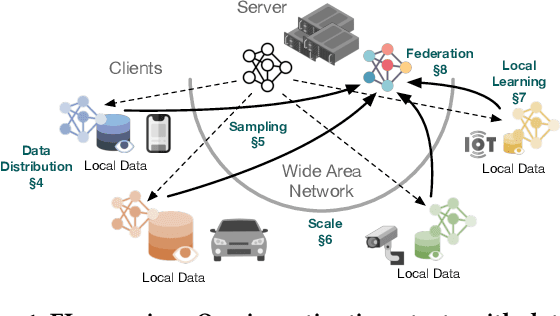
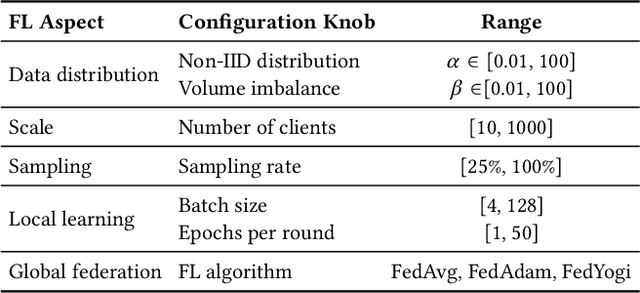

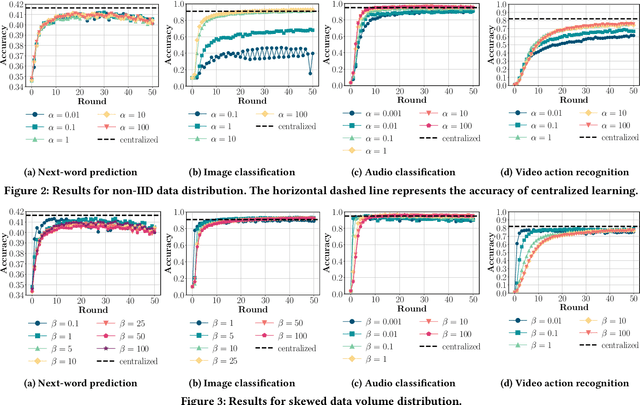
Federated Learning (FL) enables distributed ML model training on private user data at the global scale. Despite the potential of FL demonstrated in many domains, an in-depth view of its impact on model accuracy remains unclear. In this paper, we investigate, systematically, how this learning paradigm can affect the accuracy of state-of-the-art ML models for a variety of ML tasks. We present an empirical study that involves various data types: text, image, audio, and video, and FL configuration knobs: data distribution, FL scale, client sampling, and local and global computations. Our experiments are conducted in a unified FL framework to achieve high fidelity, with substantial human efforts and resource investments. Based on the results, we perform a quantitative analysis of the impact of FL, and highlight challenging scenarios where applying FL degrades the accuracy of the model drastically and identify cases where the impact is negligible. The detailed and extensive findings can benefit practical deployments and future development of FL.
Learning to Generate Structured Queries from Natural Language with Indirect Supervision
Sep 10, 2018
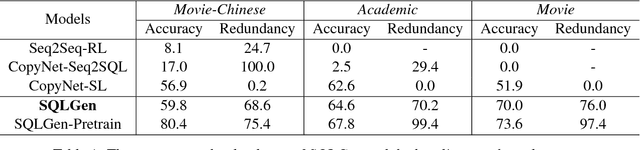
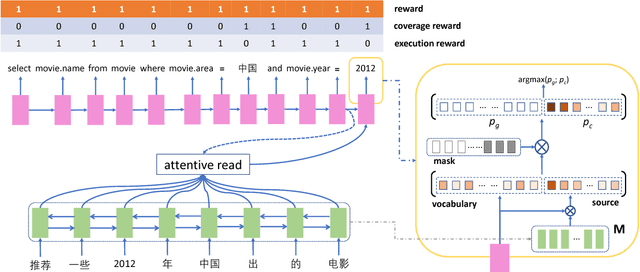
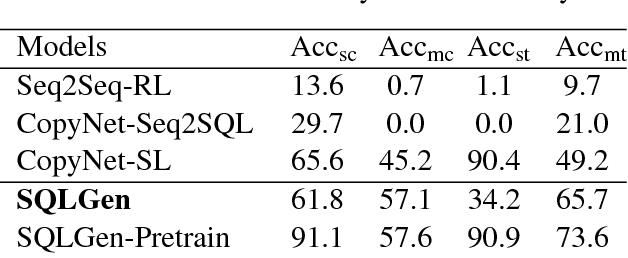
Generating structured query language (SQL) from natural language is an emerging research topic. This paper presents a new learning paradigm from indirect supervision of the answers to natural language questions, instead of SQL queries. This paradigm facilitates the acquisition of training data due to the abundant resources of question-answer pairs for various domains in the Internet, and expels the difficult SQL annotation job. An end-to-end neural model integrating with reinforcement learning is proposed to learn SQL generation policy within the answer-driven learning paradigm. The model is evaluated on datasets of different domains, including movie and academic publication. Experimental results show that our model outperforms the baseline models.
On the Linear Belief Compression of POMDPs: A re-examination of current methods
Aug 05, 2015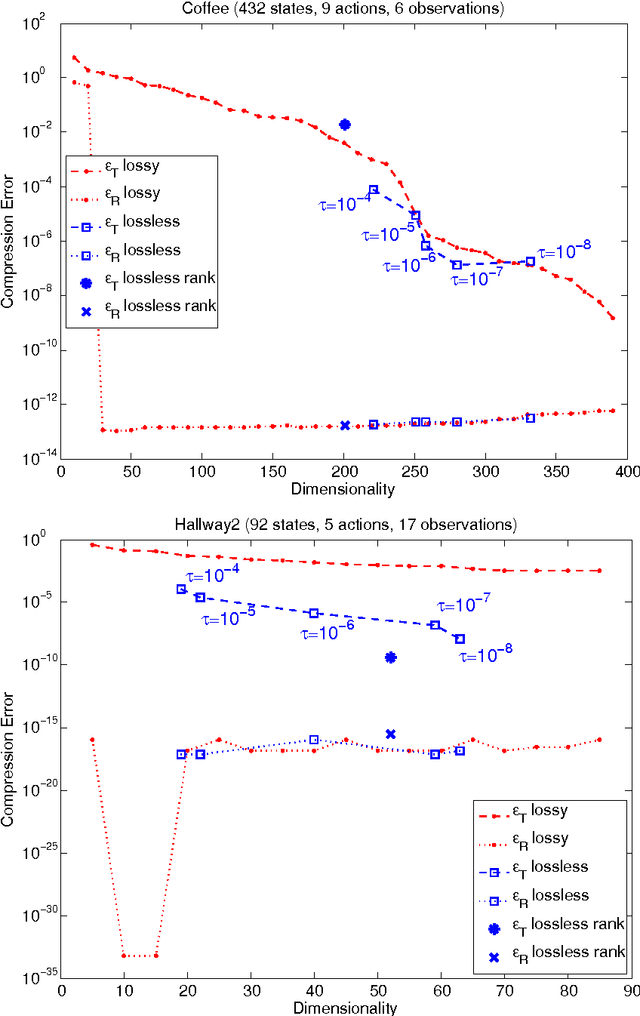
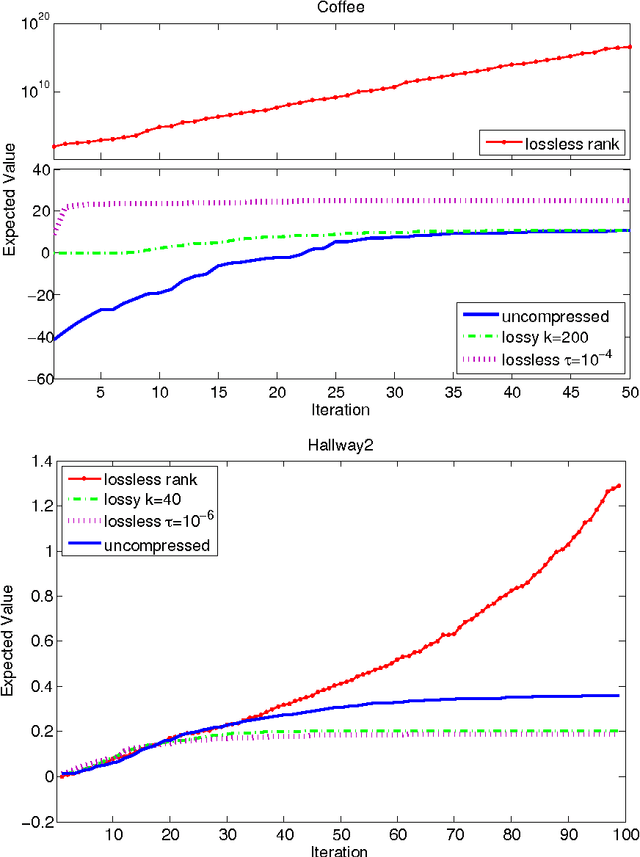
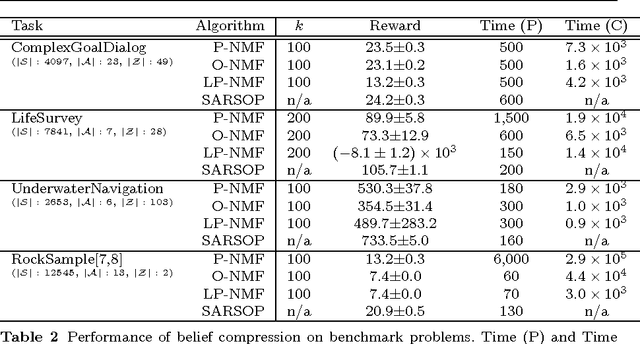
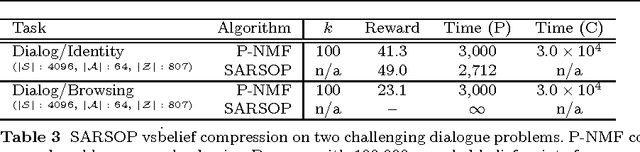
Belief compression improves the tractability of large-scale partially observable Markov decision processes (POMDPs) by finding projections from high-dimensional belief space onto low-dimensional approximations, where solving to obtain action selection policies requires fewer computations. This paper develops a unified theoretical framework to analyse three existing linear belief compression approaches, including value-directed compression and two non-negative matrix factorisation (NMF) based algorithms. The results indicate that all the three known belief compression methods have their own critical deficiencies. Therefore, projective NMF belief compression is proposed (P-NMF), aiming to overcome the drawbacks of the existing techniques. The performance of the proposed algorithm is examined on four POMDP problems of reasonably large scale, in comparison with existing techniques. Additionally, the competitiveness of belief compression is compared empirically to a state-of-the-art heuristic search based POMDP solver and their relative merits in solving large-scale POMDPs are investigated.