 Add to Chrome
 Add to Firefox
 Add to Edge
Physics-Guided Sequence-Based Generative Framework for Acoustic Metamaterial Inverse Design
Jun 08, 2026
Acoustic metamaterial (AMM) inverse design is particularly challenging for broadband target responses due to acoustic dispersion: a structure that matches the desired response at one frequency may deviate at others, and modifying geometry to improve one sub-band often perturbs neighboring sub-bands. Yet existing broadband inverse-design approaches are either constrained by predefined templates, or rely on image representations that fail to preserve the geometric precision and structural connectivity required by acoustic structures. We present MetaSeq, a physics-guided, sequence-based generative framework for acoustic metamaterial inverse design. At its core, MetaSeq introduces a language that represents each AMM as a structured sequence, rather than as a pixel grid or fixed template. This representation preserves precise geometry, explicitly encodes connectivity, and casts inverse design as a sequence-to-sequence task from target response to structure sequence. MetaSeq further constructs a balanced, high-fidelity dataset with efficient calibration and complexity-based sampling. To address the one-to-many nature of inverse design, MetaSeq combines supervised pretraining with reinforcement learning fine-tuning guided by a physics-based solver and validity checker. Extensive evaluations against COMSOL and five baselines show that MetaSeq reduces response error by 45% over the best baseline.

Assessing socio-economic climate impacts from text data
May 20, 2026Recent advances in natural language processing (NLP) and large language models (LLMs) have enabled the systematic use of large-scale textual data from news, social media, and reports to create datasets with socio-economic impacts of climate hazards such as floods, droughts, storms, and multi-hazard events. As the field of text-as-data for impact assessment expands, so does its methodological complexity. Yet research remains fragmented, with no clear guidelines for defining what constitutes an impact, handling temporal and spatial biases, and selecting appropriate modeling and post-processing strategies. This lack of coherence limits transparency and comparability across studies. Here, we address this gap by synthesising common practices, describing key challenges specific to the use of text-as-data methods for analyzing socio-economic impact data, and proposing recommendations to address them. By providing guidance on best practices, we aim to support the construction of robust text-derived socio-economic impact datasets that can more accurately inform disaster risk management and attribution studies.
Deep Attention Reweighting: Post-Hoc Attention-Based Feature Aggregation in CNNs for Disentangling Core and Spurious Features under Spurious Correlations
May 20, 2026Convolutional Neural Networks (CNNs) often exploit spurious correlations in datasets, learning superficially predictive yet causally irrelevant features, leading to poor generalization and fairness issues. Deep Feature Reweighting (DFR) is a post-hoc technique that reduces a trained model's reliance on spurious correlations by retraining its classification head on a target dataset. However, we show that DFR is fundamentally constrained by operating on entangled features, limiting its ability to amplify the core features while simultaneously suppressing the spurious ones. We trace this entanglement to the ubiquitous Global Average Pooling (GAP) layer, which indiscriminately collapses spatially distinct core and spurious features into a single representation. To address this, we propose Deep Attention Reweighting (DAR), a post-hoc attention-based aggregation module that replaces GAP and is retrained jointly with the classification head. DAR computes an adaptive weighting of spatial locations across feature maps, enabling selective suppression of spurious features before the collapse into entangled features. Across various datasets, metrics, and ablations, DAR consistently outperforms DFR, demonstrating that our attention-based aggregation mitigates GAP-induced entanglement and reduces spurious reliance.
Cumulative Meta-Learning from Active Learning Queries for Robustness to Spurious Correlations
May 20, 2026Spurious correlations in real-world datasets cause machine learning models to rely on irrelevant patterns, undermining reliability, generalization, and fairness. Active learning offers a promising way to address this failure mode by querying informative samples that distinguish core features from spurious ones. However, standard active-learning methods simply append queried examples to the labeled set, effectively updating only the likelihood term. In deep learning regimes, the influence of these informative samples can be diluted by the larger labeled set and memorized by overparameterized models. We propose Cumulative Active Meta-Learning (CAML), an active-learning framework that uses queried examples to meta-learn the prior, or inductive bias, governing how the model adapts. CAML casts each active-learning round as a meta-learning task: the current labeled set serves as meta-train data for adaptation, while the newly queried batch serves as meta-test data for evaluating generalization. Unlike conventional meta-learning, which treats tasks as independent and identically distributed, CAML exploits the sequential dependence between active-learning rounds by maintaining a cumulative inductive bias that is progressively refined. Theoretically, we show that this cumulative formulation introduces interaction terms that couple earlier meta-learned inductive biases with later query-induced objectives, capturing dependencies absent from standard meta-learning. Empirically, CAML improves minority-group accuracy across spurious-correlation benchmarks and acquisition strategies, with gains of up to 27.8% on Dominoes, 29.9% on Waterbirds, 14.3% on SpuCo, and 24.0% on CivilComments.
MmBack: Clock-free Multi-Sensor Backscatter with Synchronous Acquisition and Multiplexing
Jul 02, 2025Backscatter tags provide a low-power solution for sensor applications, yet many real-world scenarios require multiple sensors-often of different types-for complex sensing tasks. However, existing designs support only a single sensor per tag, increasing spatial overhead. State-of-the-art approaches to multiplexing multiple sensor streams on a single tag rely on onboard clocks or multiple modulation chains, which add cost, enlarge form factor, and remain prone to timing drift-disrupting synchronization across sensors. We present mmBack, a low-power, clock-free backscatter tag that enables synchronous multi-sensor data acquisition and multiplexing over a single modulation chain. mmBack synchronizes sensor inputs in parallel using a shared reference signal extracted from ambient RF excitation, eliminating the need for an onboard timing source. To efficiently multiplex sensor data, mmBack designs a voltage-division scheme to multiplex multiple sensor inputs as backscatter frequency shifts through a single oscillator and RF switch. At the receiver, mmBack develops a frequency tracking algorithm and a finite-state machine for accurate demultiplexing. mmBack's ASIC design consumes 25.56uW, while its prototype supports 5 concurrent sensor streams with bandwidths of up to 5kHz and 3 concurrent sensor streams with bandwidth of up to 18kHz. Evaluation shows that mmBack achieves an average SNR surpassing 15dB in signal reconstruction.
Reconfigurable legged metamachines that run on autonomous modular legs
May 01, 2025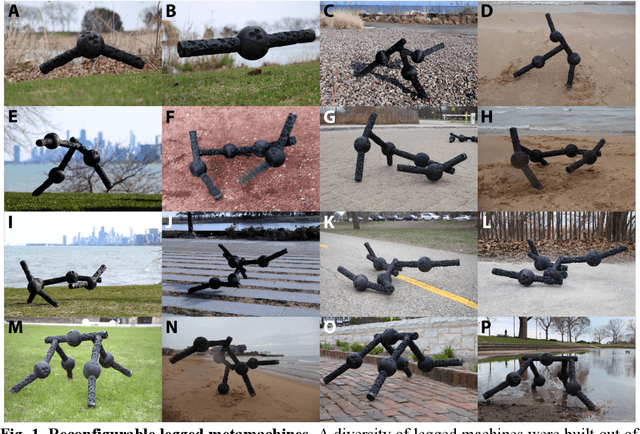


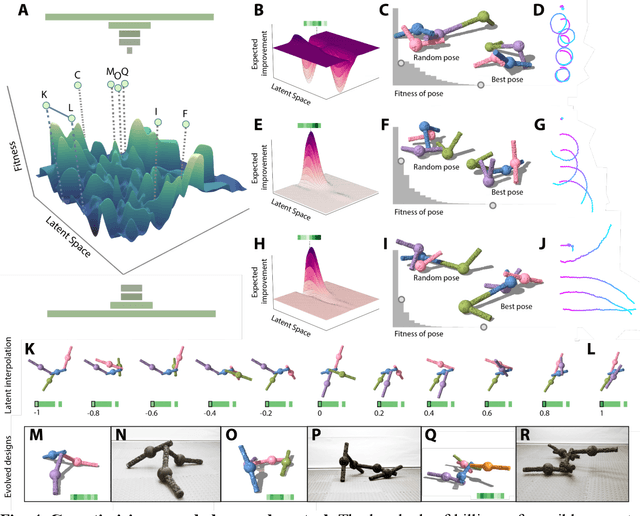
Legged machines are becoming increasingly agile and adaptive but they have so far lacked the basic reconfigurability of legged animals, which have been rearranged and reshaped to fill millions of niches. Unlike their biological counterparts, legged machines have largely converged over the past decade to canonical quadrupedal and bipedal architectures that cannot be easily reconfigured to meet new tasks or recover from injury. Here we introduce autonomous modular legs: agile yet minimal, single-degree-of-freedom jointed links that can learn complex dynamic behaviors and may be freely attached to form legged metamachines at the meter scale. This enables rapid repair, redesign, and recombination of highly-dynamic modular agents that move quickly and acrobatically (non-quasistatically) through unstructured environments. Because each module is itself a complete agent, legged metamachines are able to sustain deep structural damage that would completely disable other legged robots. We also show how to encode the vast space of possible body configurations into a compact latent design genome that can be efficiently explored, revealing a wide diversity of novel legged forms.
An Empirical Study of the Impact of Federated Learning on Machine Learning Model Accuracy
Mar 27, 2025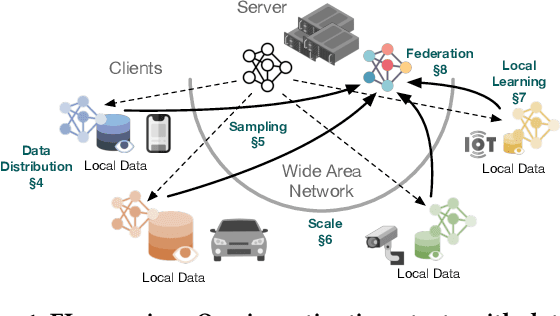
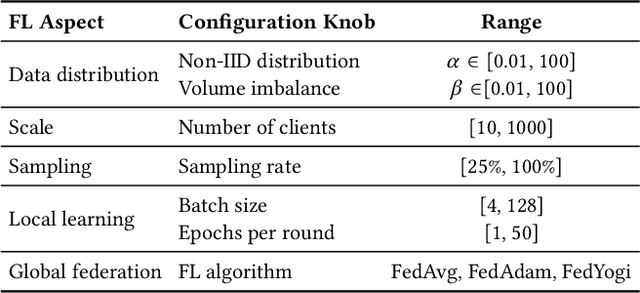

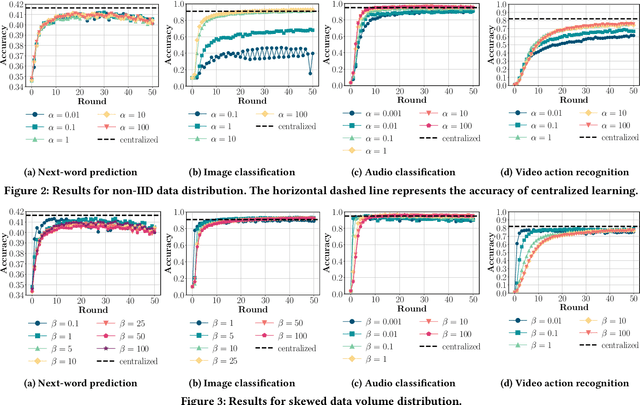
Federated Learning (FL) enables distributed ML model training on private user data at the global scale. Despite the potential of FL demonstrated in many domains, an in-depth view of its impact on model accuracy remains unclear. In this paper, we investigate, systematically, how this learning paradigm can affect the accuracy of state-of-the-art ML models for a variety of ML tasks. We present an empirical study that involves various data types: text, image, audio, and video, and FL configuration knobs: data distribution, FL scale, client sampling, and local and global computations. Our experiments are conducted in a unified FL framework to achieve high fidelity, with substantial human efforts and resource investments. Based on the results, we perform a quantitative analysis of the impact of FL, and highlight challenging scenarios where applying FL degrades the accuracy of the model drastically and identify cases where the impact is negligible. The detailed and extensive findings can benefit practical deployments and future development of FL.
High-Resolution Range-Doppler Imaging from One-Bit PMCW Radar via Generative Adversarial Networks
Mar 17, 2025

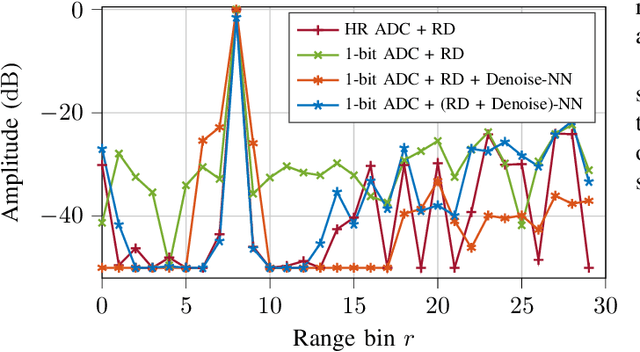

Digital modulation schemes such as PMCW have recently attracted increasing attention as possible replacements for FMCW modulation in future automotive radar systems. A significant obstacle to their widespread adoption is the expensive and power-consuming ADC required at gigahertz frequencies. To mitigate these challenges, employing low-resolution ADC, such as one-bit, has been suggested. Nonetheless, using one-bit sampling results in the loss of essential information. This study explores two RD imaging methods in PMCW radar systems utilizing NN. The first method merges standard RD signal processing with a GAN, whereas the second method uses an E2E strategy in which traditional signal processing is substituted with an NN-based RD module. The findings indicate that these methods can substantially improve the probability of detecting targets in the range-Doppler domain.
A Single Motor Nano Aerial Vehicle with Novel Peer-to-Peer Communication and Sensing Mechanism
May 23, 2024Communication and position sensing are among the most important capabilities for swarm robots to interact with their peers and perform tasks collaboratively. However, the hardware required to facilitate communication and position sensing is often too complicated, expensive, and bulky to be carried on swarm robots. Here we present Maneuverable Piccolissimo 3 (MP3), a minimalist, single motor drone capable of executing inter-robot communication via infrared light and triangulation-based sensing of relative bearing, distance, and elevation using message arrival time. Thanks to its novel design, MP3 can communicate with peers and localize itself using simple components, keeping its size and mass small and making it inherently safe for human interaction. Here we present the hardware and software design of MP3 and demonstrate its capability to localize itself, fly stably and maneuver in the environment using peer-to-peer communication and sensing.
Rollbot: a Spherical Robot Driven by a Single Actuator
Apr 08, 2024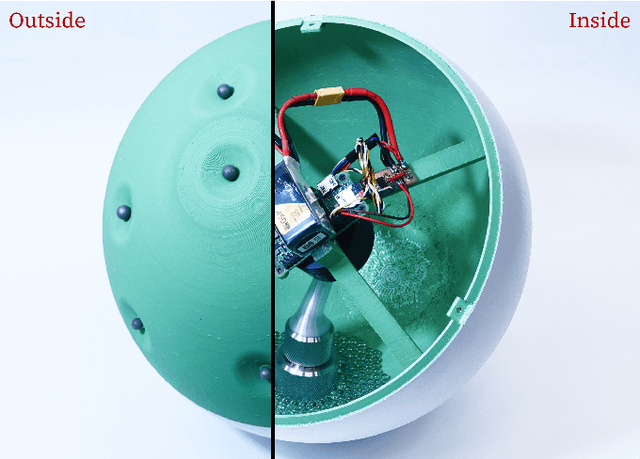
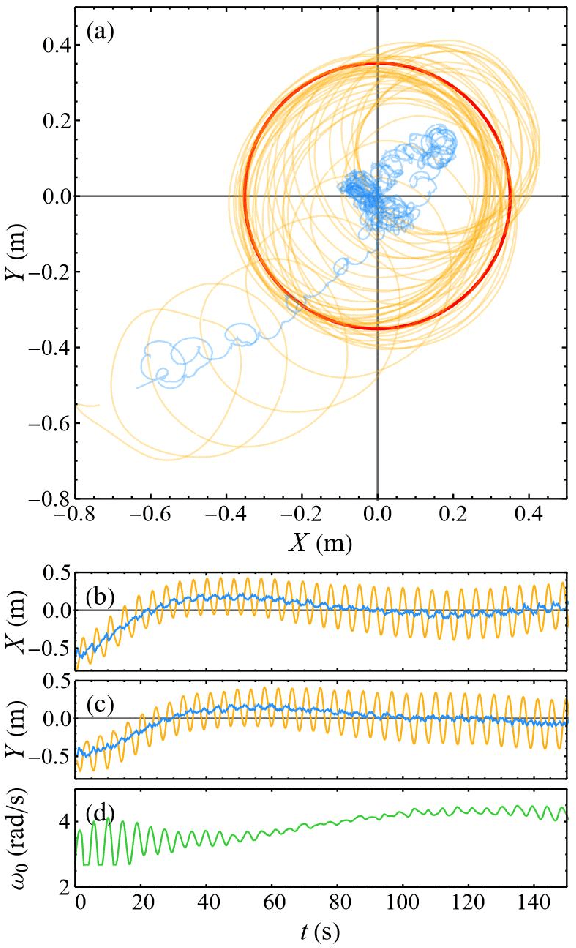
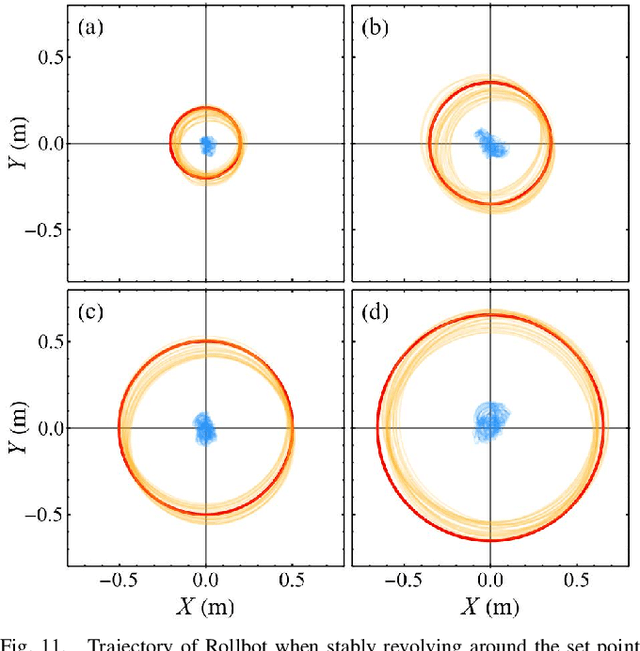
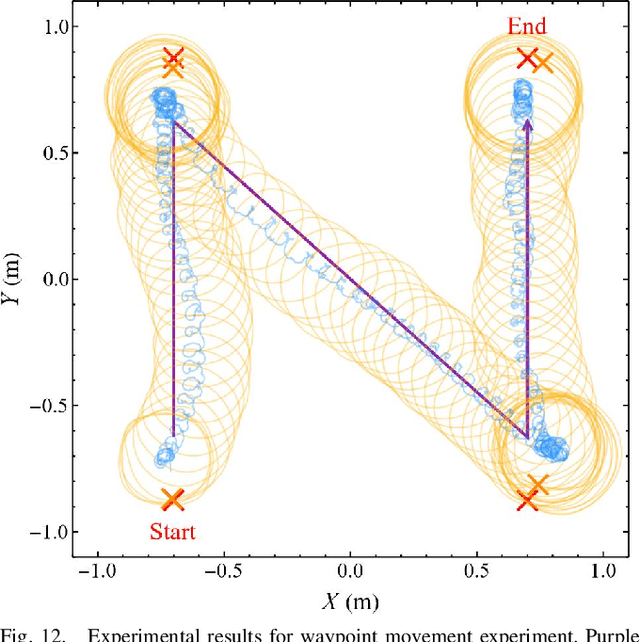
Here we present Rollbot, the first spherical robot capable of controllably maneuvering on 2D plane with a single actuator. Rollbot rolls on the ground in circular pattern and controls its motion by changing the curvature of the trajectory through accelerating and decelerating its single motor and attached mass. We present the theoretical analysis, design, and control of Rollbot, and demonstrate its ability to move in a controllable circular pattern and follow waypoints.