 Add to Chrome
 Add to Firefox
 Add to Edge
LoongReflect: Boosting Long-Horizon Reflection in Search Agents via Global Perspective Distillation
Aug 12, 2026
Large language model agents increasingly rely on long-horizon reasoning to solve complex tasks involving planning, tool use, and memory. A critical capability in such settings is reflection: assessing trajectory progress, identifying missing evidence and unreliable intermediate states, and deciding whether to continue, revise, or abandon the current branch. Learning effective reflection, however, is challenging because reflection is performed locally within the current branch, whereas its utility can only be determined by its contribution to the final trajectory outcome. This local-global mismatch makes outcome-based reinforcement learning provide only local, sparse and delayed supervision for reflective decisions. To solve these, we propose LoongReflect, a training framework that formulates reflection as a memory-control policy. The agent operates over a reversible trajectory tree using explicit reflect and backtrack actions. Reflection consolidates verified facts, missing evidence, and branch-specific risks into working memory, while backtracking removes an unreliable branch from the active context and preserves a concise corrective lesson. To learn this policy, LoongReflect combines two complementary signals through a look-ahead, extragradient-style coordination mechanism. A fast channel distills globally informed reflective behavior from a privileged teacher, with supervision restricted to reflection and backtracking tokens. A slow channel optimizes complete trajectories using outcome-based GRPO, aligning local control decisions with final task success. Experiments on multi-hop retrieval-augmented generation and mathematical reasoning benchmarks demonstrate consistent improvements over outcome-only reinforcement learning and self-distillation baselines.

Beyond Fail-to-Pass: Iterative Hardening of Co-Generated Bug Reproduction Tests and Fixes
Jul 22, 2026Large language models (LLMs) have made automated program repair (APR) increasingly practical for real-world bugs, but repairing directly from bug reports remains underconstrained. Bug reproduction tests (BRTs) help close this gap by turning a bug report into an executable, bug-specific signal that can guide repair and validate candidate patches. Existing work has therefore studied BRT generation as a core subproblem in APR and mainly evaluates a generated BRT using the fail-to-pass (F->P) criterion, which requires the test to fail on the buggy code but pass on the golden fix. We show that F->P alone is insufficient when the goal of a BRT is to improve downstream repair. In particular, some F->P BRTs are lax, reproducing the observed symptom yet still admitting plausible-but-incorrect patches. We formalize this missing quality dimension by separating F->P BRTs into rigorous and lax ones, and show empirically that only the former consistently improve repair success. We further find that co-generation introduces test--fix error coupling, where the in-trajectory fail-to-pass (F->P) check can pass even when both the generated patch and generated test are wrong. Based on these findings, we propose CoHarden, a co-generation framework that uses the Lax signal as an in-loop convergence criterion. CoHarden first generates a test before any fix, then iteratively hardens the test and fix against surviving mutation patches until the generated test no longer admits Lax regressions. Experiments show that CoHarden reaches 69.4% Resolved and 78.9% F->P on SWE-bench Verified, outperforming the strongest fix-only and cogeneration baselines by +9.6 and +7.9 percentage points in Resolved, respectively, with consistent gains across LLM backbones and benchmarks.
ToolAtlas: Learning Once, Reusing Everywhere with Tool-Side Memory
Jul 13, 2026Large language model (LLM) agents increasingly rely on external tools served by shared providers and accessed by heterogeneous downstream agents. Existing approaches improve tool use on the agent side through parameter updates, prompt refinement, or agent-side memory, making tool knowledge difficult to share and limited to behaviors observed in past tasks. We argue that reusable tool knowledge should instead be maintained by the tool provider. We introduce ToolAtlas, a graph-based framework that builds a persistent provider-side tool memory of tool capabilities, failure boundaries, and cross-tool compositions through execution-verified probing. At inference time, agents query the tool memory via adaptive graph traversal. Across two MCP-based benchmarks spanning eight services, ToolAtlas outperforms existing tool-side optimization and agent-side memory baselines by up to 21.61% in pass@1 and 18.61% in pass@4. The same tool memory also transfers across environment instances and agent frameworks without retraining or task-time exploration, yielding up to 24.16%/16.22% and 17.49%/14.27% relative gains in pass@1/pass@4, respectively. Ablation studies show that these gains arise from combining tool-centered memory organization with capability-guided execution probing. These results establish provider-side tool memory as an effective and reusable paradigm for tool servers. Our code is in: https://github.com/PuppyKnightUniversity/ToolAtlas.
The Weakest Link Tells It All: Outcome-Supervised Process Reward Modeling via Learnable Credit Assignment
Jun 26, 2026Process reward models (PRMs) enhance the reasoning capabilities of large language models (LLMs) by providing fine-grained feedback, yet training PRMs typically requires expensive stepwise annotations. Outcome-supervised PRMs offer a scalable alternative by learning from final-answer correctness alone, but this introduces a fundamental *credit assignment* challenge, i.e., attributing outcomes to responsible reasoning steps. Existing approaches rely on either uniform or causal assignment, both of which fail to anchor credit in step correctness and thus hinder process error identification. In this work, we propose Outcome-Supervised Process Reward Modeling via **L**earnable **C**redit **A**ssignment (**LCA**), an outcome-supervised PRM framework that jointly learns credit assignment and reward modeling under the principle of *Weakest Link Assignment: a reasoning chain is as strong as its weakest link*. To address mutual dependence between credit assignment and reward modeling, we formalize outcome-supervised PRM as a Multiple Instance Learning (MIL) problem and introduce Softmax-Weighted-Sum (SWS) pooling, an MIL pooling technique tailored for strong dependence and redundancy among reasoning states. We prove Bayes consistency of our algorithm under mild assumptions. Extensive experiments demonstrate that **LCA** consistently outperforms state-of-the-art outcome-supervised PRMs across multiple tasks and backbones. Code is available at https://anonymous.4open.science/r/LCA.
ScaffoldAgent: Utility-Guided Dynamic Outline Optimization for Open-Ended Deep Research
Jun 18, 2026Open-ended deep research (OEDR) requires systems to acquire knowledge through multi-round retrieval and generate coherent long-form reports. The outline plays a central role as a structural scaffold that coordinates retrieval, evidence organization, and generation. However, existing methods either fix the outline before writing or refine it with local heuristics, leading to scaffold drift under continuous information accumulation and delayed feedback for evaluating outline modifications. We propose ScaffoldAgent, a utility-guided dynamic outline optimization framework for OEDR. ScaffoldAgent models outline evolution as a structured decision process with three operations: Expansion, Contraction, and Revision, enabling controlled updates to the report scaffold. It further introduces a utility-guided feedback mechanism that estimates the downstream value of each outline operation from retrieval gain, structural coherence, and trial-generation quality. The resulting utility signal guides node selection, operation scheduling, and termination during inference. Experiments on DeepResearch Bench and DeepResearch Gym show that ScaffoldAgent consistently improves long-form report generation and factual grounding over existing deep research agents.
GraphWalker: Graph-Guided In-Context Learning for Clinical Reasoning on Electronic Health Records
Apr 08, 2026Clinical Reasoning on Electronic Health Records (EHRs) is a fundamental yet challenging task in modern healthcare. While in-context learning (ICL) offers a promising inference-time adaptation paradigm for large language models (LLMs) in EHR reasoning, existing methods face three fundamental challenges: (1) Perspective Limitation, where data-driven similarity fails to align with LLM reasoning needs and model-driven signals are constrained by limited clinical competence; (2) Cohort Awareness, as demonstrations are selected independently without modeling population-level structure; and (3) Information Aggregation, where redundancy and interaction effects among demonstrations are ignored, leading to diminishing marginal gains. To address these challenges, we propose GraphWalker, a principled demonstration selection framework for EHR-oriented ICL. GraphWalker (i) jointly models patient clinical information and LLM-estimated information gain by integrating data-driven and model-driven perspectives, (ii) incorporates Cohort Discovery to avoid noisy local optima, and (iii) employs a Lazy Greedy Search with Frontier Expansion algorithm to mitigate diminishing marginal returns in information aggregation. Extensive experiments on multiple real-world EHR benchmarks demonstrate that GraphWalker consistently outperforms state-of-the-art ICL baselines, yielding substantial improvements in clinical reasoning performance. Our code is open-sourced at https://github.com/PuppyKnightUniversity/GraphWalker
What Do Agents Learn from Trajectory-SFT: Semantics or Interfaces?
Feb 02, 2026Large language models are increasingly evaluated as interactive agents, yet standard agent benchmarks conflate two qualitatively distinct sources of success: semantic tool-use and interface-specific interaction pattern memorization. Because both mechanisms can yield identical task success on the original interface, benchmark scores alone are not identifiable evidence of environment-invariant capability. We propose PIPE, a protocol-level evaluation augmentation for diagnosing interface reliance by minimally rewriting environment interfaces while preserving task semantics and execution behavior. Across 16 environments from AgentBench and AgentGym and a range of open-source and API-based agents, PIPE reveals that trajectory-SFT substantially amplifies interface shortcutting: trained agents degrade sharply under minimal interface rewrites, while non-trajectory-trained models remain largely stable. We further introduce Interface Reliance (IR), a counterbalanced alias-based metric that quantifies preference for training-time interfaces, and show that interface shortcutting exhibits environment-dependent, non-monotonic training dynamics that remain invisible under standard evaluation. Our code is available at https://anonymous.4open.science/r/What-Do-Agents-Learn-from-Trajectory-SFT-Semantics-or-Interfaces--0831/.
StackPlanner: A Centralized Hierarchical Multi-Agent System with Task-Experience Memory Management
Jan 09, 2026Multi-agent systems based on large language models, particularly centralized architectures, have recently shown strong potential for complex and knowledge-intensive tasks. However, central agents often suffer from unstable long-horizon collaboration due to the lack of memory management, leading to context bloat, error accumulation, and poor cross-task generalization. To address both task-level memory inefficiency and the inability to reuse coordination experience, we propose StackPlanner, a hierarchical multi-agent framework with explicit memory control. StackPlanner addresses these challenges by decoupling high-level coordination from subtask execution with active task-level memory control, and by learning to retrieve and exploit reusable coordination experience via structured experience memory and reinforcement learning. Experiments on multiple deep-search and agent system benchmarks demonstrate the effectiveness of our approach in enabling reliable long-horizon multi-agent collaboration.
Bridging Global Intent with Local Details: A Hierarchical Representation Approach for Semantic Validation in Text-to-SQL
Dec 28, 2025Text-to-SQL translates natural language questions into SQL statements grounded in a target database schema. Ensuring the reliability and executability of such systems requires validating generated SQL, but most existing approaches focus only on syntactic correctness, with few addressing semantic validation (detecting misalignments between questions and SQL). As a consequence, effective semantic validation still faces two key challenges: capturing both global user intent and SQL structural details, and constructing high-quality fine-grained sub-SQL annotations. To tackle these, we introduce HEROSQL, a hierarchical SQL representation approach that integrates global intent (via Logical Plans, LPs) and local details (via Abstract Syntax Trees, ASTs). To enable better information propagation, we employ a Nested Message Passing Neural Network (NMPNN) to capture inherent relational information in SQL and aggregate schema-guided semantics across LPs and ASTs. Additionally, to generate high-quality negative samples, we propose an AST-driven sub-SQL augmentation strategy, supporting robust optimization of fine-grained semantic inconsistencies. Extensive experiments conducted on Text-to-SQL validation benchmarks (both in-domain and out-of-domain settings) demonstrate that our approach outperforms existing state-of-the-art methods, achieving an average 9.40% improvement of AUPRC and 12.35% of AUROC in identifying semantic inconsistencies. It excels at detecting fine-grained semantic errors, provides large language models with more granular feedback, and ultimately enhances the reliability and interpretability of data querying platforms.
LoRA Dropout as a Sparsity Regularizer for Overfitting Control
Apr 15, 2024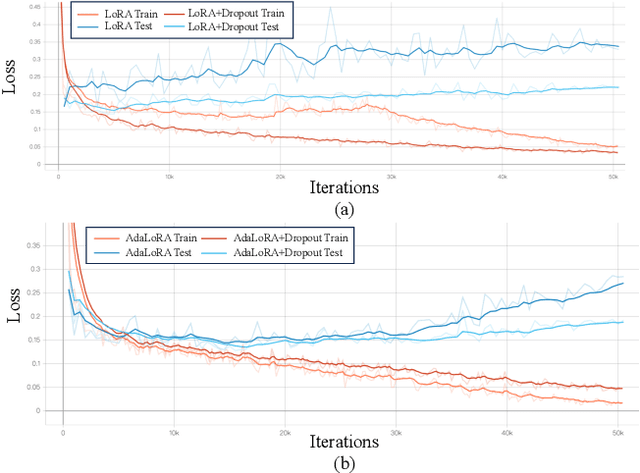

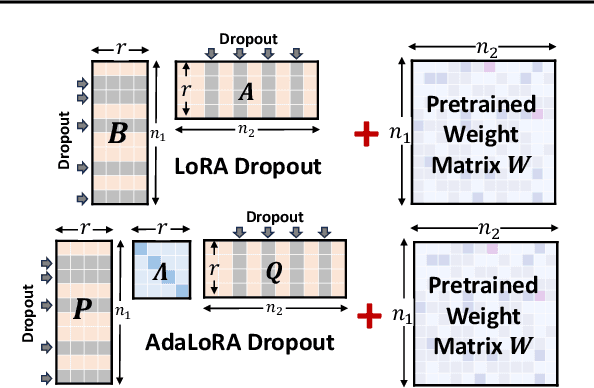

Parameter-efficient fine-tuning methods, represented by LoRA, play an essential role in adapting large-scale pre-trained models to downstream tasks. However, fine-tuning LoRA-series models also faces the risk of overfitting on the training dataset, and yet there's still a lack of theoretical guidance and practical mechanism to control overfitting on LoRA-based PEFT methods. In this paper, we propose a LoRA Dropout mechanism for the LoRA-based methods by introducing random noises to the learnable low-rank matrices and increasing parameter sparsity. We then demonstrate the theoretical mechanism of our LoRA Dropout mechanism from the perspective of sparsity regularization by providing a generalization error bound under this framework. Theoretical results show that appropriate sparsity would help tighten the gap between empirical and generalization risks and thereby control overfitting. Furthermore, based on the LoRA Dropout framework, we introduce a test-time ensemble strategy and provide theoretical evidence demonstrating that the ensemble method can further compress the error bound, and lead to better performance during inference time. Extensive experiments on various NLP tasks provide practical validations of the effectiveness of our LoRA Dropout framework in improving model accuracy and calibration.