 Add to Chrome
 Add to Firefox
 Add to Edge
ToolAtlas: Learning Once, Reusing Everywhere with Tool-Side Memory
Jul 13, 2026
Large language model (LLM) agents increasingly rely on external tools served by shared providers and accessed by heterogeneous downstream agents. Existing approaches improve tool use on the agent side through parameter updates, prompt refinement, or agent-side memory, making tool knowledge difficult to share and limited to behaviors observed in past tasks. We argue that reusable tool knowledge should instead be maintained by the tool provider. We introduce ToolAtlas, a graph-based framework that builds a persistent provider-side tool memory of tool capabilities, failure boundaries, and cross-tool compositions through execution-verified probing. At inference time, agents query the tool memory via adaptive graph traversal. Across two MCP-based benchmarks spanning eight services, ToolAtlas outperforms existing tool-side optimization and agent-side memory baselines by up to 21.61% in pass@1 and 18.61% in pass@4. The same tool memory also transfers across environment instances and agent frameworks without retraining or task-time exploration, yielding up to 24.16%/16.22% and 17.49%/14.27% relative gains in pass@1/pass@4, respectively. Ablation studies show that these gains arise from combining tool-centered memory organization with capability-guided execution probing. These results establish provider-side tool memory as an effective and reusable paradigm for tool servers. Our code is in: https://github.com/PuppyKnightUniversity/ToolAtlas.

The Weakest Link Tells It All: Outcome-Supervised Process Reward Modeling via Learnable Credit Assignment
Jun 26, 2026Process reward models (PRMs) enhance the reasoning capabilities of large language models (LLMs) by providing fine-grained feedback, yet training PRMs typically requires expensive stepwise annotations. Outcome-supervised PRMs offer a scalable alternative by learning from final-answer correctness alone, but this introduces a fundamental *credit assignment* challenge, i.e., attributing outcomes to responsible reasoning steps. Existing approaches rely on either uniform or causal assignment, both of which fail to anchor credit in step correctness and thus hinder process error identification. In this work, we propose Outcome-Supervised Process Reward Modeling via **L**earnable **C**redit **A**ssignment (**LCA**), an outcome-supervised PRM framework that jointly learns credit assignment and reward modeling under the principle of *Weakest Link Assignment: a reasoning chain is as strong as its weakest link*. To address mutual dependence between credit assignment and reward modeling, we formalize outcome-supervised PRM as a Multiple Instance Learning (MIL) problem and introduce Softmax-Weighted-Sum (SWS) pooling, an MIL pooling technique tailored for strong dependence and redundancy among reasoning states. We prove Bayes consistency of our algorithm under mild assumptions. Extensive experiments demonstrate that **LCA** consistently outperforms state-of-the-art outcome-supervised PRMs across multiple tasks and backbones. Code is available at https://anonymous.4open.science/r/LCA.
EvoRubrics: Dynamic Rubrics as Rewards via Adversarial Co-Evolution for LLM Reinforcement Learning
Jun 22, 2026Rubric-based rewards offer interpretable and fine-grained optimization signals for reinforcement learning in open-ended tasks where verifiable answers are unavailable. However, pre-constructed rubrics remain static throughout training, creating a fundamental mismatch with the evolving policy: fixed criteria gradually lose discriminative power as the model improves, leading to reward saturation and potential hacking. Recent dynamic rubric methods partially address this but rely on external frontier models or ground-truth answers, and update rubrics only at coarse granularity. We propose EvoRubrics, a co-evolutionary RL framework where a Policy LLM and a Rubric Generator jointly improve through adversarial interaction within each training step. As the policy improves under the rubric generator's guidance, the rubric generator adapts its criteria to remain discriminative and informative, enabling evaluation to track the policy in real time and naturally inducing an automatic curriculum. Experiments show that EvoRubrics consistently outperforms static and dynamic rubric baselines across benchmarks. The learned Rubric Generator further generalizes as a transferable reward model. Notably, even a fully self-supervised variant without any external supervision achieves meaningful gains, suggesting that co-evolution between generation and evaluation alone can provide sufficiently rich learning signals. Our code is publicly available at https://anonymous.4open.science/r/EvoRubrics-2155/.
ScaffoldAgent: Utility-Guided Dynamic Outline Optimization for Open-Ended Deep Research
Jun 18, 2026Open-ended deep research (OEDR) requires systems to acquire knowledge through multi-round retrieval and generate coherent long-form reports. The outline plays a central role as a structural scaffold that coordinates retrieval, evidence organization, and generation. However, existing methods either fix the outline before writing or refine it with local heuristics, leading to scaffold drift under continuous information accumulation and delayed feedback for evaluating outline modifications. We propose ScaffoldAgent, a utility-guided dynamic outline optimization framework for OEDR. ScaffoldAgent models outline evolution as a structured decision process with three operations: Expansion, Contraction, and Revision, enabling controlled updates to the report scaffold. It further introduces a utility-guided feedback mechanism that estimates the downstream value of each outline operation from retrieval gain, structural coherence, and trial-generation quality. The resulting utility signal guides node selection, operation scheduling, and termination during inference. Experiments on DeepResearch Bench and DeepResearch Gym show that ScaffoldAgent consistently improves long-form report generation and factual grounding over existing deep research agents.
The Tell-Tale Norm: $\ell_2$ Magnitude as a Signal for Reasoning Dynamics in Large Language Models
Jun 04, 2026Recent work has sought to understand Large Language Models (LLMs) reasoning, yet a principled, model-intrinsic signal that captures its layer-wise reasoning dynamics remains underexplored. We bridge this gap by demonstrating that the l2 norm of hidden states serves as an endogenous signal of the model's reasoning intensity. Using Sparse Autoencoders (SAEs) as a diagnostic probe, we observe that LLMs' internal reasoning is marked by a sharp increase in reasoning feature activations concentrated in late layers. Motivated by this pattern, we establish a formal link between reasoning intensity and the model's latent geometry and theoretically prove that the l2 norm of hidden states bounds the activation strength of SAE reasoning features. Empirical correlation analysis and causal interventions further validate the l2 norm as a faithful indicator, where heightened norms consistently correspond to critical reasoning steps. We then introduce three test-time scaling techniques guided by l2 norms: (i) Adaptive Layer-wise Reasoning Recursion, (ii) Endogenous Reasoning State Steering, and (iii) l2-guided Response Selection, which requires no additional training or data and is compatible with advanced inference engines. Experiments across model architectures and benchmarks show that l2-norm-based techniques significantly improve reasoning performance, offering a principled yet simple lens to perceive and control LLM latent reasoning dynamics. Our code is available at https://github.com/zjy1298/The-Tell-Tale-Norm.
GraphWalker: Graph-Guided In-Context Learning for Clinical Reasoning on Electronic Health Records
Apr 08, 2026Clinical Reasoning on Electronic Health Records (EHRs) is a fundamental yet challenging task in modern healthcare. While in-context learning (ICL) offers a promising inference-time adaptation paradigm for large language models (LLMs) in EHR reasoning, existing methods face three fundamental challenges: (1) Perspective Limitation, where data-driven similarity fails to align with LLM reasoning needs and model-driven signals are constrained by limited clinical competence; (2) Cohort Awareness, as demonstrations are selected independently without modeling population-level structure; and (3) Information Aggregation, where redundancy and interaction effects among demonstrations are ignored, leading to diminishing marginal gains. To address these challenges, we propose GraphWalker, a principled demonstration selection framework for EHR-oriented ICL. GraphWalker (i) jointly models patient clinical information and LLM-estimated information gain by integrating data-driven and model-driven perspectives, (ii) incorporates Cohort Discovery to avoid noisy local optima, and (iii) employs a Lazy Greedy Search with Frontier Expansion algorithm to mitigate diminishing marginal returns in information aggregation. Extensive experiments on multiple real-world EHR benchmarks demonstrate that GraphWalker consistently outperforms state-of-the-art ICL baselines, yielding substantial improvements in clinical reasoning performance. Our code is open-sourced at https://github.com/PuppyKnightUniversity/GraphWalker
Enhancing Transformation from Natural Language to Signal Temporal Logic Using LLMs with Diverse External Knowledge
May 27, 2025Temporal Logic (TL), especially Signal Temporal Logic (STL), enables precise formal specification, making it widely used in cyber-physical systems such as autonomous driving and robotics. Automatically transforming NL into STL is an attractive approach to overcome the limitations of manual transformation, which is time-consuming and error-prone. However, due to the lack of datasets, automatic transformation currently faces significant challenges and has not been fully explored. In this paper, we propose an NL-STL dataset named STL-Diversity-Enhanced (STL-DivEn), which comprises 16,000 samples enriched with diverse patterns. To develop the dataset, we first manually create a small-scale seed set of NL-STL pairs. Next, representative examples are identified through clustering and used to guide large language models (LLMs) in generating additional NL-STL pairs. Finally, diversity and accuracy are ensured through rigorous rule-based filters and human validation. Furthermore, we introduce the Knowledge-Guided STL Transformation (KGST) framework, a novel approach for transforming natural language into STL, involving a generate-then-refine process based on external knowledge. Statistical analysis shows that the STL-DivEn dataset exhibits more diversity than the existing NL-STL dataset. Moreover, both metric-based and human evaluations indicate that our KGST approach outperforms baseline models in transformation accuracy on STL-DivEn and DeepSTL datasets.
CLAS: A Machine Learning Enhanced Framework for Exploring Large 3D Design Datasets
Dec 04, 2024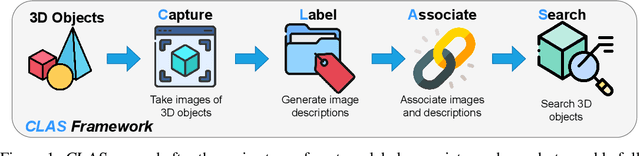

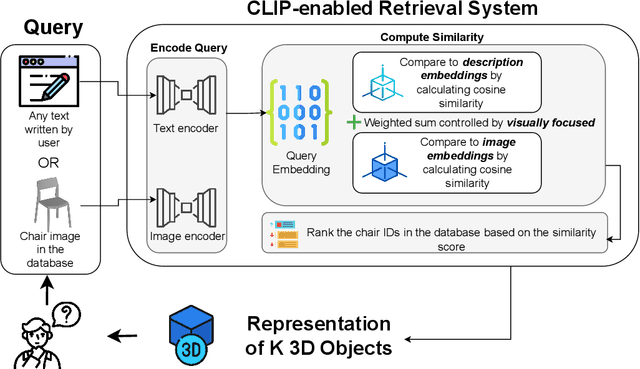
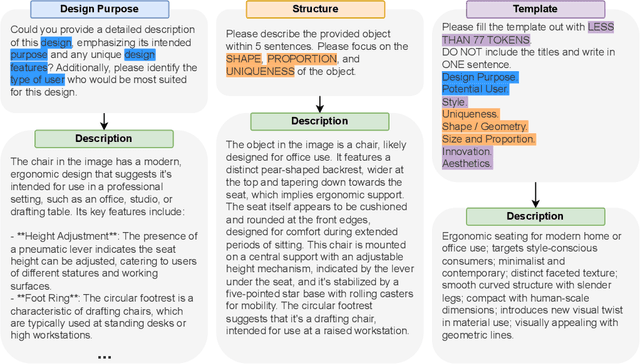
Three-dimensional (3D) objects have wide applications. Despite the growing interest in 3D modeling in academia and industries, designing and/or creating 3D objects from scratch remains time-consuming and challenging. With the development of generative artificial intelligence (AI), designers discover a new way to create images for ideation. However, generative AIs are less useful in creating 3D objects with satisfying qualities. To allow 3D designers to access a wide range of 3D objects for creative activities based on their specific demands, we propose a machine learning (ML) enhanced framework CLAS - named after the four-step of capture, label, associate, and search - to enable fully automatic retrieval of 3D objects based on user specifications leveraging the existing datasets of 3D objects. CLAS provides an effective and efficient method for any person or organization to benefit from their existing but not utilized 3D datasets. In addition, CLAS may also be used to produce high-quality 3D object synthesis datasets for training and evaluating 3D generative models. As a proof of concept, we created and showcased a search system with a web user interface (UI) for retrieving 6,778 3D objects of chairs in the ShapeNet dataset powered by CLAS. In a close-set retrieval setting, our retrieval method achieves a mean reciprocal rank (MRR) of 0.58, top 1 accuracy of 42.27%, and top 10 accuracy of 89.64%.
3DS: Decomposed Difficulty Data Selection's Case Study on LLM Medical Domain Adaptation
Oct 13, 2024


Large Language Models(LLMs) excel in general tasks but struggle in specialized domains like healthcare due to limited domain-specific knowledge.Supervised Fine-Tuning(SFT) data construction for domain adaptation often relies on heuristic methods, such as GPT-4 annotation or manual data selection, with a data-centric focus on presumed diverse, high-quality datasets. However, these methods overlook the model's inherent knowledge distribution, introducing noise, redundancy, and irrelevant data, leading to a mismatch between the selected data and the model's learning task, resulting in suboptimal performance. To address this, we propose a two-stage model-centric data selection framework, Decomposed Difficulty Data Selection (3DS), which aligns data with the model's knowledge distribution for optimized adaptation. In Stage1, we apply Prompt-Driven Data Selection via Explicit Alignment, where the the model filters irrelevant or redundant data based on its internal knowledge. In Stage2, we perform Decomposed Difficulty Data Selection, where data selection is guided by our defined difficulty decomposition, using three metrics: Instruction Understanding, Response Confidence, and Response Correctness. Additionally, an attention-based importance weighting mechanism captures token importance for more accurate difficulty calibration. This two-stage approach ensures the selected data is not only aligned with the model's knowledge and preferences but also appropriately challenging for the model to learn, leading to more effective and targeted domain adaptation. In the case study of the medical domain, our extensive experiments on real-world healthcare datasets demonstrate the superiority of 3DS over exisiting methods in accuracy by over 5.29%. Our dataset and code will be open-sourced at https://anonymous.4open.science/r/3DS-E67F.
TC-RAG:Turing-Complete RAG's Case study on Medical LLM Systems
Aug 17, 2024

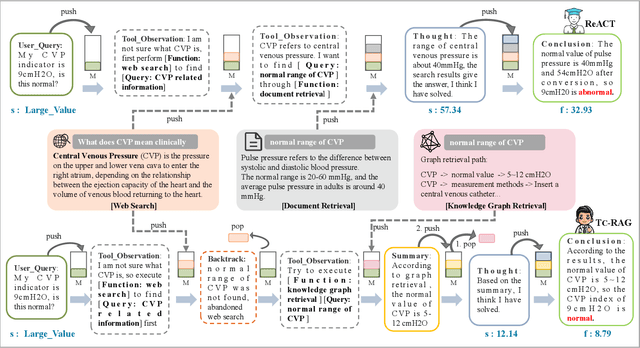

In the pursuit of enhancing domain-specific Large Language Models (LLMs), Retrieval-Augmented Generation (RAG) emerges as a promising solution to mitigate issues such as hallucinations, outdated knowledge, and limited expertise in highly specialized queries. However, existing approaches to RAG fall short by neglecting system state variables, which are crucial for ensuring adaptive control, retrieval halting, and system convergence. In this paper, we introduce the TC-RAG through rigorous proof, a novel framework that addresses these challenges by incorporating a Turing Complete System to manage state variables, thereby enabling more efficient and accurate knowledge retrieval. By leveraging a memory stack system with adaptive retrieval, reasoning, and planning capabilities, TC-RAG not only ensures the controlled halting of retrieval processes but also mitigates the accumulation of erroneous knowledge via Push and Pop actions. In the case study of the medical domain, our extensive experiments on real-world healthcare datasets demonstrate the superiority of TC-RAG over existing methods in accuracy by over 7.20\%. Our dataset and code have been available at https://https://github.com/Artessay/SAMA.git.