 Add to Chrome
 Add to Firefox
 Add to Edge
From Blind Spots to Gains: Diagnostic-Driven Iterative Training for Large Multimodal Models
Feb 26, 2026
As Large Multimodal Models (LMMs) scale up and reinforcement learning (RL) methods mature, LMMs have made notable progress in complex reasoning and decision making. Yet training still relies on static data and fixed recipes, making it difficult to diagnose capability blind spots or provide dynamic, targeted reinforcement. Motivated by findings that test driven error exposure and feedback based correction outperform repetitive practice, we propose Diagnostic-driven Progressive Evolution (DPE), a spiral loop where diagnosis steers data generation and reinforcement, and each iteration re-diagnoses the updated model to drive the next round of targeted improvement. DPE has two key components. First, multiple agents annotate and quality control massive unlabeled multimodal data, using tools such as web search and image editing to produce diverse, realistic samples. Second, DPE attributes failures to specific weaknesses, dynamically adjusts the data mixture, and guides agents to generate weakness focused data for targeted reinforcement. Experiments on Qwen3-VL-8B-Instruct and Qwen2.5-VL-7B-Instruct show stable, continual gains across eleven benchmarks, indicating DPE as a scalable paradigm for continual LMM training under open task distributions. Our code, models, and data are publicly available at https://github.com/hongruijia/DPE.

What Do Agents Learn from Trajectory-SFT: Semantics or Interfaces?
Feb 02, 2026Large language models are increasingly evaluated as interactive agents, yet standard agent benchmarks conflate two qualitatively distinct sources of success: semantic tool-use and interface-specific interaction pattern memorization. Because both mechanisms can yield identical task success on the original interface, benchmark scores alone are not identifiable evidence of environment-invariant capability. We propose PIPE, a protocol-level evaluation augmentation for diagnosing interface reliance by minimally rewriting environment interfaces while preserving task semantics and execution behavior. Across 16 environments from AgentBench and AgentGym and a range of open-source and API-based agents, PIPE reveals that trajectory-SFT substantially amplifies interface shortcutting: trained agents degrade sharply under minimal interface rewrites, while non-trajectory-trained models remain largely stable. We further introduce Interface Reliance (IR), a counterbalanced alias-based metric that quantifies preference for training-time interfaces, and show that interface shortcutting exhibits environment-dependent, non-monotonic training dynamics that remain invisible under standard evaluation. Our code is available at https://anonymous.4open.science/r/What-Do-Agents-Learn-from-Trajectory-SFT-Semantics-or-Interfaces--0831/.
SymDPO: Boosting In-Context Learning of Large Multimodal Models with Symbol Demonstration Direct Preference Optimization
Nov 17, 2024As language models continue to scale, Large Language Models (LLMs) have exhibited emerging capabilities in In-Context Learning (ICL), enabling them to solve language tasks by prefixing a few in-context demonstrations (ICDs) as context. Inspired by these advancements, researchers have extended these techniques to develop Large Multimodal Models (LMMs) with ICL capabilities. However, existing LMMs face a critical issue: they often fail to effectively leverage the visual context in multimodal demonstrations and instead simply follow textual patterns. This indicates that LMMs do not achieve effective alignment between multimodal demonstrations and model outputs. To address this problem, we propose Symbol Demonstration Direct Preference Optimization (SymDPO). Specifically, SymDPO aims to break the traditional paradigm of constructing multimodal demonstrations by using random symbols to replace text answers within instances. This forces the model to carefully understand the demonstration images and establish a relationship between the images and the symbols to answer questions correctly. We validate the effectiveness of this method on multiple benchmarks, demonstrating that with SymDPO, LMMs can more effectively understand the multimodal context within examples and utilize this knowledge to answer questions better.
Hal-Eval: A Universal and Fine-grained Hallucination Evaluation Framework for Large Vision Language Models
Feb 24, 2024
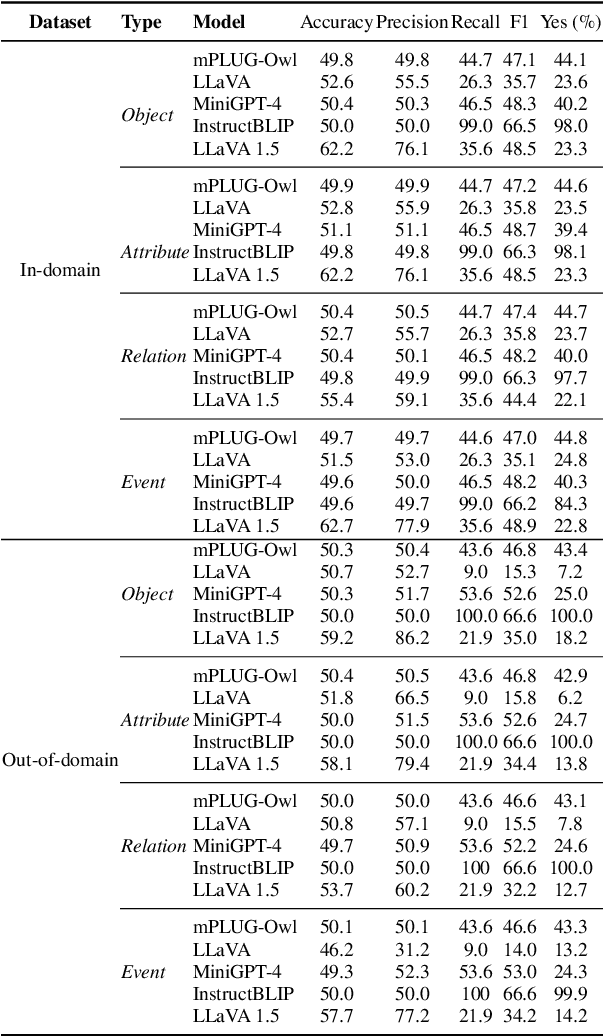
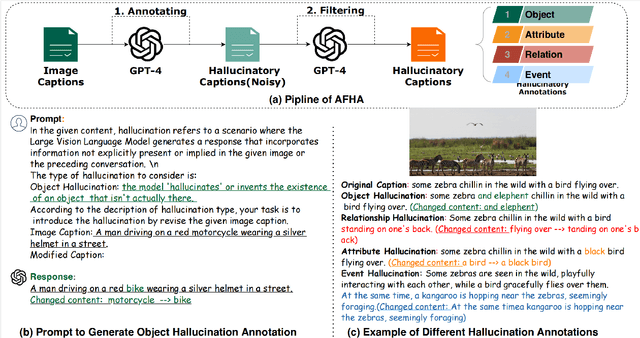
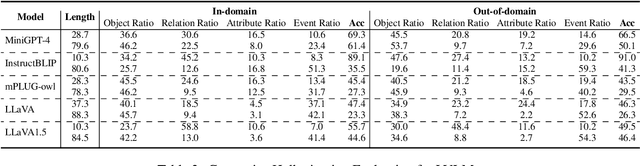
Large Vision Language Models exhibit remarkable capabilities but struggle with hallucinations inconsistencies between images and their descriptions. Previous hallucination evaluation studies on LVLMs have identified hallucinations in terms of objects, attributes, and relations but overlooked complex hallucinations that create an entire narrative around a fictional entity. In this paper, we introduce a refined taxonomy of hallucinations, featuring a new category: Event Hallucination. We then utilize advanced LLMs to generate and filter fine grained hallucinatory data consisting of various types of hallucinations, with a particular focus on event hallucinations, laying the groundwork for integrating discriminative and generative evaluation methods within our universal evaluation framework. The proposed benchmark distinctively assesses LVLMs ability to tackle a broad spectrum of hallucinations, making it a reliable and comprehensive tool for gauging LVLMs efficacy in handling hallucinations. We will release our code and data.