 Add to Chrome
 Add to Firefox
 Add to Edge
Uncertainty Quantification for LLM-based Code Generation
May 12, 2026
Prediction sets provide a theoretically grounded framework for quantifying uncertainty in machine learning models. Adapting them to structured generation tasks, in particular, large language model (LLM) based code generation, remains a challenging problem. An existing attempt proposes PAC prediction sets but is limited by its strong monotonicity assumption on risk and single-label classification framework, which severely limits the space of candidate programs and cannot accommodate the multiple valid outputs inherent to code generation. To address these limitations, we propose an approach RisCoSet that leverages multiple hypothesis testing to construct risk-controlling predictions for LLM-based code generation. Given a trained code generation model, we produce a prediction set represented by a partial program, which is guaranteed to contain a correct solution with high confidence. Extensive experiments on three LLMs demonstrate the effectiveness of the proposed method. For instance, compared with the state-of-the-art, our method can significantly reduce the code removal by up to 24.5%, at the same level of risk.

Fair Conformal Classification via Learning Representation-Based Groups
May 12, 2026Conformal prediction methods provide statistically rigorous marginal coverage guarantees for machine learning models, but such guarantees fail to account for algorithmic biases, thereby undermining fairness and trust. This paper introduces a fair conformal inference framework for classification tasks. The proposed method constructs prediction sets that guarantee conditional coverage on adaptively identified subgroups, which can be implicitly defined through nonlinear feature combinations. By balancing effectiveness and efficiency in producing compact, informative prediction sets and ensuring adaptive equalized coverage across unfairly treated subgroups, our approach paves a practical pathway toward trustworthy machine learning. Extensive experiments on both synthetic and real-world datasets demonstrate the effectiveness of the framework.
Stepwise: Neuro-Symbolic Proof Search for Automated Systems Verification
Mar 20, 2026Formal verification via interactive theorem proving is increasingly used to ensure the correctness of critical systems, yet constructing large proof scripts remains highly manual and limits scalability. Advances in large language models (LLMs), especially in mathematical reasoning, make their integration into software verification increasingly promising. This paper introduces a neuro-symbolic proof generation framework designed to automate proof search for systems-level verification projects. The framework performs a best-first tree search over proof states, repeatedly querying an LLM for the next candidate proof step. On the neural side, we fine-tune LLMs using datasets of proof state-step pairs; on the symbolic side, we incorporate a range of ITP tools to repair rejected steps, filter and rank proof states, and automatically discharge subgoals when search progress stalls. This synergy enables data-efficient LLM adaptation and semantics-informed pruning of the search space. We implement the framework on a new Isabelle REPL that exposes fine-grained proof states and automation tools, and evaluate it on the FVEL seL4 benchmark and additional Isabelle developments. On seL4, the system proves up to 77.6\% of the theorems, substantially surpassing previous LLM-based approaches and standalone Sledgehammer, while solving significantly more multi-step proofs. Results across further benchmarks demonstrate strong generalization, indicating a viable path toward scalable automated software verification.
Learning to Disprove: Formal Counterexample Generation with Large Language Models
Mar 19, 2026Mathematical reasoning demands two critical, complementary skills: constructing rigorous proofs for true statements and discovering counterexamples that disprove false ones. However, current AI efforts in mathematics focus almost exclusively on proof construction, often neglecting the equally important task of finding counterexamples. In this paper, we address this gap by fine-tuning large language models (LLMs) to reason about and generate counterexamples. We formalize this task as formal counterexample generation, which requires LLMs not only to propose candidate counterexamples but also to produce formal proofs that can be automatically verified in the Lean 4 theorem prover. To enable effective learning, we introduce a symbolic mutation strategy that synthesizes diverse training data by systematically extracting theorems and discarding selected hypotheses, thereby producing diverse counterexample instances. Together with curated datasets, this strategy enables a multi-reward expert iteration framework that substantially enhances both the effectiveness and efficiency of training LLMs for counterexample generation and theorem proving. Experiments on three newly collected benchmarks validate the advantages of our approach, showing that the mutation strategy and training framework yield significant performance gains.
Proving Olympiad Inequalities by Synergizing LLMs and Symbolic Reasoning
Feb 19, 2025
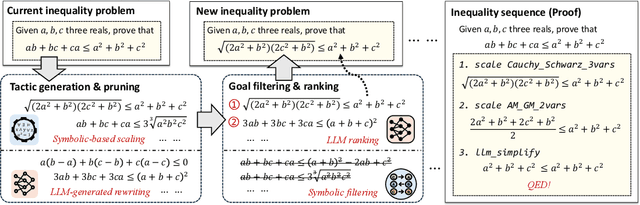


Large language models (LLMs) can prove mathematical theorems formally by generating proof steps (\textit{a.k.a.} tactics) within a proof system. However, the space of possible tactics is vast and complex, while the available training data for formal proofs is limited, posing a significant challenge to LLM-based tactic generation. To address this, we introduce a neuro-symbolic tactic generator that synergizes the mathematical intuition learned by LLMs with domain-specific insights encoded by symbolic methods. The key aspect of this integration is identifying which parts of mathematical reasoning are best suited to LLMs and which to symbolic methods. While the high-level idea of neuro-symbolic integration is broadly applicable to various mathematical problems, in this paper, we focus specifically on Olympiad inequalities (Figure~1). We analyze how humans solve these problems and distill the techniques into two types of tactics: (1) scaling, handled by symbolic methods, and (2) rewriting, handled by LLMs. In addition, we combine symbolic tools with LLMs to prune and rank the proof goals for efficient proof search. We evaluate our framework on 161 challenging inequalities from multiple mathematics competitions, achieving state-of-the-art performance and significantly outperforming existing LLM and symbolic approaches without requiring additional training data.
Neuro-Symbolic Data Generation for Math Reasoning
Dec 06, 2024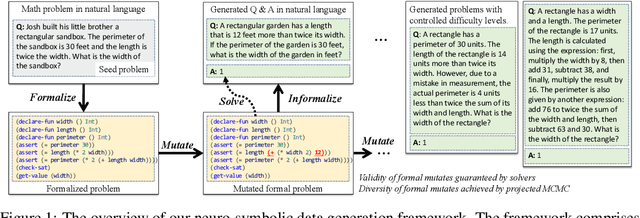
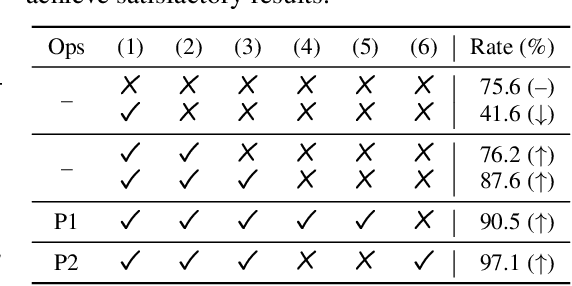
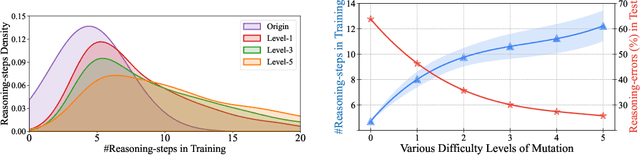
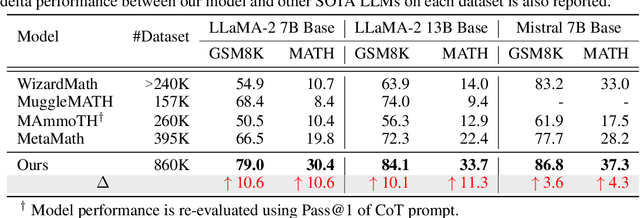
A critical question about Large Language Models (LLMs) is whether their apparent deficiency in mathematical reasoning is inherent, or merely a result of insufficient exposure to high-quality mathematical data. To explore this, we developed an automated method for generating high-quality, supervised mathematical datasets. The method carefully mutates existing math problems, ensuring both diversity and validity of the newly generated problems. This is achieved by a neuro-symbolic data generation framework combining the intuitive informalization strengths of LLMs, and the precise symbolic reasoning of math solvers along with projected Markov chain Monte Carlo sampling in the highly-irregular symbolic space. Empirical experiments demonstrate the high quality of data generated by the proposed method, and that the LLMs, specifically LLaMA-2 and Mistral, when realigned with the generated data, surpass their state-of-the-art counterparts.
Neuro-symbolic Learning Yielding Logical Constraints
Oct 28, 2024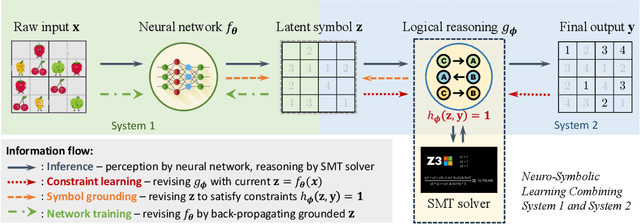
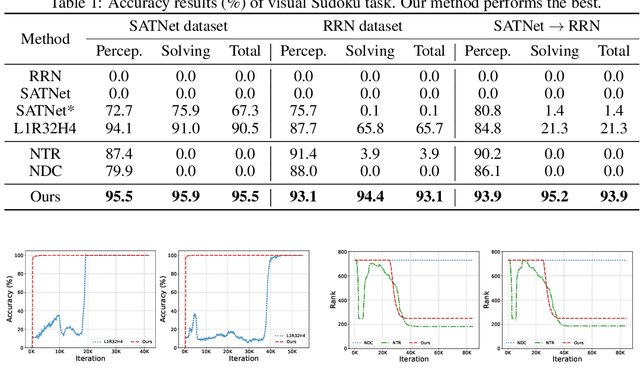
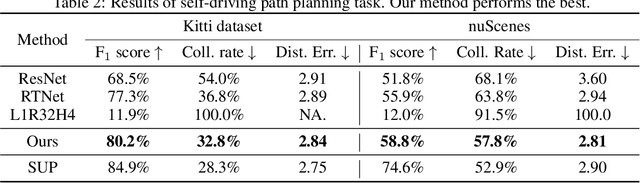
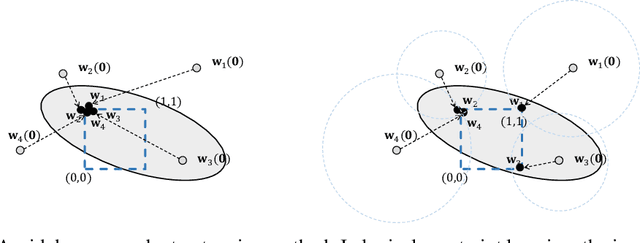
Neuro-symbolic systems combine the abilities of neural perception and logical reasoning. However, end-to-end learning of neuro-symbolic systems is still an unsolved challenge. This paper proposes a natural framework that fuses neural network training, symbol grounding, and logical constraint synthesis into a coherent and efficient end-to-end learning process. The capability of this framework comes from the improved interactions between the neural and the symbolic parts of the system in both the training and inference stages. Technically, to bridge the gap between the continuous neural network and the discrete logical constraint, we introduce a difference-of-convex programming technique to relax the logical constraints while maintaining their precision. We also employ cardinality constraints as the language for logical constraint learning and incorporate a trust region method to avoid the degeneracy of logical constraint in learning. Both theoretical analyses and empirical evaluations substantiate the effectiveness of the proposed framework.
Autoformalize Mathematical Statements by Symbolic Equivalence and Semantic Consistency
Oct 28, 2024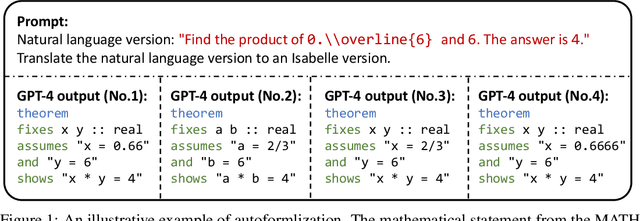

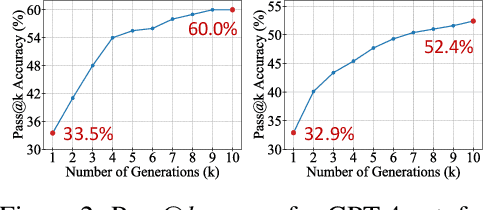
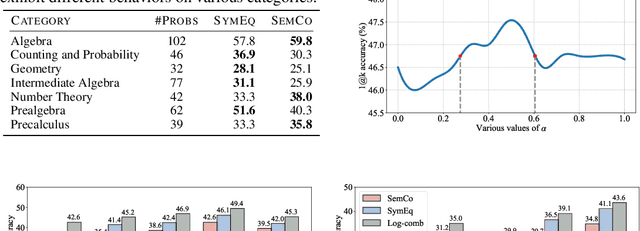
Autoformalization, the task of automatically translating natural language descriptions into a formal language, poses a significant challenge across various domains, especially in mathematics. Recent advancements in large language models (LLMs) have unveiled their promising capabilities to formalize even competition-level math problems. However, we observe a considerable discrepancy between pass@1 and pass@k accuracies in LLM-generated formalizations. To address this gap, we introduce a novel framework that scores and selects the best result from k autoformalization candidates based on two complementary self-consistency methods: symbolic equivalence and semantic consistency. Elaborately, symbolic equivalence identifies the logical homogeneity among autoformalization candidates using automated theorem provers, and semantic consistency evaluates the preservation of the original meaning by informalizing the candidates and computing the similarity between the embeddings of the original and informalized texts. Our extensive experiments on the MATH and miniF2F datasets demonstrate that our approach significantly enhances autoformalization accuracy, achieving up to 0.22-1.35x relative improvements across various LLMs and baseline methods.
LASER: Script Execution by Autonomous Agents for On-demand Traffic Simulation
Oct 21, 2024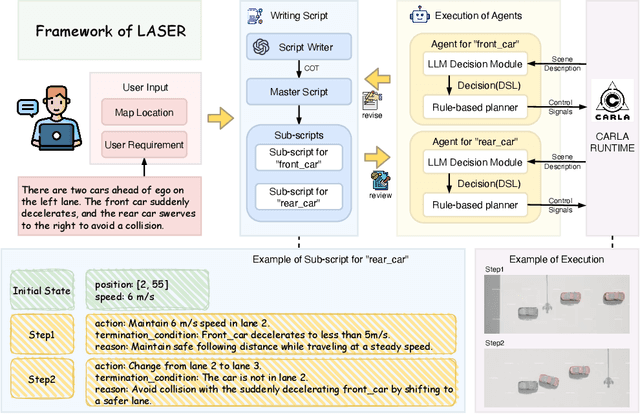
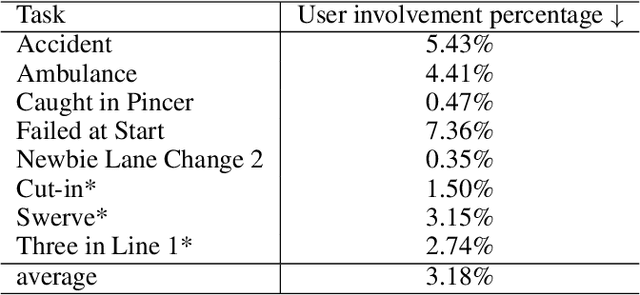
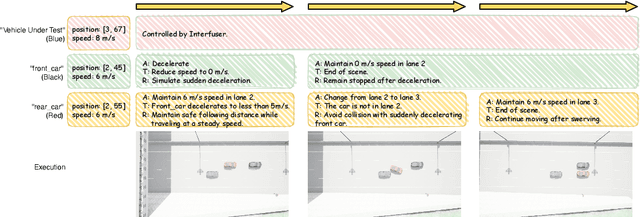
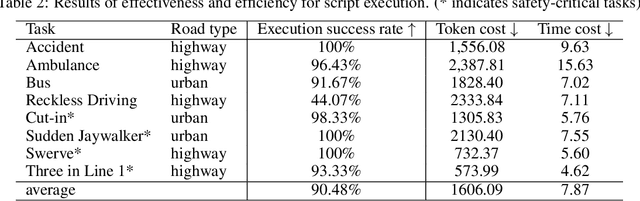
Autonomous Driving Systems (ADS) require diverse and safety-critical traffic scenarios for effective training and testing, but the existing data generation methods struggle to provide flexibility and scalability. We propose LASER, a novel frame-work that leverage large language models (LLMs) to conduct traffic simulations based on natural language inputs. The framework operates in two stages: it first generates scripts from user-provided descriptions and then executes them using autonomous agents in real time. Validated in the CARLA simulator, LASER successfully generates complex, on-demand driving scenarios, significantly improving ADS training and testing data generation.
Softened Symbol Grounding for Neuro-symbolic Systems
Mar 01, 2024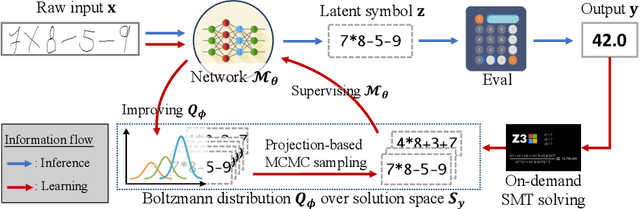
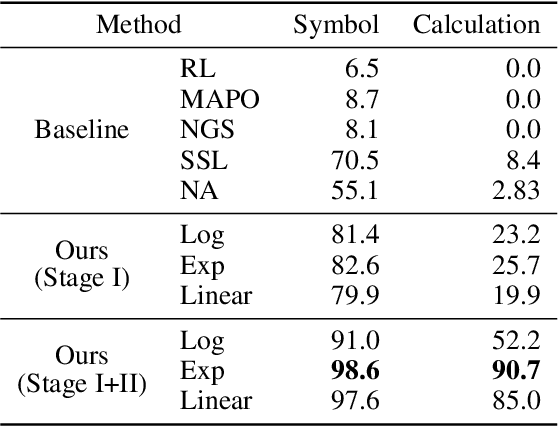
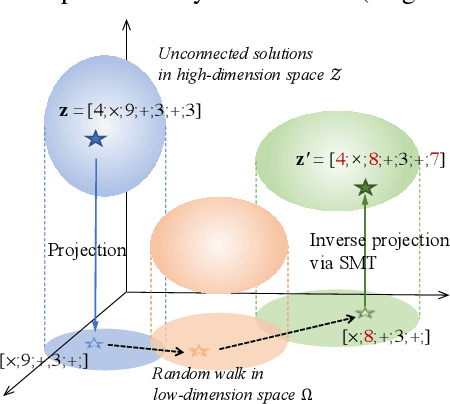
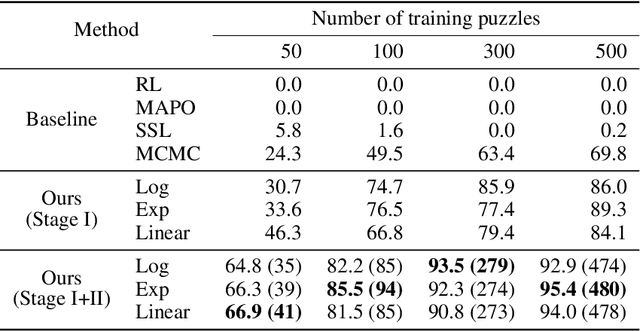
Neuro-symbolic learning generally consists of two separated worlds, i.e., neural network training and symbolic constraint solving, whose success hinges on symbol grounding, a fundamental problem in AI. This paper presents a novel, softened symbol grounding process, bridging the gap between the two worlds, and resulting in an effective and efficient neuro-symbolic learning framework. Technically, the framework features (1) modeling of symbol solution states as a Boltzmann distribution, which avoids expensive state searching and facilitates mutually beneficial interactions between network training and symbolic reasoning;(2) a new MCMC technique leveraging projection and SMT solvers, which efficiently samples from disconnected symbol solution spaces; (3) an annealing mechanism that can escape from %being trapped into sub-optimal symbol groundings. Experiments with three representative neuro symbolic learning tasks demonstrate that, owining to its superior symbol grounding capability, our framework successfully solves problems well beyond the frontier of the existing proposals.